Seasonings · Profile
Chai Spices: What Goes Into Masala Chai, and Why
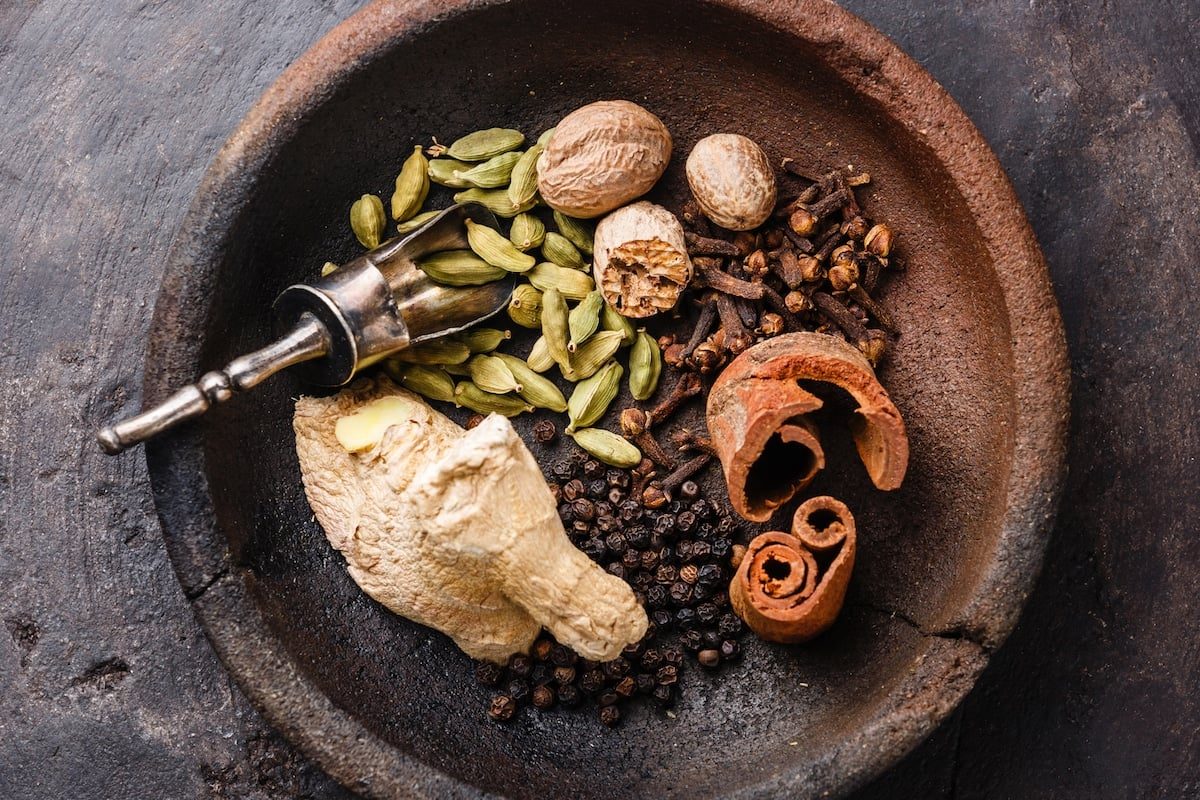
Chai spices are the mix of whole or ground spices used to flavor masala chai, black tea simmered with milk, sugar and spices. There is no single recipe. In the three bylined recipes compared below, cardamom, cinnamon, ginger and cloves appear in all three, with black pepper and fennel in two. This page shows what goes in, what each spice contributes, how chai became India’s everyday drink, and the main safety point: the coumarin in cassia cinnamon.
At a glance
| What it is | A spice mix for masala chai (spiced milk tea); no standard recipe |
| In all three recipes compared | Green cardamom, cinnamon, ginger, cloves123 |
| In two of three | Black pepper, fennel seed123 |
| In one | Mint, vanilla bean13 |
| Base | Black tea, milk, and sugar or honey123 |
| The word | Chai means “tea”; in English now used especially of spiced teas4 |
| Main safety point | Coumarin in cassia cinnamon (see Safety)56 |
What goes in: three recipes side by side
| Spice | Saveur (2014)1 | Dishoom, via loveFOOD2 | Culinary Institute of America (2021)3 |
|---|---|---|---|
| Green cardamom | 8 pods | 12 pods | 1 tsp pods |
| Cinnamon | 1 stick, halved | 2 sticks | 3 sticks, 1½ in each |
| Ginger | 1-inch piece, fresh | 12 slices, fresh | 4 tsp sliced |
| Cloves | 8 whole | 5 | 2 to 3 whole |
| Black peppercorns | none listed | 1.5 tsp | ⅛ tsp |
| Fennel seed | 1 tsp | none | 1½ tsp |
| Other | 1 sprig mint | none | 1 vanilla bean, split |
| Tea | 6 black tea bags | 2 tbsp loose Assam or Darjeeling, or 3 English breakfast bags | 12 bags Darjeeling |
| Milk and sweetener | 2 cups whole milk, ¾ cup sugar | 500 ml whole milk, 50 g sugar | 3 cups whole milk, ¼ cup honey |
The CIA’s headnote sums up the pattern: chai masala mixtures “may include cardamom, cinnamon, ginger, and peppercorns.”3 Saveur’s headnote mentions black pepper among the spices even though its ingredient list does not include it.1
Neither star anise nor nutmeg appears in these three recipes. A widely repeated description says cardamom and star anise lead the flavor; the cardamom part fits all three recipes, the star anise part none of them.
Flavor and the compounds behind it
Each spice brings its own aroma, and the balance depends on the recipe. The compound notes below come from reference works on the individual spices; we found no analysis of a chai blend as a whole.
| Spice | What it brings (our description) | Key compounds |
|---|---|---|
| Green cardamom (Elettaria cardamomum) | Cool, floral, slightly camphor-like lift | Oil mainly 1,8-cineole (20–60%) and α-terpinyl acetate (20–53%); PROSEA describes a warm, slightly pungent taste7 |
| Cinnamon (usually cassia in North America) | Sweet warmth | Cassia bark oil is 70–95% cinnamaldehyde89 |
| Ginger | Bite and warmth that builds with simmering | Pungency from gingerols, non-volatile phenolic compounds10 |
| Cloves | Deep, numbing, medicinal sweetness | Bud oil 70–90% eugenol11 |
| Black pepper | Sharp heat at the back of the throat | Piperine, 4.9–7.7% of black pepper12 |
PROSEA notes that cardamom is used to flavor coffee and tea.7 The plant is native to southwestern India.13 CBI names cinnamon as a key ingredient of masala chai, and AramcoWorld names ginger as a core one.1415
History
The word. Chai comes from the Russian or Arabic word for tea; its first English citation, in 1908, is in an Arabic context, and it is now used especially of spiced teas.4
Tea in India. Tea came to the Indian subcontinent in the early 19th century as a colonial cash crop.16 According to the historian Philip Lutgendorf, it became the everyday drink called chai mainly during the 20th century, through aggressive marketing by both British and Indian companies, advances in processing Assam tea, and changes in urban social life.16 In a University of Chicago profile of his work, Lutgendorf notes that tea producers saw no need to build a home market in India until the Great Depression, and that in 1936 the Indian Tea Market Expansion Board launched South Asia’s first mass marketing campaign, which ran for two decades with limited success.17 The profile describes tea being blended with sugar and spices by a housewife or street vendor, and factories producing teas that could stand up to copious milk.17 In many places in north India, he says, tea drinking arrived only in the 1960s and ’70s or later.17
What could not be traced. The often-repeated claims that masala chai is 5,000 or 9,000 years old, that it began in Thailand, that it started as an Ayurvedic spice drink with no tea leaves, and that the British first added milk and sugar for export were not found in any source we opened. The sources above describe chai as a 20th-century development.
How chai spices are used
- Masala chai. Whole spices are simmered with water, tea, milk and sugar, then strained. All three recipes above work this way.123 Crushing cardamom pods and ginger first is common practice.
- Chai lattes and iced chai. The CIA notes its chai can be served hot or chilled over ice.3
- Baking and desserts. By common practice, ground chai spice goes into cookies, cakes, pumpkin pie and other desserts; compare pumpkin pie spice.
Making your own blend. Start from one of the recipes above and adjust: more cardamom for a floral cup, more ginger and pepper for bite, fewer cloves if it tastes medicinal.
Buying
- Read the label. Chai spice blends vary widely. Check whether yours contains sugar, tea or milk powder (a chai “mix”) or spices only.
- Which cinnamon. Cassia is the type most commonly sold in North America.9 Its coumarin content is the main safety point for chai (see Safety). See Ceylon vs. cassia cinnamon.
Storage
We found no published shelf-life figure for chai spice blends from a regulator or standards body. Store them airtight, away from heat and light, and trust your nose: a blend that smells faint will taste faint.
Safety and health
Coumarin in cassia. Germany’s Federal Institute for Risk Assessment (BfR) reports that cassia cinnamon contains on average about 3,000 mg of coumarin per kilogram, and up to about 10,000 mg/kg.5 At the average level, an adult weighing 60 kg reaches the tolerable daily intake with about 2 g of cassia a day, and a 15 kg child with about 0.5 g.6 We found no measurement of how much coumarin passes from a cinnamon stick into simmered tea, so no per-cup figure can be given. NCCIH says cinnamon is likely safe in the amounts used in food, and that prolonged use of cassia could be an issue for sensitive people.9
Star anise. If your blend includes star anise, buy it from a reputable source. In 2003 the FDA advised the public not to drink teas brewed from star anise after about 40 illnesses, including about 15 in infants; its concern was that Chinese star anise may contain the toxic Japanese species.18 See star anise.
Health claims. Chai is often said to aid digestion, ease arthritis and protect the heart. What the evidence on individual spices shows is narrower:
- Ginger: NCCIH says it may help with nausea and vomiting in pregnancy, and that ginger supplements might help knee osteoarthritis symptoms; most studies have not shown it helps motion sickness.19
- Cinnamon: NCCIH says it is unclear whether cinnamon supplements help with diabetes or weight loss.9
- Cardamom: a 2024 meta-analysis of randomized trials reported reductions in total cholesterol, triglycerides and two inflammation markers (hs-CRP and IL-6) in adults, with no significant effect on HDL or LDL cholesterol.20
None of these studies tested chai, and this page makes no claim that chai spices treat or prevent any condition.
Nutrition. At the amounts used in a cup of tea, chai spices are not a meaningful source of vitamins or minerals. As an example, USDA data for ground black pepper give 2.3 g per teaspoon; at that weight, a teaspoon supplies about 31 mg of potassium (under 1% of the FDA Daily Value of 4,700 mg), about 10 mg of calcium (under 1% of 1,300 mg) and about 0.6 g of fiber (about 2% of 28 g).2122
The individual spices
- Cardamom, with cardamom pods vs. seeds and cooking with cardamom
- Cinnamon, cassia cinnamon and Ceylon cinnamon
- Ginger and fresh vs. ground ginger
- Cloves, black pepper, fennel seed, star anise, nutmeg
- Related blends: garam masala, pumpkin pie spice
- If a batch tastes too strong: too much cardamom, too much cinnamon, too much clove, too much ginger
Footnotes
-
“Masala Chai”, Saveur, 2014. saveur.com · Publication ↩ ↩2 ↩3 ↩4 ↩5 ↩6 ↩7
-
Masala chai recipe from Dishoom: From Bombay with Love (Thakrar, Thakrar and Nasir), loveFOOD. lovefood.com · Publication ↩ ↩2 ↩3 ↩4 ↩5
-
“Masala Chai”, CIA Foodies, The Culinary Institute of America, 2021. ciafoodies.com · Publication ↩ ↩2 ↩3 ↩4 ↩5 ↩6 ↩7 ↩8
-
“chai (n.)”, Online Etymology Dictionary. etymonline.com · Reference work ↩ ↩2
-
“FAQ on coumarin in cinnamon and other foods”, German Federal Institute for Risk Assessment (BfR). bfr.bund.de · Regulator ↩ ↩2
-
“Cassia cinnamon with high coumarin contents to be consumed in moderation”, German Federal Institute for Risk Assessment (BfR). bfr.bund.de · Regulator ↩ ↩2
-
T.H. Wardini and A. Thomas, Elettaria cardamomum, PROSEA. uses.plantnet-project.org · Reference work ↩ ↩2
-
Cinnamomum (cassia species), PROSEA Handbook No. 13: Spices. prosea.prota4u.org · Reference work ↩
-
“Cinnamon: Usefulness and Safety”, National Center for Complementary and Integrative Health, 2024. nccih.nih.gov · Regulator ↩ ↩2 ↩3 ↩4
-
Sutarno, Hadad and Brink, Zingiber officinale, PROSEA. uses.plantnet-project.org · Reference work ↩
-
Verheij and Snijders, Syzygium aromaticum, PROSEA. uses.plantnet-project.org · Reference work ↩
-
Piper nigrum, PROSEA. uses.plantnet-project.org · Reference work ↩
-
Elettaria cardamomum (L.) Maton, Plants of the World Online, Royal Botanic Gardens, Kew. powo.science.kew.org · Reference work ↩
-
“The European market potential for cinnamon”, CBI. cbi.eu · Publication ↩
-
Jeff Koehler, “Spice Migrations: Ginger”, AramcoWorld, 2021. aramcoworld.com · Publication ↩
-
Philip Lutgendorf, “Making tea in India: Chai, capitalism, culture”, Thesis Eleven, 2012 (abstract). iro.uiowa.edu · Peer-reviewed ↩ ↩2
-
Elizabeth Station, “The Triumph of Tea”, University of Chicago, 2012. artshumanities.uchicago.edu · Publication ↩ ↩2 ↩3
-
“Teas Made from Star Anise Were Associated With Illnesses Including Seizures”, FDA, 2003. fda.gov · Regulator ↩
-
“Ginger: Usefulness and Safety”, National Center for Complementary and Integrative Health, 2025. nccih.nih.gov · Regulator ↩
-
Zhang et al., “Cardamom consumption may improve cardiovascular metabolic biomarkers in adults”, Nutrition Research, 2024. busqueda.bvsalud.org · Peer-reviewed ↩
-
“Spices, pepper, black”, FDC ID 170931, USDA FoodData Central. fdc.nal.usda.gov · Regulator ↩
-
“Daily Value on the Nutrition and Supplement Facts Labels”, U.S. Food and Drug Administration. fda.gov · Regulator ↩