Spice Comparisons · Comparison
Table Salt vs. Sea Salt: Grain, Iodine, Minerals and How to Swap Them
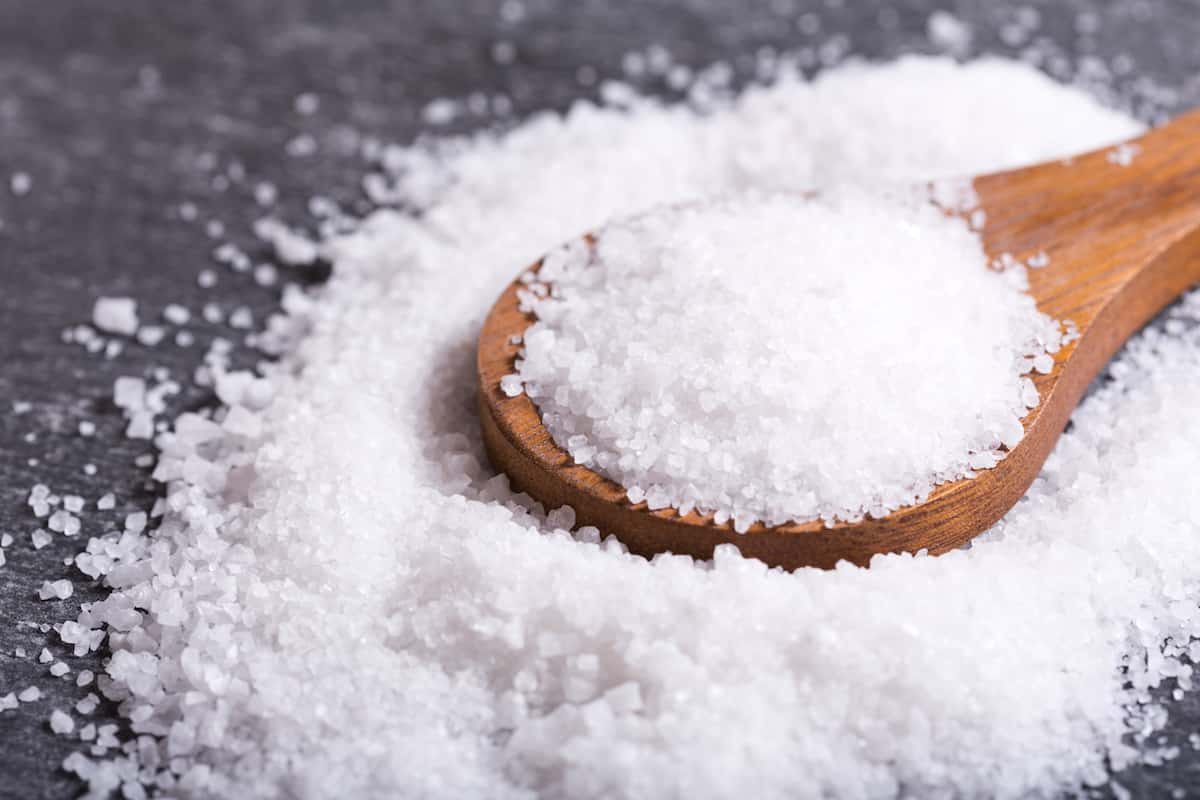
Table salt and sea salt are the same substance, sodium chloride, and the American Heart Association puts both at about 40% sodium by weight.1 Sea salt is what remains when seawater evaporates; table salt is mined from deposits and processed to a fine texture, which strips out other minerals.1 Once mixed into food, sea salt tastes no different from table salt in America’s Test Kitchen’s testing.2 The differences that matter in a kitchen are the crystal, which decides how much salt fits in a spoon, and iodine, which most sea salt lacks.3
Side by side
| Table salt | Sea salt | |
|---|---|---|
| What it is | Salt mined from deposits and processed to a fine texture1 | Salt left behind when seawater evaporates1 |
| Crystal | Tiny, uniform crystals from rapid vacuum evaporation2 | Anything from fine grains to coarse crystals and flakes2 |
| Additives | Usually an anticaking agent; Morton iodized lists calcium silicate, dextrose and potassium iodide24 | Usually none; Morton’s fine sea salt lists only sea salt5 |
| Iodine | Iodized or plain; US iodized salt has 45 mcg per gram3 | Not usually iodized; noniodized sea salt provides virtually no iodine3 |
| Grams per teaspoon | About 6 g (ATK)6 | No general figure; Morton fine and coarse sea salt labels: 1.4 g per ¼ teaspoon57 |
| Sodium | About 40%1 | About 40% for most (AHA); 38.9% to 40.7% in seven measured in Switzerland18 |
| Trace minerals | Stripped out in processing1 | May include magnesium, potassium and calcium at trace levels1 |
| Share of US salt, 2024 | Not separately reported | Solar salt, the sun-evaporated kind: 9% of salt sold or used9 |
| Main job | Measured cooking and baking, and the shaker | Finishing, where crunch shows; fine sea salt for cooking2 |
| Price | No dated, sourced comparison found | No dated, sourced comparison found |
How each is made
The Codex standard for food-grade salt covers salt from the sea, from rock deposits and from natural brine, and requires at least 97% sodium chloride on a dry basis, not counting additives, whatever the source.10 Table salt sits at the refined end. ATK describes its tiny, uniform crystals as the product of rapid vacuum evaporation, and notes that it usually carries an anticaking agent so it pours smoothly.2 Under US rules, salt with an anticaking agent may be labeled “free flowing.”11
Sea salt is made by evaporating seawater, by sun in Morton’s fine sea salt5 or over heat in Maldon’s flakes.12 The AHA describes it as usually unprocessed or lightly processed.1 Some sea salts carry color with a physical cause: under the French specification for Guérande salt, the gray salt is gray from fine clay particles picked up from the pan floor.13
Minerals and iodine
Minerals. Sea salt may carry trace levels of magnesium, potassium and calcium,1 but measured, they are small. In a 2016 survey by Switzerland’s food safety office, six of seven sea salts bought at retail or online had potassium below 0.05 g per kg, and the report concluded that specialty salts have no advantages over standard salts.8
Iodine. This is the real nutritional difference. US salt makers have added iodine to table salt since the 1920s, voluntarily, at 45 mcg per gram; the NIH Office of Dietary Supplements lists sea salt among specialty salts that are not usually iodized.3 In the Swiss survey, sea salts carried at most 54 µg of iodine per kg,8 more than 800 times less than the US iodized label (our arithmetic).
The ODS says the general US population gets enough iodine, though many pregnant women may not, and names seafood, eggs, milk and milk products among the best food sources.3 Most salt in the American diet comes from processed foods, which almost always use noniodized salt.3 A cook who switches from iodized table salt to sea salt drops one of the few dependable iodine sources at home. See sea salt vs. iodized salt.
Flavor and texture
ATK found that sea salts vary in color but only slightly in flavor, and once mixed into food taste no different from table salt; it recommends sea salt mainly as a finishing salt.2 Its tasters also found no detectable difference between iodized and noniodized salt.2
A widely repeated claim says sea salt tastes “saltier” or “stronger” because its larger crystals linger on the tongue. We found no test supporting it. What large crystals certainly do is crunch, and hold less salt in a spoon, because fewer of them fit.1
Salt’s effects on flavor apply to both. In lab taste studies, sodium chloride together with sugar was the main source of bitterness suppression in taste mixtures,14 a test of simple solutions rather than real dishes.
Can one stand in for the other?
Yes. By weight they are interchangeable; by volume, match the crystal. These treatments follow our sea salt substitute page.
| Swap | Starting amount | Treatment |
|---|---|---|
| Either, by weight | The same weight | Computed |
| Table salt for 1 teaspoon fine sea salt | 1 teaspoon, or a scant teaspoon to match Morton’s labels | Attributed / Computed (Morton products) |
| Morton fine or coarse sea salt for 1 teaspoon table salt | 1 teaspoon | Attributed (Morton products only) |
| Table salt for 1 teaspoon flaky sea salt measured into a recipe | About ½ teaspoon, then taste | Method |
| Table salt for flaky sea salt as a finishing salt | Not a good fit; use flakes, or a pinch of kosher salt | Method |
How these were worked out. By weight: Codex sets at least 97% sodium chloride on a dry basis for food-grade salt from any source.10 By volume: Morton’s chart treats a teaspoon of its table salt as equal to a teaspoon of its fine or coarse sea salt, with only a teaspoon’s difference at a full cup (1 cup of table salt equals 1 cup plus 1 teaspoon of fine sea salt), for Morton products only.15 Its labels agree: 1.5 g per ¼ teaspoon of iodized table salt against 1.4 g for both sea salts,457 about 7% apart (our arithmetic). A rule that circulates widely, 1¼ teaspoons of sea salt per teaspoon of table salt, is not supported by those figures for fine or coarse sea salt and has no source we could find. Flaky salts pack loosely, and we found no published weight per teaspoon for any of them; the ½-teaspoon start borrows the cautious figure on our Maldon salt substitute page and is not a measurement.
Which to use when
- Table salt: anything measured by the spoon, baking, brines and the shaker, and the everyday salt if you rely on salt for iodine. Morton markets its iodized salt for cooking and baking.4
- Sea salt: finishing, which is ATK’s recommendation;2 fine sea salt anywhere you’d use table salt.
Keeping iodized table salt for cooking and a flaky sea salt for finishing is a sensible split, though it is kitchen judgment rather than a tested rule.
Health notes
- Sodium. Weight for weight, the same: table salt and most sea salts are about 40% sodium, and the AHA says total sodium intake is what matters most for heart health.1 The FDA’s Daily Value for sodium is less than 2,300 mg a day, about a teaspoon of table salt.16 A coarse sea salt has less sodium per teaspoon only because fewer crystals fit.1
- Microplastics. In a 2018 study of 39 salt brands, reported in a Greenpeace press release, contamination was highest in sea salt, then lake salt, then rock salt.17 The release gives no figure for refined table salt. That is one study of specific products, not the market.
- Health claims. Neither salt treats or prevents any condition; iodized salt’s established role is as a carrier for iodine.3
What isn’t known
- No test showing sea salt tastes saltier than table salt, weight for weight.
- No published weight per teaspoon for flaky sea salts, or for any sea salt outside Morton’s labels.
- No figure for how much iodine iodized salt loses in a home pantry.
- No dated, sourced price comparison.
Related
- Table salt and sea salt, the full profiles
- Sea salt substitutes
- Sea salt vs. iodized salt, iodized vs. non-iodized salt, kosher salt vs. table salt and kosher salt vs. sea salt
- Himalayan salt vs. table salt, Celtic sea salt vs. table salt and rock salt vs. table salt
- Cooking with sea salt, too much salt and MSG vs. salt
Footnotes
-
Sodium Sources: Where Does All That Sodium Come From?, American Heart Association, 2025. heart.org · Reference work ↩ ↩2 ↩3 ↩4 ↩5 ↩6 ↩7 ↩8 ↩9 ↩10 ↩11 ↩12 ↩13
-
Salt Types and Measurements, America’s Test Kitchen. americastestkitchen.com · Publication ↩ ↩2 ↩3 ↩4 ↩5 ↩6 ↩7 ↩8 ↩9
-
Iodine: Fact Sheet for Health Professionals, NIH Office of Dietary Supplements. ods.od.nih.gov · Regulator ↩ ↩2 ↩3 ↩4 ↩5 ↩6 ↩7
-
Morton Iodized Table Salt, product page, Morton Salt. mortonsalt.com · Merchant ↩ ↩2 ↩3
-
Morton Fine Sea Salt, product page, Morton Salt. mortonsalt.com · Merchant ↩ ↩2 ↩3 ↩4
-
Kate Shannon Levine, The Best Kosher Salt, America’s Test Kitchen, 2019. americastestkitchen.com · Publication ↩
-
Morton Coarse Sea Salt, product page, Morton Salt. mortonsalt.com · Merchant ↩ ↩2
-
Esther Infanger and Max Haldimann, Report on the composition of prevalent salt varieties, Swiss Federal Food Safety and Veterinary Office, 2016. warwick.ac.uk · Regulator ↩ ↩2 ↩3
-
Wallace P. Bolen, Salt, Mineral Commodity Summaries 2025, U.S. Geological Survey. pubs.usgs.gov · Regulator ↩
-
Standard for Food Grade Salt, CXS 150-1985 (rev. 2012), Codex Alimentarius. services.bis.gov.in · Standard ↩ ↩2
-
21 CFR 100.155, Salt and iodized salt, Electronic Code of Federal Regulations. ecfr.gov · Regulator ↩
-
Clare Finney, Clear as crystal: the decades-old traditions of Maldon sea salt, Foodism, 2018. foodism.co.uk · Publication ↩
-
Cahier des charges de l’IGP Sel de Guérande / Fleur de sel de Guérande, French Ministry of Agriculture, 2025. info.agriculture.gouv.fr · Regulator ↩
-
Green BG et al., Taste Mixture Interactions: Suppression, Additivity, and the Predominance of Sweetness, Physiology & Behavior, 2010. pmc.ncbi.nlm.nih.gov · Peer-reviewed ↩
-
Salt Conversion Chart, Morton Salt. mortonsalt.com · Merchant ↩
-
Sodium in Your Diet, U.S. Food and Drug Administration. fda.gov · Regulator ↩
-
Over 90% of sampled salt brands globally found to contain microplastics, Greenpeace International press release, 2018, on Kim J-S et al., Environmental Science & Technology, 2018. greenpeace.org · Publication ↩