Spice Substitutes · Substitutes
Sea Salt Substitutes: Fine, Coarse or Flaky, and How Much to Use
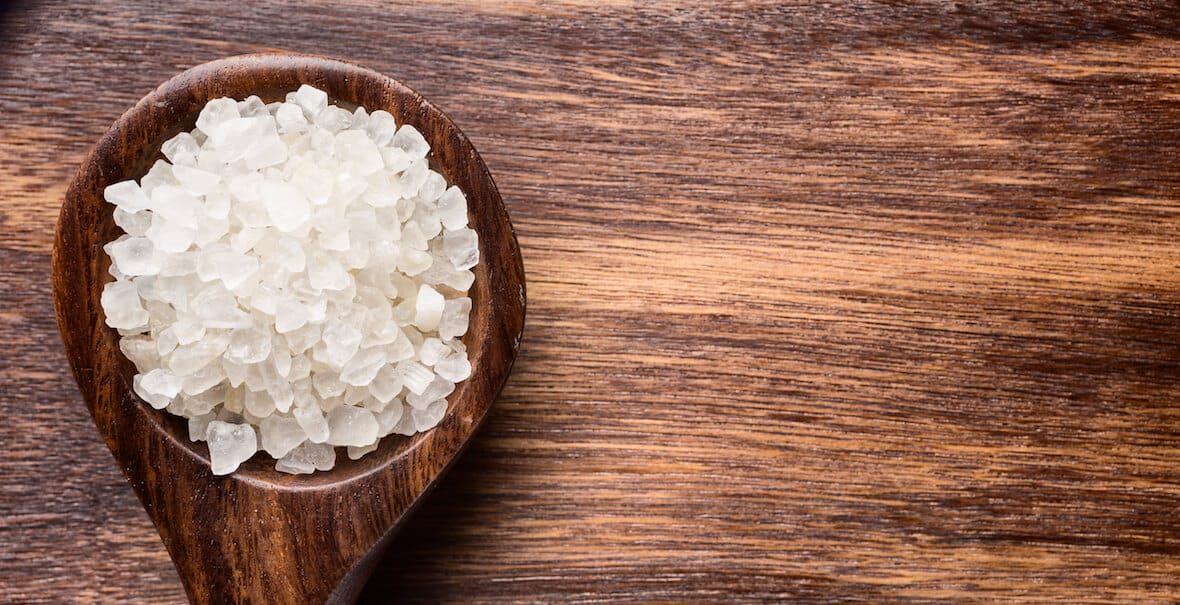
Sea salt is the salt left behind when seawater evaporates, and chemically it is the same thing as any other cooking salt: sodium chloride, with most sea salts about 40% sodium, like table salt.12 In America’s Test Kitchen’s testing, sea salt tasted no different from table salt once it was mixed into food.2 So any salt can stand in for sea salt. What matters is which sea salt the recipe means, because “sea salt” covers everything from a fine grain that measures like table salt to large flakes that hold far less salt in a spoon.21 Match the crystal to the job, and adjust the amount.
Quick answer
| What the sea salt is doing | Best substitute | Starting amount, per 1 teaspoon sea salt | Treatment |
|---|---|---|---|
| Fine sea salt measured into a recipe | Table salt or pickling salt | 1 teaspoon (a scant teaspoon if you want to match Morton’s labels) | Computed |
| The same, recipe gives grams | Any food-grade salt | The same weight | Computed |
| Fine sea salt, kosher salt on hand | Kosher salt | 1 teaspoon plus a pinch of Morton, or 2 teaspoons Diamond Crystal | Disputed |
| Coarse sea salt for a grinder, pasta water or seasoning meat | Coarse Himalayan pink salt or kosher salt | 1 teaspoon coarse Himalayan; 1¼ teaspoons Morton kosher for Morton coarse sea salt | Computed / Attributed |
| Flaky sea salt as a finishing salt | Maldon, fleur de sel or Diamond Crystal kosher salt | By the pinch | Method |
| Sea salt in a pickle recipe | Canning and pickling salt | 1 teaspoon | Attributed |
How the ratios on this page are labeled
- Computed: based on a measurable physical relationship, with the source named.
- Attributed: a named source publishes this ratio. We quote it as theirs.
- Disputed: named sources give different answers to the same swap. We show each one and do not average them.
- Method: we found no published ratio. We give a direction and a cautious starting point, and say so.
No general grams-per-teaspoon figure exists for sea salt; it depends on the crystal. The weights on this page come from ATK’s measurements and from Morton’s labels, which cover Morton’s products only.
If fine sea salt is measured into a recipe
Fine sea salt behaves like table salt in a spoon. This is the easy case.
1. Table salt
Ratio (Computed): One for one, or a hair less. Morton’s labels give 1.4 grams per ¼ teaspoon for its fine sea salt and 1.5 grams for its iodized table salt,34 so table salt is about 7% heavier by volume. Morton’s conversion chart treats a teaspoon of its table salt as equal to a teaspoon of its fine sea salt, and a cup of table salt as equal to a cup plus a teaspoon of fine sea salt.5 Both figures are Morton’s, for Morton’s products, and both say the same thing: the difference is too small to matter in a teaspoon. In a large batch, such as a brine, use slightly less table salt, or weigh.
Table salt brings additives sea salt usually lacks. Morton’s iodized table salt lists calcium silicate, an anticaking agent, along with dextrose and potassium iodide, while its fine sea salt lists only sea salt.43 Neither changes the taste: ATK’s tasters found no detectable difference between iodized and noniodized salt.2
2. Any salt, by weight
Ratio (Computed): The Codex standard for food-grade salt requires at least 97% sodium chloride on a dry basis, whether the salt comes from the sea, rock deposits or brine,6 so equal weights of food-grade salts carry close to the same amount of salt. If the recipe gives grams, weigh any salt.
3. Pickling salt
Ratio (Attributed): Morton’s chart treats its canning and pickling salt as equal to its table salt by volume.5 Use it one for one. Morton lists cooking, baking and brining among its uses.7
4. Kosher salt
Kosher salt is much coarser than table salt,8 so a teaspoon of it holds less salt, and how much less depends on the brand. A teaspoon of Morton kosher salt weighs 4.8 grams and a teaspoon of Diamond Crystal 2.8 grams, ATK found.9 Since Morton’s chart treats fine sea salt like table salt, the table-salt conversions apply, and they disagree:
| Swap for 1 teaspoon of table salt | Morton kosher | Diamond Crystal | Source |
|---|---|---|---|
| ATK’s rule of thumb | 1½ teaspoons | 2 teaspoons | 210 |
| Morton’s conversion chart (Morton products only) | 1¼ teaspoons | not covered | 5 |
| Computed from ATK’s own gram weights (6.0 ÷ 4.8 and 6.0 ÷ 2.8) | 1¼ teaspoons | about 2⅛ teaspoons | 9 |
Measured against Morton’s fine sea salt label instead (5.6 grams a teaspoon), ATK’s kosher weights give about 1⅙ teaspoons of Morton and 2 teaspoons of Diamond Crystal.39
Ratio (Disputed): Start at the lowest figure: 1 teaspoon plus a pinch of Morton kosher salt, or 2 teaspoons of Diamond Crystal, per teaspoon of fine sea salt. Taste, then add more. If a recipe gives salt in grams, weigh it; ATK recommends weighing salt rather than measuring it by volume.10
If coarse sea salt is seasoning or cooking water
Coarse sea salt fills grinders, seasons pasta water and gets pinched over meat before it cooks. You want another coarse, food-grade salt.
1. Coarse Himalayan pink salt
Himalayan pink salt is rock salt, mined in Pakistan; the state-owned Pakistan Mineral Development Corporation runs the Khewra mine.1112 Its pink color comes from traces of iron oxide.11 Pink salt carries more calcium, potassium and some other minerals than white salt, but a 2020 analysis of pink salts sold in Australia found a 5-gram serving made no clinically significant contribution to nutrient intake.11
Ratio (Computed / Attributed): Morton’s coarse Himalayan label gives 1.5 grams per ¼ teaspoon, the same as its table salt,134 and Morton’s chart treats a teaspoon of its Himalayan salt as equal to a teaspoon of its table salt and of its sea salts.5 Use it one for one with Morton’s coarse or fine sea salt. Other brands’ grinds differ.
2. Kosher salt
Ratio (Attributed): Morton’s chart treats a teaspoon of its coarse sea salt as equal to a teaspoon of table salt, and so to 1¼ teaspoons of Morton kosher salt.5 That figure covers Morton’s products only; with Diamond Crystal, start with about 2 teaspoons per teaspoon of coarse sea salt (Method, from the table above). Morton suggests its kosher salt for brining poultry and for grilled meats.14
3. Table salt
Ratio (Method): For pasta water, one for one is fine. For seasoning meat by the pinch, use a lighter hand: fine grains are harder to see on the food, so it is easy to overdo. That is our kitchen judgment.
If flaky sea salt is finishing a dish
ATK recommends sea salts mainly as finishing salts, scattered on just before serving where their crunch shows.2 For this job, the crystal is the point.
- Maldon forms thin pyramid flakes at the surface of boiling seawater, shaped by surface tension, according to the producer’s account to Foodism.15
- Fleur de sel forms as crystals floating in sheets on the surface of the salt pans at Guérande, on France’s Atlantic coast, and may hold up to 12% moisture, so it is fine and damp rather than crisp.16
- Diamond Crystal kosher salt is the pantry option. Its hollow, pyramid-shaped crystals gave what ATK’s tasters called a “delicate and fleeting crunch,” and they preferred it to Morton’s harder grains.9
- Coarse Himalayan salt gives a harder crunch and a pink fleck.
Ratio (Method): By the pinch, to taste. No published weight exists for flaky sea salt that we found, and finishing salt is not measured precisely anyway. If a recipe measures flaky sea salt into a dough, see Maldon salt substitutes for volume starting points.
If sea salt is going into pickles
Ratio (Attributed): Use canning and pickling salt, one for one by volume (Morton’s chart).5 It is what home-canning guidance from the National Center for Home Food Preservation recommends, and NCHFP does not recommend flake salt because its density varies.17 For fermented pickles, where the amount of salt matters for safety, see pickling salt substitutes.
Notes for every swap
- Sodium. Table salt, kosher salt and most sea salts are about 40% sodium. A coarse sea salt has less sodium per teaspoon only because fewer crystals fit in the spoon.1 Swapping salts doesn’t lower sodium unless you use less salt.
- Iodine. Sea salt is not usually iodized, and noniodized sea salt provides virtually no iodine.18 Swapping in iodized table salt adds iodine.
- Minerals. Sea salt may carry trace levels of magnesium, potassium and calcium,1 but they are traces; a substitute loses nothing that matters nutritionally.
What isn’t known
- No general grams-per-teaspoon figure exists for coarse or flaky sea salt; the weights here are Morton’s for its own products, and ATK’s for kosher and table salt.
- ATK’s rule of thumb and its own gram weights disagree for Morton kosher salt.
- No sensory test comparing finishing salts was found.
Related
- Sea salt and cooking with sea salt
- Table salt vs. sea salt, kosher salt vs. sea salt, Himalayan salt vs. sea salt, rock salt vs. sea salt, pickling salt vs. sea salt and sea salt vs. iodized salt
- Table salt, kosher salt, Himalayan salt, Maldon sea salt, fleur de sel, Celtic sea salt and Hawaiian sea salt
- Kosher salt substitutes, Celtic salt substitutes, fleur de sel substitutes and smoked sea salt substitutes
- Overdid it? See too much sea salt.
Footnotes
-
Sodium Sources: Where Does All That Sodium Come From?, American Heart Association, 2025. heart.org · Reference work ↩ ↩2 ↩3 ↩4
-
Salt Types and Measurements, America’s Test Kitchen. americastestkitchen.com · Publication ↩ ↩2 ↩3 ↩4 ↩5 ↩6
-
Morton Fine Sea Salt, product page, Morton Salt. mortonsalt.com · Merchant ↩ ↩2 ↩3
-
Morton Iodized Table Salt, product page, Morton Salt. mortonsalt.com · Merchant ↩ ↩2 ↩3
-
Salt Conversion Chart, Morton Salt. mortonsalt.com · Merchant ↩ ↩2 ↩3 ↩4 ↩5 ↩6
-
Standard for Food Grade Salt, CXS 150-1985 (rev. 2012), Codex Alimentarius. services.bis.gov.in · Standard ↩
-
Morton Canning and Pickling Salt, product page, Morton Salt. mortonsalt.com · Merchant ↩
-
What’s the difference between kosher salt and other salt?, Tufts Health & Nutrition Letter, 2013 (updated 2019). nutritionletter.tufts.edu · Publication ↩
-
Kate Shannon Levine, The Best Kosher Salt, America’s Test Kitchen, 2019. americastestkitchen.com · Publication ↩ ↩2 ↩3 ↩4
-
Eden Faithfull, The Wrong Brand of Kosher Salt Could Ruin Your Dinner, America’s Test Kitchen, 2022. americastestkitchen.com · Publication ↩ ↩2
-
Fayet-Moore F et al., An Analysis of the Mineral Composition of Pink Salt Available in Australia, Foods, 2020. mdpi.com · Peer-reviewed ↩ ↩2 ↩3
-
Pakistan Mineral Development Corporation, home page. pmdc.gov.pk · Merchant ↩
-
Morton Coarse Himalayan Pink Salt, product page, Morton Salt. mortonsalt.com · Merchant ↩
-
Morton Kosher Salt Flakes, product page, Morton Salt. mortonsalt.com · Merchant ↩
-
Clare Finney, Clear as crystal: the decades-old traditions of Maldon sea salt, Foodism, 2018. foodism.co.uk · Publication ↩
-
Cahier des charges de l’IGP Sel de Guérande / Fleur de sel de Guérande, French Ministry of Agriculture, 2025. info.agriculture.gouv.fr · Regulator ↩
-
Salts Used in Pickling, National Center for Home Food Preservation. nchfp.uga.edu · Reference work ↩
-
Iodine: Fact Sheet for Health Professionals, NIH Office of Dietary Supplements. ods.od.nih.gov · Regulator ↩