Cooking · Cooking with
Cooking With Sea Salt: Where It Beats Table Salt and Where It Doesn’t
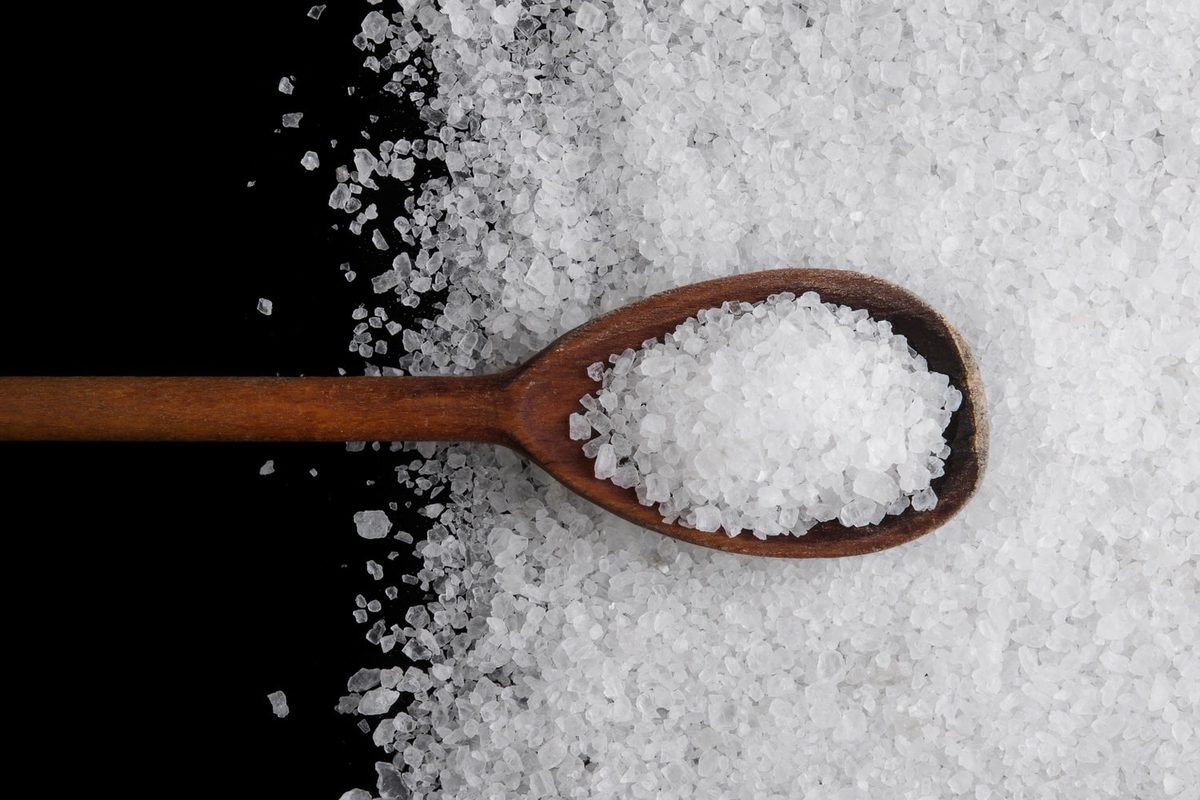
Sea salt is the salt left behind when seawater evaporates, and in a pot of soup it behaves exactly like table salt.1 America’s Test Kitchen found that sea salt tastes no different from table salt once it is mixed into food, and keeps it for finishing, where its crystals stay crunchy and visible.2 So cooking with sea salt is mostly a question of crystal size: fine sea salt for cooking and baking, coarse crystals for grinders and crusts, flakes for the top of a finished dish.
Quick guide
| Job | Which sea salt | Basis |
|---|---|---|
| Finishing steak, vegetables, salads, sweets | Flaky or coarse sea salt, added just before serving | ATK keeps sea salt for finishing2 |
| Seasoning while cooking | Fine sea salt or any salt; no flavor advantage once dissolved | ATK2 |
| Bread dough | Any fine salt, ideally weighed: about 1.8 to 2% of the flour weight | King Arthur Baking3 |
| Desserts | Fine salt in the mix, flakes on top | Kitchen judgment |
| Iodine | Not a source; use iodized salt for that | NIH ODS4 |
Sea salt is still salt
Most sea salts are about 40% sodium, like table salt.1 A Swiss government survey measured seven sea salts at 38.9 to 40.7% sodium by weight.5 Sea salt may carry trace minerals such as magnesium, potassium and calcium,1 but in the Swiss samples potassium was below 0.05 g per kilogram in six of seven sea salts and 1.2 g per kilogram in the seventh.5 The survey’s conclusion was that specialty salts “do not possess any advantages over standard salts.”5 ATK’s tasting agrees: sea salt flakes varied in color but only slightly in flavor.2
That makes some common advice hard to support. A widely repeated claim says chefs prefer sea salt for subtly flavored foods, pasta water or a good steak because it tastes “cleaner.” Once dissolved, ATK found no difference, so we treat sea salt in pasta water or a marinade as interchangeable with any other salt.2
Finishing: where sea salt earns its price
Large flakes or crystals scattered over food at the end stay crunchy and catch the eye, which is the reason ATK recommends sea salt mainly as a finishing salt.2 Good places for it: sliced steak, roasted or steamed vegetables, tomatoes, eggs, avocado toast, buttered bread, caramel, chocolate and fresh fruit such as watermelon. Those pairings, and the habit of adding flakes at the last moment so they stay crisp on a moist surface, are kitchen judgment rather than tested claims.
Measuring sea salt
Sea salts range from fine grains to big flakes, and a spoonful of each holds a different amount of salt.
| Salt | Weight per teaspoon | Source |
|---|---|---|
| Morton Fine Sea Salt | 1.4 g per ¼ teaspoon on the label (about 5.6 g per teaspoon by our arithmetic) | 6 |
| Coarse and flaky sea salts | No published figure found |
Morton’s chart treats a teaspoon of its fine or coarse sea salt as equal to a teaspoon of its table salt, with small additions at larger volumes (1 cup of table salt equals 1 cup plus 1 teaspoon of its fine sea salt), and says the chart applies only between Morton products.7 For flaky salts, which vary from brand to brand, there is no reliable volume swap. If a recipe just says “sea salt,” start with less, or weigh.
Baking with sea salt
Salt matters in bread, but the kind of salt doesn’t. King Arthur Baking explains that salt tightens and strengthens gluten strands, slows yeast, and adds flavor, and that bakers add it at about 1.8 to 2% of the flour’s weight.3 A common claim credits sea salt specifically with better gluten development; the effect King Arthur describes belongs to salt in general, and we found no source that singles out sea salt. Because the recommendation is by weight, weighing the salt removes any difference between fine and coarse crystals. King Arthur advises against leaving salt out of bread entirely, though it says the amount can usually be halved without very noticeable changes to texture and browning.3
Flaky sea salt on top of a loaf, focaccia or cookies before baking adds crunch and visible salt; that is common practice rather than a sourced finding.
In sweets
A pinch of salt in caramel, chocolate desserts and fruit is common practice, and flaky sea salt is the usual finishing choice because it shows. A widely repeated reason given for choosing sea salt in sweets is that iodized table salt tastes bitter. ATK’s tasters could not detect a difference in taste between iodized and noniodized salt, so the case for sea salt in desserts is texture, not chemistry.2
Sea salt and umami
It is sometimes said that briny sea salts boost umami the way MSG does. We found no source for that. Umami comes from three substances, glutamate, guanylate and inosinate, according to Britannica;8 salt supplies none of them. For umami, see monosodium glutamate.
Storage
We found no shelf-life figure for sea salt from a regulator or standards body. Moist, unwashed sea salts can clump, so keep the container closed and dry; that is common practice rather than a tested rule.
Sodium and iodine
Sea salt is not a low-sodium salt. A teaspoon of coarse sea salt can hold less sodium than a teaspoon of table salt only because fewer large crystals fit in the spoon, and for heart health total sodium intake is what matters most.1 The FDA’s Daily Value for sodium is less than 2,300 mg a day,9 and the WHO recommends adults stay under 2,000 mg, naming raised blood pressure as the main health effect of high intake.10 Noniodized sea salt provides virtually no iodine, according to the NIH Office of Dietary Supplements.4 See sea salt vs. iodized salt.
What isn’t known
- Grams per teaspoon for coarse and flaky sea salts.
- Any taste test showing sea salt suits mild foods better than other salts once dissolved.
- Any source linking sea salt to umami.
Related
- Sea salt, the full profile, and sea salt substitutes
- Table salt vs. sea salt, kosher salt vs. sea salt, Himalayan salt vs. sea salt and rock salt vs. sea salt
- Maldon sea salt, Celtic sea salt, fleur de sel vs. sea salt and smoked sea salt
- Too much sea salt? How to fix the dish
Footnotes
-
Sodium Sources: Where Does All That Sodium Come From?, American Heart Association, 2025. heart.org · Reference work ↩ ↩2 ↩3 ↩4
-
Salt Types and Measurements, America’s Test Kitchen. americastestkitchen.com · Publication ↩ ↩2 ↩3 ↩4 ↩5 ↩6 ↩7
-
Rossi Anastopoulo, Why is salt important in yeast bread?, King Arthur Baking, 2020. kingarthurbaking.com · Publication ↩ ↩2 ↩3
-
Iodine: Fact Sheet for Health Professionals, NIH Office of Dietary Supplements. ods.od.nih.gov · Regulator ↩ ↩2
-
Esther Infanger and Max Haldimann, Report on the composition of prevalent salt varieties, Swiss Federal Food Safety and Veterinary Office, 2016. warwick.ac.uk · Regulator ↩ ↩2 ↩3
-
Morton Fine Sea Salt, product page, Morton Salt. mortonsalt.com · Merchant ↩
-
Salt Conversion Chart, Morton Salt. mortonsalt.com · Merchant ↩
-
Umami, Encyclopaedia Britannica. britannica.com · Reference work ↩
-
Sodium in Your Diet, U.S. Food and Drug Administration. fda.gov · Regulator ↩
-
Sodium reduction, World Health Organization fact sheet, 2026. who.int · Regulator ↩