Spices · Profile
Sea Salt: What It Is, How It’s Made, and How It Compares to Table Salt
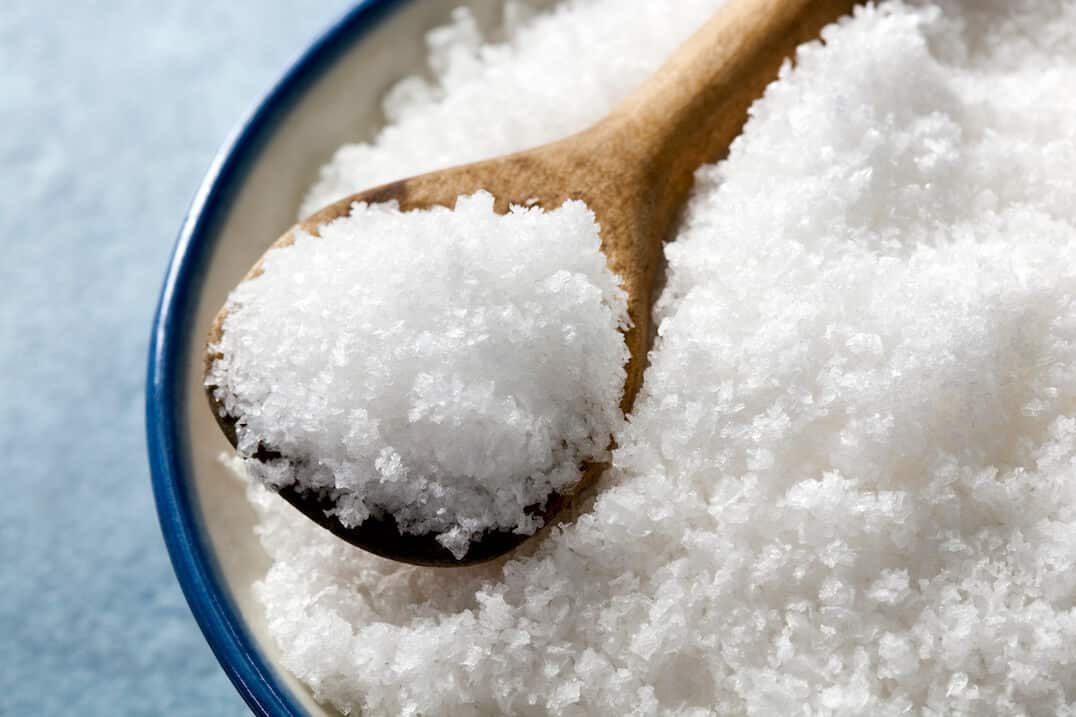
Sea salt is the salt left behind when seawater evaporates.1 Chemically it is the same thing as any other cooking salt, sodium chloride, and most sea salts carry about the same 40% sodium as table salt.12 What sets one sea salt apart from another is mostly crystal size and shape, plus traces of other minerals and, in some unwashed salts, a little color. This page covers how it is made, what the minerals do and don’t amount to, how to measure it, and the iodine and sodium questions that matter more than the label.
At a glance
| What it is | Sodium chloride left after seawater evaporates; most sea salts are about 40% sodium1 |
| How it’s made | Seawater evaporated by sun and wind in shallow pans (solar evaporation)34 |
| Crystal form | Anything from fine grains to irregular flakes and coarse crystals2 |
| Additives | Usually none; specialty salts such as sea salt are not usually iodized5 |
| Grams per teaspoon | No general figure published. One brand’s label: Morton Fine Sea Salt, 1.4 g per ¼ teaspoon (about 5.6 g per teaspoon)3. Coarse and flaky sea salts: no published figure found |
| Trace minerals | May include magnesium, potassium and calcium, at trace levels1 |
| International standard | Codex CXS 150-1985 covers food-grade salt from the sea, rock deposits or brine6 |
Measured values
4 figures, sourced| Measure | Value | Scope | Source |
|---|---|---|---|
| Sodium Nutrient | about 40 % by weight | Table salt, kosher salt and most sea salts (American Heart Association) | heart.org |
| Sodium chloride, minimum Limit | 97 % of dry matter, excluding additives | Codex CXS 150-1985 (rev. 2012), food-grade salt from sea, rock deposits or brine | services.bis.gov.in |
| Moisture, maximum Limit | 12 % | Sel de Guérande IGP specification (2025), gray salt | info.agriculture.gouv.fr |
| Microplastics | 506 particles per kg, average | 39 salt brands from 21 countries and regions (28 sea, 9 rock, 2 lake), Kim et al. 2018, as reported in a Greenpeace press releaseAverage across all salt types, not sea salt alone; the study found contamination highest in sea salt. Describes 39 products, not the market. | greenpeace.org |
Each figure is quoted as its source states it, with the samples or standard it applies to. Where sources differ, both are shown; nothing is averaged. All measured values
What sea salt is
Every food-grade salt, whatever its source, has to be mostly sodium chloride. The Codex Alimentarius standard for food-grade salt covers salt from the sea, from underground rock salt deposits and from natural brine, and sets the sodium chloride content at no less than 97% of the dry matter, not counting additives.6 America’s Test Kitchen puts it plainly: salt is sodium chloride whatever its source, and the types differ in texture, shape and mineral content.2
The American Heart Association describes sea salt as usually unprocessed or lightly processed, while table salt is mined from deposits and processed to a fine texture, which strips out other minerals.1 Morton describes its fine sea salt as made from sea water “evaporated by the sun” and calls solar evaporation the oldest method of salt production, a claim we could not check against an independent source.3
Solar salt is a small slice of the salt business. In the United States in 2024, solar salt was about 9% of salt sold or used, against 42% salt in brine, 40% rock salt and 9% vacuum pan salt; highway deicing alone took about 41% of the salt consumed.7
Flavor and texture
In America’s Test Kitchen’s testing, sea salt’s flakes varied in color but only slightly in flavor, and once mixed into food it tasted no different from table salt.2 ATK’s conclusion is that texture, not origin, is what to shop for.2 A widely repeated claim says sea salt tastes “stronger” than table salt, so you can use less of it. We found no test that supports this, and ATK’s results point the other way.
Where sea salt does change a dish is on the surface. Large flakes sprinkled on at the end stay crunchy and visible; fine sea salt dissolves like table salt. That is the reason ATK recommends sea salt mainly as a finishing salt.2
Minerals and color
Sea salt may carry trace levels of minerals such as magnesium, potassium and calcium.1 The AHA’s point is that these are trace amounts, that the same minerals come from other foods, and that for heart health total sodium intake is what matters most.1 No published analysis we found shows that darker sea salts carry meaningfully more minerals, so this page doesn’t claim it.
Color, where it appears, often has a specific physical cause. The French specification for Guérande salt is a good documented case: its gray salt is gray from clay particles picked up on the pan floor, while its fleur de sel is white and sometimes faintly pink from the alga Dunaliella salina.4 That explains the color of those two salts only; other colored salts need their own evidence.
Origin and history
Salt has been made from seawater in many places, but the history that can be documented is local. For Guérande, on France’s Atlantic coast, the earliest written mention of salt pans is in the Cartulary of Redon, dated 15 December 854; the pans expanded from the 16th century, peaked in the 19th, and production declined between 1840 and 1960.4
Two older claims that circulate widely, that sea salt production is mentioned in Buddhist scriptures of the 5th century BCE and that Romans finished their brine in clay pans over peat fires, could not be traced to a source, so they are not repeated here.
How sea salt is used
Fine sea salt can be used anywhere table salt is. Coarse crystals and flakes are mostly finishing salts: on sliced steak, roasted vegetables, salads, bread crusts, caramel and chocolate. ATK’s testers found no noticeable benefit to cooking with sea salt rather than table salt and keep it for finishing, where its crunch shows.2 For recipes and techniques, see cooking with sea salt; for flavored versions, see smoked sea salt.
Measuring sea salt
Salts of different crystal size put different amounts of salt into a spoon. For its own products, Morton’s chart treats 1 teaspoon of table salt as equal to 1 teaspoon of its coarse or fine sea salt, with small additions only at larger volumes (1 cup of table salt equals 1 cup plus 1 teaspoon of its fine sea salt).8 Morton says the chart applies when swapping one Morton product for another.8 We found no published conversion for flaky sea salts, which vary too much from brand to brand for one number to mean much. When a recipe just says “sea salt,” start with less and taste.
Buying and quality
Decide on texture first. Fine sea salt is for cooking and baking, coarse crystals for grinders and crusts, flakes for finishing. Origin labels matter mostly where a protected designation sets rules. Under the Guérande specification, for example, the salt is harvested by hand, is not washed after harvest, and may contain no additives; gray salt can hold up to 12% moisture.4 For specific salts, see Celtic sea salt, Maldon sea salt, fleur de sel, Hawaiian sea salt and Anglesey sea salt.
Storage
We found no shelf-life figure for sea salt from a regulator or standards body. Moist, unwashed salts can clump, so keep the container closed and dry; that is common practice rather than a tested rule.
Safety and health
Sodium
Sea salt is not a low-sodium salt. Table salt, kosher salt and most sea salts are about 40% sodium.1 A teaspoon of a coarse sea salt can hold less sodium than a teaspoon of table salt only because fewer large crystals fit in the spoon, and the AHA suggests checking the Nutrition Facts label.1 The FDA’s Daily Value for sodium is less than 2,300 mg a day, which it puts at about a teaspoon of table salt.9 The WHO recommends adults keep sodium below 2,000 mg a day (under 5 g of salt) and names raised blood pressure as the main health effect of high sodium intake.10
Iodine
Most sea salt is not iodized. The NIH Office of Dietary Supplements says specialty salts such as sea salt, kosher salt, Himalayan salt and fleur de sel usually aren’t, and that noniodized sea salt provides virtually no iodine.5 Morton’s fine sea salt, for instance, lists its only ingredient as sea salt.3 Anyone who relies on salt for iodine should use iodized salt; see sea salt vs. iodized salt and iodized vs. non-iodized salt.
Microplastics
A 2018 study by Ji-Su Kim and colleagues in Environmental Science & Technology tested 39 salt brands from 21 countries and regions and found microplastics in 36 of them.11 The sample was 28 sea salts, 9 rock salts and 2 lake salts, and contamination was highest in sea salt, then lake salt, then rock salt.11 The average across all samples was 506 particles per kilogram.11 These figures come from a Greenpeace press release on the study; we could not open the paper itself. They describe 39 products bought for one study, not the sea salt market as a whole.
Substitutes and comparisons
Any salt can stand in for sea salt by weight. By volume, crystal size decides the swap. See sea salt substitutes for options, and these comparisons:
- Table salt vs. sea salt
- Kosher salt vs. sea salt
- Himalayan salt vs. sea salt
- Fleur de sel vs. sea salt
- Rock salt vs. sea salt
- Pickling salt vs. sea salt
If a dish has gone over, see too much sea salt. For choosing between salts, see the best salt for cooking.
Footnotes
-
Sodium Sources: Where Does All That Sodium Come From?, American Heart Association, 2025. heart.org · Reference work ↩ ↩2 ↩3 ↩4 ↩5 ↩6 ↩7 ↩8 ↩9
-
Salt Types and Measurements, America’s Test Kitchen. americastestkitchen.com · Publication ↩ ↩2 ↩3 ↩4 ↩5 ↩6 ↩7
-
Morton Fine Sea Salt, product page, Morton Salt. mortonsalt.com · Merchant ↩ ↩2 ↩3 ↩4
-
Cahier des charges de l’IGP Sel de Guérande / Fleur de sel de Guérande, French Ministry of Agriculture, 2025. info.agriculture.gouv.fr · Regulator ↩ ↩2 ↩3 ↩4
-
Iodine: Fact Sheet for Health Professionals, NIH Office of Dietary Supplements. ods.od.nih.gov · Regulator ↩ ↩2
-
Standard for Food Grade Salt, CXS 150-1985 (rev. 2012), Codex Alimentarius. services.bis.gov.in · Standard ↩ ↩2
-
Wallace P. Bolen, Salt, Mineral Commodity Summaries 2025, U.S. Geological Survey. pubs.usgs.gov · Regulator ↩
-
Salt Conversion Chart, Morton Salt. mortonsalt.com · Merchant ↩ ↩2
-
Sodium in Your Diet, U.S. Food and Drug Administration. fda.gov · Regulator ↩
-
Sodium reduction, World Health Organization fact sheet, 2026. who.int · Regulator ↩
-
Over 90% of sampled salt brands globally found to contain microplastics, Greenpeace International press release, 2018, on Kim J-S et al., Environmental Science & Technology, 2018. greenpeace.org · Publication ↩ ↩2 ↩3