Spices · Profile
White Peppercorns: How They’re Made, How They Taste, and How to Use Them
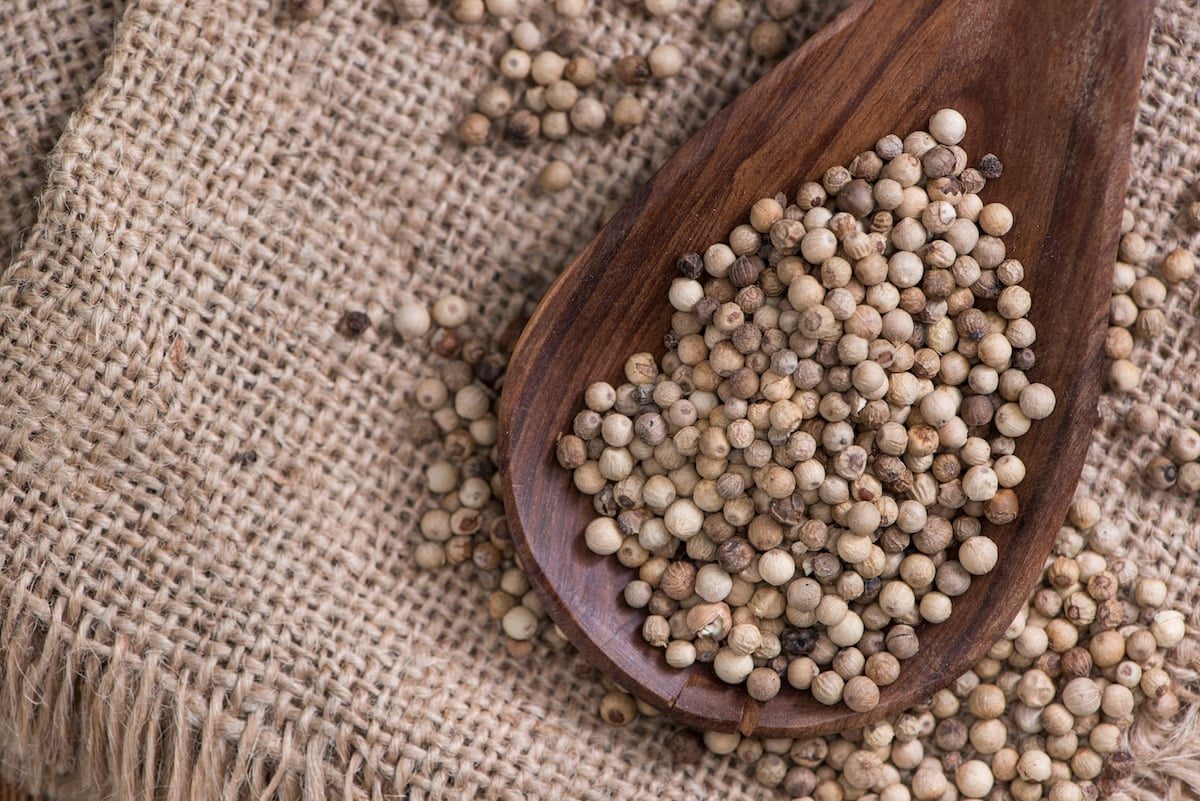
White peppercorns are the seeds of the same berry that gives black pepper, Piper nigrum, with the outer hull soaked off. That one step changes a lot: the corns turn pale, lose part of their aroma, keep their bite, and pick up a faintly fermented note that some cooks prize and others dislike. This page covers how white pepper is made, why it tastes the way it does, the grades the international standard sets, where it comes from, how it is used, and what the health and safety record shows.
At a glance
| Botanical name | Piper nigrum L., the same species as black and green pepper12 |
| Plant family | Piperaceae13 |
| Part used | The dried berry with its pericarp (outer layers) removed4 |
| Main source | The Indonesian island of Bangka (traded as Muntok); smaller amounts from Sarawak, Brazil and India’s Malabar region5 |
| Pungent compound | Piperine; Codex minimum 4.0% (Grade I) on a dry basis4 |
| Essential oil | About 1.5% (Katzer), lower than black pepper5 |
| Forms sold | Whole and ground |
| International standard | Codex CXS 326-2017 (black, white and green peppers)4 |
Measured values
35 figures, sourced| Measure | Value | Scope | Source |
|---|---|---|---|
| Bulk density, minimum Limit | 600 g/L | Codex CXS 326-2017, whole white pepper, Grade I | fao.org |
| Bulk density, minimum Limit | 600 g/L | Codex CXS 326-2017, whole white pepper, Grade II | fao.org |
| Bulk density, minimum Limit | 550 g/L | Codex CXS 326-2017, whole white pepper, Grade III | fao.org |
| Black berries, maximum Limit | 5.0 % | Codex CXS 326-2017, whole white pepper, Grade I | fao.org |
| Black berries, maximum Limit | 7.5 % | Codex CXS 326-2017, whole white pepper, Grade II | fao.org |
| Black berries, maximum Limit | 10.0 % | Codex CXS 326-2017, whole white pepper, Grade III | fao.org |
| Light berries, maximum Limit | 1.0 % | Codex CXS 326-2017, whole white pepper, Grade I | fao.org |
| Light berries, maximum Limit | 2.0 % | Codex CXS 326-2017, whole white pepper, Grade II | fao.org |
| Light berries, maximum Limit | 2.0 % | Codex CXS 326-2017, whole white pepper, Grade III | fao.org |
| Broken berries, maximum Limit | 2.0 % | Codex CXS 326-2017, whole white pepper, Grade I | fao.org |
| Broken berries, maximum Limit | 3.0 % | Codex CXS 326-2017, whole white pepper, Grade II | fao.org |
| Broken berries, maximum Limit | 3.0 % | Codex CXS 326-2017, whole white pepper, Grade III | fao.org |
| Moisture, maximum Limit | 12.0 % | Codex CXS 326-2017, whole white pepper, Grade I | fao.org |
| Moisture, maximum Limit | 12.0 % | Codex CXS 326-2017, whole white pepper, Grade II | fao.org |
| Moisture, maximum Limit | 13.0 % | Codex CXS 326-2017, whole white pepper, Grade III | fao.org |
| Total ash, maximum Limit | 3.5 %, dry basis | Codex CXS 326-2017, whole white pepper, Grade I | fao.org |
| Total ash, maximum Limit | 4.0 %, dry basis | Codex CXS 326-2017, whole white pepper, Grade II | fao.org |
| Total ash, maximum Limit | 4.0 %, dry basis | Codex CXS 326-2017, whole white pepper, Grade III | fao.org |
| Volatile oil, minimum Limit | 1.5 mL/100 g, dry basis | Codex CXS 326-2017, whole white pepper, Grade I | fao.org |
| Volatile oil, minimum Limit | 1.5 mL/100 g, dry basis | Codex CXS 326-2017, whole white pepper, Grade II | fao.org |
| Volatile oil, minimum Limit | 1.0 mL/100 g, dry basis | Codex CXS 326-2017, whole white pepper, Grade III | fao.org |
| Piperine, minimum Limit | 4.0 %, dry basis | Codex CXS 326-2017, whole white pepper, Grade I | fao.org |
| Piperine, minimum Limit | 3.5 %, dry basis | Codex CXS 326-2017, whole white pepper, Grade II | fao.org |
| Piperine, minimum Limit | 3.0 %, dry basis | Codex CXS 326-2017, whole white pepper, Grade III | fao.org |
| Moisture, maximum Limit | 13.0 % | Codex CXS 326-2017, ground white pepper | fao.org |
| Volatile oil, minimum Limit | 0.7 mL/100 g, dry basis | Codex CXS 326-2017, ground white pepper | fao.org |
| Piperine, minimum Limit | 4.0 %, dry basis | Codex CXS 326-2017, ground white pepper | fao.org |
| Essential oil | about 1.5 % | White pepper, per Katzer | gernot-katzers-spice-pages.com |
| Skatole (3-methylindole) | about 2 ppm | Overstored white pepper, per KatzerA storage defect: gives a disagreeable, fecal flavor. | gernot-katzers-spice-pages.com |
| Dietary fiber Nutrient | 26.2 g per 100 g | USDA FoodData Central, spices, pepper, white, ground (FDC ID 170933, SR Legacy) | fdc.nal.usda.gov |
| Iron Nutrient | 14.3 mg per 100 g | USDA FoodData Central, spices, pepper, white, ground (FDC ID 170933, SR Legacy) | fdc.nal.usda.gov |
| Calcium Nutrient | 265 mg per 100 g | USDA FoodData Central, spices, pepper, white, ground (FDC ID 170933, SR Legacy) | fdc.nal.usda.gov |
| Manganese Nutrient | 4.30 mg per 100 g | USDA FoodData Central, spices, pepper, white, ground (FDC ID 170933, SR Legacy) | fdc.nal.usda.gov |
| Vitamin C Nutrient | 21.0 mg per 100 g | USDA FoodData Central, spices, pepper, white, ground (FDC ID 170933, SR Legacy) | fdc.nal.usda.gov |
| Riboflavin Nutrient | 0.126 mg per 100 g | USDA FoodData Central, spices, pepper, white, ground (FDC ID 170933, SR Legacy) | fdc.nal.usda.gov |
Each figure is quoted as its source states it, with the samples or standard it applies to. Where sources differ, both are shown; nothing is averaged. All measured values
How white pepper is made
The Codex Alimentarius standard defines white pepper as pepper obtained from dried berries after the pericarp has been removed.4 Katzer explains the usual method: fully ripened fruits are soaked for about a week, preferably in slow-running water, until the outer flesh (the mesocarp) breaks down and can be separated mechanically from the inner kernel.5 Britannica adds that whole white pepper can also be made by grinding off the outer coating mechanically.3
Black pepper, by contrast, is the whole berry picked and dried until it darkens.4 For the full comparison, see white pepper vs. black pepper; for the unripe, undried form, see green peppercorns.
Flavor and aroma
Milder, or just less aromatic?
Sources describe white pepper’s strength differently, and the difference matters in the kitchen.
| Source | What it says |
|---|---|
| Britannica3 | White pepper’s flavor is less pungent than black pepper’s |
| Katzer5 | Pungency is strongest in white pepper; white keeps the full pungency of black but has an altered flavor from losing part of its aroma compounds |
| Codex CXS 326-20174 | Sets a higher piperine minimum for Grade I whole white pepper (4.0%) than for Grade I black (3.5%) |
The Codex figures are minimums for graded lots, not measurements of what is on a store shelf, so they show only that the standard expects white pepper to carry at least as much piperine as black. Katzer’s explanation of the flavor difference is that the soaked-off mesocarp holds part of the volatile aroma compounds.5 These positions are not reconciled here. What the sources do agree on is that white pepper is less aromatic than black.5
The compounds
Katzer puts white pepper’s essential oil content at about 1.5% and names linalool (a minor component that matters to the aroma), limonene and α-pinene among the important aroma compounds.5 He also rates black and green peppercorns as more aromatic than white.5
The musty note
White pepper’s barnyard or fermented smell has a named cause in poorly kept stock. Katzer reports that in overstored white pepper, skatole (3-methylindole) forms at about 2 ppm and gives a disagreeable, fecal flavor, and that old white pepper can take on a moldy, earthy taste that can spoil a meal.5 In our view a faint funk is part of white pepper’s character, and a strong one is a reason to replace the jar.
Where it comes from
Katzer names Bangka, a small Indonesian island southeast of Sumatra, as the most important source of white pepper; its peppercorns are named Muntok after the island’s main port.5 Sarawak in Malaysian Borneo produces smaller amounts of particularly light-colored white pepper, the best known as Sarawak Cream Label.5 Brazil also produces white pepper, which Katzer says has a poorer flavor and a lower reputation in international trade, and India’s Malabar region has its own tradition of it.5 No official production figure for white pepper alone was found; India’s Spices Board, for example, reports pepper as one total. For black pepper production, see black pepper.
Katzer also notes that white pepper is significantly more expensive than black, partly to compensate growers for the higher risk of losing a harvest to weather while the berries ripen on the vine.5 No dated price comparison was found for this review.
History
White pepper shares black pepper’s history, since both come from the same vine. A few points that the sources support:
- Native range. Kew’s species profile places pepper’s origin in the Western Ghats of Kerala, while its distribution data list it as native only to Sri Lanka; see black pepper for that disagreement.1
- Egypt. Black peppercorns were placed in the nasal cavity of the mummy of the pharaoh Ramesses II, according to a 2024 review of spices in the ancient world.6
- Rome. Of the 468 recipes in the first-century Roman collection Apicius, 349 call for pepper.7 Britannica notes that tributes were levied in pepper in ancient Greece and Rome, and that pepper often served as a medium of exchange.3
- Medieval Europe. In the Middle Ages, Venetian and Genoese merchants became Europe’s main distributors of pepper.3 In London, the Worshipful Company of Grocers traces its origin to the Guild of Pepperers, first officially recorded in the Pipe Roll of 1180 and active before that.8
Claims that pepper was used in India by 2000 BCE, or that it was a prized commodity in ninth-century England, are often repeated, but no source for either was found.
How it is used
Katzer says white pepper is mainly used in Western cooking, often for white, cream-based sauces such as béchamel where black specks would spoil the color.5 He also recommends it whenever pungency matters more than pepper flavor, and notes that ground white pepper suits last-minute seasoning, because black pepper’s strong fragrance fades only after long cooking.5 Katzer adds that East Asian cooks often prefer white pepper, and that its mildly aromatic pungency is popular in Japan.5
In practice, white pepper turns up in mashed potatoes, cream soups, white fish, Chinese hot and sour soup and stir-fries, and pale sausages; those uses are common practice rather than sourced findings. Because the flavor is simpler than black pepper’s, a little goes a long way, and many cooks add it near the end.
Buying and quality
The Codex standard for black, white and green peppers sets three grades for whole white pepper.4 Key requirements:
| Requirement (whole white pepper) | Grade I | Grade II | Grade III |
|---|---|---|---|
| Bulk density, minimum (g/L) | 600 | 600 | 550 |
| Black berries, maximum (%) | 5.0 | 7.5 | 10.0 |
| Light berries, maximum (%) | 1.0 | 2.0 | 2.0 |
| Broken berries, maximum (%) | 2.0 | 3.0 | 3.0 |
| Moisture, maximum (%) | 12.0 | 12.0 | 13.0 |
| Total ash, maximum (% dry basis) | 3.5 | 4.0 | 4.0 |
| Volatile oil, minimum (mL/100 g dry basis) | 1.5 | 1.5 | 1.0 |
| Piperine, minimum (% dry basis) | 4.0 | 3.5 | 3.0 |
For ground white pepper, Codex sets one specification: moisture no more than 13.0%, volatile oil at least 0.7 mL/100 g and piperine at least 4.0%, both on a dry basis.4 The lower oil minimum for ground pepper than for whole Grade I fits the general advice to buy whole corns and grind them as needed; that advice is ours.
Whole white peppercorns should be cream to pale gray, with few dark corns (the “black berries” Codex limits). A strong fecal or moldy smell signals old or poorly stored stock.5
Storage
No shelf-life figure for white pepper was found from a regulator or standards body. Katzer’s warning that overstored white pepper develops skatole and a moldy taste is the best practical guide: buy whole, in quantities you will use, keep it sealed, and smell it before use.5
Health and safety
Nutrients
USDA’s FoodData Central lists ground white pepper, per 100 g, at 26.2 g of dietary fiber, 14.3 mg of iron, 265 mg of calcium, 4.30 mg of manganese, 21.0 mg of vitamin C and 0.126 mg of riboflavin.9 For comparison, USDA’s ground black pepper entry lists 9.71 mg of iron and 25.3 g of fiber per 100 g.10 On these figures white pepper is not uniformly “less nutritious” than black. Either way, these are per-100 g values, and a seasoning portion is a small fraction of that.
Piperine and health claims
Claims that white pepper aids digestion by stimulating stomach acid, or protects against osteoporosis, were not supported by any regulator summary or systematic review found for this review. The narrower piperine finding that does hold up concerns curcumin: NCCIH says combining curcumin with piperine is one way to improve curcumin’s bioavailability, and cautions that highly bioavailable curcumin formulations may harm the liver.11 That is a finding about supplements, not a reason to eat pepper with turmeric.
Contaminants
EU law sets maximum aflatoxin levels for pepper, defined to include white and black pepper.12 For pepper’s Salmonella record in the United States, see black pepper.
Substitutes and comparisons
Black pepper is the obvious stand-in, with more aroma and visible specks; see white pepper substitutes for the ranked list. Comparisons: white pepper vs. black pepper and peppercorn medley vs. black pepper. Other forms of the same vine: black pepper, green peppercorns, Kampot pepper. If a dish has gone over, see too much pepper.
Footnotes
-
Piper nigrum L., Plants of the World Online and Kew Species Profiles, Royal Botanic Gardens, Kew. powo.science.kew.org · Reference work ↩ ↩2 ↩3
-
21 CFR 182.10, Spices and other natural seasonings and flavorings, US FDA. ecfr.gov · Regulator ↩
-
“Black pepper”, Encyclopaedia Britannica, 2026. britannica.com · Reference work ↩ ↩2 ↩3 ↩4 ↩5
-
Standard for Black, White and Green Peppers, CXS 326-2017, Codex Alimentarius. fao.org · Standard ↩ ↩2 ↩3 ↩4 ↩5 ↩6 ↩7 ↩8
-
Black Pepper (Piper nigrum), Gernot Katzer’s Spice Pages. gernot-katzers-spice-pages.com · Reference work ↩ ↩2 ↩3 ↩4 ↩5 ↩6 ↩7 ↩8 ↩9 ↩10 ↩11 ↩12 ↩13 ↩14 ↩15 ↩16 ↩17 ↩18
-
Matthew Adam Cobb, Spices in the Ancient World, 2024. repository.uwtsd.ac.uk · Reference work ↩
-
Jeff Koehler, “Spice Migrations: Pepper”, AramcoWorld, 2021. aramcoworld.com · Publication ↩
-
“The Company”, The Worshipful Company of Grocers. grocershall.co.uk · Reference work ↩
-
Spices, pepper, white (FDC 170933), USDA FoodData Central. fdc.nal.usda.gov · Regulator ↩
-
Spices, pepper, black (FDC 170931), USDA FoodData Central. fdc.nal.usda.gov · Regulator ↩
-
“Turmeric: Usefulness and Safety”, NCCIH, 2025. nccih.nih.gov · Regulator ↩
-
Commission Regulation (EU) 2023/915, maximum levels for certain contaminants in food. eur-lex.europa.eu · Regulator ↩