Spice Comparisons · Comparison
White Pepper vs. Black Pepper: One Berry, Two Ways of Processing It
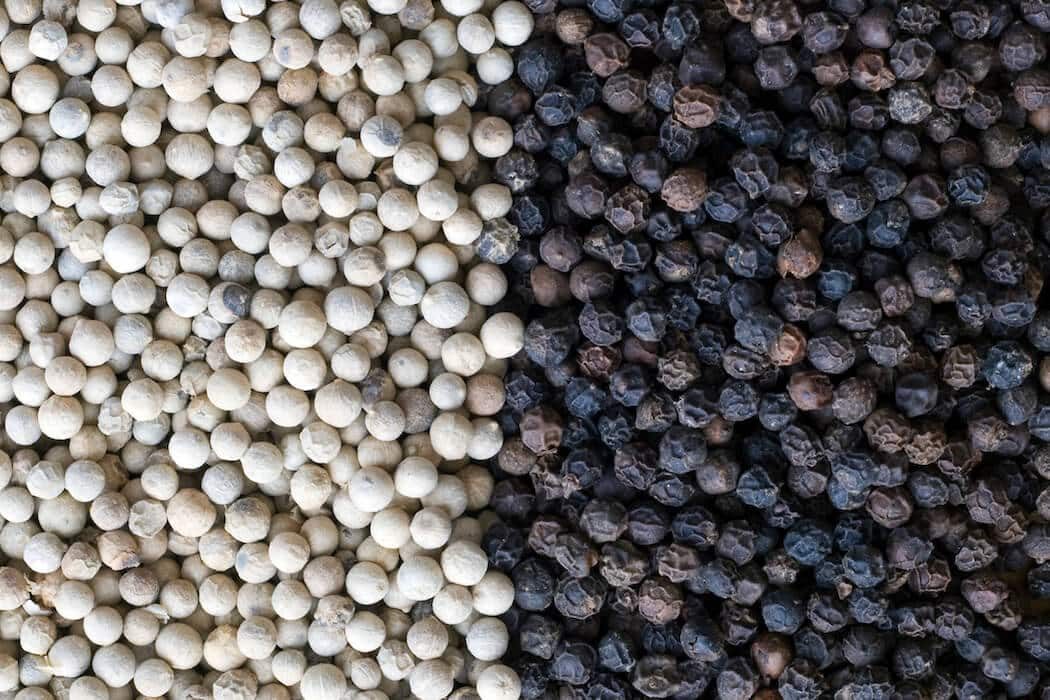
White and black pepper are the same berry, Piper nigrum, handled two ways.12 Black pepper is the whole berry dried with its outer layer intact; white pepper is the berry with that layer removed.2 Removing it strips out much of the volatile oil, so white pepper is the less aromatic of the two.34 Which one is hotter is a question the sources answer differently. In the kitchen the practical differences are aroma, color and a faintly fermented note in white pepper.
Side by side
| White pepper | Black pepper | |
|---|---|---|
| Plant | Piper nigrum1 | Piper nigrum1 |
| Codex definition | From dried berries after removing the pericarp2 | From dried berries with the pericarp unbroken2 |
| Ripeness at harvest | Fully ripened berries (ATK, Katzer)43 | Unripe berries (ATK)4 |
| Processing | Soaked in water to ferment, then the skin removed; can also be ground off mechanically45 | Dried until the skins blacken46 |
| Essential oil | About 1.5% (Katzer)3 | Up to 3% in ground black pepper (Britannica)5 |
| Piperine, Codex Grade I minimum (whole, dry basis) | 4.0%2 | 3.5%2 |
| Aroma | Less aromatic than black (Katzer, ATK)34 | More aromatic3 |
| Color in food | Pale; disappears in white sauces3 | Visible dark specks |
| Flavor (editorial) | Clean heat with an earthy, slightly fermented note | Hot, woody, piney and citrusy |
| Price | Katzer: significantly more expensive than black; no dated figures3 | No dated, sourced retail comparison found |
The essential-oil figures come from different sources and describe different things (Katzer’s whole white pepper, Britannica’s ground black), so they show direction rather than an exact gap. The piperine row compares like with like, but these are minimums a graded lot must meet, not measurements of what is on the shelf.
How each is made
Both start on the same vine. ATK explains the split: black pepper is made from unripe berries dried until their skins blacken, while white peppercorns are fully ripened berries soaked in water to ferment, and stripping the skin removes much of the volatile oils and aroma compounds.4 AramcoWorld quotes Ibn Battuta describing berries spread in the sun until they “are thoroughly dried and become black,” and spice author Ian Hemphill explaining that an enzyme in the skin turns them black.6 Britannica adds that white pepper can also be made by grinding off the outer coating mechanically.5
A widely repeated claim says white pepper made under running water is cleaner than pepper soaked in standing water. We found no source that compares the two methods.
Which is hotter?
Sources disagree, and the disagreement is shown rather than settled:
| Source | What it says |
|---|---|
| Britannica5 | White pepper’s flavor is less pungent than black pepper’s |
| Katzer3 | White pepper keeps the full pungency of black; pungency is strongest in white and weakest in green |
| Codex CXS 326-20172 | Sets a higher piperine minimum for Grade I whole white pepper (4.0%) than for Grade I black (3.5%) |
| America’s Test Kitchen tasting4 | With 1 teaspoon of each in hot and sour soup, the black-pepper soup was more aromatic and had more spicy heat |
Part of the disagreement may be what each source means by “hot.” Piperine, the main pungent compound in pepper,5 survives in the white kernel, while much of the aroma goes with the skin;43 a taster can read a more aromatic pepper as stronger. No study we found measures the piperine of white and black pepper from the same lot.
Flavor beyond heat
Black pepper’s aroma comes from its essential oil, about 90 percent monoterpene and sesquiterpene hydrocarbons.7 Katzer rates black and green peppercorns as more aromatic than white, and says the soaked-off outer flesh carries part of the volatile aroma compounds.3
Less aroma does not mean less character. In ATK’s hot and sour soup test, tasters preferred the white-pepper soup for its “floral, earthy flavor and greater complexity.”4 So the common claim that white pepper is simply the duller of the two does not hold for every dish. Its earthy note has a limit, though: Katzer warns that overstored white pepper develops skatole, which gives a disagreeable, fecal flavor, and can take on a moldy taste that spoils a meal.3
Where each one goes
White pepper. Katzer says it is often suggested for cream-based sauces where black pepper could spoil the color, and whenever pungency matters more than pepper flavor; ground white pepper also suits last-minute seasoning.3 He notes that East Asian cooks often prefer white pepper, and that its mildly aromatic pungency is popular in Japan.3 By common practice it goes into mashed potatoes, cream soups, pale fish dishes and Chinese hot and sour soup.
Black pepper. Ground over food at the table, cracked for a steak crust, and anywhere the aroma is the point, such as cacio e pepe (common practice). See black pepper and cracked vs. ground black pepper.
Can one stand in for the other?
Usually, with two caveats: color, and how much pepper the dish uses. The amounts below come from our black pepper substitutes and white pepper substitutes pages and keep their labels: Attributed quotes a named source, Method is our starting point where no published number exists.
| Swap | Starting amount | Treatment |
|---|---|---|
| Ground white pepper for ground black pepper | 1/2 teaspoon for 1/2 teaspoon | Attributed (Better Homes & Gardens) |
| Black pepper for a small amount of white pepper (a stir-fry, a sauce) | Same amount, finely ground | Method |
| Black pepper where white pepper is a lead flavor (hot and sour soup) | About half the amount, then taste | Method |
White in place of black. Better Homes & Gardens gives 1/2 teaspoon of ground white pepper for 1/2 teaspoon of black.8 White pepper replaces the bite better than the aroma, so pepper-led dishes such as steak au poivre will taste noticeably different (our judgment).
Black in place of white. ATK found that in a stir-fry with a small amount of pepper, tasters had a hard time telling the two apart; with a larger amount in hot and sour soup, the difference was clear, and ATK does not recommend swapping in black for a recipe that relies on a fair amount of white pepper.4 ATK gives no ratio, so the amounts above are ours. A widely repeated tip says to use more black pepper when replacing white because white is hotter; ATK’s tasting points the other way. In a pale sauce, black pepper also leaves dark specks.3
Price and keeping
Katzer says white pepper is significantly more expensive than black, partly to compensate growers for the higher risk of losing a harvest to weather while the berries ripen on the vine.3 We found no dated price comparison.
No regulator or standards body gives a shelf life for either. Katzer’s warning about skatole in overstored white pepper is the practical guide: buy white pepper whole, in amounts you will use, and smell it before use.3 Black pepper fades too; Katzer says few spices deteriorate as quickly as ground pepper.3 For both, buying whole and grinding as needed is the usual advice.
What isn’t known
- No study measures piperine in white and black pepper made from the same lot, so which is hotter remains disputed.
- No published ratio exists for black pepper in place of white; the amounts above are Method.
- No source compares soaking methods for white pepper.
- No dated price comparison.
Related
- Black pepper, white peppercorns, green peppercorns
- Black pepper substitutes, white pepper substitutes, too much pepper
- Tellicherry pepper vs. black pepper, peppercorn medley vs. black pepper, cracked vs. ground black pepper
Footnotes
-
Piper nigrum L., Plants of the World Online and Kew Species Profiles, Royal Botanic Gardens, Kew. powo.science.kew.org · Reference work ↩ ↩2 ↩3
-
Standard for Black, White and Green Peppers (CXS 326-2017), Codex Alimentarius Commission. fao.org · Standard ↩ ↩2 ↩3 ↩4 ↩5 ↩6 ↩7
-
Gernot Katzer, “Pepper (Piper nigrum L.)”, Gernot Katzer’s Spice Pages. gernot-katzers-spice-pages.com · Reference work ↩ ↩2 ↩3 ↩4 ↩5 ↩6 ↩7 ↩8 ↩9 ↩10 ↩11 ↩12 ↩13 ↩14 ↩15 ↩16 ↩17
-
“Substituting Black Pepper for White Pepper”, America’s Test Kitchen. americastestkitchen.com · Publication ↩ ↩2 ↩3 ↩4 ↩5 ↩6 ↩7 ↩8 ↩9 ↩10 ↩11
-
“Black pepper”, Encyclopaedia Britannica. britannica.com · Reference work ↩ ↩2 ↩3 ↩4 ↩5
-
Jeff Koehler, “Spice Migrations: Pepper”, AramcoWorld, 2021. aramcoworld.com · Publication ↩ ↩2
-
Piper nigrum, Plant Resources of South-East Asia (PROSEA). uses.plantnet-project.org · Reference work ↩
-
“Emergency Ingredient Substitutions”, Better Homes & Gardens. static.onecms.io · Publication ↩