Spice Comparisons · Comparison
Peppercorn Medley vs. Black Pepper: What’s in the Mix and When It Helps
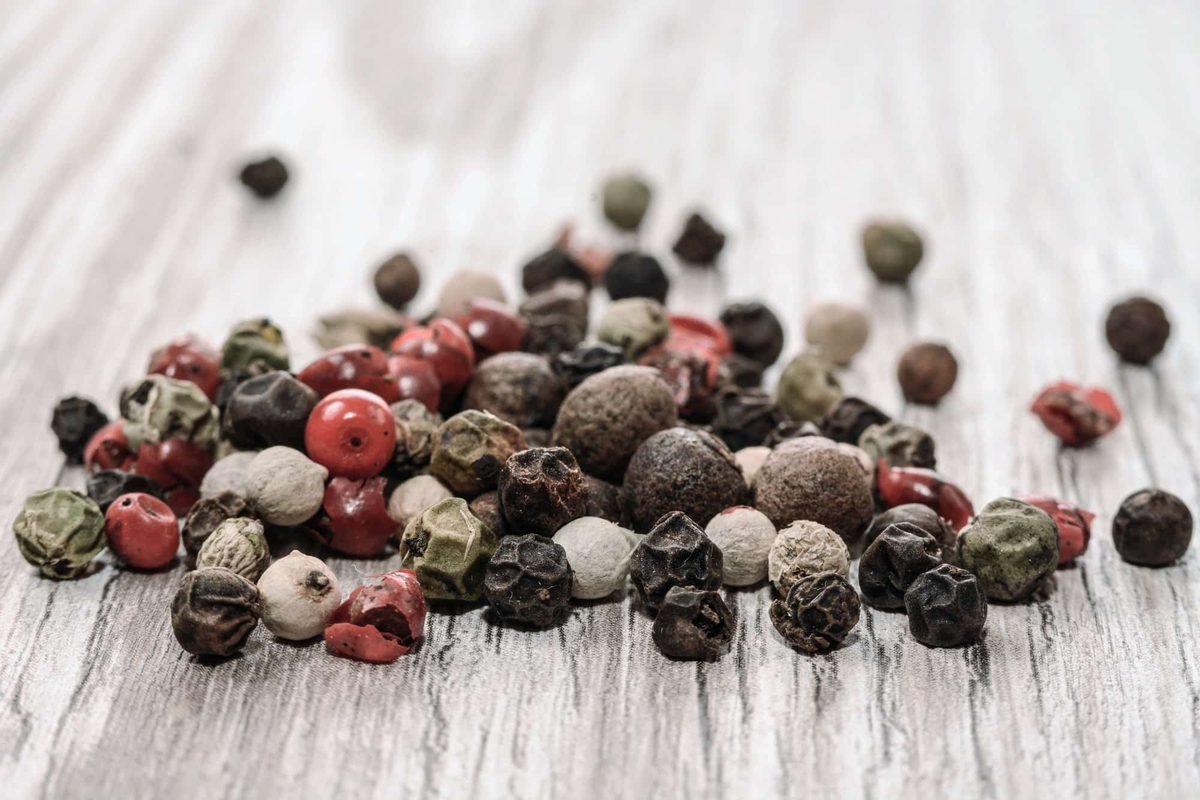
Black pepper is one spice, the dried berry of Piper nigrum.12 A peppercorn medley is a recipe, and the recipe changes by brand. The two we checked both contain black, white, green and pink peppercorns; McCormick’s also adds coriander and allspice.34 Only three of those are true pepper. Pink peppercorns come from a South American tree in the cashew family, and allspice and coriander are separate spices again.567 So a medley trades some of black pepper’s bite for color and a sweeter, more perfumed aroma.
Side by side
| Peppercorn medley | Black pepper | |
|---|---|---|
| What it is | A blend of whole peppercorns, often with other spices; contents vary by brand34 | The dried berry of Piper nigrum with its outer layer intact2 |
| True pepper (Piper nigrum) in it | Black, white and green peppercorns34 | All of it2 |
| Other plants in it | Pink peppercorns (Schinus) in both brands checked; coriander and allspice in McCormick’s34 | None |
| Heat | Piperine from the black and white corns only; pink pepper is only slightly peppery89 | Piperine throughout8 |
| Aroma | Mixed: pepper plus pink pepper’s sweet, juniper-like note and, where included, allspice and coriander106 | Pepper’s own essential oil8 |
| Color | Black, cream, green and pink | Black when whole; black and pale flecks when ground |
| Forms | Sold whole, often in a grinder34 | Whole, cracked or ground |
| Price | No dated, sourced retail comparison found | No dated, sourced retail comparison found |
What goes into a medley
Labels differ. The two products we checked:
| Product | Contents as stated |
|---|---|
| McCormick Peppercorn Medley Grinder | Black peppercorns, coriander, pink peppercorns (Schinus terebinthifolius), white peppercorns, allspice and green peppercorns3 |
| Regal Gourmet Peppercorn Medley | Black, white, green and pink peppercorns4 |
Two products are not a market survey, so we can’t say what most medleys contain. They do show why the label matters: one medley carries two spices that are not peppercorns of any kind, and the other does not.
What each part brings:
- Black peppercorns. The whole dried berry; piperine supplies the bite and the essential oil the aroma.28
- White peppercorns. The same berry with the outer layer removed.2 Katzer says white keeps the full pungency of black but is less aromatic.11 See white pepper vs. black pepper.
- Green peppercorns. Green berries dried under controlled conditions.2 Katzer ranks pepper’s pungency strongest in white and weakest in green.11 See green peppercorns.
- Pink peppercorns. Berries of Schinus, in the cashew family, not pepper.5 Katzer describes them as sweet and aromatic, similar to juniper, and says they are named for their shape, not their flavor;10 Atlas Obscura calls the flavor only slightly peppery.9 See pink pepper.
- Allspice (McCormick’s). Britannica notes it is also called Jamaican pepper or pimento, and that its flavor resembles a mix of cinnamon, cloves and nutmeg.6 See allspice vs. black pepper.
- Coriander (McCormick’s). The seed of an annual herb in the parsley family.7 See coriander.
How they taste
In our judgment, a medley tastes milder and rounder than the same volume of black pepper, with a sweet, piney lift from the pink corns and, in McCormick’s, a citrusy note from coriander and a warm clove note from allspice. That follows from what is in the jar: part of every grind is not pepper, and pink pepper adds little heat.9 No published tasting compares a medley with black pepper.
Freshness matters more than the blend. Katzer says few spices deteriorate as quickly as ground pepper and recommends a pepper mill.11 A medley in a grinder is ground fresh by design. Comparing it with a jar of pre-ground black pepper mixes up the effect of the blend with the effect of grinding to order; freshly ground plain black pepper is the fair comparison.
One practical catch: Atlas Obscura notes that pink peppercorns’ flaky texture means they need to be crushed rather than ground.9 In a mixed grinder, whether they grind evenly depends on the mill (our judgment).
Where each one goes
These are cooking judgments. A medley suits dishes where the pepper is visible and the other flavors are light: white fish, eggs, salads, fresh cheese, and buttered vegetables. Katzer notes that pink pepper mostly serves an ornamental purpose in decorative mixtures, and that some books suggest it for fish and certain vegetables.10 Plain black pepper is the better choice where pepper is the point (steak au poivre, cacio e pepe), in spice rubs and blends whose recipe was written around black pepper, and wherever allspice or coriander would clash.
Can one stand in for the other?
Mostly, with the label in mind. No source publishes a ratio either way, so both starting points below are Method: ours, not tested figures.
| Swap | Starting amount | Treatment |
|---|---|---|
| Freshly ground medley for ground black pepper | Same amount, then taste; add more if the heat is low | Method |
| Freshly ground black pepper for a medley | A little less than the medley called for, then taste | Method |
Medley in place of black pepper. Expect less heat per spoonful, because part of the blend is not pepper, and extra flavors from pink pepper and any allspice or coriander. In a dish built on black pepper, that changes the result.
Black pepper in place of a medley. You lose the color and the sweet, perfumed notes, but keep the bite. Start a little lower, since every grain is pepper, and taste. For the pink-pepper aroma specifically, see the substitutes on our pink pepper page.
Safety
Pink pepper had a brief scare in the United States: Atlas Obscura reports that the FDA banned pink peppercorns from importation in 1982 and later dropped the ban.9 Katzer says that for the dried berries only very weak irritating action, if any, was confirmed.10 Atlas Obscura found recent allergy reports limited to one patient with a tree-nut allergy.9 Because pink pepper is in the cashew family,5 people with a cashew allergy may want to check a medley’s label or ask an allergist; that advice is ours, not a regulator’s. More is on the pink pepper page.
What isn’t known
- What most medleys contain: only two products were checked, and their recipes differ.
- The share of each ingredient in a medley; neither product states proportions.
- How a medley’s heat compares with black pepper’s; no tasting or piperine measurement was found.
- No published ratio for swapping either way.
- No dated price comparison.
Related
- Black pepper, black pepper substitutes, cracked vs. ground black pepper, too much pepper
- White peppercorns, green peppercorns, pink pepper, allspice, coriander
- White pepper vs. black pepper, Tellicherry pepper vs. black pepper, allspice vs. black pepper, black pepper vs. cayenne
Footnotes
-
Piper nigrum L., Plants of the World Online and Kew Species Profiles, Royal Botanic Gardens, Kew. powo.science.kew.org · Reference work ↩
-
Standard for Black, White and Green Peppers (CXS 326-2017), Codex Alimentarius Commission. fao.org · Standard ↩ ↩2 ↩3 ↩4 ↩5 ↩6
-
McCormick Peppercorn Medley Grinder, product listing, H-E-B. heb.com · Merchant ↩ ↩2 ↩3 ↩4 ↩5 ↩6
-
Regal Gourmet Peppercorn Medley, product page, WebstaurantStore. argo.webstaurantstore.com · Merchant ↩ ↩2 ↩3 ↩4 ↩5 ↩6
-
Schinus terebinthifolia Raddi, Plants of the World Online, Royal Botanic Gardens, Kew. powo.science.kew.org · Reference work ↩ ↩2 ↩3
-
“Allspice”, Encyclopaedia Britannica. britannica.com · Reference work ↩ ↩2 ↩3
-
“Coriander”, Encyclopaedia Britannica. britannica.com · Reference work ↩ ↩2
-
“Black pepper”, Encyclopaedia Britannica. britannica.com · Reference work ↩ ↩2 ↩3 ↩4
-
Anne Ewbank, “When People Panicked Over Pink Peppercorns”, Atlas Obscura, 2018. atlasobscura.com · Publication ↩ ↩2 ↩3 ↩4 ↩5 ↩6
-
Gernot Katzer, “Pink Pepper (Schinus terebinthifolius and Schinus molle)”, Gernot Katzer’s Spice Pages. gernot-katzers-spice-pages.com · Reference work ↩ ↩2 ↩3 ↩4
-
Gernot Katzer, “Pepper (Piper nigrum L.)”, Gernot Katzer’s Spice Pages. gernot-katzers-spice-pages.com · Reference work ↩ ↩2 ↩3