Spices · Profile
Green Peppercorns: How They’re Made, How They Taste and How to Use Them
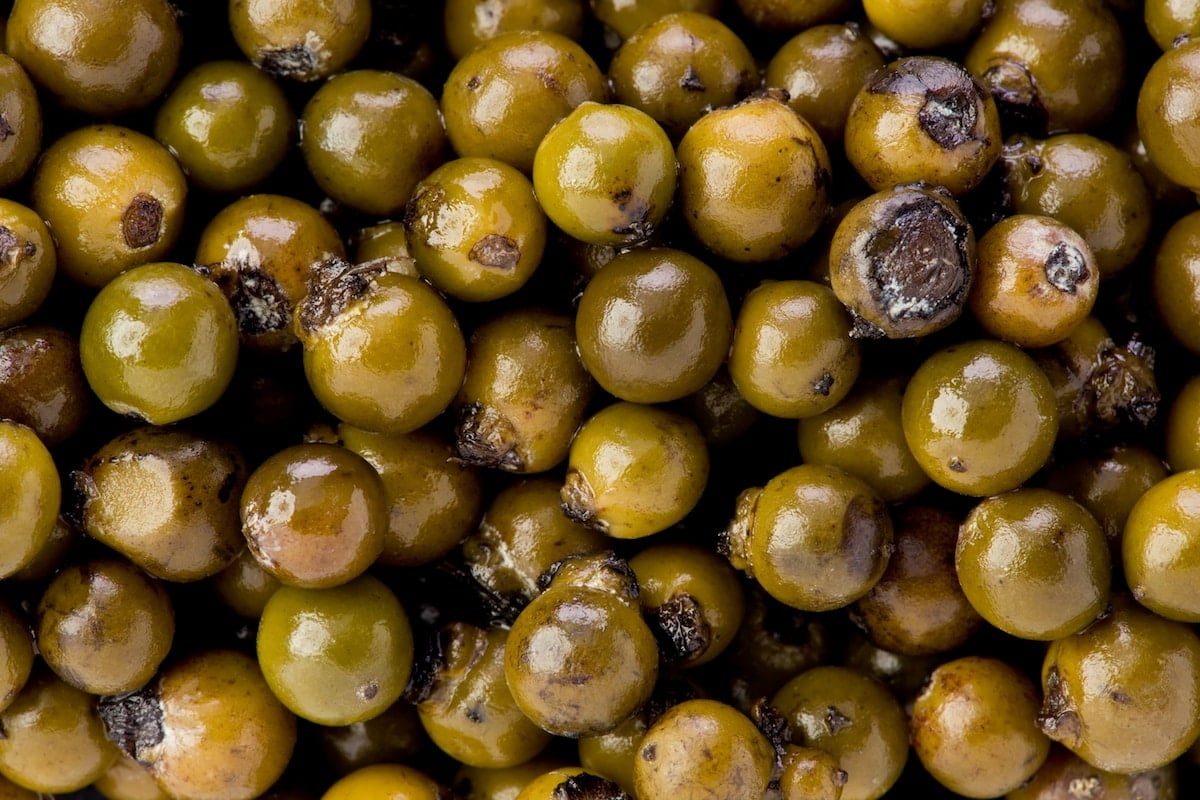
Green peppercorns are the unripe berries of Piper nigrum, the same vine that gives black and white pepper.1 What makes them green is how they are handled after picking: they are dried quickly under controlled conditions, or preserved in brine, so the skin never darkens.12 They taste fresher and more herbal than black pepper, and in brine they are soft enough to crush with a fork. This page covers how they are made, what the forms are, how they taste, how to use them, and what the standards and safety rules say.
At a glance
| Botanical name | Piper nigrum L.31 |
| Plant family | Piperaceae3 |
| Part used | Green (unripe) berries1 |
| Berry size | About 2.0–6.0 mm across for whole green pepper under Codex1 |
| Forms sold | In brine, canned, dehydrated (air-dried), freeze-dried; fresh on the stem where pepper grows245 |
| International standard | Codex CXS 326-2017, which covers black, white and green pepper1 |
| Main producers of pepper overall | Vietnam, Indonesia, Brazil, India, Burkina Faso and Malaysia in 2022, per McCormick Science Institute6 |
Measured values
22 figures, sourced| Measure | Value | Scope | Source |
|---|---|---|---|
| Berry size Limit | 2.0–6.0 mm across (about) | Codex CXS 326-2017, whole green pepper | fao.org |
| Extraneous vegetable matter, maximum Limit | 0.5 % m/m | Codex CXS 326-2017, whole green pepper, Class I | fao.org |
| Extraneous vegetable matter, maximum Limit | 1.0 % m/m | Codex CXS 326-2017, whole green pepper, Class II | fao.org |
| Extraneous vegetable matter, maximum Limit | 1.2 % m/m | Codex CXS 326-2017, whole green pepper, Class III | fao.org |
| Foreign matter, maximum Limit | 0.1 % m/m | Codex CXS 326-2017, whole green pepper, Class I | fao.org |
| Foreign matter, maximum Limit | 0.5 % m/m | Codex CXS 326-2017, whole green pepper, Class II | fao.org |
| Foreign matter, maximum Limit | 0.5 % m/m | Codex CXS 326-2017, whole green pepper, Class III | fao.org |
| Black berries, maximum Limit | 5.0 % m/m | Codex CXS 326-2017, whole green pepper, Class IIIClass I and II: nil | fao.org |
| Broken berries, maximum Limit | 1.0 % m/m | Codex CXS 326-2017, whole green pepper, Class I | fao.org |
| Broken berries, maximum Limit | 3.0 % m/m | Codex CXS 326-2017, whole green pepper, Class II | fao.org |
| Broken berries, maximum Limit | 10.0 % m/m | Codex CXS 326-2017, whole green pepper, Class III | fao.org |
| Moldy berries, maximum Limit | 1.0 % m/m | Codex CXS 326-2017, whole green pepper, Class IIClass I: nil | fao.org |
| Moldy berries, maximum Limit | 2.0 % m/m | Codex CXS 326-2017, whole green pepper, Class III | fao.org |
| Mammalian or other excreta, maximum Limit | 1.0 mg/kg | Codex CXS 326-2017, whole green pepper, Class I | fao.org |
| Mammalian or other excreta, maximum Limit | 1.0 mg/kg | Codex CXS 326-2017, whole green pepper, Class II | fao.org |
| Mammalian or other excreta, maximum Limit | 2.0 mg/kg | Codex CXS 326-2017, whole green pepper, Class III | fao.org |
| Moisture, maximum Limit | 12.0 % | Codex CXS 326-2017, green pepper, all classes | fao.org |
| Total ash, maximum Limit | 5.0 % | Codex CXS 326-2017, green pepper, all classes | fao.org |
| Volatile oil, minimum Limit | 1.0 mL per 100 g (dry basis) | Codex CXS 326-2017, green pepper, all classes | fao.org |
| Moisture, freeze-dried green pepper | 2–4 % | Kerala Agricultural University processing guide, freeze-dried productProcess outcome stated by KAU; sample basis not stated | celkau.in |
| Aflatoxin B1, maximum Limit | 5.0 µg/kg | EU Regulation 2023/915, pepper (fruits of Piper species) | eur-lex.europa.eu |
| Total aflatoxins, maximum Limit | 10.0 µg/kg | EU Regulation 2023/915, pepper (fruits of Piper species) | eur-lex.europa.eu |
Each figure is quoted as its source states it, with the samples or standard it applies to. Where sources differ, both are shown; nothing is averaged. All measured values
One vine, three colors
The Codex standard defines all three by processing:1
- Black pepper comes from dried berries with the outer layer (pericarp) unbroken. AramcoWorld, quoting spice author Ian Hemphill, explains that when green peppercorns are dried in the sun, a naturally occurring enzyme in the skin turns them black.7
- White pepper comes from dried berries with the pericarp removed.1
- Green pepper comes from green berries with the moisture removed under controlled conditions.1
McCormick Science Institute sums it up: depending on harvest time and processing, peppercorns can be black, white, green or red.6 So green peppercorns are not a separate plant or variety, and the difference from black pepper lies mostly in what happens after harvest. Timing matters too: India’s food-processing institute NIFTEM gives harvest stages for each green product, from about 3 months for canned green pepper to 10–15 days before full maturity for dehydrated green pepper.4 PROSEA calls preserved immature green pepper a use “of secondary importance” next to black pepper.8
How green peppercorns are made
Kerala Agricultural University (KAU) and NIFTEM describe several processes. The details differ by source, so both are shown where they overlap:
| Form | How it is made | Source |
|---|---|---|
| In brine (bulk) | Cleaned berries stored in a 17% ± 2% salt solution, with vinegar added | KAU2 |
| In brine | Green berries harvested at 4–5 months, held in about 17% salt with 0.6% citric acid | NIFTEM4 |
| Bottled | 20% brine with 100 ppm sulfur dioxide and 0.2% citric acid; the citric acid prevents blackening | KAU2 |
| Canned | Preserved in 2% brine and heat sterilized | KAU2 |
| Dehydrated | Berries washed, blanched and sulfited, then dried in a mechanical dehydrator at 60–65°C; KAU says the result keeps its green color and gives the best flavor | NIFTEM, KAU42 |
| Freeze-dried | Blanched, frozen to −40°C and dried; KAU gives 2–4% moisture and notes the product is very light | NIFTEM, KAU42 |
KAU adds that berries for green pepper products are taken straight from the vine and processed within 24 hours.2 Fresh green peppercorns on the stem are used in Thai cooking (see below).
Flavor
Brined green peppercorns taste bright, green and gently hot, with a soft bite and a salty, slightly sour edge from the brine. Dried ones are more concentrated and closer to black pepper. That description is ours. The Codex standard requires green pepper to have a pungent odor and flavor characteristic of green pepper, free from mustiness and bitterness.1 Suwanee, a cook who learned Thai cooking in Thailand, describes fresh green peppercorns as adding “a sharp, herbal heat that’s different from dried pepper or chilies.”5
A widely repeated claim says green peppercorns are much milder than black. No sensory study or piperine measurement comparing the two was found for this page; the Codex standard sets minimum piperine levels for black and white pepper but none for green.1 Treat “milder” as a common impression rather than a measured fact.
Origin and history
Green peppercorns share black pepper’s history; see black pepper for the full account. In brief:
- Native range. Kew’s species profile places black pepper’s origin in the Western Ghats of Kerala, India, as does PROSEA,38 while Kew’s own distribution data list only Sri Lanka as native. The disagreement is set out on the black pepper page.
- Value. Pepper often served as a medium of exchange, and tributes were levied in pepper in ancient Greece and Rome, according to Britannica.9 Kew traces the English term “peppercorn rent” to pepper’s high price in medieval Europe.3
- Trade. In the Middle Ages the Venetians and Genoese became pepper’s main distributors in Europe, and their near-monopoly helped spur the search for a sea route east.9 Vasco da Gama reached India by sailing around Africa at the end of the 15th century.7
Production
McCormick Science Institute lists the largest black pepper producers in 2022 as Vietnam, Indonesia, Brazil, India, Burkina Faso and Malaysia, citing a secondary compilation.6 AramcoWorld reported in 2021 that Vietnam, Brazil and Indonesia together grow more than 60% of the world’s pepper, without giving a year or source for the figure.7 India’s Spices Board reports 104,751 tonnes of pepper in 2024-25.10 None of these figures separates green pepper from black, and no production figure for green pepper alone was found.
How to use green peppercorns
- Thai curries. Suwanee’s jungle curry calls for about ¼ cup of fresh green peppercorns on the stem, and suggests green peppercorns preserved in brine, drained lightly, when fresh ones are not available.5 See Thai spices.
- Cream and pan sauces. By common practice, crushed brined green peppercorns go into cream or brandy sauces for steak and duck, a familiar French combination. See French spices and best spices for steak.
- Pâtés, terrines and butters. Whole brined peppercorns stud pâtés and compound butters; common practice.
- Grinding dried green peppercorns. Dried ones can go in a pepper mill, alone or in a mix; see peppercorn medley vs. black pepper.
Rinse brined peppercorns if you want less salt. Because they are soft, crush them with the back of a spoon rather than grinding. Both are kitchen judgment.
Buying and quality
The Codex standard sets these limits for whole green pepper:1
| Requirement | Class I | Class II | Class III |
|---|---|---|---|
| Extraneous vegetable matter, maximum (% m/m) | 0.5 | 1.0 | 1.2 |
| Foreign matter, maximum (% m/m) | 0.1 | 0.5 | 0.5 |
| Black berries, maximum (% m/m) | Nil | Nil | 5.0 |
| Broken berries, maximum (% m/m) | 1.0 | 3.0 | 10.0 |
| Moldy berries, maximum (% m/m) | Nil | 1.0 | 2.0 |
| Mammalian or other excreta, maximum (mg/kg) | 1.0 | 1.0 | 2.0 |
For all classes, green pepper may hold no more than 12.0% moisture and 5.0% total ash, and must contain at least 1.0 mL of volatile oil per 100 g (dry basis).1 The color must be green, greenish or dark greenish, with no added coloring, and green pepper is the only one of the three peppers for which Codex allows preservatives.1
For shoppers: dried green peppercorns should be olive to dark green, not brown or black; brined ones should be firm and bright, in clear brine. That is kitchen judgment.
Storage
Dried green peppercorns keep like other whole spices: airtight, dark and cool. Once a jar of brined peppercorns is opened, keep it refrigerated and the berries covered with brine. Both are common practice; no shelf-life figure from a regulator or standards body was found for either form.
Health and safety
Pepper is often credited with a long list of benefits, from aiding digestion to fighting cancer. Britannica notes only a limited medicinal use for pepper as a carminative (to relieve gas),9 and no review was found supporting the disease claims; no source was found that measures vitamins, minerals or antioxidants in green peppercorns specifically. The best-documented finding about piperine concerns supplements: NCCIH says combining curcumin with piperine is one way to improve curcumin’s bioavailability.11 No claim is made here that green peppercorns treat or prevent any disease.
- Salt. Brined and bottled green peppercorns are stored in strong salt solutions (17–20% in the processes above).2 No sodium measurement for drained peppercorns was found.
- Mycotoxins (EU). EU law caps aflatoxin B1 at 5.0 µg/kg and total aflatoxins at 10.0 µg/kg in pepper, defined as the fruits of Piper species including white and black pepper.12
Substitutes and comparisons
- Green peppercorn substitutes
- Green peppercorns vs. capers, for the brined form
- The same vine: black pepper, white peppercorns, Tellicherry pepper
- A different plant with a similar name: pink pepper
- Over-peppered a dish? See too much pepper.
Footnotes
-
Standard for Black, White and Green Peppers, CXS 326-2017, Codex Alimentarius. fao.org · Standard ↩ ↩2 ↩3 ↩4 ↩5 ↩6 ↩7 ↩8 ↩9 ↩10 ↩11 ↩12 ↩13 ↩14
-
Pepper: Processing and Value Addition, Kerala Agricultural University. celkau.in · Reference work ↩ ↩2 ↩3 ↩4 ↩5 ↩6 ↩7 ↩8 ↩9
-
Piper nigrum L., Plants of the World Online and Kew Species Profiles, Royal Botanic Gardens, Kew. powo.science.kew.org · Reference work ↩ ↩2 ↩3 ↩4
-
Black pepper processing, NIFTEM (PMFME scheme). niftem.ac.in · Reference work ↩ ↩2 ↩3 ↩4 ↩5
-
Suwanee, Jungle curry, Simply Suwanee. simplysuwanee.com · Publication ↩ ↩2 ↩3
-
“Black Pepper”, McCormick Science Institute. mccormickscienceinstitute.com · Merchant ↩ ↩2 ↩3
-
Jeff Koehler, “Spice Migrations: Pepper”, AramcoWorld, 2021. aramcoworld.com · Publication ↩ ↩2 ↩3
-
Piper nigrum, Plant Resources of South-East Asia (PROSEA). uses.plantnet-project.org · Reference work ↩ ↩2
-
“Black pepper”, Encyclopaedia Britannica. britannica.com · Reference work ↩ ↩2 ↩3
-
Spice wise area and production in India, 2021-22 to 2025-26, Spices Board India. indianspices.com · Regulator ↩
-
“Turmeric: Usefulness and Safety”, National Center for Complementary and Integrative Health, 2025. nccih.nih.gov · Regulator ↩
-
Commission Regulation (EU) 2023/915, EUR-Lex. eur-lex.europa.eu · Regulator ↩