Spice Substitutes · Substitutes
White Pepper Substitutes, Ranked by the Job White Pepper Is Doing
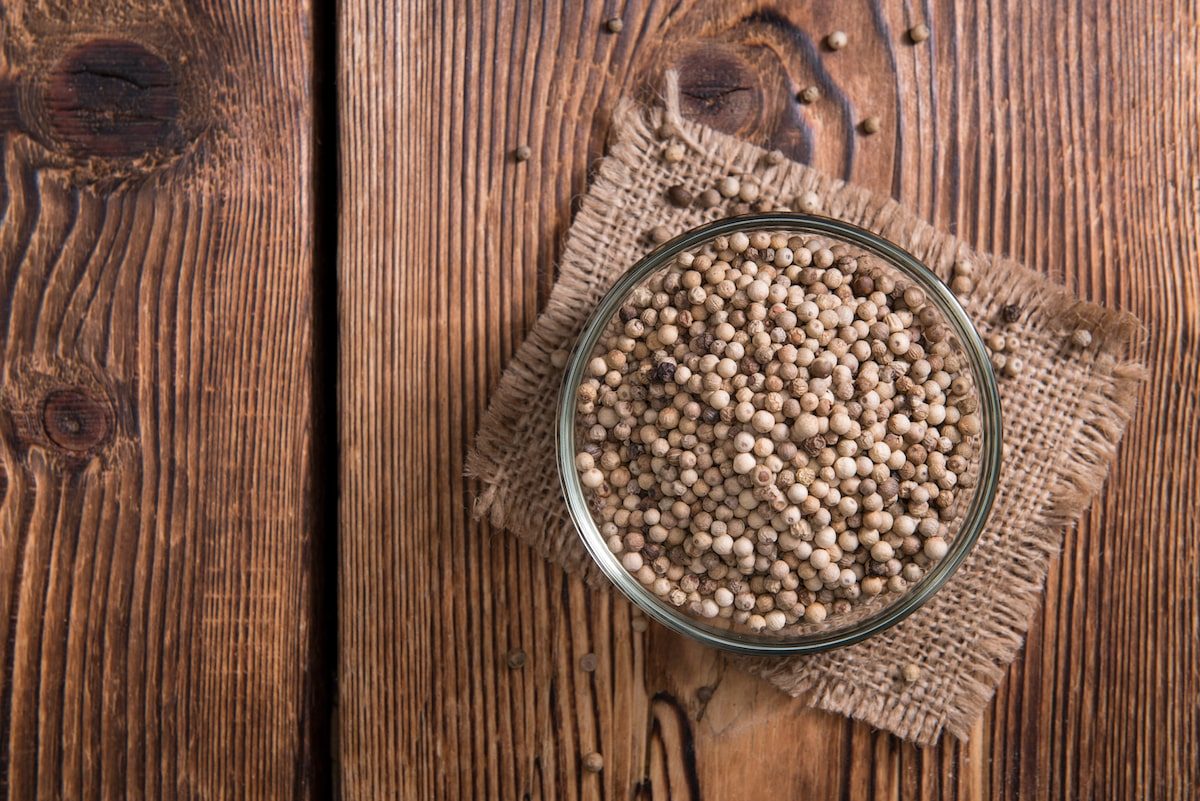
White pepper is the same spice as black pepper with its outer layer removed. Codex defines it as pepper obtained from dried berries of Piper nigrum after removing the pericarp.1 America’s Test Kitchen explains the difference: black pepper is made from unripe berries dried until their skins blacken, while white peppercorns are fully ripened berries soaked in water to ferment, and stripping the skin removes much of the volatile oils and aroma compounds.2 So the closest substitute is black pepper, and how well it works depends on how much white pepper the recipe uses and why.
Quick answer
| What white pepper is doing | Best substitute | Starting amount, per 1 part white pepper | Treatment |
|---|---|---|---|
| A small amount of seasoning in a stir-fry or sauce | Finely ground black pepper | 1 part | Method |
| A lead flavor (hot and sour soup, peppery broths) | Finely ground black pepper | 1/2 part, then taste | Method |
| Bite without dark specks in a pale dish | Ground dried green peppercorns, or finely ground black pepper | 1 part green; 1/2 part black | Method |
The rest of the page explains each choice and the alternatives.
How the ratios on this page are labeled
Every ratio carries one of four labels.
- Computed: based on a measurable physical relationship, with the source named.
- Attributed: a named source publishes this ratio. We quote it as theirs.
- Disputed: named sources give different answers to the same swap. We show each one and do not average them.
- Method: we found no published ratio. We give a direction and a cautious starting point, and say so.
Every ratio on this page is Method. America’s Test Kitchen tested black pepper in place of white at the same amount and reported how it tasted, but it did not publish a ratio. No other source we found gives one.
How white and black pepper differ
Named sources disagree about which is hotter. They agree that white is less aromatic.
| Source | What it says |
|---|---|
| Britannica3 | White pepper’s flavor is less pungent than black pepper’s |
| Gernot Katzer4 | White pepper keeps the full pungency of black pepper; pungency is strongest in white and weakest in green |
| Codex CXS 326-20171 | Sets a higher piperine minimum for Grade I whole white pepper (4.0%) than for Grade I black (3.5%); minimums, not measurements |
| America’s Test Kitchen2 | Removing the skin strips much of the volatile oils and aroma compounds |
On aroma, Katzer gives white pepper’s essential oil as about 1.5 percent and says black and green peppercorns are more aromatic than white.4 White pepper also has a character of its own. In ATK’s test, tasters preferred the white-pepper soup for its “floral, earthy flavor and greater complexity.”2 Katzer warns that overstored white pepper can develop a fecal, musty note from skatole,4 which is not a flavor anyone is trying to copy.
If white pepper is a small amount of seasoning
Black pepper
Ratio (Method): ATK found that in a stir-fry calling for a small amount of white pepper, tasters had a hard time telling it apart from black pepper, and its advice is to substitute only when the amount called for is small.2 ATK gives no ratio, so the one-for-one figure here is our reading of its test. Grind the black pepper as finely as you can.
If white pepper is a lead flavor
Katzer notes that East Asian countries often prefer white pepper and that it is popular in Japan.4 In dishes built around it, such as hot and sour soup, black pepper changes the result. ATK made hot and sour soup with 1 teaspoon of black or white pepper: tasters found the black-pepper version more aromatic, with more spicy heat, and preferred the white.2 For a recipe that relies on a fair amount of white pepper for flavor, ATK does not recommend swapping in black.2
Ratio (Method): If black pepper is all you have, start with about half the amount of white pepper called for, because ATK’s tasters found the same amount spicier and more aromatic. Taste, and add more toward the end. This is our starting point, not a tested ratio, and the soup will still taste different.
If the dish is pale
Katzer says white pepper is often suggested for cream-based sauces where black pepper could spoil the color,4 and ATK notes that some recipes call for white pepper when uniformly light-colored results are wanted.2
1. Dried green peppercorns, ground
Green pepper also comes from Piper nigrum; Codex describes it as made from green berries dried under controlled conditions.1 Ground, it is greenish rather than black, so it shows less in a white sauce; that is our judgment. Katzer rates its pungency the weakest of the three and its aroma higher than white pepper’s.4
Ratio (Method): No published ratio was found. Start with an equal amount and add more if the bite is too gentle.
Brined or pickled green peppercorns are a different product. In one Kerala Agricultural University process, the berries are held in a 17 percent salt solution,5 so rinse them and expect saltiness. They are better crushed into a pan sauce than ground into béchamel.
2. A little finely ground black pepper
Ratio (Method): No published ratio was found. In a small amount, black specks are hard to see; start with half the white pepper amount, finely ground, and add more only if you can accept the specks.
Substitutes that work less well
| Substitute | What the sources say | Use it? |
|---|---|---|
| Pink peppercorns | Not pepper at all: the fruit of Schinus trees in the cashew family, native to South America.67 Katzer says they are named for their shape only and describes them as sweet and aromatic, like juniper.7 Atlas Obscura calls the flavor only slightly peppery.8 True pepper, Piper nigrum, belongs to a different family, Piperaceae.9 | For color and perfume, not bite |
| Ground ginger | Its pungency comes from gingerols and related compounds, not piperine.10 It is pale but adds an unmistakable ginger flavor. | Only where ginger belongs in the dish |
| Mustard powder | Its heat appears only when the powder is mixed with water, as the enzyme myrosinase acts on sinigrin to form allyl isothiocyanate.11 Sprinkled dry into a sauce, it behaves differently from pepper, and it is yellow, not white. | Only where mustard suits the dish |
What isn’t known
- No published ratio for black pepper, green pepper or anything else in place of white pepper was found. ATK’s test is the only tasting comparison we found.
- Whether white pepper is hotter or milder than black is disputed between named sources (see the table above).
- It is sometimes said that green peppercorns are milder than white and should be used at one and a half times the amount, and that pink peppercorns can replace white pepper one for one. We found no source for either figure.
Related
- White peppercorns and white pepper vs. black pepper
- Black pepper, black pepper substitutes, cracked vs. ground black pepper
- Green peppercorns, green peppercorns substitutes, pink pepper
- Ginger, mustard powder, Tellicherry pepper substitutes
- Too much pepper? and the master list of herbs and spices
Footnotes
-
Standard for Black, White and Green Peppers, CXS 326-2017, Codex Alimentarius. fao.org · Standard ↩ ↩2 ↩3
-
“Substituting Black Pepper for White Pepper”, America’s Test Kitchen. americastestkitchen.com · Publication ↩ ↩2 ↩3 ↩4 ↩5 ↩6 ↩7
-
“Black pepper”, Encyclopaedia Britannica. britannica.com · Reference work ↩
-
Gernot Katzer, “Black Pepper (Piper nigrum L.)”, Gernot Katzer’s Spice Pages. gernot-katzers-spice-pages.com · Reference work ↩ ↩2 ↩3 ↩4 ↩5 ↩6
-
Pepper: Processing and Value Addition, Kerala Agricultural University. celkau.in · Reference work ↩
-
Schinus terebinthifolia Raddi, Plants of the World Online, Royal Botanic Gardens, Kew. powo.science.kew.org · Reference work ↩
-
Gernot Katzer, “Pink Pepper (Schinus terebinthifolius and S. molle)”, Gernot Katzer’s Spice Pages. gernot-katzers-spice-pages.com · Reference work ↩ ↩2
-
Anne Ewbank, “When People Panicked Over Pink Peppercorns”, Atlas Obscura, 2018. atlasobscura.com · Publication ↩
-
Piper nigrum L., Plants of the World Online, Royal Botanic Gardens, Kew. powo.science.kew.org · Reference work ↩
-
Sutarno, Hadad and Brink, Zingiber officinale, Plant Resources of South-East Asia (PROSEA). uses.plantnet-project.org · Reference work ↩
-
Sandra Gutierrez G., “When the mustard shortage hits, make your own”, Popular Science, 2022. popsci.com · Publication ↩