Spices · Profile
Black Lava Salt: Sea Salt Colored With Activated Charcoal, Not Lava
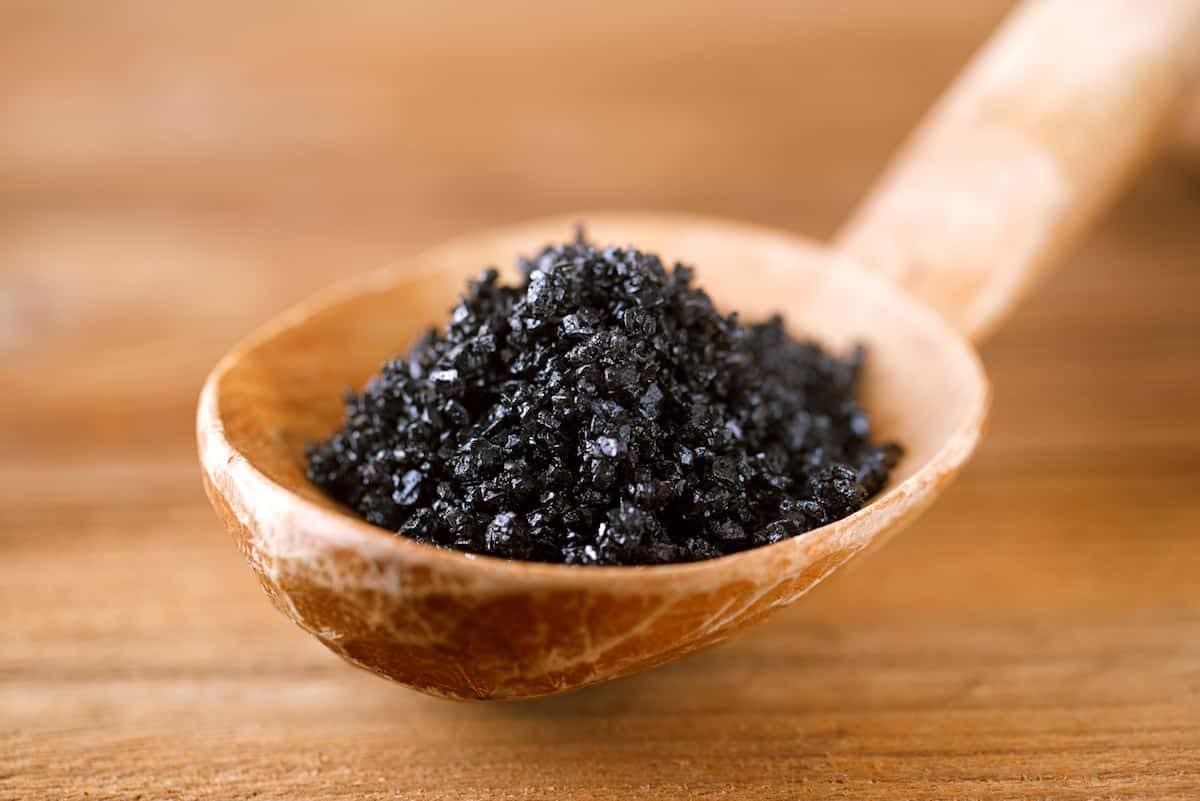
Black lava salt is sea salt colored black with activated charcoal. Despite the name, the products we found get their color from charcoal, not lava: a Swiss government analysis listed a black Hawaiian-style salt’s ingredients as salt, active coal and taro, and a Cyprus black flake salt lists sea salt and activated charcoal.12 It is a finishing salt, used for its color and crunch. It is not the same thing as Indian black salt (kala namak), a kiln-fired salt with a sulfurous smell.
At a glance
| What it is | Sea salt combined with activated charcoal12 |
| Where it’s made | Sold as Hawaiian or Hawaiian-style salt, and as Cyprus black salt123 |
| Sodium | 36.7% in one black Hawaiian-style salt (Swiss FSVO, one sample); most sea salts about 40%14 |
| Crystal | Cyprus versions: large, pyramid-shaped flakes2 |
| Flavor | Salt, with an earthy note from the charcoal (merchant description)2 |
| Use | Finishing salt23 |
| Activated charcoal in food | New York City’s health department: approved only to filter food, not as a colorant or additive5 |
Measured values
3 figures, sourced| Measure | Value | Scope | Source |
|---|---|---|---|
| Sodium | 36.7 % by weight | one black Hawaiian-style salt (salt, active coal, taro), Swiss FSVO 2016, one sample | warwick.ac.uk |
| Iodine | 34 µg per kg | same black Hawaiian-style salt sample, Swiss FSVO 2016 | warwick.ac.uk |
| Sodium Nutrient | about 40 % | most sea salts generally (American Heart Association) | heart.org |
Each figure is quoted as its source states it, with the samples or standard it applies to. Where sources differ, both are shown; nothing is averaged. All measured values
What black lava salt is
Two products share the name.
Hawaiian-style black salt. In the Swiss Federal Food Safety and Veterinary Office’s 2016 analysis of 25 salts, the one black Hawaiian salt it analyzed listed its ingredients as salt, active coal and taro.1 The same report quotes a marketing claim for another black Pacific salt that it is produced by adding highly purified active coal.1
Cyprus black salt. The Meadow, a salt merchant, sells a Mediterranean flake salt from Cyprus whose ingredients are sea salt and activated charcoal, describing it as thoroughly suffused with the charcoal.2 Saveur’s 2008 guide to specialty salts listed a “Cyprus Black Lava” salt that gets its color from activated charcoal.3
A widely repeated claim says traditional Hawaiian black salt took its color from lava, and that Cypriot black salt was once gathered from volcanic areas. We found no source for either; every product we could check names charcoal.
Hawaiian salt making
Salt is called paʻakai in Hawaiian, glossed by the University of Hawaiʻi as “to solidify the sea.”6 Hawaiians harvested sea salt on a larger scale in man-made shallow clay ponds, and preserving fish and octopus with salt was essential for storage and for ocean voyages.6 The University of Hawaiʻi describes that salt as white, with some of it mixed with red ʻalaea clay to make alaea salt.6
Flavor
Black lava salt is mostly sodium chloride and tastes like salt. The Meadow describes its Cyprus flakes as intensely earthy, tannic and bold, with a distinctly earthy taste of carbon from the charcoal.2 That is a merchant’s description, not a measured result, and we found no sensory test. Some writers describe black lava salt as smoky or sulfurous. The sulfur note of Indian black salt comes from hydrogen sulfide,1 and no source we read reports hydrogen sulfide in charcoal-colored salts, so black lava salt is not a stand-in for kala namak.
How black lava salt is used
Finishing. Its job is contrast. The Meadow notes that its large crystals give a toothsome crunch and resist dissolving even on moist foods, and suggests it on pasta, baked potatoes, Cobb salad, chèvre, caprese salad and grilled asparagus.2 Saveur suggested sprinkling the Cyprus salt on flaky white fish for a dramatic effect.3
Not for cooking. Dissolved into a sauce or soup, it loses the color that is the reason to buy it; use an ordinary salt there. This is common practice rather than a sourced finding.
Buying and quality
Read the ingredient list: it should say salt (or sea salt) and activated charcoal, and sometimes another ingredient, such as the taro in the Swiss sample.12 “Hawaiian” or “Hawaiian-style” on a label does not by itself say where the salt was harvested. We found no source documenting where most black lava salt is made.
Storage
We found no shelf-life figure for black lava salt from a regulator or standards body. Keep it closed and dry, as with any salt.
Safety and health
Activated charcoal. New York City’s health department tells food businesses that activated charcoal is only approved to filter food and is not approved as a food colorant or food additive. The department adds that it may cause nausea, vomiting, diarrhea or constipation, and may reduce the absorption of certain nutrients or medication.5 The department’s guidance does not give an amount, and we found no measurement of how much charcoal a serving of black lava salt contains. Claims that the charcoal in black lava salt removes toxins, slows aging or relieves gas are not supported by anything we found.
Sodium. The black Hawaiian salt in the Swiss analysis was 36.7% sodium, and its potassium, calcium and iron were below the limit of detection.1 Most sea salts are about 40% sodium.4 The Swiss report concluded that specialty salts do not have nutritional properties that would justify recommending them as a standard choice of salt.1 The FDA’s Daily Value for sodium is less than 2,300 mg a day,7 and the World Health Organization recommends that adults stay below 2,000 mg a day, naming raised blood pressure as the main health effect of high intake.8
Iodine. Specialty salts such as sea salt are not usually iodized.9 The Swiss sample contained 34 µg of iodine per kilogram, a trace amount.1
Substitutes and comparisons
- Black lava salt uses
- Black salt (kala namak) and black salt substitutes
- Hawaiian sea salt and alaea salt
- Smoked sea salt, sea salt, fleur de sel, Maldon sea salt
Footnotes
-
Esther Infanger and Max Haldimann, Report on the composition of prevalent salt varieties, Federal Food Safety and Veterinary Office (Switzerland), 2016. warwick.ac.uk · Regulator ↩ ↩2 ↩3 ↩4 ↩5 ↩6 ↩7 ↩8 ↩9 ↩10 ↩11
-
Black Diamond Flake Sea Salt, product page, The Meadow. themeadow.com · Merchant ↩ ↩2 ↩3 ↩4 ↩5 ↩6 ↩7 ↩8 ↩9 ↩10
-
Exotic Sea Salts, Saveur, 2008. saveur.com · Publication ↩ ↩2 ↩3 ↩4
-
Sodium Sources: Where Does All That Sodium Come From?, American Heart Association, 2025. heart.org · Reference work ↩ ↩2
-
Adulterated Food: What Food Service Operators Need To Know, New York City Department of Health and Mental Hygiene. nyc.gov · Regulator ↩ ↩2
-
Traditional Ways of Knowing: Salt Harvesting, Exploring Our Fluid Earth, University of Hawaiʻi at Mānoa, 2011. manoa.hawaii.edu · Reference work ↩ ↩2 ↩3
-
Sodium in Your Diet, U.S. Food and Drug Administration. fda.gov · Regulator ↩
-
Sodium reduction, World Health Organization fact sheet, 2026. who.int · Regulator ↩
-
Iodine: Fact Sheet for Health Professionals, NIH Office of Dietary Supplements. ods.od.nih.gov · Regulator ↩