Spices · Uses
Black Lava Salt Uses: A Finishing Salt for Color and Crunch
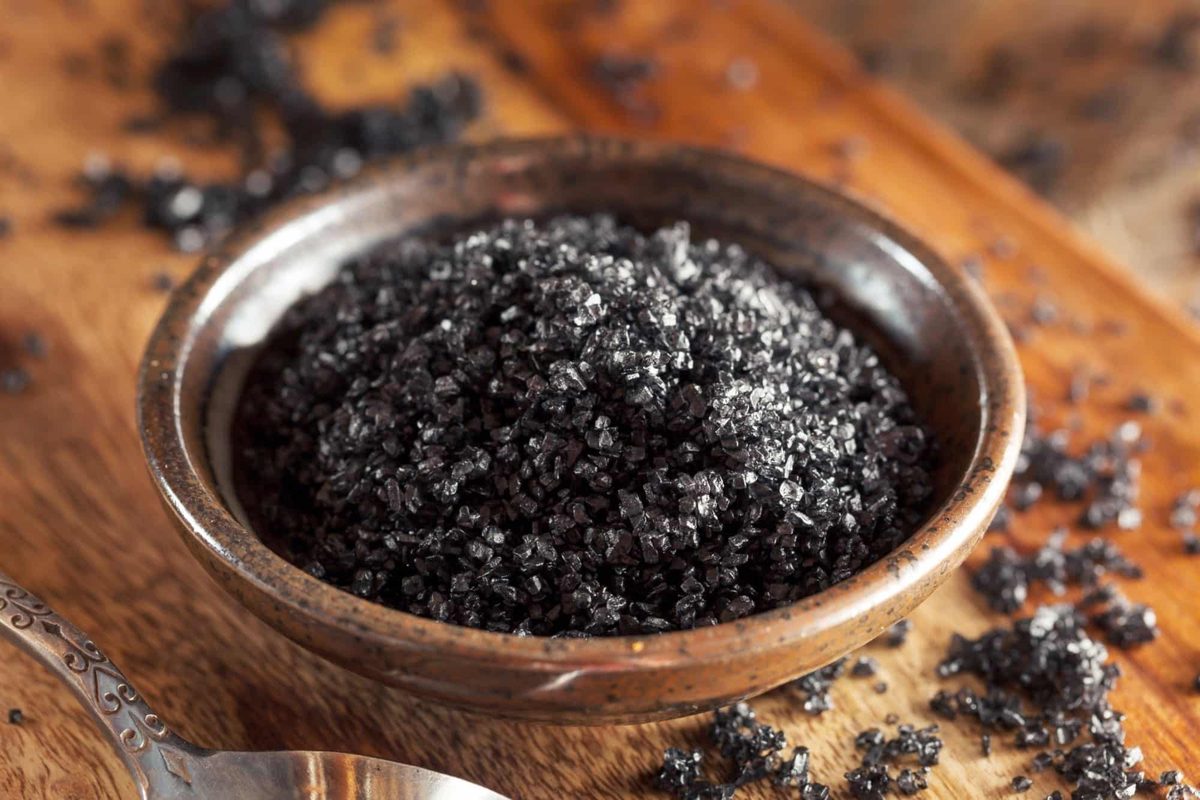
Black lava salt is a finishing salt. It is bought for its color and crunch, not for a different taste, so almost every good use comes down to one move: scatter it on a pale food just before serving. The products we checked are sea salt colored with activated charcoal, not lava: a Swiss government analysis listed a black Hawaiian-style salt as salt, active coal and taro, and a Cyprus black flake salt lists sea salt and activated charcoal.12 It is not Indian black salt (kala namak), which tastes of sulfur.
Quick guide
| Use | Works? | Why |
|---|---|---|
| Finishing pale foods (fish, eggs, potatoes, salads, cheese) | Yes, its main use | Color contrast; large crystals resist dissolving23 |
| Cocktail rims | Yes, for looks | Kitchen judgment |
| Pretzels and bagels | Yes, for looks | Kitchen judgment |
| Salsa | Color only; it does not add roasted flavor | See below |
| Soups, sauces, cooking water | No advantage | Dissolved, it is just salt4 |
| Dry rubs | No advantage | Same reason4 |
What it tastes like
Black lava salt is mostly salt. The black Hawaiian-style salt in the Swiss analysis was 36.7% sodium, a little under the roughly 40% of most sea salts.15 The Meadow, which sells a Cyprus version, describes a distinctly earthy taste of carbon from the charcoal.2 That is a merchant’s description; we found no sensory test.
A common claim says black lava salt tastes smoky. None of the sources we read says so. If you want smoke, use smoked sea salt.
1. As a finishing salt
This is where it earns its price. The Meadow notes that its large crystals give a toothsome crunch and resist dissolving even on very moist foods, and suggests it on pasta, baked potatoes, Cobb salad, chèvre, caprese salad and grilled asparagus.2 Saveur suggested the Cyprus black salt on flaky white fish for a dramatic effect.3
The paler the food, the stronger the contrast. Other good places for it, as kitchen judgment: fried or roasted potatoes, cauliflower, scrambled or deviled eggs, halibut or cod, tuna crudo, avocado toast, fresh mozzarella, and blini with crème fraîche. Add it at the last moment so the crystals stay black and crisp.
2. On a cocktail rim
A black rim is a striking look on a margarita, a salty dog, or a Bloody Mary. Run a lime wedge around the rim and dip it in the salt. The salt adds the same saltiness any rimming salt would; the reason to use this one is color. These are common uses, not sourced claims.
3. On pretzels and bagels
Black lava salt can stand in for white pretzel salt on soft pretzels or salt bagels, mainly for the look. We found no source that tests how the color holds up in the oven, so if it matters, sprinkle a little on a test pretzel first.
4. On salsa and other dark-flecked dishes
A common suggestion is to use black lava salt in place of fire-roasting a salsa. The charcoal can give dark flecks, but the only flavor note any source attributes to it is the earthy carbon The Meadow describes,2 not the charred, roasted flavor of blistered tomatoes and chiles. For that flavor, roast the vegetables, or try smoked salt or smoked paprika.
5. In soups and sauces (not recommended)
In a soup or sauce, the black crystals that are the reason to buy it are gone from view. America’s Test Kitchen found that sea salt tastes no different from table salt when mixed into food.4 Black lava salt in a soup or sauce costs more and can give pale liquids a gray cast (kitchen observation, not a tested claim). In a dark tomato or bean soup the color won’t show, but a cheaper salt does the same job.
6. In dry rubs (no advantage)
A widely repeated claim says the coarse texture of black lava salt helps a rub seal juices inside meat. We found no source for it. Mixed into food, America’s Test Kitchen found sea salt tastes no different from table salt,4 and nothing we read suggests charcoal-colored salt behaves differently in a rub. Use ordinary salt in the rub and save the black salt for sprinkling over the sliced meat at the table (kitchen judgment).
7. On sweets
Flaky black salt over caramel, chocolate bark or a pale vanilla ice cream gives the same salt-and-crunch effect as white flakes, with more contrast. This is kitchen judgment.
Safety and sodium
Activated charcoal. New York City’s health department tells food businesses that activated charcoal is only approved to filter food and is not approved as a food colorant or food additive. It adds that activated charcoal may cause nausea, vomiting, diarrhea or constipation, and may reduce the absorption of certain nutrients or medication.6 That guidance gives no amount, and we found no measurement of how much charcoal a serving of black lava salt contains. Anyone taking medication who is concerned can ask a pharmacist. Restaurants in New York City should read the department’s guidance before using it.
Sodium. Black lava salt is not a lower-sodium salt in any meaningful sense: the one sample tested was 36.7% sodium.1 The World Health Organization recommends that adults keep sodium below 2,000 mg a day.7 As a finishing salt it is used in pinches, but those pinches count.
What isn’t known
- How much activated charcoal a serving of black lava salt contains.
- Whether the color survives baking on pretzels or bread.
- Any sensory test comparing black lava salt with other finishing salts.
Related
- Black lava salt, the full profile
- Black salt (kala namak) and black salt substitutes
- Hawaiian sea salt and alaea salt
- Smoked sea salt uses, Maldon sea salt and cooking with sea salt
- Charcoal seasoning
Footnotes
-
Esther Infanger and Max Haldimann, Report on the composition of prevalent salt varieties, Federal Food Safety and Veterinary Office (Switzerland), 2016. warwick.ac.uk · Regulator ↩ ↩2 ↩3
-
Black Diamond Flake Sea Salt, product page, The Meadow. themeadow.com · Merchant ↩ ↩2 ↩3 ↩4 ↩5
-
Exotic Sea Salts, Saveur, 2008. saveur.com · Publication ↩ ↩2
-
Salt Types and Measurements, America’s Test Kitchen. americastestkitchen.com · Publication ↩ ↩2 ↩3 ↩4
-
Sodium Sources: Where Does All That Sodium Come From?, American Heart Association, 2025. heart.org · Reference work ↩
-
Adulterated Food: What Food Service Operators Need To Know, New York City Department of Health and Mental Hygiene. nyc.gov · Regulator ↩
-
Sodium reduction, World Health Organization fact sheet, 2026. who.int · Regulator ↩