Spices · Profile
Maldon Sea Salt: How the Pyramid Flakes Are Made and How to Use Them
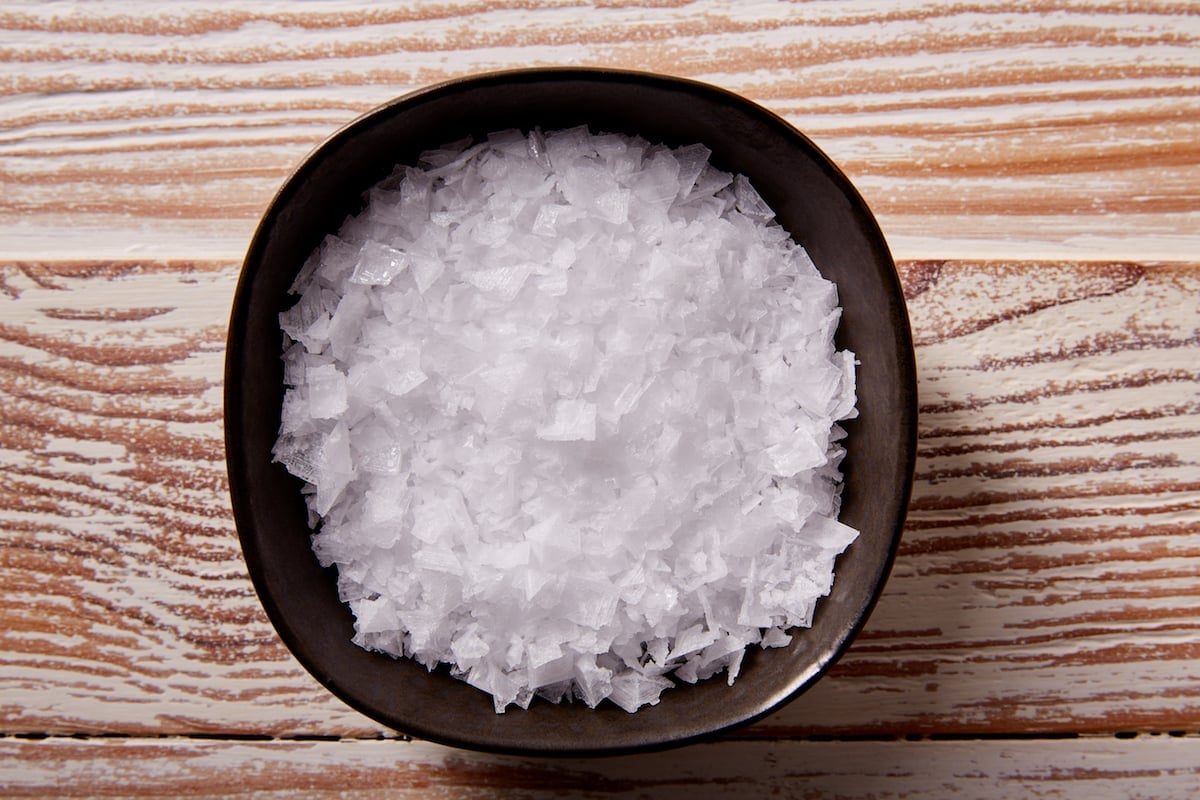
Maldon sea salt is a flaky English sea salt made in the town of Maldon in Essex, on the south side of the Blackwater estuary.12 The Maldon Salt Company has traded under that name since 1882, and its pyramid-shaped flakes are harvested by hand.13 Like other sea salts it is almost entirely sodium chloride; what sets it apart is texture, not chemistry.45
At a glance
| What it is | Flaky sea salt (sodium chloride) from evaporated seawater14 |
| Where | Maldon, Essex, on the Blackwater estuary, southeastern England2 |
| Producer | Maldon Salt Company, trading under that name since 1882; run by the Osborne family since 19221 |
| Crystal shape | Thin pyramids that form on the surface of the brine13 |
| Sodium | About 40% by weight, like table salt and most sea salts (AHA)5 |
| Iodine | Not stated by the maker; noniodized sea salt provides virtually no iodine6 |
| Weight per teaspoon | No published figure found; varies with how the flakes pack |
| Main use | Finishing salt, sprinkled on food just before serving4 |
Measured values
1 figure, sourced| Measure | Value | Scope | Source |
|---|---|---|---|
| Sodium | 40 % by weight (about) | table salt, kosher salt and most sea salts, general statement by the American Heart AssociationGeneral figure, not a Maldon measurement | heart.org |
Each figure is quoted as its source states it, with the samples or standard it applies to. Where sources differ, both are shown; nothing is averaged. All measured values
How it is made
According to Foodism’s 2018 visit to the saltworks, seawater is collected according to the lunar cycle, when the tide covers the salt marshes. It is brought to “a galloping boil” to remove impurities, then the temperature is lowered until salt starts to form on the surface. The surface tension of the water bends around each growing crystal, which is what gives the flakes their pyramid shape, and the salt is raked out by hand.1 Maldon describes four generations of the Osborne family hand-harvesting the “naturally formed pyramid crystals.”3
The producer does not publish its temperatures or timings, and we found no independent description of them.
History
- Salt making on the Essex coast. Historic England notes that over 300 salterns have been recorded in Essex, sites known locally as “red hills” for soil reddened by heating; at the early Roman saltern it protects on Mersea Island, heat was applied to brine held in pans and bowls.7 (A widely repeated claim says the Romans boiled the water in lead pots; we found no source for lead.)
- Domesday. An Essex Field Club history counts some 46 salt pans in the Essex returns of the Domesday Survey, nearly all on the northern half of the county’s coast.8 It does not single out Maldon.
- The company. The Maldon Salt Company started trading under that name in 1882; salt had been made in the area long before. In 1922 Steve Osborne’s great-grandfather bought the company from a local wine merchant, and Steve is the fourth generation of the family to run it.1
- Early reputation. Foodism quotes an early letter from Harrods saying it found the salt “much better than ordinary salt for pickling beef.”1
- Royal Warrant. Steve Osborne told Foodism the company was granted its Royal Warrant in 2012.1 Maldon now describes itself as holding the Royal Warrant as Purveyors of Sea Salt to King Charles III.3
Other dates that circulate, a typhoid remedy in 1866, a first export order to Sweden in 1955, salt at the 1977 Silver Jubilee and a first Sainsbury’s order in 1978, could not be traced to a source we could open, so they are left out.
Flavor and texture
All salt tastes of sodium chloride. America’s Test Kitchen notes that salt is the same compound whatever its source, and that sea salts vary in color but only slightly in flavor.4 Maldon says its flakes have “a fresh intensity and clean taste.”3 That is the maker’s description.
The real difference is in the mouth. The thin flakes give a brief, delicate crunch and then dissolve, so the saltiness arrives in small bursts rather than evenly through the food. Foodism notes the crystal’s thin pyramid shape affects how its flavor comes across.1 The rest of that description is ours.
How to use it
America’s Test Kitchen recommends sea salts as finishing salts rather than for cooking, where their texture is lost.4 By common practice, Maldon goes on:
- steaks, chops and roast meat just after slicing
- sliced tomatoes, salads and roasted vegetables
- fried eggs, avocado toast and buttered bread
- chocolate desserts, caramel and cookies
Pinch the flakes between your fingers rather than pouring; crush them lightly for a finer sprinkle. For cooking and baking, use a fine salt you can measure reliably. See Maldon salt vs. kosher salt for how they compare in use.
Buying and storage
Salt does not spoil; keep the box closed and dry so the flakes don’t clump or soften. That is common practice; we found no regulator shelf-life figure. In our judgment, flakes are best saved for finishing, where their texture shows.
Health and nutrition
- Same sodium. The American Heart Association says table salt, kosher salt and most sea salts contain about 40% sodium; a flaky salt may have less sodium per teaspoon only because fewer crystals fit in the spoon.5 Gram for gram, it is not a lower-sodium salt.
- No meaningful minerals. A Swiss government survey of 25 salts concluded that specialty salts “do not possess relevant beneficial nutritional properties” that would make them a better standard choice.9 Maldon was not among the salts tested.
- Iodine. Noniodized sea salt provides virtually no iodine, according to NIH’s Office of Dietary Supplements.6 Maldon’s site, as we read it, says nothing about added iodine. If you rely on iodized salt for iodine, a finishing salt doesn’t replace it.
- How much. FDA’s Daily Value for sodium is less than 2,300 mg a day, and WHO recommends that adults eat less than 2,000 mg of sodium a day.1011
Substitutes and comparisons
Any flaky finishing salt will do the same job; see Maldon salt substitutes. Comparisons:
- Fleur de sel vs. Maldon salt
- Maldon salt vs. kosher salt
- Fleur de sel, Anglesey sea salt and smoked sea salt
- Sea salt, kosher salt, best salt for cooking and cooking with sea salt
- Overdid it? See too much sea salt.
Footnotes
-
Clare Finney, “Clear as crystal: the decades-old traditions of Maldon sea salt”, Foodism, 2018. foodism.co.uk · Publication ↩ ↩2 ↩3 ↩4 ↩5 ↩6 ↩7 ↩8 ↩9 ↩10
-
“Maldon”, Encyclopaedia Britannica. britannica.com · Reference work ↩ ↩2
-
“About Us”, Maldon Salt (the producer’s own account). maldonsalt.com · Merchant ↩ ↩2 ↩3 ↩4 ↩5
-
“Salt Types and Measurements”, America’s Test Kitchen. americastestkitchen.com · Publication ↩ ↩2 ↩3 ↩4 ↩5
-
“Sodium Sources: Where Does All That Sodium Come From?”, American Heart Association. heart.org · Reference work ↩ ↩2 ↩3
-
“Iodine: Fact Sheet for Health Professionals”, NIH Office of Dietary Supplements. ods.od.nih.gov · Regulator ↩ ↩2
-
“Roman saltern 750m north west of Maydays Farm”, List entry 1020490, Historic England. historicengland.org.uk · Regulator ↩
-
“A History of Salt-Making in Essex”, Essex Field Club archive. essexfieldclub.org.uk · Publication ↩
-
Esther Infanger and Max Haldimann, “Report on the composition of prevalent salt varieties”, Federal Food Safety and Veterinary Office, Switzerland, 2016. warwick.ac.uk · Regulator ↩
-
“Sodium in Your Diet”, US Food and Drug Administration. fda.gov · Regulator ↩
-
“Sodium reduction”, World Health Organization, 2026. who.int · Regulator ↩