Spices · Profile
Smoked Sea Salt: Wood-Smoked vs. Smoke-Flavored, and How to Use It
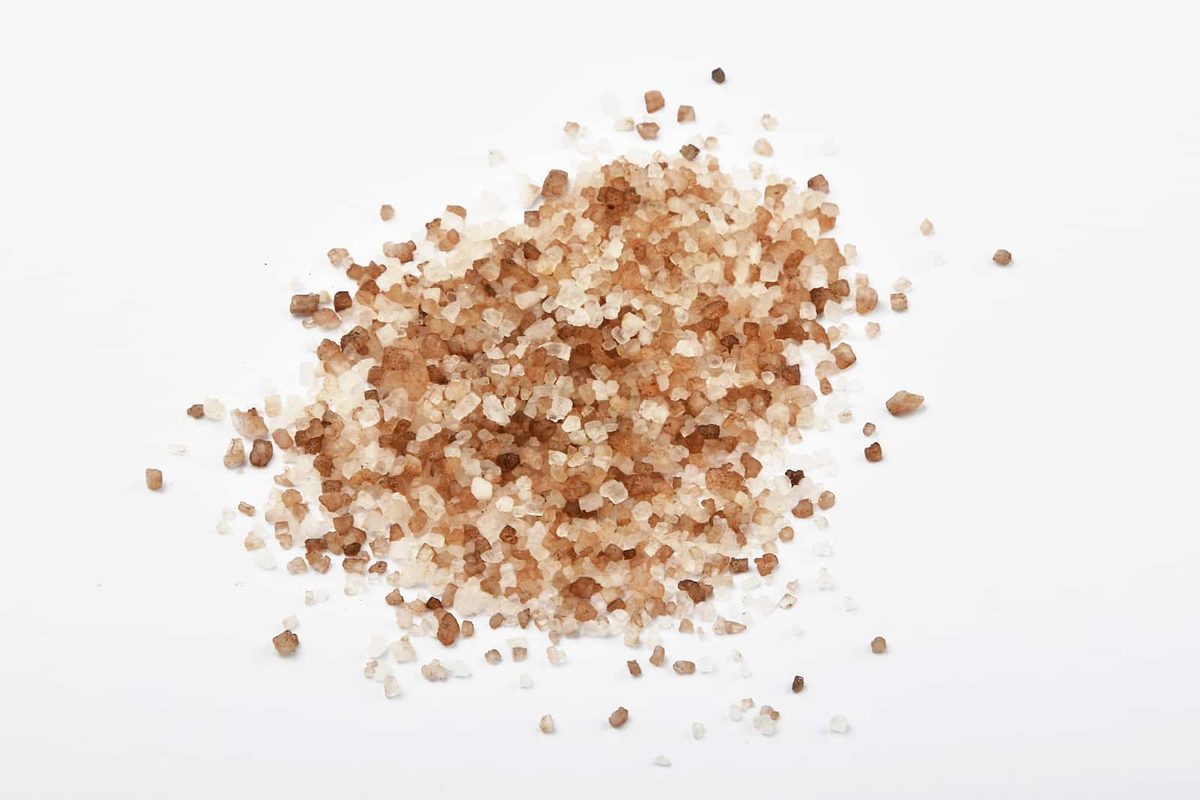
Smoked sea salt is sea salt that tastes of wood smoke. It reaches the jar in two different ways. Some is smoked over wood: Maldon sells oak-smoked flakes, and Saveur has described salts cool-smoked over red alder and cold-smoked over old Chardonnay barrels.12 Other “smoke salts” are salt mixed with smoke flavor, and say so on the label.34 Both are still salt, and season like it.
At a glance
| What it is | Salt smoked over wood, or salt blended with smoke flavor13 |
| Woods named by producers | Oak (Maldon); red alder; Chardonnay barrels (both described by Saveur)12 |
| Composition | Sodium chloride, like other salts; most sea salts are about 40% sodium56 |
| How to tell the types apart | The ingredient list: wood-smoked salt lists salt; flavored versions list smoke flavor34 |
| Contaminants checked | Austria’s food agency tested 22 smoked salts for PAHs; all complied with food law7 |
| Best use | Finishing and rubs, where the smoke aroma survives (editorial) |
Measured values
1 figure, sourced| Measure | Value | Scope | Source |
|---|---|---|---|
| Sodium Nutrient | about 40 % by weight | Most sea salts (American Heart Association)Austria's AGES tested 22 smoked salts for PAHs (all compliant) but did not publish the measured values. | heart.org |
Each figure is quoted as its source states it, with the samples or standard it applies to. Where sources differ, both are shown; nothing is averaged. All measured values
Two kinds of smoked salt
Wood-smoked. The salt itself is exposed to smoke. Maldon describes its product as oak-smoked pyramid flakes.1 Saveur’s 2008 guide to specialty salts listed a salt cool-smoked over red alder, which it suggested for a touch of barbecue flavor on meat, chicken or salmon, and a salt cold-smoked over Chardonnay barrels with a mild smoke and hints of wine.2 None of the product pages we read gave smoking times or temperatures.
Smoke-flavored. Here the smokiness comes from an added flavoring rather than from smoking the salt. The Spice House’s hickory smoke salt lists salt, smoke flavor and silicon dioxide, and describes it as natural smoke flavor on a fine-grained salt base.3 Spice Islands’ Old Hickory Smoked Salt lists salt, cocoa (processed with alkali), natural smoke flavor, propylene glycol and silicon dioxide, and calls itself a combination of salt and aged hickory flavoring.4 Despite the word “smoked” in that name, the label shows a flavoring.
If the label matters to you, read the ingredient list rather than the front of the jar.
Flavor
Underneath the smoke, smoked sea salt is ordinary salt. America’s Test Kitchen notes that salt in its most basic form is the same, sodium chloride, and found that sea salt tastes no different from table salt once mixed into food.5 The smoke is the point. Its character depends on the wood and the method: oak, alder, hickory and mesquite each give a different smoke. Those flavor points are editorial; we found no sensory study comparing smoked salts.
Origin and history
Smoking and salting are both old ways of preserving food, but we found no source that dates the first smoked salt, so this page doesn’t offer one. Stories about Paleolithic people discovering smoke preservation in their dwellings could not be traced.
How smoked sea salt is used
Finishing. Smoked salt shows its smoke best when added at the end, on grilled or roasted meat, fish, eggs or vegetables. Maldon suggests its smoked flakes for barbecue, grilled vegetables, sauces and even desserts.1
Rubs and brines. In a dry rub it adds salt and a smoke note in one step. The Spice House suggests its smoke salt for meat rubs, sausage seasoning, cured meats and baked beans.3
Where liquid smoke or a smoker isn’t practical. Cooks use smoked salt to give a smoky edge to dishes cooked indoors, vegetarian dishes that would otherwise include bacon or ham, popcorn, chocolate and caramel, and the rims of cocktail glasses. Those are common uses, not sourced claims.
Making it at home. Salt can be smoked in a smoker or covered grill like any other food, spread thin so the smoke reaches it. This is common practice; we found no tested method with times or temperatures.
Measuring. Smoked salts come as flakes and as fine grains.13 Crystal size changes how much salt fits in a spoon: America’s Test Kitchen weighed a teaspoon of table salt at about 6 grams and a teaspoon of Diamond Crystal kosher salt at 2.8 grams.8 Salt to taste rather than swapping spoon for spoon.
Buying and quality
Decide which kind you want and check the ingredient list.34 A wood-smoked salt should name the wood; a flavored one will list smoke flavor and may add color or carriers, such as Spice Islands’ cocoa and propylene glycol.4
Storage
We found no shelf-life figure for smoked salt from a regulator or standards body. Keep it in a closed container, dry and away from heat. Common practice is to replace it once the smoke aroma has faded.
Safety
Smoke contaminants. Smoking produces polycyclic aromatic hydrocarbons (PAHs), which form during incomplete combustion and in grilling, frying, smoking and drying food.7 Austria’s food safety agency, AGES, checked 22 smoked salts from across Austria for composition and PAH content, assessing them on benzo(a)pyrene and PAH4. All complied with food law on composition and PAH content; four were rejected, two for incorrect labeling and two for not meeting packaging rules.7 AGES did not publish the measured values on the page we read.
Smoke flavorings. In EU law, smoke flavorings are made from condensed smoke: the primary smoke condensate is the purified water-based part of condensed smoke.9 When the EU set its rules in 2003, it said smoke flavorings were generally considered of less health concern than traditional smoking.9 In April 2024, EU member states endorsed not renewing the authorization of eight smoke flavorings after EFSA found that genotoxicity concerns were either confirmed or could not be ruled out. After a transition of 5 years where the flavoring replaces traditional smoking, and 2 years where it is added for extra taste, those flavorings will no longer be permitted in the EU.10 That decision concerns the flavorings themselves. We found no regulator statement on smoke-flavored salt specifically, and the US rules were not researched for this page.
Sodium. Smoked salt is not a lower-sodium salt. Most sea salts are about 40% sodium.6 The FDA’s Daily Value for sodium is less than 2,300 mg a day,11 and the World Health Organization recommends that adults stay below 2,000 mg a day, naming raised blood pressure as the main health effect of high intake.12
Substitutes and comparisons
- Smoked sea salt substitutes
- Smoked sea salt uses
- Smoked paprika and smoked paprika substitutes
- Sea salt, cooking with sea salt, Maldon sea salt, fleur de sel
- Black lava salt and truffle salt
Footnotes
-
Smoked Sea Salt Flakes, product page, Maldon Salt. maldonsalt.com · Merchant ↩ ↩2 ↩3 ↩4 ↩5 ↩6
-
Exotic Sea Salts, Saveur, 2008. saveur.com · Publication ↩ ↩2 ↩3
-
Hickory Smoke Salt, product page, The Spice House. thespicehouse.com · Merchant ↩ ↩2 ↩3 ↩4 ↩5 ↩6 ↩7
-
Old Hickory Smoked Salt, product page, Spice Islands. spiceislands.com · Merchant ↩ ↩2 ↩3 ↩4 ↩5
-
Salt Types and Measurements, America’s Test Kitchen. americastestkitchen.com · Publication ↩ ↩2
-
Sodium Sources: Where Does All That Sodium Come From?, American Heart Association, 2025. heart.org · Reference work ↩ ↩2
-
PAHs in smoked salt, Final Report of Priority Action A-004-17, AGES, 2022. ages.at · Regulator ↩ ↩2 ↩3
-
Kate Shannon Levine, The Best Kosher Salt, America’s Test Kitchen, 2019. americastestkitchen.com · Publication ↩
-
Regulation (EC) No 2065/2003 on smoke flavourings, recital 6 and Article 3, EUR-Lex. eur-lex.europa.eu · Regulator ↩ ↩2
-
Member States endorse withdrawal of smoke flavourings from EU market, European Commission, 2024. ec.europa.eu · Regulator ↩
-
Sodium in Your Diet, U.S. Food and Drug Administration. fda.gov · Regulator ↩
-
Sodium reduction, World Health Organization fact sheet, 2026. who.int · Regulator ↩