Spices · Profile
Fleur de Sel: How the Flower of Salt Is Harvested, and How to Use It
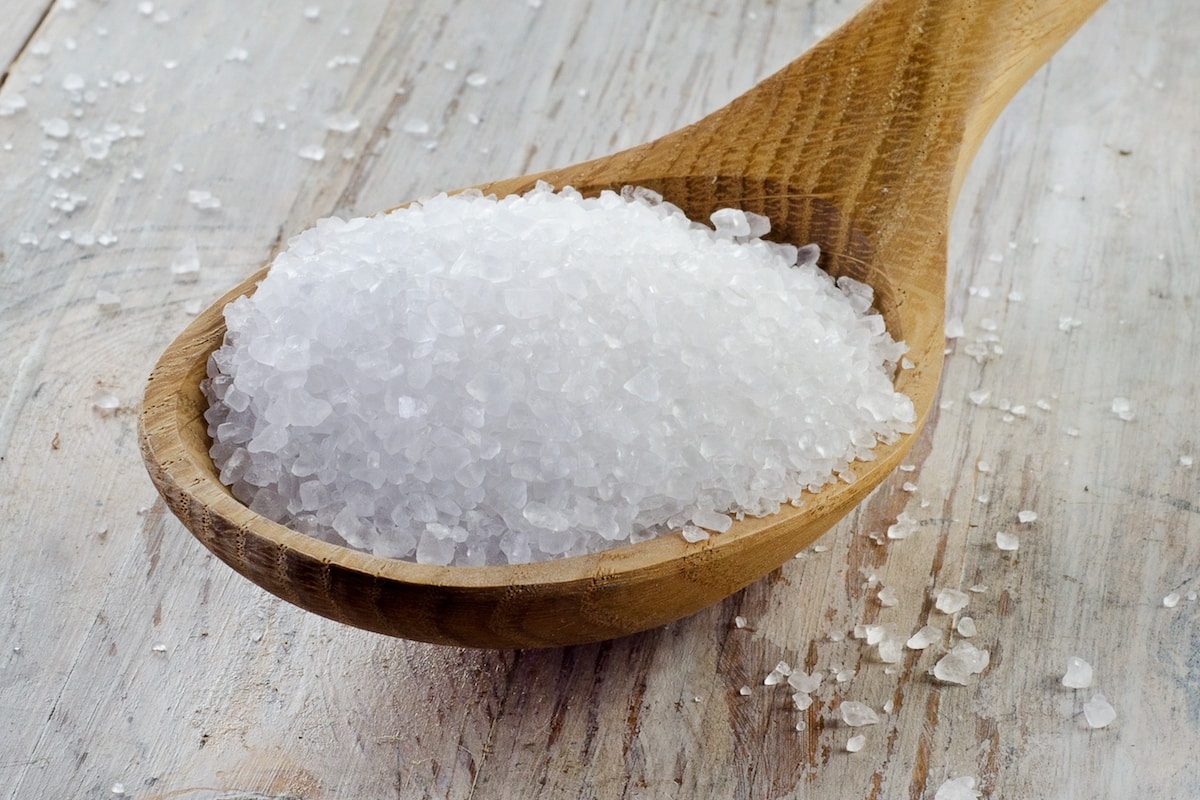
Fleur de sel, “flower of salt,” is the thin layer of salt crystals that forms on the surface of the brine in seawater salt pans and is skimmed off by hand.1 It is a finishing salt, slightly moist and meant to be sprinkled on food just before it is eaten. Its best-documented source is Guérande, on France’s Atlantic coast, where the name “Fleur de sel de Guérande” is a protected geographical indication with a published specification.21 Most of the hard facts on this page come from that specification, so they describe Guérande fleur de sel; other producers work to their own rules.
At a glance
| What it is | Sea salt (mainly sodium chloride crystals with other natural minerals) that forms in floating sheets on the surface of the pan1 |
| How it’s made | Skimmed by hand from the surface of the shallow evaporating basins (œillets) with a tool called a lousse1 |
| Season | At Guérande, on average mid-June to mid-September, when there is wind and sun1 |
| Crystal form and color | Crystals formed in floating sheets; white, sometimes faintly pink1 |
| Additives | None allowed under the Guérande specification; not washed after harvest1; not usually iodized3 |
| Moisture | Up to 12% (Guérande specification)1 |
| Grams per teaspoon | No published figure found |
| Protected name | “Sel de Guérande ou Fleur de sel de Guérande,” PGI registered 19 March 2012 (Regulation (EU) No 238/2012)2 |
Measured values
3 figures, sourced| Measure | Value | Scope | Source |
|---|---|---|---|
| Moisture, maximum Limit | 12 % | Fleur de sel de Guérande PGI specification | info.agriculture.gouv.fr |
| Insoluble matter, maximum Limit | under 0.20 % | Fleur de sel de Guérande PGI specification | info.agriculture.gouv.fr |
| Sodium Nutrient | about 40 % | table salt, kosher salt and most sea salts (American Heart Association) | heart.org |
Each figure is quoted as its source states it, with the samples or standard it applies to. Where sources differ, both are shown; nothing is averaged. All measured values
What fleur de sel is
Guérande’s salt marshes make two products from the same pans. Gray salt (sel gris) crystallizes on the clay bottom of the shallow basins and is raked up by hand; it is gray because of fine clay particles.1 Fleur de sel forms instead as crystals floating in sheets on the surface of the brine, and the salt worker (paludier) skims it off by hand with a lousse.1 It forms only in favorable weather, with wind and sun, and the harvest runs on average from mid-June to mid-September.1
The Guérande specification describes fleur de sel as white, sometimes faintly pink, a tint the specification attributes to the alga Dunaliella salina.1 Its moisture can be no more than 12%, its insoluble matter must stay under 0.20% (against up to 1% for gray salt), the salt is not washed after harvest, and no additives are allowed.1
The protected area covers communes in Loire-Atlantique and Morbihan on and around the Guérande peninsula, including Guérande, Le Croisic and La Baule-Escoublac.21 A common description places Guérande’s fleur de sel where the Rhône meets the Mediterranean, or simply in Brittany. Neither matches the specification: the protected area is the Atlantic coast around Guérande, in the two departments above.1
Flavor and texture
Fleur de sel tastes of salt. What sets it apart is texture: thin, flaky, slightly damp crystals that hold together and stay crisp for a moment on the tongue before dissolving. That description is ours. A widely repeated explanation says its moisture makes the crystals stick together and dissolve more slowly, so the saltiness lingers; we found no study testing that, so treat it as a plausible kitchen observation rather than an established fact. America’s Test Kitchen’s general finding on sea salts, that they vary in color more than in flavor and taste no different from table salt once mixed into food, is a good reason not to cook with it.4
Origin and history
Salt making at Guérande is old and well recorded. The specification cites the earliest written mention of salt pans in the region in the Cartulary of Redon, dated 15 December 854.1 The marshes expanded from the 16th century and peaked in the 19th; between 1840 and 1960 they were abandoned or turned to other uses as mined salt and Mediterranean sea salt took the market.1
Several stories about fleur de sel’s history circulate without sources we could open: that Pliny the Elder described it as flos salis and that Romans used it as an ointment and laxative; that Guérande was the capital of French sea salt in 868; that the harvest was women’s work until the 19th century; and that the marshes covered 1,500 acres in 1500. They are left out here.
How fleur de sel is used
Use it at the end. ATK recommends sea salts as finishing salts, where their crunch can be noticed.4 Fleur de sel is the classic example: a pinch over a sliced steak, grilled fish, ripe tomatoes, buttered bread, or fried eggs, added at the table. It is also widely used on caramels, chocolate and other sweets, where a few crystals contrast with the sugar. Stirring it into a pot of soup wastes the texture. These are kitchen judgments, not tested rules.
Buying and quality
Look for a protected designation if origin matters to you. “Fleur de sel de Guérande” sold under the PGI has to meet the specification above: hand-skimmed, unwashed, no additives, white or faintly pink, moisture no higher than 12%.12 Crystals should be fine, flaky and slightly damp; heavy gray color points to gray salt, not fleur de sel. We found no sourced retail price data, so this page gives none.
Storage
We found no shelf-life figure for fleur de sel from a regulator or standards body. Because it can hold some moisture, keep it in a closed container away from humidity so the flakes don’t clump or dissolve; that is common practice.
Safety and health
Fleur de sel is salt, and its sodium counts the same as any other. Table salt, kosher salt and most sea salts are about 40% sodium; flaky salts hold less sodium per teaspoon only because fewer crystals fit in the spoon.5 The FDA’s Daily Value for sodium is less than 2,300 mg a day; the WHO recommends adults stay under 2,000 mg.67 The trace minerals in sea salt are present in trace amounts, and the AHA says total sodium intake is what matters most for heart health.5
Fleur de sel is not a source of iodine. The NIH Office of Dietary Supplements names fleur de sel among the specialty salts that are not usually iodized.3
Substitutes and comparisons
Any flaky finishing salt can stand in, Maldon among them; see Maldon sea salt and Maldon salt substitutes. Comparisons:
- Fleur de sel vs. sea salt
- Fleur de sel vs. kosher salt
- Fleur de sel vs. Maldon salt
- Fleur de sel vs. Himalayan salt
Related: sea salt, Celtic sea salt, table salt.
Footnotes
-
Cahier des charges de l’IGP Sel de Guérande / Fleur de sel de Guérande, French Ministry of Agriculture, 2025. info.agriculture.gouv.fr · Regulator ↩ ↩2 ↩3 ↩4 ↩5 ↩6 ↩7 ↩8 ↩9 ↩10 ↩11 ↩12 ↩13 ↩14 ↩15 ↩16 ↩17 ↩18
-
Sel de Guérande ou Fleur de sel de Guérande, IGP product record, INAO. inao.gouv.fr · Regulator ↩ ↩2 ↩3 ↩4
-
Iodine: Fact Sheet for Health Professionals, NIH Office of Dietary Supplements. ods.od.nih.gov · Regulator ↩ ↩2
-
Salt Types and Measurements, America’s Test Kitchen. americastestkitchen.com · Publication ↩ ↩2
-
Sodium Sources: Where Does All That Sodium Come From?, American Heart Association, 2025. heart.org · Reference work ↩ ↩2
-
Sodium in Your Diet, U.S. Food and Drug Administration. fda.gov · Regulator ↩
-
Sodium reduction, World Health Organization fact sheet, 2026. who.int · Regulator ↩