Spice Substitutes · Substitutes
Black Salt (Kala Namak) Substitutes, and Why None of Them Smells of Eggs
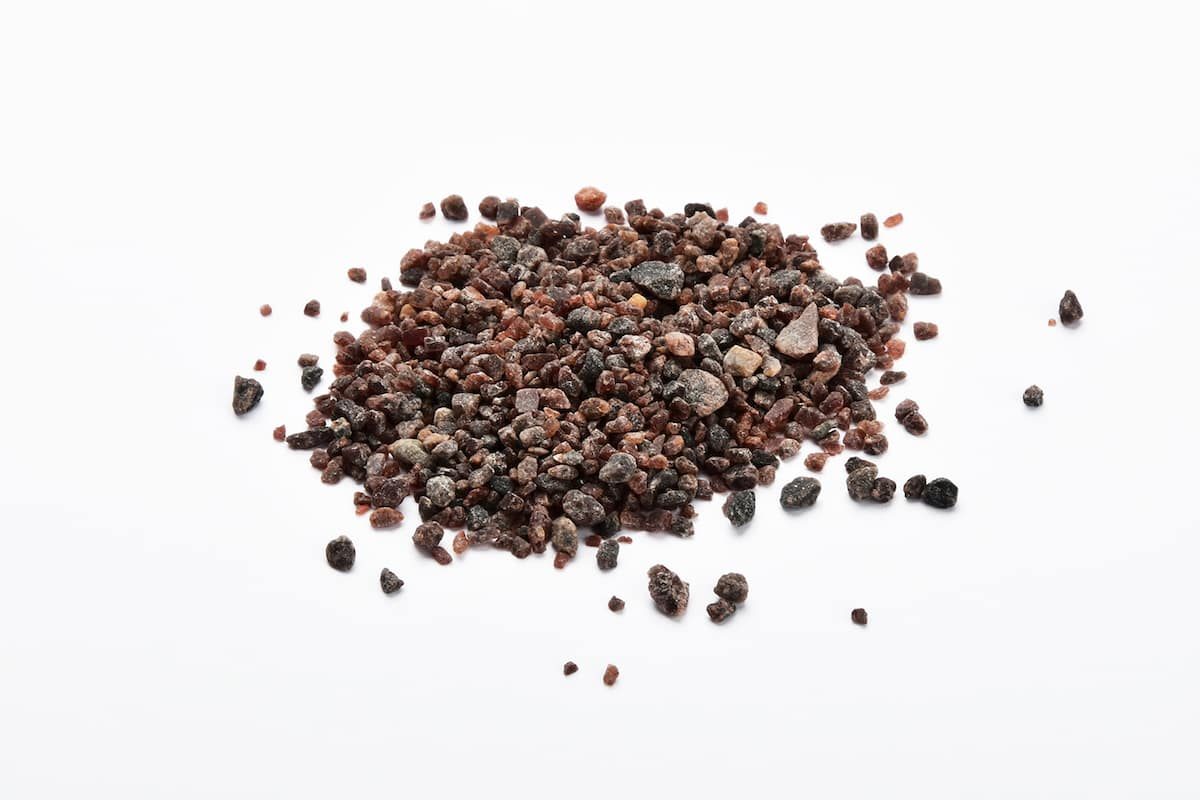
Black salt, or kala namak, is ordinary salt that has been fired with charcoal or plant material, which turns some of its sulfate into sulfide.1 What makes it worth buying is the smell. Swiss and German food-safety authorities put its hydrogen sulfide content at about 200 mg per kilogram, and the Swiss report credits that gas with its characteristic sulfuric taste.23 Food Republic describes the result as eggy.4 No other salt on a supermarket shelf has it, so every substitute below covers only part of black salt’s job.
Quick answer
| What black salt is doing | Best substitute | Starting amount, per 1 part black salt | Treatment |
|---|---|---|---|
| Plain salting | Table, kosher or Himalayan salt | 1 part by weight | Computed |
| Seasoning chaat, fruit or drinks | Chaat masala | 1 part, up to about 3 parts if the tang suits | Computed (one recipe), Method |
| Eggy note in tofu scrambles and egg-free dishes | No true substitute; plain salt, plus a pinch of asafoetida if you like | Salt 1 part by weight; asafoetida a small pinch | Computed (salt), Method |
| Finishing, for its pink-gray look | Fine Himalayan pink salt | Sprinkle to taste | Method |
How the ratios on this page are labeled
Every ratio carries one of four labels.
- Computed: based on a measurable physical relationship, with the source named.
- Attributed: a named source publishes this ratio. We quote it as theirs.
- Disputed: named sources give different answers to the same swap. We show each one and do not average them.
- Method: we found no published ratio. We give a direction and a cautious starting point, and say so.
We found no credible published ratio for replacing black salt with anything. The Computed figures below rest on sodium content and on one published chaat masala recipe.
If black salt is just salting the dish
Under the smell, black salt is mostly sodium chloride. One sample in the Swiss government’s 2016 analysis was 38.7 percent sodium and 57.9 percent chloride.2 Table salt is about 40 percent sodium.5
Ratio (Computed): By weight, swap 1:1. The sodium difference in that sample is about 3 percent, too small to taste. Black salt is not a lower-sodium salt, whatever its reputation.25
By volume (Method): No source gives the weight of a teaspoon of ground black salt. If yours is finely ground, start with the same volume of table salt and taste. If you are using a coarse kosher salt, remember that brands differ a lot by the spoonful: America’s Test Kitchen weighed a teaspoon of table salt at about 6 grams, Morton kosher at 4.8 grams and Diamond Crystal at 2.8 grams.6 With Diamond Crystal you may need close to twice the volume.
Any of these salts will season. America’s Test Kitchen notes that salt is sodium chloride whatever its source,7 but none of them carries black salt’s sulfur.
If black salt is seasoning chaat, fruit or drinks
Chaat masala
This is the closest match, because chaat masala usually contains black salt. Both published recipes we compared include it, along with dried mango powder (amchur) and cumin.89 Tarla Dalal credits black salt with the blend’s characteristic chatpata aroma and amchur with its tang.9
Ratio (Computed, from one recipe): In Gulf News’s recipe, black salt is 1 tablespoon in a blend of about 3 1/2 tablespoons (1 tablespoon each of amchur, black salt and roasted cumin, plus small amounts of pepper, chili and pink salt).8 By our arithmetic, that is about 30 percent black salt by volume, so a teaspoon of that blend carries roughly a third of a teaspoon of black salt. Commercial blends will differ.
Starting point (Method): Start with the same amount of chaat masala as the black salt called for, and taste. You would need about three times as much to bring the same amount of black salt, and that would also bring three times the tang and cumin. Use more only where those suit the dish, as on fruit, chaat or yogurt. In a drink such as salted lassi or jaljeera, where Food Republic notes that black salt lifts the flavor,4 the extra sourness may or may not be welcome.
If black salt is giving an eggy flavor
Plant-based cooks add black salt to tofu scrambles and other egg-free dishes because its sulfurous smell reads as egg.4 Nothing else common does this.
1. Plain salt, and accept the difference
Ratio (Computed): Salt 1:1 by weight, as above. The dish will be seasoned but won’t taste of egg.
2. A pinch of asafoetida, for a different sulfur note
Asafoetida’s essential oil is rich in sulfur compounds; its main one, a disulfide, makes up about half the oil.10 Gernot Katzer describes the smell of the raw spice as remotely similar to not altogether fresh garlic,10 which is a sulfur note, but not an eggy one. Katzer says the resin needs to be fried quickly in hot oil, while the powder can go in without frying at the cost of some aroma.10 Powdered asafoetida may be a compounded product: Katzer notes such powders can be more than half rice flour and gum arabic.10
Ratio (Method): We found no published ratio, and no source that tests asafoetida as a black salt substitute. Start with a small pinch per dish, fried briefly in the cooking fat, and salt the dish separately. Treat this as an experiment, not an equivalent.
If black salt is a finishing salt
Food Republic describes black salt as a finishing salt, added a pinch or two just before serving.4 Once ground it is not black: the BfR described a reddish-gray to pink powder, and World Spice Merchants describes colors from gray through pink to purple.311
1. Fine Himalayan pink salt, for the look
Himalayan pink salt gets its color from traces of iron oxide.12 It looks similar to ground black salt on the plate and seasons the same, but it has none of the sulfur. Black salt is often said to be mined alongside Himalayan salt or made from it. The sources we read describe it instead as a fired product of common salt, made mostly in northern India; the manufacturer in a 1970 Indian court case made it from Sambhar salt and charcoal.1
Ratio (Method): Sprinkle to taste.
2. Black lava salt: dark, but not a match
Black “lava” salts are sea salts colored with activated charcoal. The Swiss analysis tested one listing salt, active coal and taro as ingredients, and The Meadow’s Black Diamond flakes list sea salt and activated charcoal.213 Despite the name, the products we checked are colored with charcoal, not made from lava. No source we read reports hydrogen sulfide in them; The Meadow describes an earthy, carbon taste instead.13 They give a dark, dramatic look but no black salt flavor. New York City’s health department notes that activated charcoal is approved only to filter food, not as a colorant or additive, and that it may reduce the absorption of some nutrients or medicines.14
Ratio (Method): Sprinkle to taste, for looks only.
Other salts
- Alaea salt is Hawaiian sea salt mixed with red clay, colored by iron oxide.15 Like Himalayan salt, it seasons and adds color but has no sulfur.
- Kosher salt has no sulfur either, and brands differ widely in weight per spoonful.6
What isn’t known
- No credible source we found publishes a ratio for replacing black salt with any other ingredient.
- The composition figures come from single samples: one Swiss sample for sodium and a hydrogen sulfide figure confirmed by German and Swiss authorities.32 Black salt from other producers may differ.
- No source gives the weight of a teaspoon of ground black salt, so volume swaps are starting points.
- Whether any spice reproduces black salt’s eggy note has not been tested in anything we could find.
Related
- Black salt
- Chaat masala, chaat masala substitutes and chaat masala vs. garam masala
- Mango powder and mango powder substitutes
- Asafoetida
- Himalayan salt, black lava salt, black lava salt uses, alaea salt
- Kosher salt, table salt and kosher salt vs. sea salt
Footnotes
-
Commissioner, Sales Tax v. Balwant Singh Jag Roshan Lal, Allahabad High Court, 1970, quoting Satya Prakash, Advanced Inorganic Chemistry. indiankanoon.org · Reference work ↩ ↩2
-
Esther Infanger and Max Haldimann, Report on the composition of prevalent salt varieties, Federal Food Safety and Veterinary Office (Switzerland), 2016. warwick.ac.uk · Regulator ↩ ↩2 ↩3 ↩4 ↩5
-
Vorkommen von Schwefelwasserstoff in “Schwarzsalz,” BfR opinion of 25 August 2003. bfr.bund.de · Regulator ↩ ↩2 ↩3
-
Sean Pagnotti, The Secret To Giving Scrambled Tofu An Eggy Flavor, Food Republic, 2025. foodrepublic.com · Publication ↩ ↩2 ↩3 ↩4
-
Sodium Sources: Where Does All That Sodium Come From?, American Heart Association, 2025. heart.org · Reference work ↩ ↩2
-
Kate Shannon Levine, The Best Kosher Salt, America’s Test Kitchen, 2019. americastestkitchen.com · Publication ↩ ↩2
-
Salt Types and Measurements, America’s Test Kitchen. americastestkitchen.com · Publication ↩
-
Anupa Kurian, Homemade Indian chaat masala, Gulf News, 2022. gulfnews.com · Publication ↩ ↩2
-
Tarla Dalal, Chaat Masala, TarlaDalal.com. cdn.tarladalal.com · Publication ↩ ↩2
-
Gernot Katzer, Asafetida, Gernot Katzer’s Spice Pages. gernot-katzers-spice-pages.com · Reference work ↩ ↩2 ↩3 ↩4
-
Black Salt, product page, World Spice Merchants. worldspice.com · Merchant ↩
-
Fayet-Moore et al., An Analysis of the Mineral Composition of Pink Salt Available in Australia, Foods, 2020. mdpi.com · Peer-reviewed ↩
-
Black Diamond Flake Sea Salt, product page, The Meadow. themeadow.com · Merchant ↩ ↩2
-
Adulterated Food: What Food Service Operators Need To Know, New York City Department of Health and Mental Hygiene. nyc.gov · Regulator ↩
-
Traditional Ways of Knowing: Salt Harvesting, Exploring Our Fluid Earth, University of Hawaiʻi at Mānoa, 2011. manoa.hawaii.edu · Reference work ↩