Spices · Profile
Hawaiian Sea Salt: Red Alaea, Black and White Salts, and What’s Actually in Them
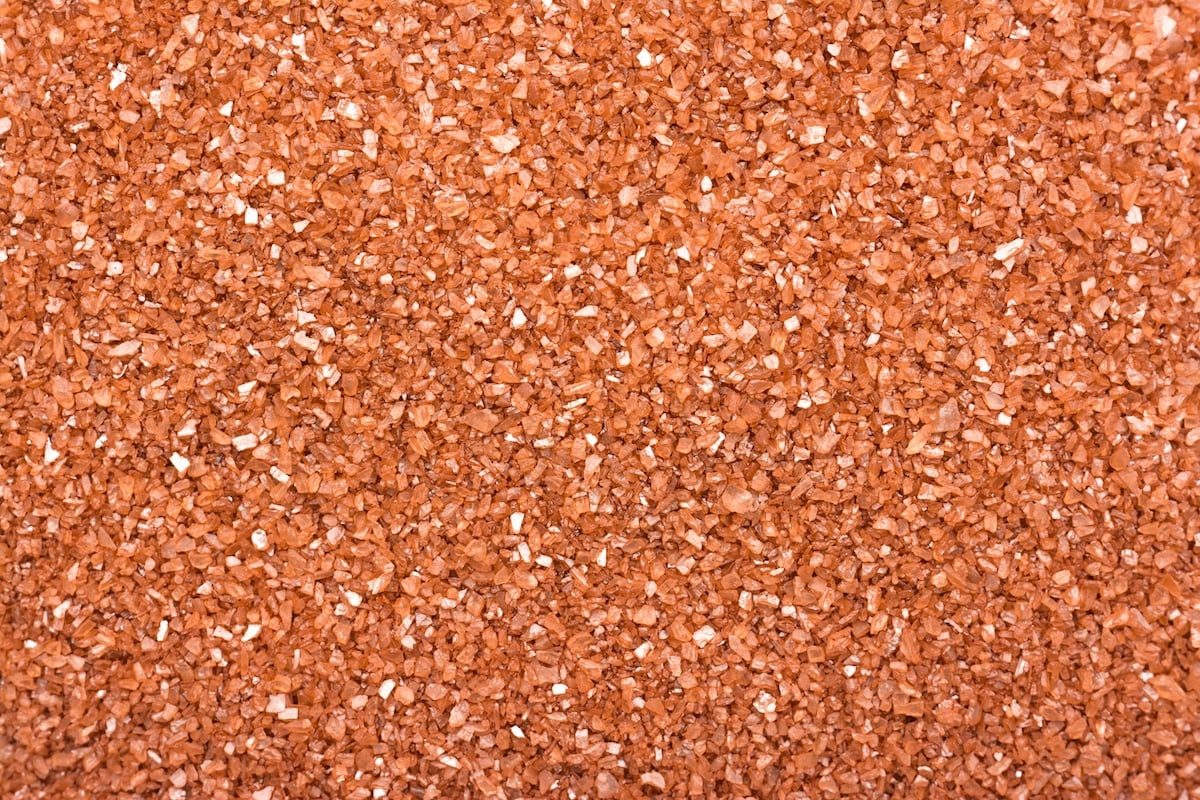
Hawaiian sea salt, paʻakai in Hawaiian, is sea salt from Hawaiʻi or sold in a Hawaiian style. It is commonly sold in three forms: plain white salt, red salt mixed with ʻalaea clay, and black salt colored with activated charcoal.12 Traditional salt is still made at the Hanapēpē salt ponds on Kauaʻi, but that salt cannot be sold, so what is in stores is a commercial product, and a “Hawaiian” label may refer to the style or to one ingredient rather than to where the salt was harvested.13 This page covers the three types, how the traditional salt is made, its history, how it is used, and what the health claims are worth.
At a glance
| Hawaiian name | Paʻakai, glossed “to solidify the sea”1 |
| Types | White; red (ʻalaea, salt mixed with red clay); black (salt with activated charcoal)12 |
| Red color | Iron oxide in ʻalaea clay1 |
| Black color | Activated charcoal, not lava, in the products we checked2 |
| Traditional source | Hanapēpē salt ponds, Kauaʻi4 |
| Can the traditional salt be sold? | No: it may be given or traded but not sold15 |
| Sodium | 36.7% in one black Hawaiian salt (Swiss analysis); most sea salts about 40%26 |
| Iodine | Specialty sea salts are not usually iodized7 |
Measured values
2 figures, sourced| Measure | Value | Scope | Source |
|---|---|---|---|
| Sodium | 36.7 % by weight | one black Hawaiian salt (salt, active coal and taro), Swiss FSVO analysis of 25 salts, 2016Potassium, calcium and iron were below the limit of detection in the same sample | warwick.ac.uk |
| Sodium | 40 % (about) | most sea salts, general statement by the American Heart AssociationGeneral figure, not a measurement of a Hawaiian salt | heart.org |
Each figure is quoted as its source states it, with the samples or standard it applies to. Where sources differ, both are shown; nothing is averaged. All measured values
The three types
White. The University of Hawaiʻi describes Hawaiian salt as white, raked from the top of shallow ponds, rinsed and dried.1 It is used like any other sea salt; see sea salt.
Red (ʻalaea). Some of the white salt is mixed with red ʻalaea clay, whose color comes from iron oxide.1 The color is added with the clay; it does not come from the salt itself. Commercial versions vary: SaltWorks, for example, sells an “Alaea Red Hawaiian-style Sea Salt” of Pacific sea salt and clay from the Hawaiian islands.3 Full detail is on the alaea salt page.
Black. Black “lava” salt gets its color from activated charcoal. In the Swiss Federal Food Safety and Veterinary Office’s 2016 analysis of 25 salts, the one black Hawaiian salt listed its ingredients as salt, active coal and taro.2 See black lava salt.
How the traditional salt is made
At Hanapēpē, underground seawater is drawn from deep wells into holding pools, then moved to shallow ponds; the white salt that forms on top is raked, rinsed and dried.1 The University of Hawaiʻi describes Hawaiians harvesting salt on a larger scale in man-made shallow clay ponds,1 and a 2008 state legislative resolution describes salt pans shaped with clay from the area and calls Hanapēpē’s ponds ancient, authentic Hawaiian salt ponds.4 Salt is not harvested in the rainy winter months.1 Honolulu Civil Beat reported in 2018 that 21 families connected by bloodline still work the flats.5
Although it is made by traditional methods, Hanapēpē salt does not meet US government food-grade requirements, so it may be given as a gift or traded but not sold commercially.15
History
Salt was central to Hawaiian food and ritual. The University of Hawaiʻi notes that preserving fish and octopus was essential both for storage on land and for ocean voyages, and that ʻalaea salt is used in ceremonies, for ritual blessing and purifying, and for healing.1 Food writer Martha Cheng notes that adding salt to raw fish was both seasoning and preservation.8
Salt also figured in 19th-century Pacific trade. A National Park Service history of Fort Vancouver records that by 1834 the Hudson’s Bay Company’s trade with Hawaiʻi had grown enough to open an office in Honolulu, and that its shippers received coffee, sugar, molasses, rice and salt in return for their cargoes.9 That source does not say the salt was used to cure salmon. Stories that Hawaiʻi was the Pacific Northwest’s main salt supplier, that salt was among the first goods traded with European visitors, or that it was sold to whaling ships could not be traced to a source we could open.
Flavor
America’s Test Kitchen found that sea salts vary in color but only slightly in flavor, and taste no different from table salt once mixed into food.10 We found no sensory test of red or black Hawaiian salt. Opinions differ: food writer Sue Lau called ʻalaea salt complex in flavor and not quite as salty as other salts.11 That is her view, not a measured result. Claims that red salt has a nutty taste, or that black salt’s charcoal gives it a strong earthy flavor, are also unmeasured.
How Hawaiian salt is used
Kalua pig. Sue Lau describes kalua pig, traditionally cooked in a pit, as seasoned simply with ʻalaea salt,11 and SaltWorks says its alaea salt is traditionally used on kalua pig.3
Poke. Martha Cheng writes that traditional poke was raw fish seasoned with sea salt dried in the sun, limu (seaweed) and ʻinamona (roasted, crushed kukui nut), and that later Japanese, Chinese and Korean influences replaced the salt and ʻinamona with shoyu and sesame oil.8
Finishing. The red and black salts are mostly used for their color, scattered over a dish just before serving. America’s Test Kitchen recommends sea salts as finishing salts.10
Buying and quality
Read the label for where the salt was harvested, where the clay or other coloring came from, and the full ingredient list.32 “Hawaiian” or “Hawaiian-style” in a product name does not by itself say where the salt was made. Claims that most Hawaiian-style salt is imported, or made with clay from particular countries, circulate widely; we found no source documenting them. The same goes for the claim that the best red salt comes from Molokaʻi.
Storage
We found no shelf-life figure for Hawaiian salt from a regulator or standards body. Keep it closed and dry; that is common practice rather than a tested rule.
Health and safety
Sodium. Hawaiian salt is not meaningfully lower in sodium. The black Hawaiian salt in the Swiss analysis was 36.7% sodium, and most sea salts are about 40%, the same as table salt.26 The FDA’s Daily Value for sodium is less than 2,300 mg a day,12 and the World Health Organization recommends adults stay below 2,000 mg, naming raised blood pressure as the main health effect of high intake.13
Minerals. In the same Swiss sample, potassium, calcium and iron were below the limit of detection, and the report concluded that specialty salts do not have nutritional properties that would justify recommending them as a standard choice.2 The American Heart Association says minerals in sea salt are present only at trace levels.6 We found no evidence that Hawaiian salt helps prevent osteoporosis or treat iron-deficiency anemia.
Activated charcoal. New York City’s health department tells food businesses that activated charcoal is approved only for filtering food, not as a food colorant or additive, and that it may reduce the absorption of certain nutrients or medication.14
Iodine. Specialty sea salts are not usually iodized.7 If you rely on salt for iodine, use iodized salt as well; see iodized vs. non-iodized salt.
Substitutes and comparisons
- Hawaiian sea salt substitutes
- Alaea salt, alaea salt substitutes and alaea salt vs. Himalayan salt
- Black lava salt and black lava salt uses
- Sea salt, fleur de sel and Himalayan salt
- Black salt (kala namak), a different product with a sulfurous smell
Footnotes
-
Traditional Ways of Knowing: Salt Harvesting, Exploring Our Fluid Earth, University of Hawaiʻi at Mānoa, 2011. manoa.hawaii.edu · Reference work ↩ ↩2 ↩3 ↩4 ↩5 ↩6 ↩7 ↩8 ↩9 ↩10 ↩11 ↩12 ↩13
-
Infanger and Haldimann, Report on the composition of prevalent salt varieties, Swiss Federal Food Safety and Veterinary Office, 2016. warwick.ac.uk · Regulator ↩ ↩2 ↩3 ↩4 ↩5 ↩6 ↩7 ↩8
-
Alaea Red Hawaiian-style Sea Salt, product page, SaltWorks. seasalt.com · Merchant ↩ ↩2 ↩3 ↩4
-
House Concurrent Resolution No. 117, Hawaii State Legislature, 2008. data.capitol.hawaii.gov · Regulator ↩ ↩2
-
Brittany Lyte, The Imperiled Legacy of the Hanapepe Salt Flats, Honolulu Civil Beat, 2018. civilbeat.org · Publication ↩ ↩2 ↩3
-
Sodium Sources: Where Does All That Sodium Come From?, American Heart Association, 2025. heart.org · Reference work ↩ ↩2 ↩3
-
Iodine: Fact Sheet for Health Professionals, NIH Office of Dietary Supplements. ods.od.nih.gov · Regulator ↩ ↩2
-
Martha Cheng, How Hawaiʻi Taught the World to Love Raw Seafood, Zócalo Public Square. live-zocalopublicsquare.ws.asu.edu · Publication ↩ ↩2
-
Edward and Alice Beechert, Part 7: Changing Times, Fort Vancouver National Historic Site, National Park Service. home.nps.gov · Regulator ↩
-
Salt Types and Measurements, America’s Test Kitchen. americastestkitchen.com · Publication ↩ ↩2
-
Sue Lau, Hawaiian pulled pork, The Christian Science Monitor, 2015. csmonitor.com · Publication ↩ ↩2
-
Sodium in Your Diet, U.S. Food and Drug Administration. fda.gov · Regulator ↩
-
Sodium reduction, World Health Organization, 2026. who.int · Regulator ↩
-
Adulterated Food: What Food Service Operators Need To Know, New York City Department of Health and Mental Hygiene. nyc.gov · Regulator ↩