Cooking · Cooking with
Cooking With Za’atar: Bread and Oil, Eggs, Meat and a Homemade Blend
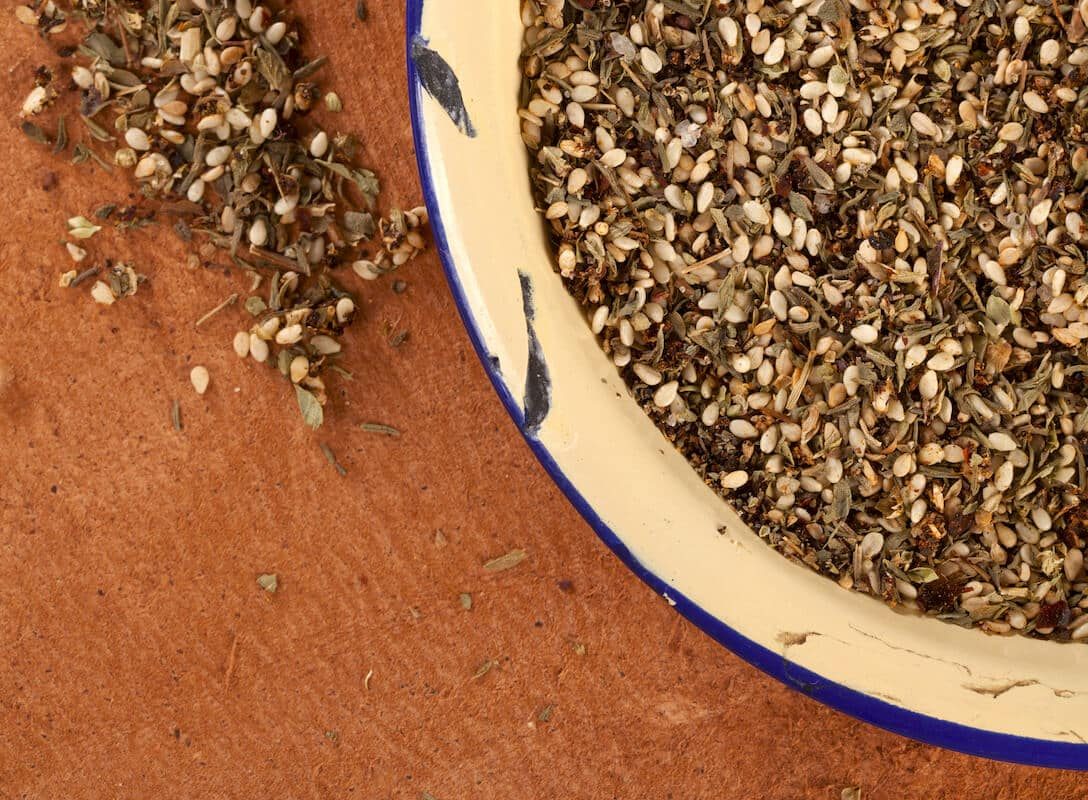
Za’atar is a seasoning of dried wild thyme, oregano or marjoram with sumac and toasted sesame seeds, usually salted.12 Its classic use is the simplest: flatbread brushed with olive oil and covered in za’atar, which is the base of man’ouché, a flatbread UNESCO calls the quintessential Lebanese breakfast.3 From there it goes onto eggs, hummus, vegetables, chicken, fish and kebabs.12 This page covers those uses, how to make and keep the blend, and the confusion over the herb that shares its name.
Quick guide
| Use | How | Basis |
|---|---|---|
| Flatbread | Brush with olive oil, sprinkle with za’atar, bake | Belsinger; UNESCO23 |
| Dip | Stir za’atar into an equal amount of olive oil; refrigerate up to a week | Belsinger2 |
| Eggs, chickpeas, hummus, vegetables | Sprinkle on before serving | Crowley1 |
| Chicken, fish, kebabs | Rub on before grilling or roasting | Crowley; Belsinger12 |
| Grains, legumes, salads, soups | Sprinkle on | Belsinger2 |
What’s in it
There is no single recipe. Three named versions show the range:
| Laura Crowley, UC Master Food Preservers1 | Susan Belsinger, Fine Gardening2 | Bryan Roof, America’s Test Kitchen4 | |
|---|---|---|---|
| Herbs | 1 tbsp dried thyme; 1 tbsp dried oregano, marjoram or a mix | 2 tbsp dried thyme; 2 tbsp dried marjoram and/or oregano | 2 tbsp dried thyme; 1 tbsp dried oregano |
| Sumac | 2 tbsp ground | About 1 tbsp | 1½ tbsp |
| Sesame | 1 tbsp, toasted | ¼ cup, toasted | 1 tbsp, toasted |
| Salt | Optional | 2 to 3 tsp | ¼ tsp |
Crowley’s is the most sour, Belsinger’s the nuttiest, and ATK’s sits between them, with only ¼ teaspoon of salt. Each brings three jobs: the herbs give a warm, resinous note; sumac, which Gernot Katzer describes as tart and sour from organic acids including malic and citric acid, gives the lemony one; and toasted sesame gives the nutty one.56 When you cook with a store-bought blend, taste it first, since the balance and the salt vary as much as these recipes do.
On bread with olive oil
This is the use to learn first. Belsinger brushes rolls, flatbread, pitas or pizza dough with olive oil, sprinkles on za’atar, and also works it into bread or cracker dough.2 UNESCO describes Lebanon’s man’ouché as a flatbread made in homes and specialized bakeries, topped with a mixture of thyme, sumac, toasted sesame seeds, salt and olive oil, and sometimes finished with labne (soft cheese), tomatoes, cucumbers, olives and mint.3 Old Dominion University’s Plants of the Bible project gives a Palestinian version of the same morning habit: bread dipped in olive oil and za’atar.7
Za’atar mixed with oil is also a dip; Belsinger mixes the blend with an equal amount of olive oil and keeps it in the refrigerator for up to a week.2
At breakfast and beyond
- Eggs. Crowley pairs za’atar with eggs.1 Sprinkle it on fried or scrambled eggs at the end; see spices for scrambled eggs.
- Labneh and yogurt. Labne appears among man’ouché toppings.3 A spoonful of labneh or thick yogurt with olive oil and za’atar on top is a common breakfast plate; that is common practice rather than a sourced recipe.
- Chickpeas, hummus and vegetables. Crowley names chickpeas and hummus, and vegetables such as cauliflower, cucumber and eggplant.1 See hummus spices.
- Meat and fish. Crowley suggests it on kebabs, and Belsinger on chicken and fish.12 Mixed with oil, it works as a rub; that is kitchen practice.
- Grains, legumes, salads and soups. Belsinger sprinkles it over all of these.2
Sprinkled on at the table, za’atar is also a condiment, the way salt and pepper are; that is common practice rather than a sourced claim. In a hot oven or on a grill, watch it closely, since the sesame and dried herbs can scorch; that is kitchen judgment.
Making your own
ODU notes that it is sold dried in almost any Arab market as a ready mixture.7 Making it at home lets you set the sumac and salt.
- Toast the sesame. Belsinger toasts the seeds until they just turn pale gold, cools them, and grinds them lightly with some of the salt before stirring in the herbs and sumac.2 Katzer notes that some of sesame’s aroma compounds form only during toasting.6
- Grind the herbs. ATK processes the thyme and oregano in a spice grinder or mortar and pestle before stirring in the sumac, sesame and salt.4
- Store it. ATK says its blend keeps at room temperature in an airtight container for up to a year.4 A dark cupboard, away from heat, is the usual advice for dried herbs; we found no test specific to za’atar.
For swaps when an ingredient is missing, see za’atar substitutes and sumac.
The herb and the blend
Za’atar is also the Arabic name for herbs, which can cause confusion when shopping. Katzer writes that Arabic zatar or satar covers several native herbs, including oregano, marjoram, thyme and savory, and that in Jordan zahtar usually means a spice mixture containing them.8 One species is singled out: ODU and Belsinger both name Origanum syriacum, sometimes called Syrian oregano, as known in Arabic as za’atar.72 Where that herb isn’t available, Belsinger suggests equal parts thyme and marjoram, oregano or both.2
The biblical link is less settled than it is often made to sound. ODU calls Origanum syriacum the most likely candidate for the hyssop of the Bible, but notes that modern Bible scholars still express uncertainty about hyssop’s identity.7 For the herb sold in Western nurseries and spice shops under the name hyssop, see hyssop.
It is often said that Jordanian, Lebanese and Palestinian za’atar are distinct styles. Katzer’s note on Jordan is the only regional detail we could source, so this page doesn’t describe national styles.8
Safety
Za’atar usually contains sesame, which became the ninth major food allergen in the U.S. when the FASTER Act took effect on 1 January 2023 and must be declared on labels.9 Read the label on store-bought blends for sesame and for salt.
What isn’t known
- No published comparison of regional za’atar styles.
- No shelf-life test for za’atar beyond ATK’s recipe note.
- No measurement of the sumac, salt or sesame share in store-bought blends.
Related
- Za’atar, the full profile, za’atar uses and za’atar substitutes
- Sumac and cooking with sumac
- Thyme, oregano and marjoram
- Sesame seeds and dukkah, another seasoning eaten with bread and olive oil
Footnotes
-
Laura Crowley, Za’atar Spice Blend, UC Cooperative Extension Master Food Preservers of El Dorado County. ccfruitandnuts.ucanr.edu · Reference work ↩ ↩2 ↩3 ↩4 ↩5 ↩6 ↩7 ↩8
-
Susan Belsinger, Za’atar: An Exotic Herb Blend, Fine Gardening, 2010. finegardening.com · Publication ↩ ↩2 ↩3 ↩4 ↩5 ↩6 ↩7 ↩8 ↩9 ↩10 ↩11 ↩12 ↩13 ↩14
-
Al-Man’ouché, an emblematic culinary practice in Lebanon, UNESCO Intangible Cultural Heritage, 2023. ich.unesco.org · Reference work ↩ ↩2 ↩3 ↩4
-
Bryan Roof, Za’atar, America’s Test Kitchen, 2017. americastestkitchen.com · Publication ↩ ↩2 ↩3
-
Sumac, Gernot Katzer’s Spice Pages. gernot-katzers-spice-pages.com · Reference work ↩
-
Sesame, Gernot Katzer’s Spice Pages. gernot-katzers-spice-pages.com · Reference work ↩ ↩2
-
Hyssop, Plants of the Bible, Old Dominion University. ww2.odu.edu · Reference work ↩ ↩2 ↩3 ↩4
-
Oregano, Gernot Katzer’s Spice Pages. gernot-katzers-spice-pages.com · Reference work ↩ ↩2
-
Robert M. Califf, An Update on Sesame Allergen Labeling on Food Packages, FDA, 2023. fda.gov · Regulator ↩