Spice Comparisons · Comparison
Cilantro vs. Parsley: Same Family, Different Chemistry
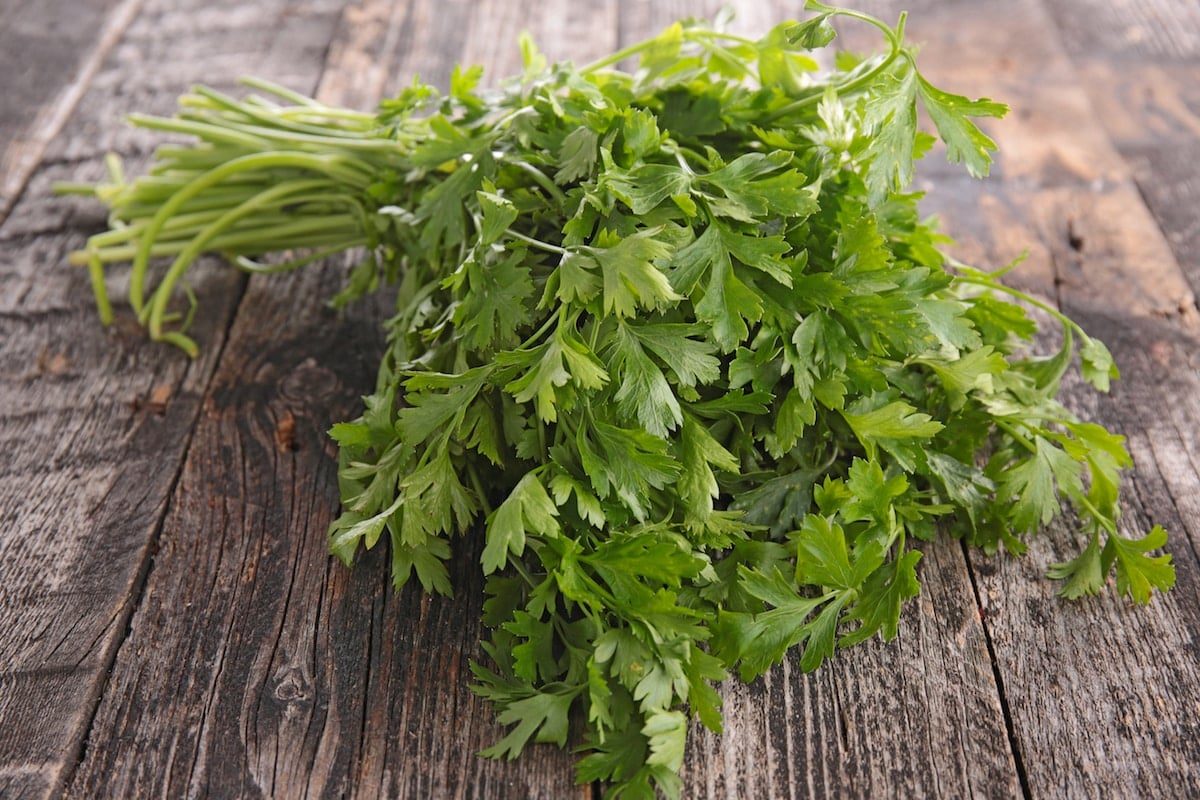
Cilantro and parsley are close relatives. Both belong to the carrot family, Apiaceae, both are sold in bunches of green leaves, and flat-leaf parsley looks enough like cilantro to be mistaken for it.123 Britannica even lists “Chinese parsley” as another name for cilantro.1 The real difference is in the leaf oil. More than 80% of cilantro’s is aldehydes, the compounds behind both its citrusy lift and the soapy taste some people get.45 Parsley’s oil is led by different compounds, and there is much less of it in the fresh herb.6 That is why one can garnish for the other but neither tastes like the other.
Side by side
| Cilantro | Parsley | |
|---|---|---|
| Species | Coriandrum sativum7 | Petroselinum crispum8 |
| Family | Apiaceae (carrot or parsley family)1 | Apiaceae (carrot or parsley family)2 |
| Native range | Eastern Mediterranean to western Pakistan7 | Northwest Africa and the Balkan Peninsula (Kew); “Mediterranean lands” (Britannica)82 |
| Life cycle | Annual1 | Biennial2 |
| Types | One species; the leaf is cilantro, the dried fruit is the spice coriander1 | Curly-leaved, flat-leaved (often sold as Italian) and turnip-rooted6 |
| Leaves | Shiny green; the lowest leaves deeply lobed and toothed, the upper ones divided into narrow, pointed lobes4 | Dark green and glossy, flat or curled; wedge-shaped to linear leaflets cut into pointed segments6 |
| Volatile oil | About 4 mg per gram of fresh leaves4 | 0.07 to 0.15% of the fresh herb in curly types, 0.04% in flat-leaved6 |
| Leading oil compounds | Aldehydes, over 80%; (E)-2-dodecenal largest at 15.6%4 | 1,3,8-p-menthatriene about 20%, then myristicin and limonene, in German samples6 |
| Flavor (editorial) | Bright, citrusy and sharp; soapy to some people | Green, fresh, lightly bitter; flat-leaf stronger than curly6 |
| In the pot | Delicate: add in the last minute or two9 | Delicate: add in the last minute or two9 |
| Fresh or dried | Much weaker dried10 | Much weaker dried10 |
| Typical uses | Latin American, Indian and Chinese dishes;1 Mexican salsas and meat dishes11 | Fish, meats, soups, sauces and salads2 |
| Safety note | FDA import controls on some fresh cilantro from Puebla, Mexico, over Cyclospora12 | Among the foods MedlinePlus lists as able to affect the blood thinner warfarin13 |
The oil figures come from separate PROSEA entries, measured on different samples and stated in different units, so they show which compounds lead in each herb rather than a precise ratio of strength. The flavor row is our description, apart from PROSEA’s note that flat-leaved parsley is the stronger-flavored type.6
For the individual herbs, see cilantro and parsley.
The flavor gap, and the soapy taste
Cilantro’s aroma is built almost entirely on aldehydes. PROSEA puts them at more than 80% of the leaf’s volatile oil, led by (E)-2-dodecenal, (E)-2-tetradecenal and (E)-2-decenal.4 Eriksson and colleagues note that the (E)-2-alkenals in cilantro are described as soapy, fatty, “like cilantro” or pungent.5 The Wisconsin Master Gardener program says descriptions of cilantro’s flavor run from citrusy with a biting tang to soapy.11
Part of that split is genetic. In a study of 14,604 people of European ancestry who reported whether cilantro tasted soapy, Eriksson’s team found a variant near a cluster of smell-receptor genes, one of which codes for a receptor that binds several of cilantro’s aldehydes. The heritability tagged by common variants was low, about 0.087, so genes explain only part of the reaction.5
Parsley has no comparable reputation. PROSEA describes the flavor of parsley oil as warm but slightly burning and bitter, and Britannica calls the leaves mildly aromatic.62 The two types differ more than many cooks expect. In PROSEA’s figures for German-grown leaf oil, both had about 20% 1,3,8-p-menthatriene, but curly parsley’s oil carried 32% myristicin against 9.1% in flat-leaved, and flat-leaved had more limonene, 18% against 14%.6 See Italian vs. curly parsley.
Telling them apart at the store
Healthline notes that cilantro looks similar to fresh flat-leaf parsley.3 PROSEA’s botanical descriptions give a few clues. Cilantro’s leaves change shape up the stem, from lobed, toothed lower leaves to finely divided upper ones with narrow, pointed lobes.4 Parsley’s leaves are dark green and glossy, with wedge-shaped to linear leaflets cut into pointed segments.6 Curly parsley, with its frilled leaves, is easy to tell from either.
In practice the quickest test is to crush a leaf and smell it: cilantro’s sharp, citrusy aroma is hard to miss. That is kitchen judgment, not a published method.
How they are used
The two do much the same job in different cuisines. PROSEA says parsley plays a role in Western cooking similar to that of coriander leaves in Asia.6
- Cilantro. Britannica notes that the young leaves are widely used in Latin American, Indian and Chinese dishes.1 In Mexico it goes into salsas and meat dishes,11 and by common practice into guacamole. PROSEA notes that the taproots are eaten as a vegetable in China and Thailand.4
- Parsley. Britannica lists fish, meats, soups, sauces and salads.2 PROSEA says the fresh leaves of curly cultivars are commonly used for garnishing and seasoning.6 By common practice, flat-leaf parsley is the main herb in chimichurri, gremolata and tabbouleh.
Both are fragile in the pan. LSU AgCenter lists cilantro and parsley among the delicate herbs to add in the last minute or two of cooking.9 Both also lose a lot when dried: ATK’s Danielle Lapierre lists parsley and cilantro among the herbs that are much weaker in flavor once dried.10 See dried vs. fresh cilantro and fresh vs. dried parsley.
Safety
Cilantro. The FDA links recurring outbreaks of cyclosporiasis in the United States in 2012 through 2015 to fresh cilantro from the state of Puebla, Mexico. Under Import Alert 24-23, such cilantro offered for entry from April 1 through August 31 each year can be detained without physical examination.12
Parsley. MedlinePlus lists parsley, with endive, lettuce, spinach, watercress, garlic and scallions, among foods that can change how warfarin works. It does not tell people to avoid them; it advises keeping the amount steady from day to day.13 Anyone on warfarin should follow their prescriber’s guidance.
Can one stand in for the other?
As a garnish, yes. For flavor, only loosely. No source we found publishes a measured ratio in either direction, so both swaps below carry the Method label used on our substitute pages: a direction and a cautious starting point, not a tested number.
| Swap | Treatment | Starting amount | Notes |
|---|---|---|---|
| Flat-leaf parsley in place of cilantro | Method | Same amount | A Couple Cooks lists parsley first but gives no amount, and says it is grassy and citrusy but doesn’t taste like cilantro.14 Also the swap for people who find cilantro soapy. A squeeze of lime helps in salsa, in our judgment. |
| Cilantro in place of parsley | Method | About half the amount | The Spice House calls cilantro stronger and more citrusy,15 and Healthline warns its bright flavor may clash with some dishes that usually get parsley.3 Best as a garnish or in Latin American and Asian dishes. |
Use flat-leaf parsley rather than curly when standing in for cilantro, since PROSEA rates it the stronger-flavored type.6 For dried herbs in place of fresh, LSU AgCenter’s general rule is 1 tablespoon of fresh to 1 teaspoon of dried,9 though both of these herbs lose more in drying than most. Full rankings are on cilantro substitutes and parsley substitutes.
What isn’t known
- No published sensory study compares cilantro and parsley directly. The flavor row is editorial.
- No source gives a measured ratio for either swap.
- No study has tested whether people who find cilantro soapy dislike parsley. Parsley’s leading compounds are not cilantro’s aldehydes,46 but that is chemistry, not a taste test.
- The Eriksson study gives no share of people who taste soap, and neither does this page.
- A widely repeated tip says parsley is a brighter green than cilantro. PROSEA describes parsley as dark green and glossy and cilantro as shiny green,64 which is not a reliable way to tell them apart.
Related
- Cilantro, cooking with cilantro, how to store cilantro and too much cilantro
- Parsley, flat-leaf vs. Italian parsley, how to store parsley and too much parsley
- Coriander vs. parsley, coriander vs. cilantro and culantro vs. cilantro
- Chervil vs. parsley, chervil vs. cilantro, basil vs. cilantro and cilantro vs. oregano
Footnotes
-
“Coriander”, Encyclopaedia Britannica. britannica.com · Reference work ↩ ↩2 ↩3 ↩4 ↩5 ↩6 ↩7
-
“Parsley”, Encyclopaedia Britannica. britannica.com · Reference work ↩ ↩2 ↩3 ↩4 ↩5 ↩6 ↩7
-
SaVanna Shoemaker, “10 Tasty Parsley Substitutes”, Healthline, 2020. healthline.com · Publication ↩ ↩2 ↩3
-
Coriandrum sativum, Plant Resources of South-East Asia (PROSEA). uses.plantnet-project.org · Reference work ↩ ↩2 ↩3 ↩4 ↩5 ↩6 ↩7 ↩8 ↩9
-
Eriksson et al., “A genetic variant near olfactory receptor genes influences cilantro preference”, Flavour, 2012. link.springer.com · Peer-reviewed ↩ ↩2 ↩3
-
I.B. Ipor and L.P.A. Oyen, Petroselinum crispum, Plant Resources of South-East Asia (PROSEA). uses.plantnet-project.org · Reference work ↩ ↩2 ↩3 ↩4 ↩5 ↩6 ↩7 ↩8 ↩9 ↩10 ↩11 ↩12 ↩13 ↩14 ↩15
-
Coriandrum sativum L., Plants of the World Online, Royal Botanic Gardens, Kew. powo.science.kew.org · Reference work ↩ ↩2
-
Petroselinum crispum, Plants of the World Online, Royal Botanic Gardens, Kew. powo.science.kew.org · Reference work ↩ ↩2
-
“Flavorful Herbs”, LSU AgCenter. lsuagcenter.com · Reference work ↩ ↩2 ↩3 ↩4
-
Danielle Lapierre, “When You Should Actually Use Dried Herbs (and Which Ones to Avoid)”, America’s Test Kitchen, 2022. americastestkitchen.com · Publication ↩ ↩2 ↩3
-
Susan Mahr, “Cilantro”, Wisconsin Master Gardener Program, University of Wisconsin-Madison, 2017. mastergardener.extension.wisc.edu · Reference work ↩ ↩2 ↩3
-
Import Alert 24-23, U.S. Food and Drug Administration. accessdata.fda.gov · Regulator ↩ ↩2
-
“Taking warfarin”, MedlinePlus, U.S. National Library of Medicine. medlineplus.gov · Regulator ↩ ↩2
-
Sonja Overhiser, “Best Cilantro Substitute”, A Couple Cooks, 2026. acouplecooks.com · Publication ↩
-
“The 8 Best Parsley Substitutes”, The Spice House, 2018. thespicehouse.com · Merchant ↩