Spice Comparisons · Comparison
Flat-Leaf vs. Italian Parsley: Two Names for One Herb
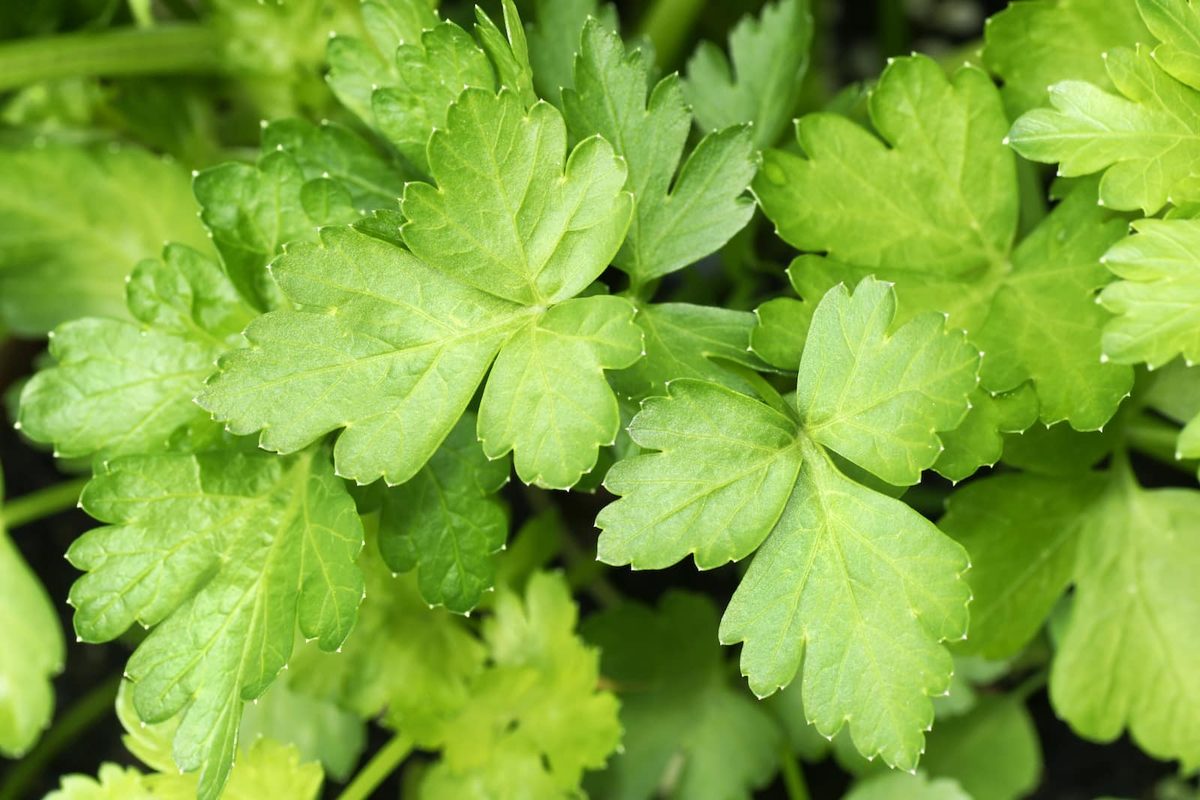
There is no difference: flat-leaf parsley and Italian parsley are two names for the same herb. The Royal Horticultural Society lists “flat-leaved parsley,” “Italian parsley” and “plain-leaved parsley” as common names for one plant, and the University of Maryland Extension captions it “Italian or flat-leaf parsley.”12 Both are forms of Petroselinum crispum, the same species as curly parsley.34 If a recipe says one and the shop label says the other, buy it. The comparison that does change a dish is flat-leaf against curly.
One herb, several names
| Name you may see | What it refers to |
|---|---|
| Flat-leaf or flat-leaved parsley | The flat-leaved group of Petroselinum crispum41 |
| Italian parsley | Same plant; PROSEA files “Italian parsley” under the flat-leaved group412 |
| Plain-leaved parsley | Same plant (RHS); “Plain” and “Plain Italian Dark Green” are cultivar names in this group41 |
| P. crispum var. neapolitanum | The botanical variety name the RHS and Maryland Extension use for it12 |
| Chinese parsley | Not parsley: another name for cilantro, the leaf of coriander5 |
A note on the botanical name. PROSEA groups cultivated parsley into three cultivar groups and lists var. neapolitanum, “or Italian parsley,” inside the flat-leaved group.4 Kew’s Plants of the World Online accepts only the species, Petroselinum crispum, and its page lists no separate variety for flat-leaf types.3 For a cook the point is the same either way: the names describe one kind of leaf.
The comparison that matters: flat-leaf vs. curly
PROSEA describes three cultivated groups: curly-leaved, flat-leaved and turnip-rooted (Hamburg) parsley, which is grown for its root.4 So there are more than two kinds of parsley, though only two are common as fresh herbs.
| Flat-leaf (Italian) parsley | Curly parsley | |
|---|---|---|
| Species | Petroselinum crispum3 | Petroselinum crispum3 |
| Family | Apiaceae (carrot family)3 | Apiaceae3 |
| Native range of the species (Kew) | Northwest Africa and the Balkan Peninsula3 | Same |
| Leaves | Flat leaf blades on more open branches; the RHS calls them strongly aromatic and dark green41 | Curled leaf blades on compact branches;4 Britannica describes parsley leaves as either flat or deeply frilled6 |
| Flavor strength | Stronger flavored than curly (PROSEA)4 | Milder4 |
| Essential oil in the fresh herb | 0.04%4 | 0.07 to 0.15%4 |
| Leaf oil, German-grown samples | Myristicin 9.1%, limonene 18%, 1,3,8-p-menthatriene about 20%4 | Myristicin about 32%, limonene 14%, 1,3,8-p-menthatriene about 20%4 |
| Main use (PROSEA) | Mainly to flavor sauces, soups and stews4 | Garnishing and seasoning4 |
| Price | No dated, sourced retail comparison found | No dated, sourced retail comparison found |
The chemistry rows come from one reference and one set of German-grown samples, so they show how the types can differ, not what any bunch in a shop contains. They also show that “stronger flavored” is not simply “more oil”: PROSEA gives curly parsley the higher oil content and flat-leaf the stronger flavor.4 We found no source that explains the gap.
In practice, flat-leaf parsley tastes greener and more peppery, and curly is milder and more grassy, with a crisp texture that holds up as a garnish (editorial). PROSEA says flat-leaved parsley plays a role in Western cooking similar to that of coriander leaves in Asia.4
Can one stand in for the other?
- Flat-leaf and Italian parsley. Always, one for one. They are the same herb.12
- Curly for flat-leaf, or the reverse. Yes, though the dish will taste slightly different. We found no published ratio. Method: use the same amount, and if you are using curly in place of flat-leaf where parsley is a main flavor, as in tabbouleh or a parsley sauce, taste and add more.
- Dried for fresh. See fresh vs. dried parsley and parsley substitutes, which give the attributed dried-to-fresh conversion and ranked alternatives.
Safety
Culinary amounts of parsley leaf are not a concern for most people. MedlinePlus lists parsley among foods that can change how the blood thinner warfarin works; its advice is not to avoid them but to keep the amount steady from day to day.7 See the parsley profile for more.
What isn’t known
- No source we found explains how the name “Italian parsley” arose or when it came into common use in the United States, and widely repeated stories about its rise with Italian restaurants could not be traced.
- The myristicin and oil figures come from a single set of samples; we found no retail survey comparing flat-leaf and curly parsley.
Related
- Italian parsley vs. curly parsley
- Cilantro vs. parsley, chervil vs. parsley and basil vs. parsley
- How to store parsley, too much parsley and fines herbes
Footnotes
-
Petroselinum crispum var. neapolitanum, Royal Horticultural Society. rhs.org.uk · Reference work ↩ ↩2 ↩3 ↩4 ↩5 ↩6 ↩7
-
“Parsley”, University of Maryland Extension, 2023. extension.umd.edu · Reference work ↩ ↩2 ↩3 ↩4
-
Petroselinum crispum, Plants of the World Online, Royal Botanic Gardens, Kew. powo.science.kew.org · Reference work ↩ ↩2 ↩3 ↩4 ↩5 ↩6 ↩7
-
I.B. Ipor and L.P.A. Oyen, Petroselinum crispum, Plant Resources of South-East Asia (PROSEA). uses.plantnet-project.org · Reference work ↩ ↩2 ↩3 ↩4 ↩5 ↩6 ↩7 ↩8 ↩9 ↩10 ↩11 ↩12 ↩13 ↩14 ↩15 ↩16 ↩17 ↩18
-
“Coriander”, Encyclopaedia Britannica. britannica.com · Reference work ↩
-
“Parsley”, Encyclopaedia Britannica. britannica.com · Reference work ↩
-
“Taking warfarin”, MedlinePlus, U.S. National Library of Medicine. medlineplus.gov · Regulator ↩