Spice Substitutes · Substitutes
Cinnamon Substitutes: What to Use, How Much, and When Cassia Needs Care
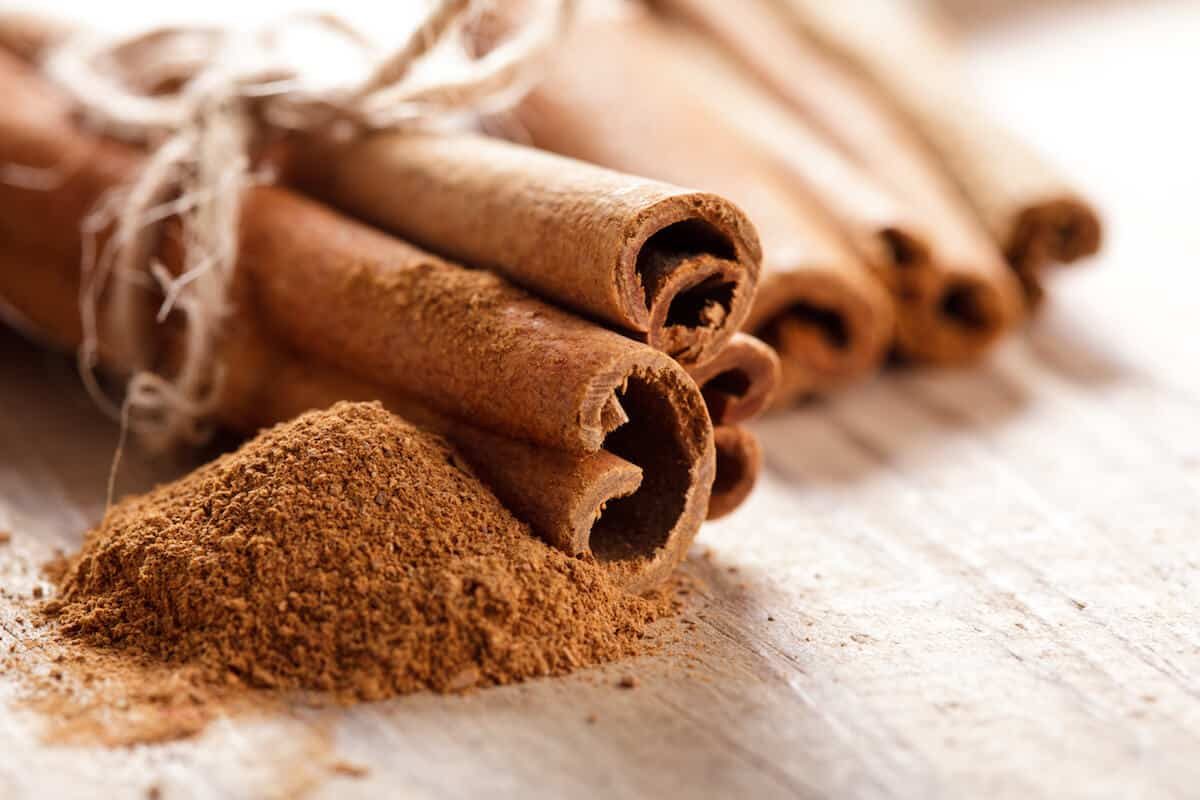
Most “cinnamon” sold in North America is cassia, a group of related Cinnamomum species; Ceylon cinnamon, from Sri Lanka, is the one the NIH calls “true” cinnamon.1 Both owe their flavor mainly to cinnamaldehyde. PROSEA gives it as 70 to 95 percent of Chinese cassia’s bark oil, with only traces of eugenol, and 50 to 75 percent of Ceylon’s, with 5 to 18 percent eugenol.23 The substitutes below imitate cinnamon’s warmth rather than match it: none of the ones whose chemistry we checked is built on cinnamaldehyde.
Quick answer
| What cinnamon is doing | Best substitute | Starting amount, per 1 teaspoon ground cinnamon | Treatment |
|---|---|---|---|
| Lead flavor in baking (rolls, pies, cookies) | Apple pie or pumpkin pie spice | 1 teaspoon, then taste | Method |
| Warm background in a spice mix or savory dish | Allspice or nutmeg | ¼ teaspoon | Attributed |
| Warm background, milder | Ground ginger | 1 teaspoon | Attributed |
| A stick steeped in liquid, and you only have ground | Ground cinnamon | ¼ to 1 teaspoon per stick | Disputed |
| Ceylon called for, cassia on hand (or the reverse) | The other cinnamon | 1 teaspoon | Method |
How the ratios on this page are labeled
- Computed: based on a measurable physical relationship, with the source named.
- Attributed: a named source publishes this ratio. We quote it as theirs.
- Disputed: named sources give different answers to the same swap. We show each one and do not average them.
- Method: we found no published ratio. We give a direction and a cautious starting point, and say so.
The published ratios here are merchants’ rules of thumb. None says how it was arrived at, and no study we found measures cinnamon’s strength against any substitute.
If cinnamon is the lead flavor in baking
When cinnamon is the flavor you’d name, the best stand-in is a blend that already contains it.
1. Apple pie spice or pumpkin pie spice
McCormick’s apple pie spice lists cinnamon, nutmeg and allspice; its pumpkin pie spice lists cinnamon, ginger, nutmeg and allspice.45 US labels list ingredients in descending order by weight, so cinnamon is the largest single ingredient in both.6 McCormick itself suggests using its apple pie spice in place of cinnamon in baked goods, though it gives no amount.4
How much of a blend is cinnamon varies. Oregon State University’s homemade pumpkin pie spice uses 2 tablespoons of cinnamon in a recipe that makes 4 tablespoons, so cinnamon is about half the mix by volume.7 McCormick does not publish its proportions.
Ratio (Method): No published ratio was found for this swap. Start one for one. The result will taste less of cinnamon and more of nutmeg, allspice or ginger. If cinnamon is the point of the recipe, as in cinnamon sugar, a blend is a compromise.
If cinnamon is warm background in a mix or savory dish
In chili, tagines, curries and spice rubs, cinnamon is one warm note among several. A stronger warm spice, used sparingly, can fill the gap.
1. Allspice or nutmeg
Allspice is named for a flavor that resembles a mix of cinnamon, cloves and nutmeg, according to Britannica.8 Its chemistry is closer to cloves than to cinnamon: PROSEA gives eugenol as 50 to 80 percent of allspice berry oil.9 That eugenol overlaps with Ceylon cinnamon’s minor eugenol note, not with cinnamaldehyde.3
Ratio (Attributed): McCormick calls nutmeg, allspice and mace “more powerful spices” and suggests 1/4 teaspoon of any of them for each teaspoon of cinnamon.10 The Spice House gives the same figure for nutmeg and allspice: use ¼ the amount.11 Two merchants agree here, but neither says how the figure was set.
2. Ground ginger
Ratio (Attributed): The Spice House says ginger and cinnamon are “fairly equal in strength” and suggests trying a 1:1 swap.11 Ginger brings its own bite rather than cinnamon’s sweetness, so it suits savory dishes and gingerbread-style baking better than cinnamon toast. That is our judgment.
3. Cardamom
Cardamom often appears alongside cinnamon, but its aroma is different. PROSEA gives its oil as mainly 1,8-cineole and α-terpinyl acetate.12 It shares nothing chemically with cinnamon’s main compound.
Ratio (Method): We found no credible published ratio. Start with half the cinnamon amount, taste, and add more. Expect a cooler, more resinous result.
If the recipe calls for a stick and you have ground (or the reverse)
Sticks are usually simmered in a liquid, such as cider, a curry sauce or a pot of rice, and then removed. Ground cinnamon stays in the dish, so it can cloud a clear liquid. That is a cooking observation.
Ratio (Disputed): McCormick publishes two figures that do not agree.
| Source | Stick to ground |
|---|---|
| McCormick, How to Grind Your Own Spices | One 1½-inch stick = 1 teaspoon ground cinnamon13 |
| McCormick, About Cinnamon | For each cinnamon stick, use ¼ teaspoon ground cinnamon10 |
The first is a bulking figure for grinding a short stick. The second is a flavor substitution for a stick of unstated length. They answer slightly different questions, and they are four times apart. Method starting point: use ¼ teaspoon of ground cinnamon per stick in a simmered liquid, taste near the end, and add more if needed.
If you are swapping one cinnamon for another
Ceylon in place of cassia
PROSEA notes that cinnamon and cassia barks are interchangeable in many applications.2 Ceylon is the milder and finer of the two, according to CBI, the Dutch government’s import-promotion center.14 Its oil carries less cinnamaldehyde and more eugenol than Chinese cassia’s.32
Ratio (Method): No published ratio was found. Start one for one and add a little more Ceylon if the dish tastes flat.
Cassia in place of Ceylon: the coumarin point
The flavor swap is easy: use slightly less cassia, since Ceylon is the milder of the two, and taste.14 The difference that matters is coumarin, a natural flavor compound that can harm the liver in a small group of sensitive people.15
- How much is in each. The German Federal Institute for Risk Assessment (BfR) reports that cassia contains on average about 3,000 mg of coumarin per kilogram.15 Ceylon bark contains only traces, according to a 2013 US study.16
- The safe-intake benchmark. The European Food Safety Authority’s tolerable daily intake is 0.1 mg of coumarin per kilogram of body weight.17 By the BfR’s estimate, a 60 kg adult reaches it with about 2 g of average cassia a day, and a 15 kg child with about 0.5 g.15 The BfR notes that even relatively low doses can cause liver damage in a small group of especially sensitive people.15
- What that means for a recipe. The NIH says ordinary amounts of cassia in food usually don’t supply enough coumarin to cause problems, but that prolonged use could be an issue for sensitive people.1 So swapping cassia into an occasional pie is not the concern. If a recipe was written for Ceylon because it uses cinnamon heavily and often, such as a daily cinnamon drink or a child’s breakfast, keep using Ceylon.
- Telling them apart. The BfR says consumers can hardly tell the two apart once ground.15 Look for “Ceylon cinnamon” on the label.
Ratio (Method): Start with three quarters as much cassia as the Ceylon called for, and taste. No published ratio exists.
What isn’t known
- No study compares the flavor strength of cinnamon with allspice, nutmeg, ginger or cardamom. The ¼ and 1:1 figures are merchants’ guidance.
- How much cinnamon is in a commercial pie spice blend is not published. Labels give only the order of ingredients by weight.6
- The two McCormick stick conversions differ fourfold, and neither states stick length in the substitution figure.1013
- A widely repeated tip says allspice should replace cinnamon at one third the amount. We found no source for that figure; the two sources we found both say one quarter.1011
Related
- Cinnamon, Ceylon cinnamon, cassia cinnamon and Ceylon vs. cassia cinnamon
- Saigon cinnamon and Korintje cinnamon
- Ground cinnamon vs. cinnamon stick and cinnamon vs. nutmeg
- Allspice, nutmeg, ginger, cardamom and mace
- Apple pie spice and pumpkin pie spice
- Too much cinnamon? How to fix the dish
Footnotes
-
Cinnamon: Usefulness and Safety, National Center for Complementary and Integrative Health, 2024. nccih.nih.gov · Regulator ↩ ↩2
-
Cinnamomum, PROSEA Spices, via Pl@ntUse. uses.plantnet-project.org · Reference work ↩ ↩2 ↩3
-
Cinnamomum verum, PROSEA Handbook No. 13: Spices. prosea.prota4u.org · Reference work ↩ ↩2 ↩3
-
McCormick Apple Pie Spice, product page, McCormick. mccormick.com · Merchant ↩ ↩2
-
McCormick Pumpkin Pie Spice, product page, McCormick. mccormick.com · Merchant ↩
-
21 CFR 101.4, Food; designation of ingredients. ecfr.gov · Regulator ↩ ↩2
-
Pumpkin Pie Spice, Food Hero, Oregon State University Extension Service. extension.oregonstate.edu · Reference work ↩
-
Allspice, Encyclopaedia Britannica. britannica.com · Reference work ↩
-
Sulistiarini, Pimenta dioica, PROSEA, via Pl@ntUse. uses.plantnet-project.org · Reference work ↩
-
About Cinnamon: Uses, Pairings and Recipes, McCormick, 2025. mccormick.com · Merchant ↩ ↩2 ↩3 ↩4
-
The 9 Best Cinnamon Substitutes, The Spice House, 2018. thespicehouse.com · Merchant ↩ ↩2 ↩3
-
Wardini and Thomas, Elettaria cardamomum, PROSEA, via Pl@ntUse. uses.plantnet-project.org · Reference work ↩
-
How to Grind Your Own Spices, McCormick. mccormick.com · Merchant ↩ ↩2
-
The European market potential for cinnamon, CBI. cbi.eu · Regulator ↩ ↩2
-
FAQ on coumarin in cinnamon and other foods, German Federal Institute for Risk Assessment. bfr.bund.de · Regulator ↩ ↩2 ↩3 ↩4 ↩5
-
Wang et al., Cassia cinnamon as a source of coumarin in cinnamon-flavored food and food supplements in the United States, Journal of Agricultural and Food Chemistry, 2013. hero.epa.gov · Peer-reviewed ↩
-
Coumarin in flavourings and other food ingredients with flavouring properties, European Food Safety Authority, 2008. efsa.europa.eu · Regulator ↩