Spice Comparisons · Comparison
Ground Cinnamon vs. Cinnamon Sticks: Flavor Release, Conversions and Shelf Life
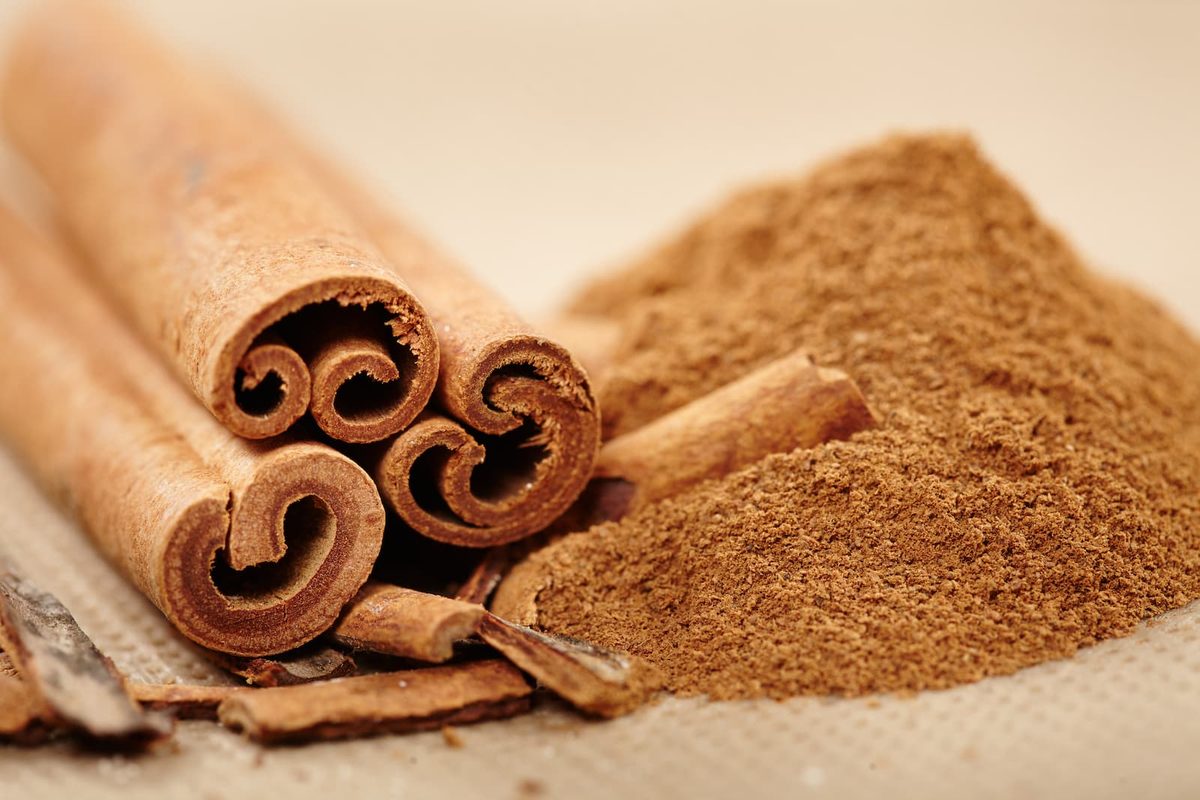
A cinnamon stick and a spoonful of ground cinnamon are the same dried inner bark in two forms. What changes is timing. Ground cinnamon has a bolder flavor and releases it quickly, while a whole stick is slow to give up its aroma, according to Saveur.1 So ground cinnamon suits quick-cooking foods and anything it has to stay in, and sticks suit liquids and long, slow cooking.12
Side by side
| Cinnamon sticks | Ground cinnamon | |
|---|---|---|
| What it is | Dried inner bark rolled into quills3 | The same bark, milled; for cassia, grinding usually happens in the consuming country3 |
| Species | Ceylon (Cinnamomum verum) or one of the cassia species; both are sold as sticks43 | Same; once ground, BfR says consumers can hardly tell Ceylon from cassia4 |
| How to recognize the type | Ceylon: thin bark, at most 0.5 cm thick, with smaller pieces slid inside longer ones;5 its cross-section looks like a cut cigar.4 Chinese cassia: bark sun-dried into reddish-brown quills3 | Not by eye. Check the label for “Ceylon”4 |
| Flavor release | Slow; suited to braises and steeped liquids1 | Fast and bolder; suited to quick-cooking foods1 |
| In the finished dish | Removed before serving | Stays in, so it shows in texture and color |
| Named shelf-life windows | 2 years (UC Cooperative Extension, America’s Test Kitchen); 3 to 4 years (McCormick)678 | 1 year (UC Cooperative Extension, America’s Test Kitchen); 2 to 4 years (McCormick)678 |
| Quality and safety notes | CBI says ground cinnamon is more open to microbial contamination and fraud;9 FDA’s 2024 lead alerts covered ground cinnamon products10 |
The shelf-life row is three named sources disagreeing, not a range to average. All of them give whole spices an equal or longer window than ground ones. None measured cinnamon specifically.
For which species you’re buying and why it matters, see Ceylon vs. cassia cinnamon. In North America, most cinnamon sold is cassia.11
How the two behave in cooking
Ground cinnamon acts fast and fades. Saveur says ground cinnamon has a bolder flavor than sticks and releases it more quickly, which makes it best for quick-cooking foods.1 Chowhound puts the same contrast in other words: ground cinnamon is more pungent on first impact but does not last as long in a recipe.2 In a long braise, Saveur warns, ground cinnamon can overpower the other flavors.1
A stick works slowly. Saveur describes a whole stick as slow to give up its perfume and recommends sticks in braised dishes such as Indonesian chicken curry.1 Chef Maneet Chauhan, quoted by Chowhound, sums it up: for long-lasting flavor use the bark, for immediate flavor use the powder, and use both when cinnamon is the focus of a dish.2
In hot fat. Saveur also describes frying whole cinnamon in clarified butter or oil to flavor the fat before cooking with it.1 Ground spices can be bloomed in fat too, but America’s Test Kitchen warns that they burn fairly quickly and leave a scorched flavor.12 With ground cinnamon, keep the heat moderate and the time short.
Why whole spices keep longer. Tasting Table states the general rule that pre-ground spices begin to lose flavor and aroma almost as soon as they are ground,13 and America’s Test Kitchen advises buying spices whole and grinding them just before use.7 Both are statements about spices in general. We found no measurement of how fast ground cinnamon loses its aroma compared with sticks.
Which to use when
These follow the sources above; the specific dish lists are our judgment.
- Sticks: mulled cider and wine, poaching syrups, tea, rice pilafs, braises and curries, and any clear liquid you don’t want clouded. Chowhound calls sticks great for steeping tea.2
- Ground: cinnamon rolls, cinnamon toast, cookies, cakes, oatmeal, spice rubs and anything sprinkled on at the end. Chowhound says ground suits baked goods and sprinkling over food.2
- Both: when cinnamon is the point of the dish, as in some curries and holiday drinks, a stick in the pot plus a pinch of ground near the end gives both the slow background and the up-front hit.2
Can one stand in for the other?
Yes, with an adjustment for amount and timing. The amount is where sources disagree.
Ground cinnamon in place of a stick
Ratio (Disputed):
| Source | Stick to ground |
|---|---|
| McCormick, How to Grind Your Own Spices | One 1½-inch stick = 1 teaspoon ground cinnamon14 |
| McCormick, About Cinnamon | For each cinnamon stick, use ¼ teaspoon ground cinnamon15 |
| Thatchers, mulled cider recipe | 2 cinnamon sticks, or ½ teaspoon ground cinnamon16 |
The first figure is what a short stick yields when you grind it. The second and third are flavor swaps, and they agree with each other: Thatchers’ recipe works out to ¼ teaspoon per stick (our arithmetic). Neither of those says how long the stick is. We have not averaged the figures.
Method starting point: in a simmered liquid, use ¼ teaspoon of ground cinnamon per stick, add it later in the cooking than you would the stick, taste near the end and add more if needed. Ground cinnamon can’t be lifted out, so it will cloud a clear liquid; a tea ball or a twist of cheesecloth helps (our suggestion).
A stick in place of ground cinnamon
In a liquid, steep the stick and take it out before serving. In a dry recipe, such as a batter or a rub, grind it first; Chowhound notes that buying sticks lets you grind your own powder.2 McCormick’s grinding figure tells you roughly what to expect: a 1½-inch stick makes about 1 teaspoon of ground cinnamon.14 No source compares freshly ground bark with a jar of pre-ground, so start with a little less than the recipe calls for and taste (Method).
For other swaps, see cinnamon substitutes.
Form doesn’t decide coumarin; species does
Coumarin, the natural flavor compound behind European safety limits on cinnamon, depends on the species, not on whether the bark is ground. In a 2010 study of cinnamon bought in German stores, cassia powder contained up to 63 times more coumarin than Ceylon powder.17 Whether you buy sticks or powder, if you use cinnamon heavily every day, choose Ceylon. Ground, the two species look almost the same, so the label is the only reliable guide.4 The details, with measured levels by species, are on Ceylon vs. cassia cinnamon.
Storage
Keep both forms tightly closed, away from heat and light. The shelf-life windows in the table are general guidance for whole and ground spices; none was measured on cinnamon. A simple test is to break a stick or open the jar and smell: if the aroma is faint, the cinnamon has faded. More on how long spices last.
What isn’t known
- No study measures how fast ground cinnamon loses its aroma compared with sticks, at home or in the store.
- The stick-to-ground figures disagree fourfold, and the flavor-swap figures don’t state stick length or species.
- No shelf-life figure specific to cinnamon was found in any source.
- A common claim says ground cinnamon lasts about six months and sticks up to two years. The named sources give ground spices 1 to 4 years.
Related
- Cinnamon, Ceylon cinnamon, cassia cinnamon, Saigon cinnamon and Korintje cinnamon
- Ceylon vs. cassia cinnamon and Saigon vs. Ceylon cinnamon
- Cinnamon substitutes and too much cinnamon
- Mulling spices for apple cider
- Other whole-versus-ground comparisons: ground vs. whole cloves, cumin seeds vs. ground cumin and fresh vs. ground nutmeg
Footnotes
-
Ben Mims, “Cooking With Cinnamon”, Saveur, 2009. saveur.com · Publication ↩ ↩2 ↩3 ↩4 ↩5 ↩6 ↩7 ↩8
-
Eva Merrill, “Ground Vs Stick Cinnamon: The Best Use For Each Type”, Chowhound, 2025. chowhound.com · Publication ↩ ↩2 ↩3 ↩4 ↩5 ↩6 ↩7
-
Cinnamomum (cassia species), PROSEA Handbook No. 13: Spices. prosea.prota4u.org · Reference work ↩ ↩2 ↩3 ↩4
-
FAQ on coumarin in cinnamon and other foods, German Federal Institute for Risk Assessment (BfR). bfr.bund.de · Regulator ↩ ↩2 ↩3 ↩4 ↩5
-
Cinnamomum verum, PROSEA Handbook No. 13: Spices. prosea.prota4u.org · Reference work ↩
-
Anna Martin, “Add a Little Spice to Your Life! Part II”, University of California Cooperative Extension, 2002. ucanr.edu · Reference work ↩ ↩2
-
Keeping Spices and Dried Herbs Fresher Longer, America’s Test Kitchen. americastestkitchen.com · Publication ↩ ↩2 ↩3
-
How Long Do Spices Last?, McCormick, 2025. mccormick.com · Merchant ↩ ↩2
-
The European market potential for cinnamon, CBI, 2026. cbi.eu · Regulator ↩
-
More Ground Cinnamon Products Added to FDA Public Health Alert Due to Presence of Elevated Levels of Lead, U.S. Food and Drug Administration. fda.gov · Regulator ↩
-
Cinnamon: Usefulness and Safety, National Center for Complementary and Integrative Health, 2024. nccih.nih.gov · Regulator ↩
-
How to Bloom Spices, America’s Test Kitchen, 2023. americastestkitchen.com · Publication ↩
-
Hope Ngo, “Why You Should Start Toasting Your Spices”, Tasting Table, 2016. tastingtable.com · Publication ↩
-
How to Grind Your Own Spices, McCormick. mccormick.com · Merchant ↩ ↩2
-
About Cinnamon: Uses, Pairings and Recipes, McCormick, 2025. mccormick.com · Merchant ↩
-
Mulled Cider, Thatchers Cider Company. thatcherscider.co.uk · Merchant ↩
-
ScienceDaily, news release on Woehrlin et al., J. Agric. Food Chem., 2010. sciencedaily.com · Publication ↩