Spice Comparisons · Comparison
Saigon vs. Ceylon Cinnamon: Vietnamese Cassia Against True Cinnamon
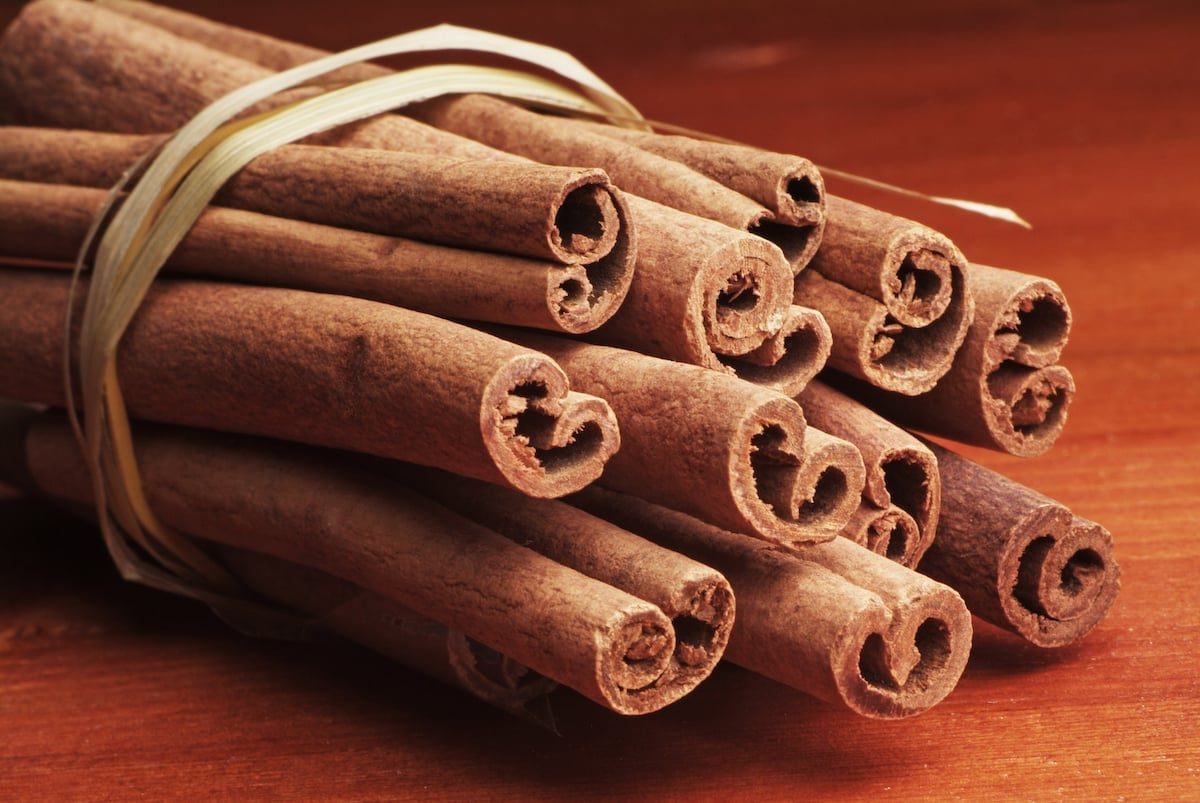
Saigon cinnamon is not a stronger grade of Ceylon cinnamon. It is a different tree: Vietnamese cassia, Cinnamomum loureiroi, native to Vietnam, while Ceylon is Cinnamomum verum, native to Sri Lanka.123 Two differences matter in the kitchen. Saigon’s bark oil is almost all cinnamaldehyde, which makes it hot and loud, while Ceylon’s carries a real share of eugenol and tastes gentler.34 And in a US study of authenticated bark, Saigon carried about 400 times more coumarin than Ceylon.5
Side by side
| Saigon cinnamon | Ceylon cinnamon | |
|---|---|---|
| Species | Cinnamomum loureiroi (PROSEA spells it loureirii)13 | Cinnamomum verum (syn. C. zeylanicum)2 |
| Trade group | Vietnamese cassia, one of three cassias3 | “True” cinnamon, per the NIH6 |
| Family | Lauraceae (laurel family)1 | Lauraceae2 |
| Native range | Vietnam (Kew); some botanists also include Cambodia and Laos13 | Sri Lanka2 |
| Main producer | Vietnam3 | Sri Lanka, which dominates the market4 |
| Part used | Dried bark, cut in slabs from the trunk and in quills from branches3 | Dried inner bark, at most 0.5 cm thick, rolled into compound quills4 |
| Bark oil | 1–7% of the bark; mainly cinnamaldehyde, only traces of eugenol3 | 50–75% cinnamaldehyde and 5–18% eugenol in the oil4 |
| Coumarin, authenticated sample (same US study) | 6.97 g/kg5 | 0.017 g/kg5 |
| Flavor (editorial) | Intensely sweet and hot, with a slightly bitter finish | Milder and more layered; CBI calls Ceylon milder and finer7 |
| Price | No dated, sourced retail comparison found | No dated, sourced retail comparison found |
The oil rows are not the same measurement. PROSEA gives an oil content for Saigon bark but no cinnamaldehyde percentage, and an oil composition for Ceylon. So the table can say Saigon’s oil is cinnamaldehyde with almost no eugenol, but not that it holds more cinnamaldehyde than Ceylon’s by any particular margin. The coumarin row does compare like with like: both figures are authenticated samples from the same US study, as tabulated in a 2020 review.5
How they taste, and why
Both get their cinnamon flavor mainly from cinnamaldehyde.34 The difference is what comes with it. Ceylon bark oil has 5 to 18 percent eugenol, the clove compound,4 which rounds the flavor out. Vietnamese cassia oil is mainly cinnamaldehyde with only traces of eugenol.3 PROSEA adds that among cassia’s less volatile constituents, only coumarin contributes much to taste and smell.3
In our judgment, that makes Saigon the hotter, sweeter, more one-note spice and Ceylon the softer and more complex one. A widely repeated claim calls Saigon the more complex of the two because of its oil content; the chemistry above points the other way. Another calls it the best cinnamon in the world. What a source does say is that the United States has a clear preference for cassia over Ceylon, “and for Vietnamese cassia in particular.”3
Telling them apart
Whole, it is easy. Ceylon quills are thin, at most 0.5 cm, with smaller pieces slid inside longer ones,4 and BfR notes that a Ceylon stick in cross-section looks like a cut cigar.8 Saigon bark comes off the trunk in flat slabs and off the branches as quills.3 Ground, BfR says shoppers can hardly tell Ceylon and cassia apart.8 Read the label: “Saigon” or “Vietnamese” names the cassia, “Ceylon” or Cinnamomum verum the true cinnamon. Most cinnamon sold in North America is cassia of some kind.6
Coumarin: the real difference
Coumarin is a natural flavor compound that can damage the liver in a small group of especially sensitive people, even at relatively low doses.8 A 2013 US study of authenticated bark found only traces in Ceylon and substantial amounts in all three cassias, “especially C. loureiroi and C. burmannii.”9
| Sample (scope) | Coumarin | Source |
|---|---|---|
| C. loureiroi, authenticated sample | 6.97 g/kg | Lončar et al. 2020, Table 45 |
| C. loureiroi bark, commercial, Vietnam | 1.06 g/kg | same5 |
| C. verum, authenticated sample | 0.017 g/kg | same5 |
| Cassia in general, German food monitoring | about 3 g/kg on average | BfR8 |
A single authenticated sample is not a market average, and the commercial Vietnamese bark in the same table was far lower. Saigon’s coumarin varies; Ceylon’s stays low. For the wider set of figures, see Ceylon vs. cassia cinnamon.
What a teaspoon means. EFSA’s tolerable daily intake (TDI) is 0.1 mg of coumarin per kg of body weight,10 or 6 mg a day for a 60 kg adult. BfR works out that such an adult reaches it with about 2 g a day of cassia of average coumarin content.11 USDA puts a teaspoon of ground cinnamon at 2.6 g (species not stated).12 Our arithmetic from those figures:
| Coumarin level | Coumarin in 1 teaspoon (2.6 g) | Share of a 60 kg adult’s TDI |
|---|---|---|
| Saigon, authenticated sample (6.97 g/kg) | about 18 mg | about 3 times |
| Cassia, BfR average (3 g/kg) | about 7.8 mg | about 1.3 times |
| Saigon, commercial Vietnamese bark (1.06 g/kg) | about 2.8 mg | about half |
| Ceylon, authenticated sample (0.017 g/kg) | about 0.04 mg | under 1% |
So a rule of “no more than a teaspoon of Saigon a day,” which circulates widely, can still run well over the TDI, depending on the lot. EFSA concluded that three times the TDI for one to two weeks is not a safety concern,10 so an occasional heavy day is not the issue; steady daily use is. NCCIH says ordinary amounts of cassia usually don’t supply enough coumarin to cause significant problems, but prolonged use could matter for sensitive people.6 If cinnamon is a daily habit, Ceylon keeps you far below the TDI.
Not a blood thinner. A widely repeated claim calls coumarin a blood thinner. ANSES says the anticoagulant properties belong to dimeric derivatives such as dicoumarol, and that simple coumarins do not have them.13
Cancer. A widely repeated claim links cinnamon’s coumarin to cancer risk. BfR says there are no indications that coumarin triggers tumors in humans.8
Blood sugar. Claims that Saigon’s cinnamaldehyde makes it better for blood sugar have no support here: NCCIH says it is unclear whether cinnamon supplements help with diabetes, and that research does not clearly support cinnamon for any health condition.6
Using them in the kitchen
PROSEA says the inner bark of all three cassias is used the same way, to flavor food at home and in industry.3 Britannica lists cassia, “Chinese cinnamon,” among the five spices of Chinese five-spice;14 that is a different cassia from Saigon, though Saigon does the same job. CBI notes that cinnamon in general goes into baked goods, sweets and drinks, and into Indian garam masala and masala chai.7
In our judgment, Saigon suits cinnamon rolls, cinnamon toast, apple and pumpkin pies and spice blends, where its intensity reads as a feature. Ceylon suits custards, rice pudding, poached fruit and hot chocolate, where cinnamon leads and a gentler note is wanted. Mexico is a big buyer of Ceylon: cinnamon heads Sri Lanka’s exports there, worth USD 91 million in 2025.15 That fits the common advice to use Ceylon in Mexican dishes, though no source we opened measures what Mexican recipes call for. A widely repeated claim says Saigon is the cinnamon of Vietnamese pho; we found no source that says which cinnamon pho uses.
Can one stand in for the other?
Yes, in flavor terms. PROSEA says cinnamon and cassia barks are interchangeable in many applications.3 The amounts below come from our cinnamon substitutes page, where no published ratio exists, so both are Method starting points, not tested figures.
| Swap | Starting amount | Treatment |
|---|---|---|
| Saigon (or any cassia) in place of Ceylon | Three quarters as much, then taste | Method |
| Ceylon in place of Saigon (or any cassia) | One for one, adding a little more if the dish tastes flat | Method |
Saigon in place of Ceylon. Start low and taste; it is the stronger spice in our judgment. The bigger reason not to swap is coumarin: if the recipe uses a lot of cinnamon and you make it often, or you cook for small children, keep Ceylon.
Ceylon in place of Saigon. The result is softer and less fiery. The difference shows most where cinnamon is the main flavor and least in long braises or busy spice blends (our judgment).
For sticks versus ground, see ground cinnamon vs. cinnamon sticks.
What isn’t known
- No published taste test compares Saigon and Ceylon cinnamon.
- PROSEA gives no cinnamaldehyde percentage for Vietnamese cassia oil, so the share cannot be compared directly with Ceylon’s.
- The Saigon coumarin figures are a single authenticated sample and one commercial source; no market-wide survey of Saigon cinnamon alone was found.
- USDA’s teaspoon weight is for ground cinnamon generally, not for either species.
- No dated price comparison.
Related
- Saigon cinnamon, Ceylon cinnamon, cassia cinnamon, Korintje cinnamon, cinnamon
- Ceylon vs. cassia cinnamon, cinnamon vs. nutmeg, cloves vs. cinnamon
- Cinnamon substitutes, too much cinnamon, ground cinnamon vs. cinnamon sticks
- Chinese five-spice powder
Footnotes
-
Cinnamomum loureiroi Nees, Plants of the World Online, Royal Botanic Gardens, Kew. powo.science.kew.org · Reference work ↩ ↩2 ↩3 ↩4
-
Cinnamomum verum J.Presl, Plants of the World Online, Royal Botanic Gardens, Kew. powo.science.kew.org · Reference work ↩ ↩2 ↩3 ↩4
-
Cinnamomum (cassia species), PROSEA Handbook No. 13: Spices. prosea.prota4u.org · Reference work ↩ ↩2 ↩3 ↩4 ↩5 ↩6 ↩7 ↩8 ↩9 ↩10 ↩11 ↩12 ↩13 ↩14 ↩15
-
Cinnamomum verum, PROSEA Handbook No. 13: Spices. prosea.prota4u.org · Reference work ↩ ↩2 ↩3 ↩4 ↩5 ↩6 ↩7
-
Lončar et al., Coumarins in Food and Methods of Their Determination, Foods, 2020 (Table 4). mdpi.com · Peer-reviewed ↩ ↩2 ↩3 ↩4 ↩5 ↩6 ↩7
-
Cinnamon: Usefulness and Safety, NCCIH. nccih.nih.gov · Regulator ↩ ↩2 ↩3 ↩4
-
The European market potential for cinnamon, CBI, 2026. cbi.eu · Reference work ↩ ↩2
-
FAQ on coumarin in cinnamon and other foods, BfR. bfr.bund.de · Regulator ↩ ↩2 ↩3 ↩4 ↩5
-
Wang et al., Cassia cinnamon as a source of coumarin in cinnamon-flavored food and food supplements in the United States, J. Agric. Food Chem., 2013. hero.epa.gov · Peer-reviewed ↩
-
Coumarin in flavourings and other food ingredients with flavouring properties, EFSA AFC Panel, 2008. efsa.europa.eu · Regulator ↩ ↩2
-
Cassia cinnamon with high coumarin contents to be consumed in moderation, BfR. bfr.bund.de · Regulator ↩
-
Spices, cinnamon, ground (FDC ID 171320), USDA FoodData Central. fdc.nal.usda.gov · Regulator ↩
-
Opinion on the risk of hepatotoxicity associated with the coumarin content of certain plants (2018-SA-0180), ANSES, 2021. anses.fr · Regulator ↩
-
Tony Hill, “Five-spice powder”, Encyclopaedia Britannica. britannica.com · Reference work ↩
-
Market Profile: Mexico 2026, Export Development Board of Sri Lanka. srilankabusiness.com · Reference work ↩