Herbs · Profile
Bay Leaves: What They Are, What They Taste Like, and the Other Bays
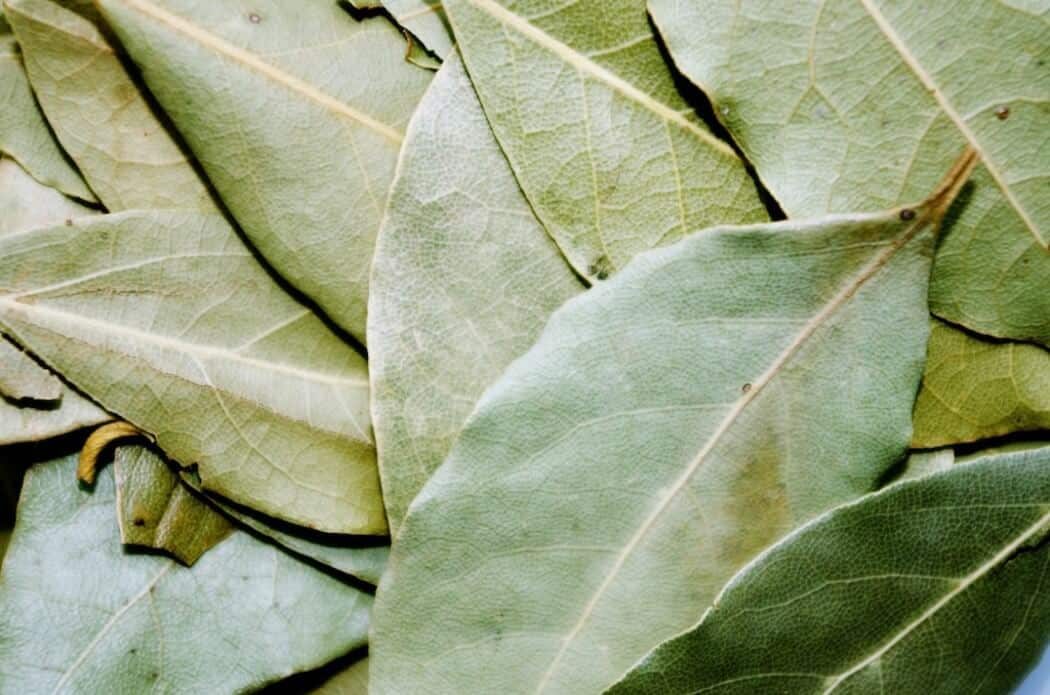
Bay leaves are the dried leaves of bay laurel, Laurus nobilis, an evergreen Mediterranean tree in the laurel family. They go into the pot whole, give soups, stocks, braises and beans a subtle herbal, faintly medicinal background, and come out before serving. Several unrelated leaves are also sold as “bay”, and they do not taste the same. This page covers the plant, the chemistry of its aroma, how it is used, how to buy and store it, the other bays, and the safety facts.
At a glance
| Botanical name | Laurus nobilis L.1 |
| Plant family | Lauraceae (laurel family)1 |
| Plant | Evergreen tree or shrub12 |
| Native range | Mediterranean, including Türkiye, Greece, Italy, France and North Africa1 |
| Part used | Leaves, usually dried; also the leaf oil2 |
| Main aroma compound | 1,8-Cineole, in proportions that vary by origin2 |
| Common trade name | “Turkish bay leaf”, the same species3 |
| US status | Listed by the FDA as a spice generally recognized as safe4 |
Measured values
18 figures, sourced| Measure | Value | Scope | Source |
|---|---|---|---|
| Essential oil yield | 0.57 % | leaves gathered February 2016 at Montecorice, southern Italy, one sample (Caputo et al., 2017) | mdpi.com |
| 1,8-Cineole | 31.9 % of oil | leaves gathered February 2016 at Montecorice, southern Italy, one sample (Caputo et al., 2017) | mdpi.com |
| Sabinene | 12.2 % of oil | leaves gathered February 2016 at Montecorice, southern Italy, one sample (Caputo et al., 2017) | mdpi.com |
| Linalool | 10.2 % of oil | leaves gathered February 2016 at Montecorice, southern Italy, one sample (Caputo et al., 2017)The paper's table and text give different linalool figures; treat with caution | mdpi.com |
| α-Terpinyl acetate | 5.9 % of oil | leaves gathered February 2016 at Montecorice, southern Italy, one sample (Caputo et al., 2017) | mdpi.com |
| α-Pinene | 5.8 % of oil | leaves gathered February 2016 at Montecorice, southern Italy, one sample (Caputo et al., 2017) | mdpi.com |
| α-Terpineol | 3.3 % of oil | leaves gathered February 2016 at Montecorice, southern Italy, one sample (Caputo et al., 2017) | mdpi.com |
| Methyl eugenol | 3.3 % of oil | leaves gathered February 2016 at Montecorice, southern Italy, one sample (Caputo et al., 2017) | mdpi.com |
| Eugenol | 1.6 % of oil | leaves gathered February 2016 at Montecorice, southern Italy, one sample (Caputo et al., 2017) | mdpi.com |
| 1,8-Cineole | 44.97 % of oil | Turkish sample, separate study compared in the 2017 review | mdpi.com |
| 1,8-Cineole | 56.0 % of oil | Tunisia, separate study compared in the 2017 review | mdpi.com |
| 1,8-Cineole | 58.59 % of oil | Cyprus, separate study compared in the 2017 review | mdpi.com |
| 1,8-Cineole | 52.43 % of oil | Morocco, separate study compared in the 2017 review | mdpi.com |
| 1,8-Cineole | 34.62 % of oil | Algeria, separate study compared in the 2017 review | mdpi.com |
| Moisture, maximum Limit | 10 % | Kenya standard KS 2263:2016 | kebs.org |
| Total ash, maximum Limit | 5 % | Kenya standard KS 2263:2016 | kebs.org |
| Acid-insoluble ash, maximum Limit | 0.5 unit not given in the standard's table | Kenya standard KS 2263:2016 | kebs.org |
| Extraneous matter, maximum Limit | under 2 % | Kenya standard KS 2263:2016 | kebs.org |
Each figure is quoted as its source states it, with the samples or standard it applies to. Where sources differ, both are shown; nothing is averaged. All measured values
What bay leaves are
Kew’s Plants of the World Online describes Laurus nobilis as a subtropical tree native to the Mediterranean.1 Its native list runs from Morocco, Algeria, Tunisia and Libya through France, Italy, Greece, Cyprus, Lebanon-Syria and Palestine to Türkiye, and Kew records it as introduced in Spain, Portugal, Great Britain, Ireland, the Caucasus, Korea and Vietnam, among other places.1 A 2017 review describes it as native to the southern Mediterranean and cultivated mainly in Europe and the US as an ornamental and medicinal plant, with the dried leaves and leaf oil used as a spice.2 Atlas Obscura notes that “Turkish bay leaf” is a variety of this same species, known for being especially mild and sweet.3
A widely repeated claim says bay trees are native to Asia Minor and spread from there to the Mediterranean. Kew’s range includes Türkiye but treats the whole Mediterranean as native, so there is no support for Asia Minor as a single starting point.
Flavor and aroma
J. Kenji López-Alt describes bay leaves as having a very subtle flavor next to many other herbs and spices, and says they bring out the meaty flavors of beef and chicken.5 He calls Turkish bay leaves milder, more nuanced and a little sweeter than California bay, which has a stronger menthol and eucalyptus note.5 Atlas Obscura describes bay laurel’s flavor as herbal, bitter and slightly piney, and points out that the leaves taste unpleasantly intense when chewed.3 To us, a long-simmered pot with bay smells faintly of tea and eucalyptus; that impression is ours.
The compounds
Bay’s aroma comes from the leaf oil. In one 2017 analysis of leaves gathered in February 2016 at Montecorice in southern Italy, the oil yield was 0.57% and 55 compounds were identified, accounting for 91.6% of the oil.2 The main ones:
| Compound | Share of the oil (Montecorice sample) |
|---|---|
| 1,8-Cineole | 31.9% |
| Sabinene | 12.2% |
| Linalool | 10.2% |
| α-Terpinyl acetate | 5.9% |
| α-Pinene | 5.8% |
| α-Terpineol | 3.3% |
| Methyl eugenol | 3.3% |
| Eugenol | 1.6% |
Source: Caputo et al., 2017.2 The same paper’s table gives a different figure for linalool than its text, so treat that one value with caution.
The same review compares its 1,8-cineole figure with oils from other countries, which ran higher: 44.97% in a Turkish sample, 56.0% in Tunisia, 58.59% in Cyprus and 52.43% in Morocco, and 34.62% in Algeria.2 Those are separate studies with separate methods, so they show how much bay oil varies rather than a ranking of countries. The common claim that bay contains “more than 50 compounds” is consistent with the 55 identified in the Italian sample, but that number belongs to one sample and one method.
Origin and history
According to Atlas Obscura, the ancient Greeks and Romans used laurel leaves in food and medicine and to crown the winners of competitions, and laurel was the symbol of Apollo, whose oracle at Delphi held a laurel branch while prophesying.3
How bay leaves are used
Bay goes into liquids that cook for a while: stocks, soups, stews, braises, sauces, beans and lentils. That is common practice rather than a sourced finding, and so is the advice to add one or two leaves to a pot rather than a handful.
- Bouquet garni. Britannica gives the classic French bouquet garni as sprigs of parsley and thyme and a bay leaf.6 See bouquet garni.
- Spice blends. Great British Chefs lists bay leaf among the spices commonly used in garam masala.7 In South Asian cooking “bay leaf” often means a different leaf from a cinnamon relative (see below), so check which one a recipe means.
- Strength. The University of Delaware’s extension service groups bay leaf with the strong or dominant flavors, alongside rosemary and sage.8
López-Alt’s advice is that bay is optional in most dishes but that things are better with it.5 Whole leaves come out before serving because they stay tough, which he compares to the texture of a fish bone.5 For whole versus crushed leaves, see crushed vs. whole bay leaves; for more ideas, see cooking with bay leaves. If a dish has gone over, see too much bay leaf.
The other “bays”
Several unrelated leaves share the name. They are not interchangeable.
| Leaf | Plant | How it differs from bay laurel |
|---|---|---|
| California bay | A different laurel3 | Longer and narrower leaves with a similar but much stronger scent and flavor; contains umbellulone, which Atlas Obscura says can induce headaches3 |
| Indian bay leaf (tejpatta) | A close relative of the cinnamon tree | Sweet, cinnamon-like flavor, completely different from bay laurel; the Hindi name means “pungent leaf”3 |
| West Indian bay | Pimenta racemosa | Every part of the plant is poisonous except the oil-rich leaves; bay rum made from it is for external use and toxic if consumed3 |
| Mexican bay leaf | Litsea glaucescens | Similar to bay laurel in flavor but milder; protected by law in Mexico3 |
| Indonesian bay leaf | A different plant3 | Dried leaves are delicate and brittle, with little scent until cooked3 |
If a recipe written for Turkish bay is made with California bay, López-Alt suggests starting with a quarter to half the amount.5 See bay leaf substitutes, curry leaves vs. bay leaves and bay leaves vs. basil.
Buying and quality
No Codex standard for bay leaves was found. Kenya’s national standard for bay leaf (KS 2263:2016) sets a maximum of 10% moisture, 5% total ash and an acid-insoluble ash limit of 0.5 (the table gives no unit), and requires under 2% extraneous matter. It sets no minimum for volatile oil and defines no grades.9 It is one country’s standard, cited here as an example of what a specification checks. In practice, good dried bay leaves are whole, olive-green rather than brown, and smell clearly when crushed; that is kitchen judgment.
Storage
López-Alt buys dried bay leaves in bulk and keeps the jar in the freezer, where he says they last indefinitely.5 We found no published shelf-life figure from a regulator or standards body. If a crushed leaf smells faint, it has faded.
Safety
Bay leaves are not poisonous. Atlas Obscura calls the belief that they are a misconception and says they are safe to eat.3 The FDA lists bay (Laurus nobilis) among spices generally recognized as safe.4
The real reason to remove them is physical. Whole leaves are rigid and can have sharp points and edges, and they stay intact on the way through the gut.10 Doctors have reported two cases of bay leaves lodged in the esophagus,11 and a case in which a 2 cm piece of bay leaf penetrated the bowel wall at a Meckel’s diverticulum.10 These are case reports, so they show the hazard exists, not how common it is. Count the leaves in and count them out.
Other plants called bay are a different matter: Atlas Obscura identifies West Indian bay as having poisonous parts (see the table above).3
Health claims
Lists of conditions that bay leaves are said to treat, from blood sugar to migraines, circulate widely. None is supported by a regulator or a systematic review we found, and the NIH’s National Center for Complementary and Integrative Health has no fact sheet on bay leaf.12 The 2017 review notes that the leaves have been used in Iranian folk medicine.2 This page makes no claim that bay leaves treat or prevent any condition.
Related pages
Footnotes
-
Laurus nobilis L., Plants of the World Online, Royal Botanic Gardens, Kew. powo.science.kew.org · Reference work ↩ ↩2 ↩3 ↩4 ↩5 ↩6
-
Caputo et al., “Laurus nobilis: Composition of Essential Oil and Its Biological Activities”, Molecules, 2017. mdpi.com · Peer-reviewed ↩ ↩2 ↩3 ↩4 ↩5 ↩6 ↩7 ↩8
-
Andrew Coletti, “What Is a Bay Leaf, Exactly?”, Atlas Obscura, 2023. atlasobscura.com · Publication ↩ ↩2 ↩3 ↩4 ↩5 ↩6 ↩7 ↩8 ↩9 ↩10 ↩11 ↩12 ↩13
-
21 CFR 182.10, Spices and other natural seasonings and flavorings, US Food and Drug Administration. ecfr.gov · Regulator ↩ ↩2
-
David Leite with J. Kenji López-Alt, “Bay leaves are an optional ingredient, ‘but things are definitely better with them’”, The Splendid Table, 2014. splendidtable.org · Publication ↩ ↩2 ↩3 ↩4 ↩5 ↩6
-
“Bouquet garni”, Encyclopaedia Britannica. britannica.com · Reference work ↩
-
“How to make garam masala”, Great British Chefs, 2025. greatbritishchefs.com · Publication ↩
-
“Using Herbs and Spices”, University of Delaware Cooperative Extension, 2025. udel.edu · Reference work ↩
-
KS 2263:2016, Bay leaf: Specification, Kenya Bureau of Standards. kebs.org · Standard ↩
-
Bell and Mustard, “Bay leaf perforation of Meckel’s diverticulum”, Canadian Journal of Surgery, 1997. canjsurg.ca · Peer-reviewed ↩ ↩2
-
Ahmed and McCormick, “Bay-leaf: an unusual oesophageal foreign body”, Journal of Laryngology & Otology, 1993. cambridge.org · Peer-reviewed ↩
-
Herbs at a Glance, National Center for Complementary and Integrative Health. nccih.nih.gov · Regulator ↩