Seasonings · Profile
Chaat Masala: What’s in It, Why It Smells of Sulfur, and How to Use It
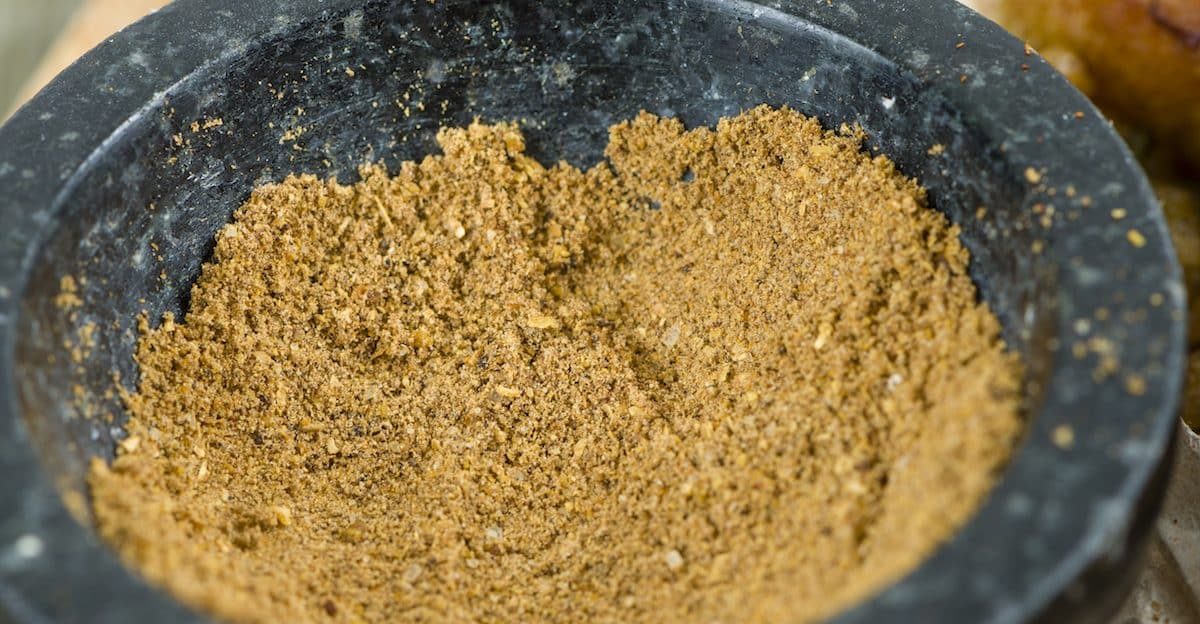
Chaat masala is a ground Indian seasoning that tastes sour, salty and faintly sulfurous. It is the finishing sprinkle on chaat, the family of savory snacks such as papri chaat and sev puri, and on cut fruit. Its character comes from two ingredients most spice blends never use: dried mango powder (amchur), which supplies the sourness, and black salt (kala namak), which supplies the eggy aroma.1 This page covers what goes into it, the chemistry behind that smell, how to use it, and how to buy and store it.
At a glance
| What it is | A ground seasoning blend; recipes differ from cook to cook12 |
| Core ingredients | Amchur, black salt, roasted cumin and black pepper in both recipes compared below12 |
| Taste | Tangy and salty, with the sulfurous note of black salt123 |
| Where the smell comes from | Hydrogen sulfide in black salt; about 200 mg/kg in one sample tested by Germany’s BfR3 |
| Used | Sprinkled over chaat, fruit, vegetables, snacks, yogurt and curries12 |
| Cooked? | Usually not; added at the end or at the table12 |
| Official standard | None found; the USDA spice-blend specification does not include it4 |
| Keeps | Up to 2 to 3 months (Tarla Dalal)1 |
What is in it
There is no fixed formula. Two published recipes show the common core and where cooks diverge:
| Recipe | Ingredients | Roasting | Source |
|---|---|---|---|
| Tarla Dalal | Cumin seeds, black peppercorns, dried mango powder, black salt, asafoetida, salt | Cumin seeds dry-roasted about 1 minute; peppercorns not roasted | 1 |
| Anupa Kurian, Gulf News | 1 tbsp amchur, 1 tbsp black salt, 1 tbsp roasted cumin powder, 1/4 tbsp black pepper, 1/4 tsp Kashmiri chili powder (optional), 1/4 tsp Himalayan pink salt | Uses ready-roasted cumin | 2 |
Both recipes rest on the same four ingredients: amchur, black salt, roasted cumin and black pepper. Tarla Dalal adds asafoetida; Gulf News adds optional Kashmiri chili and a little pink salt.12 In the Gulf News version, black salt makes up a full tablespoon, as much as the amchur or the cumin, so this is a salty seasoning as well as a spice blend.2 Coriander, which often appears in lists of chaat masala ingredients, is in neither recipe.
Tarla Dalal assigns each ingredient a job: amchur gives the tangy taste, and black salt gives the classic chatpata aroma and flavor.1
Flavor and the chemistry behind it
Chaat masala hits sour first, then salt, then a toasty cumin warmth and a mild bite from pepper. That description is ours. The compounds behind it are known for some ingredients and not for others:
| Ingredient | What is behind its flavor | Source |
|---|---|---|
| Black salt | Hydrogen sulfide, measured semi-quantitatively at about 200 mg/kg in one imported sample; the gas smells of rotten eggs | 3 |
| Cumin | Cuminaldehyde, 20 to 72% of the essential oil | 5 |
| Black pepper | Piperine, the main pungent alkaloid | 6 |
| Amchur | Tangy taste (Tarla Dalal); no analysis of its acids was found among the sources checked | 1 |
The black salt finding comes from a 2003 opinion by Germany’s Federal Institute for Risk Assessment (BfR), which assessed hydrogen sulfide in black salt using a sample imported from Britain. The BfR describes the salt as a very light, finely ground special salt, used mainly in fruit salads and chutneys, and notes that its sulfurous taste is the one cooks want.3 No analysis of a finished chaat masala blend was found.
How chaat masala is used
Tarla Dalal calls chaat masala multipurpose. It goes over sukha puri, sev puri, papri chaat and fruit or vegetable chaat, and into drinks and sandwiches.1 Gulf News suggests sprinkling it over fruit, crisps, curries or yogurt.2 It is generally a finishing seasoning rather than something cooked into a base; neither recipe asks for it to be fried or simmered.12
Practical points, from common practice rather than measurement:
- Taste before salting. Because the blend carries black salt, a dish seasoned with it may need less ordinary salt.
- To make your own, roast the cumin only until fragrant. Tarla Dalal warns against burning it.1
For a ready-made swap, see chaat masala substitutes.
Buying and quality
The USDA’s specification for spice blends names fifteen blends, from barbecue to jerk seasoning, but not chaat masala,4 and no other standard for it was found. The ingredient list is the guide. Look for amchur and black salt near the top; a blend without them will not taste like chaat masala. Some recipes add ordinary salt as well as black salt (Tarla Dalal’s does),1 so check whether salt is listed.
Storage
Tarla Dalal says the blend keeps 2 to 3 months in an airtight container, refrigerated or at room temperature.1 Gulf News says simply to store it in an airtight jar.2 These are recipe guidance, not measured shelf lives. If it has lost its sour, eggy smell when you open the jar, it has faded.
Safety
Black salt. The BfR concluded that, although the available data did not allow a firm statement on the toxicological relevance of hydrogen sulfide in black salt, the salt poses no health risk to consumers when used as intended in Indian cooking. Its reasoning noted that black salt is used very sparingly and that such consumption is only occasional.3
Lead in spices generally. A New York City health department review of 1,496 spice samples collected from 2008 to 2017 found detectable lead in more than half.7 The abstract does not break results out by blend, so it says nothing specific about chaat masala.
Salt. Because black salt is a major ingredient, chaat masala adds sodium. No published sodium figure for chaat masala was found among the sources checked.
Health claims
Widely repeated lists credit chaat masala’s spices with treating diabetes, lowering blood pressure and aiding digestion. No regulator or systematic review we found supports such claims for the blend, and this page makes none.
Substitutes and comparisons
The main ingredients: mango powder, black salt, cumin, black pepper, asafoetida, chili powder and Himalayan salt.
Footnotes
-
Tarla Dalal, “Chaat Masala (Chaat Masala Recipe for Chaats)”, TarlaDalal.com. cdn.tarladalal.com · Publication ↩ ↩2 ↩3 ↩4 ↩5 ↩6 ↩7 ↩8 ↩9 ↩10 ↩11 ↩12 ↩13 ↩14 ↩15 ↩16
-
Anupa Kurian, “Homemade Indian chaat masala”, Gulf News, 2022. gulfnews.com · Publication ↩ ↩2 ↩3 ↩4 ↩5 ↩6 ↩7 ↩8 ↩9 ↩10 ↩11
-
BfR, “Vorkommen von Schwefelwasserstoff in ‘Schwarzsalz’”, opinion of 25 August 2003. bfr.bund.de · Regulator ↩ ↩2 ↩3 ↩4 ↩5
-
Commercial Item Description A-A-20001C, Spices and Spice Blends, USDA Agricultural Marketing Service, 2023. ams.usda.gov · Regulator ↩ ↩2
-
P.C.M. Jansen, Cuminum cyminum, Plant Resources of South-East Asia (PROSEA). uses.plantnet-project.org · Reference work ↩
-
McNamara, Randall and Gunthorpe, “Effects of piperine at the human vanilloid receptor (TRPV1)”, British Journal of Pharmacology, 2005. pmc.ncbi.nlm.nih.gov · Peer-reviewed ↩
-
Hore et al., “A Spoonful of Lead: A 10-Year Look at Spices as a Potential Source of Lead Exposure”, Journal of Public Health Management and Practice, 2019. scholars.mssm.edu · Peer-reviewed ↩