Spices · Profile
Himalayan Salt: Where It Comes From, What’s in It, and What the Claims Are Worth
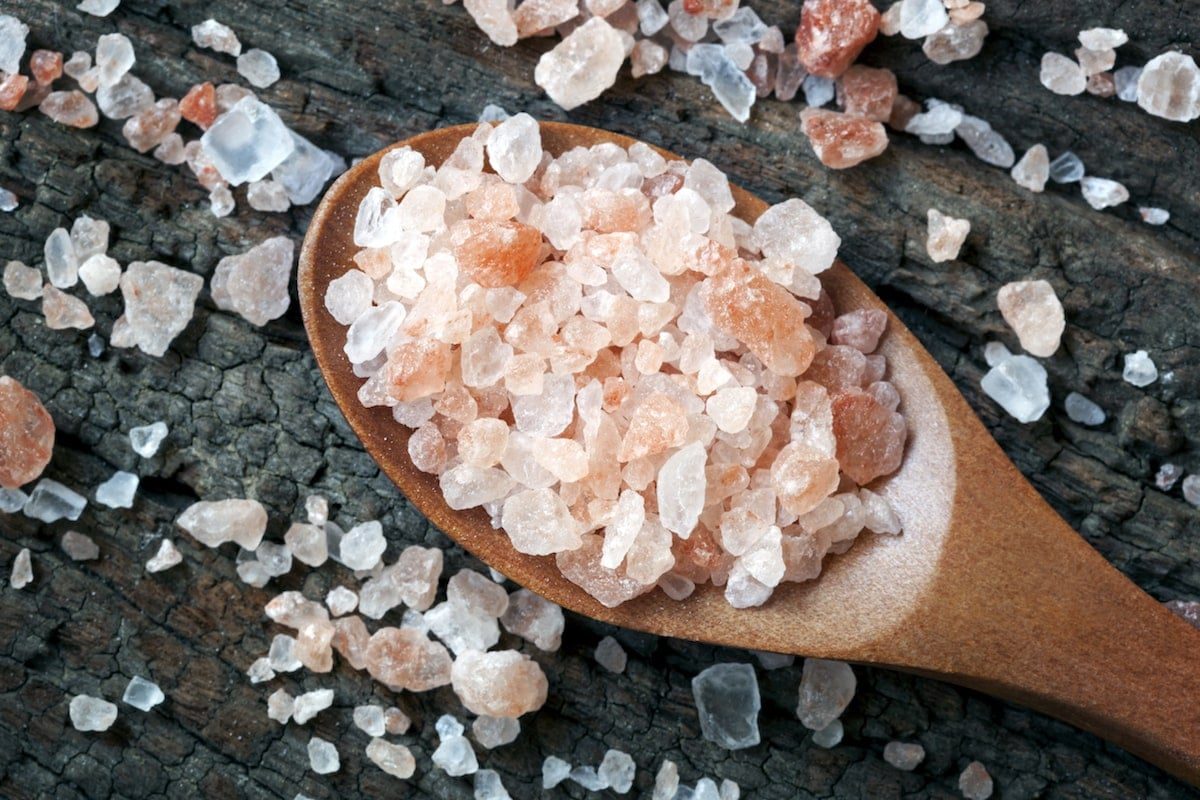
Himalayan salt, usually sold as Himalayan pink salt, is rock salt mined in Pakistan and colored pink by traces of iron oxide.1 It is still overwhelmingly sodium chloride. It also carries more calcium, iron, magnesium and potassium than white table salt, but a 2020 analysis of 31 pink salts found that you would have to eat more than 30 grams of it a day, about six teaspoons, before those minerals made a meaningful difference to your diet, and at that point the sodium would far outweigh any benefit.1 This page covers where it comes from, what is measurably in it, the marketing claims, and how to use it.
At a glance
| What it is | Rock salt (mined sodium chloride) with trace minerals; color from traces of iron oxide1 |
| How it’s made | Mined from underground rock salt deposits in Pakistan12 |
| Main source | Pakistan; the state-owned PMDC is the registrant of the geographical indication “Khewra Pink Rock Salt”12 |
| Crystal form | Sold ground fine or coarse, and as blocks; color ranges from white through pink and dark pink to grayish2 |
| Additives | Usually none; specialty salts including Himalayan salt are not usually iodized3 |
| Grams per teaspoon | No independent figure found. Morton’s coarse Himalayan label: 1.5 g per ¼ teaspoon4 |
| Sodium | In a study of 31 pink salts, about 1,974 mg in a 5 g teaspoon on average1 |
| International standard | Codex CXS 150-1985 (food-grade salt from rock deposits, sea or brine)5 |
Measured values
4 figures, sourced| Measure | Value | Scope | Source |
|---|---|---|---|
| Sodium Nutrient | 1,974 mg per 5 g teaspoon (about, average) | 31 pink salts bought in Sydney, Canberra and Coffs Harbour, June 2018; ICP-MS (Fayet-Moore et al., 2020) | mdpi.com |
| Sodium | 394,717.96 mg (per the paper's units; basis not stated on page) | 31 pink salts, ICP-MS (Fayet-Moore et al., 2020)White iodized control in the same study: 427,636.27; pink roughly 8% less. Each sample measured once in one laboratory | mdpi.com |
| Calcium | 2,695.09 mg (per the paper's units; basis not stated on page) | 31 pink salts, ICP-MS (Fayet-Moore et al., 2020)White control: 393.28 | mdpi.com |
| Lead | 2.59 mg/kg | one sample of 31 (the only one from Peru), Fayet-Moore et al., 2020Exceeded the 2 mg/kg limit the authors applied; 130 times the white control | mdpi.com |
Each figure is quoted as its source states it, with the samples or standard it applies to. Where sources differ, both are shown; nothing is averaged. All measured values
What Himalayan salt is
Himalayan salt is rock salt, mined rather than evaporated from seawater. Science-Based Medicine’s Harriet Hall describes the salt beds as deposited from ancient oceans about 250 million years ago and later lifted when the Himalayas formed.6 The commercial product comes from Pakistan.1 Pakistan’s state-owned Pakistan Mineral Development Corporation (PMDC) runs the Khewra mine in Jhelum district, which it calls the world’s second largest salt mine, and registered the geographical indication “Khewra Pink Rock Salt.”2 PMDC says it extracts about 1.4 million tons of rock salt a year across all its operations, not Khewra alone.2 Morton, for its part, describes its pink salt only as sourced from the Himalayan Mountains.4
A widely repeated story says that all Himalayan salt comes from Khewra, that Khewra is the world’s oldest salt mine, that it covers about 43 square miles, and that a British engineer laid out its tunnels in the 19th century. We could not open a source for any of these, so the page doesn’t repeat them as fact.
Color
The pink comes from traces of iron oxide, according to the 2020 study’s authors.1 PMDC sells salt from white through pink and dark pink to grayish.2 In the 2020 analysis, darker pink salts generally contained more minerals than paler ones.1 That finding covers pink salt bought in Australia; it says nothing about other kinds of colored salt.
What’s actually in it
The best data we found comes from a peer-reviewed study by Flavia Fayet-Moore and colleagues, published in Foods in 2020. They bought 31 pink salts in Sydney, Canberra and Coffs Harbour in June 2018, plus one iodized white table salt as a control, and measured 25 minerals by ICP-MS.1
| Finding | Result | Scope |
|---|---|---|
| Sodium | Pink salt lower than white: 394,717.96 vs 427,636.27 (mg per the paper’s units), roughly 8% less | 31 pink salts vs 1 white control1 |
| Calcium | 2,695.09 vs 393.28 (mg, same basis) | same1 |
| Also higher in pink salt | Iron, magnesium, manganese, potassium; among non-nutrients, aluminum, barium, silicon, sulfur | same1 |
| One teaspoon (5 g) | No clinically significant contribution to nutrient intake except sodium | same1 |
| Amount needed to matter | More than 30 g a day (about 6 teaspoons), which would exceed the sodium target by 592% | same1 |
| Lead | One sample, the only one from Peru, had 2.59 mg/kg against the 2 mg/kg limit the authors applied, 130 times the white control | 1 of 31 samples1 |
| Cadmium, arsenic, mercury | Did not exceed limits | 31 samples1 |
The authors caution that each sample was measured once in one laboratory and that some subgroups were very small.1 Their conclusion is that any benefit from pink salt’s extra minerals would be counteracted by the sodium that comes with them.1
The “84 minerals” claim
Himalayan salt is widely advertised as containing 84 trace minerals. We could not trace that number to any published laboratory analysis. The 2020 study measured 25 minerals and does not mention it.1 Harriet Hall traces the figure to marketing, including a supplement seller’s own product copy, and points out that the elements on such lists include poisons such as mercury, arsenic, lead and thallium and radioactive elements such as radium, uranium and polonium. She argues that the health claims rest on minerals present only in minute amounts.6 Treat “84 minerals” as a marketing figure with no traceable analysis behind it.
Flavor
Himalayan salt tastes like salt. It is often described as milder or less bitter than table salt, but we found no taste test that supports that. In the 2020 analysis, pink salt had roughly 8% less sodium by weight than the one white salt tested.1 Coarse grains give crunch on the surface of food, which is the main reason to choose it; that is a kitchen judgment.
How it’s used
Fine pink salt can be used like any other salt. Coarse crystals go in grinders or on food as a finishing salt, where the color shows. Salt blocks and slabs are sold for heating and cooking on, or chilling and serving from; we found no published testing of how much salt they transfer to food, so treat that as a matter of taste. For techniques, see cooking with Himalayan salt.
Measuring
Morton’s conversion chart, which it says applies only between Morton products, treats a teaspoon of table salt as equal to a teaspoon of its coarse or fine Himalayan pink salt, but 1 cup of table salt as equal to 1 cup plus 2 tablespoons of coarse Himalayan salt.7 Morton’s own coarse Himalayan label lists 1.5 g per ¼ teaspoon, the same as its table salt label.4 Those two Morton figures don’t line up exactly at larger volumes, and we found no independent measurement, so for baking, weigh it.
Buying and quality
Look for a country of origin and an ingredient list that says only salt; Morton’s, for example, lists “Salt.”4 Pakistan’s PMDC is the registrant for “Khewra Pink Rock Salt” as a geographical indication.2 Because the 2020 study found one pink salt over the lead limit the authors used, the place of origin is worth knowing; in that study, the high-lead sample was the only one from Peru, so “pink salt” on a label does not by itself mean Pakistani rock salt.1
Storage
We found no shelf-life figure for Himalayan salt from a regulator or standards body. It needs only to be kept dry.
Safety and health claims
Blood pressure and sodium
Himalayan salt is sometimes promoted as better for blood pressure because coarse crystals put less salt in a teaspoon. Any salt with larger crystals holds less sodium per teaspoon only because fewer crystals fit, and the American Heart Association says that for heart health, total sodium intake is what matters most.8 In the 2020 analysis, a 5 g teaspoon of pink salt still held about 1,974 mg of sodium.1 The FDA’s Daily Value for sodium is less than 2,300 mg a day; the WHO recommends adults stay under 2,000 mg.910
Iodine
Himalayan salt is not a source of iodine. The NIH Office of Dietary Supplements lists Himalayan salt among the specialty salts that are not usually iodized.3 Iodine is an essential nutrient; if you use only pink salt and rely on salt for iodine, see iodized vs. non-iodized salt.
Other health claims
Claims that Himalayan salt detoxifies the body, lowers blood pressure or strengthens bones are collected and rejected in Harriet Hall’s review as unsupported by evidence.6 The 2020 analysis, the only laboratory study we found that set out to test pink salt’s nutritional value, found no meaningful benefit at normal intakes.1 This page makes no claim that Himalayan salt treats or prevents any condition.
Microplastics
In a 2018 study of 39 salt brands from 21 countries and regions, microplastic contamination was highest in sea salt, then lake salt, then rock salt, according to a Greenpeace press release on the study.11 The release does not give separate figures for pink or Himalayan salt.
Substitutes and comparisons
Any salt can replace Himalayan salt by weight; only the color and crunch are lost. Comparisons:
- Himalayan salt vs. table salt
- Himalayan salt vs. sea salt
- Kosher salt vs. Himalayan salt
- Celtic salt vs. Himalayan salt
- Alaea salt vs. Himalayan salt
- Fleur de sel vs. Himalayan salt
Related salts: rock salt and black salt.
Footnotes
-
Fayet-Moore F et al., An Analysis of the Mineral Composition of Pink Salt Available in Australia, Foods, 2020. mdpi.com · Peer-reviewed ↩ ↩2 ↩3 ↩4 ↩5 ↩6 ↩7 ↩8 ↩9 ↩10 ↩11 ↩12 ↩13 ↩14 ↩15 ↩16 ↩17 ↩18 ↩19 ↩20 ↩21 ↩22 ↩23 ↩24
-
Pakistan Mineral Development Corporation, home page. pmdc.gov.pk · Merchant ↩ ↩2 ↩3 ↩4 ↩5 ↩6 ↩7
-
Iodine: Fact Sheet for Health Professionals, NIH Office of Dietary Supplements. ods.od.nih.gov · Regulator ↩ ↩2
-
Morton Coarse Himalayan Pink Salt, product page, Morton Salt. mortonsalt.com · Merchant ↩ ↩2 ↩3 ↩4
-
Standard for Food Grade Salt, CXS 150-1985 (rev. 2012), Codex Alimentarius. services.bis.gov.in · Standard ↩
-
Harriet Hall, Pink Himalayan Sea Salt: An Update, Science-Based Medicine, 2017. sciencebasedmedicine.org · Publication ↩ ↩2 ↩3
-
Salt Conversion Chart, Morton Salt. mortonsalt.com · Merchant ↩
-
Sodium Sources: Where Does All That Sodium Come From?, American Heart Association, 2025. heart.org · Reference work ↩
-
Sodium in Your Diet, U.S. Food and Drug Administration. fda.gov · Regulator ↩
-
Sodium reduction, World Health Organization fact sheet, 2026. who.int · Regulator ↩
-
Over 90% of sampled salt brands globally found to contain microplastics, Greenpeace International press release, 2018, on Kim J-S et al., Environmental Science & Technology, 2018. greenpeace.org · Publication ↩