Seasonings · Profile
Chili Powder: What’s in the Blend, How Hot It Is, and Who Invented It
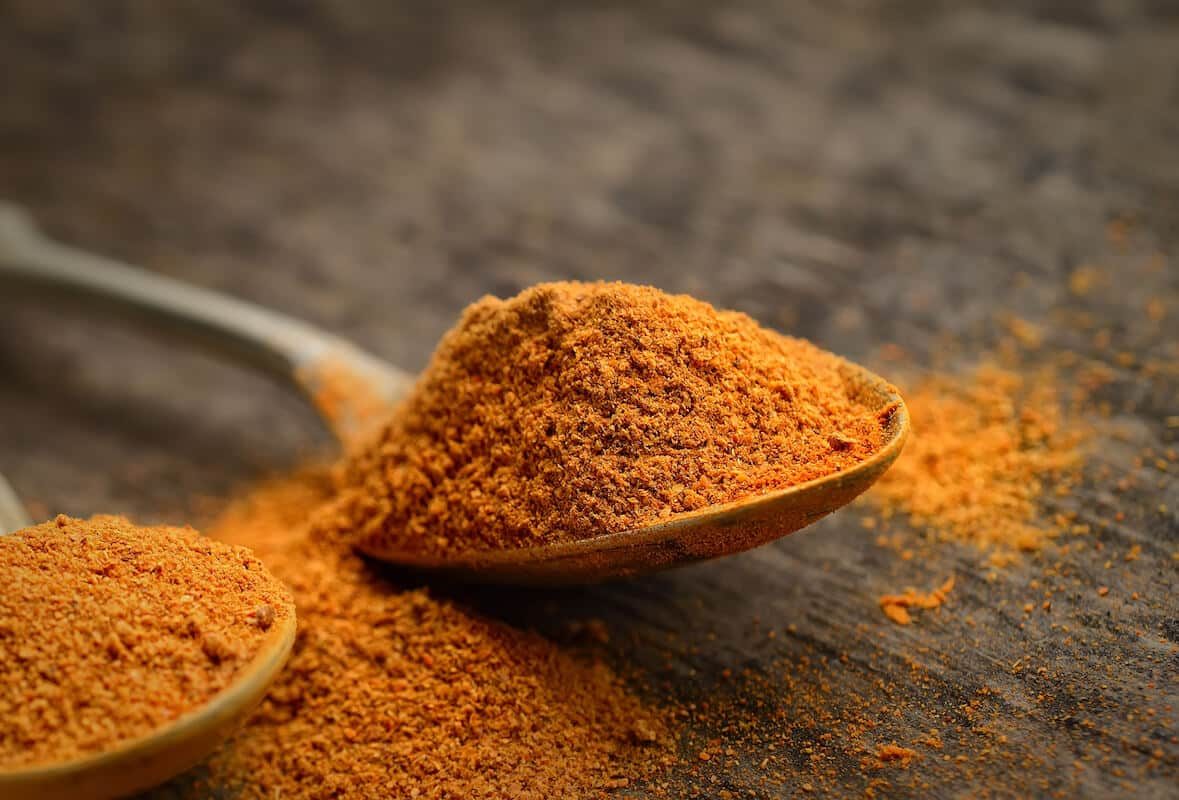
In the United States, chili powder is a blend: ground dried chile with cumin, oregano, garlic and usually salt. The international food standard for dried chile, by contrast, treats ground chile as chile alone. Knowing which one a recipe means matters more than any other fact about the jar. This page covers what goes into the American blend, how hot it is meant to be, who invented it, how to use it, and what the nutrition and safety records show.
At a glance
| What it is (US) | A blend of ground chili pepper, cumin, oregano, salt and garlic powder, per USDA’s purchasing specification1 |
| Usual chile | Ancho, according to Saveur2 |
| Chile species | Capsicum annuum for USDA’s chili powder entry3; native from the southern US to Brazil and the Caribbean4 |
| Heat | 900–2,000 Scoville heat units in USDA’s specification (federal purchases only); see the table below1 |
| Color | Reddish-brown, per the same specification1 |
| First sold | Texas, 1890s; who was first is disputed (see History)56 |
| Forms sold | Ground blend; also mild, hot and dark styles from individual makers |
Measured values
7 figures, sourced| Measure | Value | Scope | Source |
|---|---|---|---|
| Pungency (Scoville) Limit | 900–2,000 SHU | chili powder bought under USDA purchasing specification A-A-20001C (2023), federal purchases onlyA purchasing specification, not a survey of store shelves | ams.usda.gov |
| Sodium Nutrient | 2,870 mg per 100 g | USDA FoodData Central FDC 171319, "Spices, chili powder" | fdc.nal.usda.gov |
| Vitamin A (RAE) Nutrient | 1,480 µg per 100 g | USDA FoodData Central FDC 171319 | fdc.nal.usda.gov |
| Vitamin E (alpha-tocopherol) Nutrient | 38.1 mg per 100 g | USDA FoodData Central FDC 171319 | fdc.nal.usda.gov |
| Iron Nutrient | 17.3 mg per 100 g | USDA FoodData Central FDC 171319 | fdc.nal.usda.gov |
| Dietary fiber Nutrient | 34.8 g per 100 g | USDA FoodData Central FDC 171319 | fdc.nal.usda.gov |
| Vitamin C Nutrient | 0.7 mg per 100 g | USDA FoodData Central FDC 171319 | fdc.nal.usda.gov |
Each figure is quoted as its source states it, with the samples or standard it applies to. Where sources differ, both are shown; nothing is averaged. All measured values
Two things called chili powder
The American blend. USDA’s Commercial Item Description for spices, the specification federal buyers use, says chili powder should include, but is not limited to, ground chili pepper, cumin, oregano, salt and garlic powder, and that it must be reddish-brown and free from lumps.1 Saveur describes it the same way: dried chiles, usually ancho, with oregano, cumin, garlic and sometimes salt.2 PepperScale likewise says store-bought chili powders often use a lower-heat pepper such as poblano (the fresh form of ancho) as their chile base, which is why they are typically mild.7 The words “not limited to” are the point: each maker sets its own recipe, and USDA lists chili powder separately from plain ground red pepper and paprika.1
Pure ground chile. The Codex Alimentarius standard for dried chilli pepper and paprika (CXS 353-2022) covers chile that is whole, crushed or flaked, or ground to a powder, made by drying the fruits of Capsicum species.8 Under that standard, ground chilli is chile alone; it does not mention spice blends at all.8 Korean gochugaru, single-chile powders such as ancho, guajillo, pasilla and chile de árbol, and most “chilli powder” sold outside North America belong in this group.
In our judgment, a recipe from outside North America that calls for “chilli powder” usually means the second kind, with no cumin or oregano; check the recipe’s origin and the label.
Flavor and what drives it
A typical American chili powder tastes earthy and warm first, from the cumin, with a mild, slightly sweet and raisiny chile base and a green, faintly bitter edge from the oregano. Garlic and salt round it out. That description is ours, and any given brand can lean hotter, smokier or saltier.
Each component brings its own chemistry; see the profiles for detail:
- Chile. Ancho, the chile Saveur names as usual in the blend,2 is described by the Chile Pepper Institute at New Mexico State University as having sweet, smoky flavors with hints of dried fruit.9 Heat comes from capsaicinoids; see cayenne pepper for how chile heat is measured.
- Cumin. The aroma comes from its essential oil, led by cuminaldehyde. See cumin.
- Oregano. Many Southwestern recipes use Mexican oregano, a different plant; see Mexican oregano vs. oregano.
How hot is chili powder?
The figures below are not measuring the same thing, so they are shown side by side and not combined:
| Scope | Heat | Source |
|---|---|---|
| Chili powder bought under USDA’s federal purchasing specification | 900–2,000 SHU | USDA AMS, A-A-20001C (2023)1 |
| Dried chilli pepper (chile only, whole or crushed) under the international standard | 900 SHU or more | Codex CXS 353-20228 |
| Ancho, as a pepper type (Chile Pepper Institute’s general figure, not a lot measurement) | 1,000–2,000 SHU | NMSU Chile Pepper Institute9 |
| Retail chili powder brands | No published measurement found |
How to read this:
- The USDA range is a purchasing specification, the heat a federal buyer will accept. It tells you the American blend is meant to be mild, but it is not a survey of what is on store shelves.1
- The Codex figure applies to chile, not blends. The standard uses Scoville heat units as its pungency criterion and draws the line between paprika (480 SHU or less), hot paprika (above 480 and below 900) and chilli pepper (900 or more).8 A blend diluted with cumin, oregano and salt is outside its scope.
- Pure chile powders depend on the chile. See cayenne pepper for that chile’s published figures and their scope.
History
The word. “Chili” entered English in the 1640s from Nahuatl chilli, the native name for the peppers.10 The plant is American: Kew gives the native range of Capsicum annuum as the southern United States to Brazil and the Caribbean,4 and a 2014 study combining genetics, ecology, archaeobotany and historical linguistics found that all four lines of evidence pointed to domestication in central-east Mexico.11 Two claims often attached to this history, that people have eaten chiles since 7500 BCE and that Columbus named them “peppers” because they tasted like black pepper, could not be traced to a source checked for this page.
Who invented chili powder? It is usually credited to William Gebhardt of New Braunfels, Texas, but the record supports a rival and more than one date:
- DeWitt Clinton Pendery, a Fort Worth grocer, was marketing a chili blend called Chiltomaline in local newspapers by 1890, according to D Magazine.6 Saveur also dates his seasoning powder to 1890 and says it failed to catch on; Barry Popik gives about 1890.212
- William Gebhardt opened a café in New Braunfels in 1892, imported ancho chiles from Mexico and ground them repeatedly in a meat grinder.5 The year he began selling powder varies: 1894 in the New Braunfels Herald-Zeitung’s account,13 or 1896, when he registered the Eagle Brand trademark and opened a factory in San Antonio.5214 He first sold it as “Tampico Dust.”1314 Chili historian Joe Cooper credited Gebhardt with first grinding dried chiles in a meat grinder.6
- The earliest dated advertisement Barry Popik found for “Gebhardt’s Chili Powder” ran in the Laredo Daily Times on 20 October 1897.12
What went into Gebhardt’s first blend is thinly documented. The 2019 Herald-Zeitung article says he ground chiles with cumin seed, oregano and black pepper;13 the UTSA Libraries collection description names only ancho.5 Popular accounts also say Gebhardt’s powder made Tex-Mex cooking popular across the United States; no source checked for this page shows that.
How it is used
- Chili con carne. The defining use. For how chili powder works alongside whole chiles, cumin and oregano in different styles of chili, see best spices for chili.
- Tex-Mex fillings and sauces. By common practice it seasons the meat for tacos, burritos and enchiladas; see taco seasoning, spices for taco meat and fajita seasoning.
- Rubs. It is a common base for barbecue dry rubs; see BBQ spices.
Technique. Many cooks warm chili powder briefly in oil before adding liquid, which takes the raw edge off the cumin and chile; it scorches quickly over high heat. This is kitchen practice, not a measured finding.
Salt. Because most blends contain salt (USDA lists it as an ingredient1), taste before salting a dish seasoned heavily with chili powder.
Buying and quality
- Read the ingredient list. It tells you which kind you are buying. A label that lists only chile is pure ground chile; one that lists cumin, oregano and garlic is the American blend.
- Color. The USDA specification calls for reddish-brown.1 A dull, brownish-gray powder has likely faded; that part is kitchen judgment.
- Heat. Few retail jars state a heat level. “Hot” and “mild” labels are each maker’s own.
Storage
Keep it airtight, dark and away from the stove. No published shelf-life figure from a regulator or standards body was found for chili powder. PepperScale says to expect up to three years if it is stored correctly, with pungency fading gradually even so; that is a publication’s rule of thumb, not a tested figure.15 It notes that a dry powder usually does not turn rancid, that mold or clumping from moisture means it should be thrown out, and that a jar more than a year old is worth smelling and tasting before use.15 If the color has dulled and the cumin smell is faint, replace it.
Nutrition and health
Per USDA FoodData Central’s chili powder entry (one SR Legacy record), 1 teaspoon weighs 2.7 g.3 Per teaspoon, that works out to:
| Nutrient | Per 100 g3 | Per 1 tsp (2.7 g), computed | % Daily Value per tsp16 |
|---|---|---|---|
| Sodium | 2,870 mg | about 77 mg | about 3% (DV 2,300 mg) |
| Vitamin A (RAE) | 1,480 µg | about 40 µg | about 4% (DV 900 µg) |
| Vitamin E (alpha-tocopherol) | 38.1 mg | about 1.0 mg | about 7% (DV 15 mg) |
| Iron | 17.3 mg | about 0.47 mg | about 3% (DV 18 mg) |
| Dietary fiber | 34.8 g | about 0.94 g | about 3% (DV 28 g) |
| Vitamin C | 0.7 mg | under 0.1 mg | about 0% (DV 90 mg) |
In the amounts used for seasoning, chili powder is a minor source of these nutrients. Salt is one of the ingredients USDA’s specification lists for the blend.1
Capsaicin. The strongest human evidence on capsaicin concerns a prescription skin patch, not food. A 2017 Cochrane systematic review found moderate-quality evidence that a high-concentration (8%) capsaicin patch gave moderate pain relief to a minority of people with postherpetic neuralgia, with about 10% more people much or very much improved than on placebo.17 Claims that chili powder or its ingredients aid digestion, fight fungi or reduce inflammation were not supported by any source reviewed for this page, and no claim is made here that chili powder treats or prevents any disease.
Safety
- Mycotoxins (EU). EU law caps ochratoxin A at 20 µg/kg in dried Capsicum fruits, a category it says includes chilli powder, cayenne and paprika, and sets 5.0 µg/kg for aflatoxin B1 and 10.0 µg/kg for total aflatoxins in dried Capsicum.18 The regulation’s wording covers chile products; it does not address blends.
- Handling. Wash hands after handling chile powders and keep them away from your eyes. This is common-sense guidance rather than a sourced finding.
Substitutes and comparisons
- Chili powder substitutes
- Paprika vs. chili powder
- Single chiles and powders: ancho powder, chipotle powder, cayenne pepper, paprika, red pepper flakes
- The other ingredients: cumin, oregano
Footnotes
-
Commercial Item Description A-A-20001C, Spices and Spice Blends, USDA Agricultural Marketing Service, 2023. ams.usda.gov · Regulator ↩ ↩2 ↩3 ↩4 ↩5 ↩6 ↩7 ↩8 ↩9 ↩10
-
Chili Powder, Saveur, 2009. saveur.com · Publication ↩ ↩2 ↩3 ↩4 ↩5
-
Spices, chili powder (FDC 171319), USDA FoodData Central. fdc.nal.usda.gov · Regulator ↩ ↩2 ↩3
-
Capsicum annuum L., Plants of the World Online, Royal Botanic Gardens, Kew. powo.science.kew.org · Reference work ↩ ↩2
-
Mexican Foods Company Collection (Gebhardt), UTSA Libraries Special Collections. lib.utsa.edu · Reference work ↩ ↩2 ↩3 ↩4
-
Kathy Wise, The Man Who Invented Chili Powder, D Magazine, 2018. dmagazine.com · Publication ↩ ↩2 ↩3
-
Matt Bray, Spicy Homemade Chili Powder, PepperScale, updated 2026. pepperscale.com · Publication · PepperScale is also owned by Matt Bray, the editor of this site. ↩
-
Standard for Dried or Dehydrated Chilli Pepper and Paprika, CXS 353-2022, Codex Alimentarius. fao.org · Standard ↩ ↩2 ↩3 ↩4
-
Ancho recipe card, Chile Pepper Institute, New Mexico State University. cpi.nmsu.edu · Reference work ↩ ↩2
-
chili (n.), Online Etymology Dictionary. etymonline.com · Reference work ↩
-
Kraft et al., Multiple lines of evidence for the origin of domesticated chili pepper, PNAS, 2014. escholarship.org · Peer-reviewed ↩
-
Chili Powder, Barry Popik, The Big Apple. barrypopik.com · Reference work ↩ ↩2
-
Lindsey Carnett, Chili powder has its roots in New Braunfels, New Braunfels Herald-Zeitung, 2019. herald-zeitung.com · Publication ↩ ↩2 ↩3
-
These early Tex-Mex recipes come from “Mexican Cookery for American Homes”, Hagley Museum and Library, 2023. hagley.org · Reference work ↩ ↩2
-
Matt Bray, Does Chili Powder Go Bad?, PepperScale. pepperscale.com · Publication · PepperScale is also owned by Matt Bray, the editor of this site. ↩ ↩2
-
Daily Value on the Nutrition and Supplement Facts Labels, FDA. fda.gov · Regulator ↩
-
Derry et al., Topical capsaicin (high concentration) for chronic neuropathic pain in adults, Cochrane Database of Systematic Reviews, 2017. cochrane.org · Peer-reviewed ↩
-
Commission Regulation (EU) 2023/915, EUR-Lex. eur-lex.europa.eu · Regulator ↩