Spice Comparisons · Comparison
Genovese Basil vs. Thai Basil: One Species, Two Very Different Oils
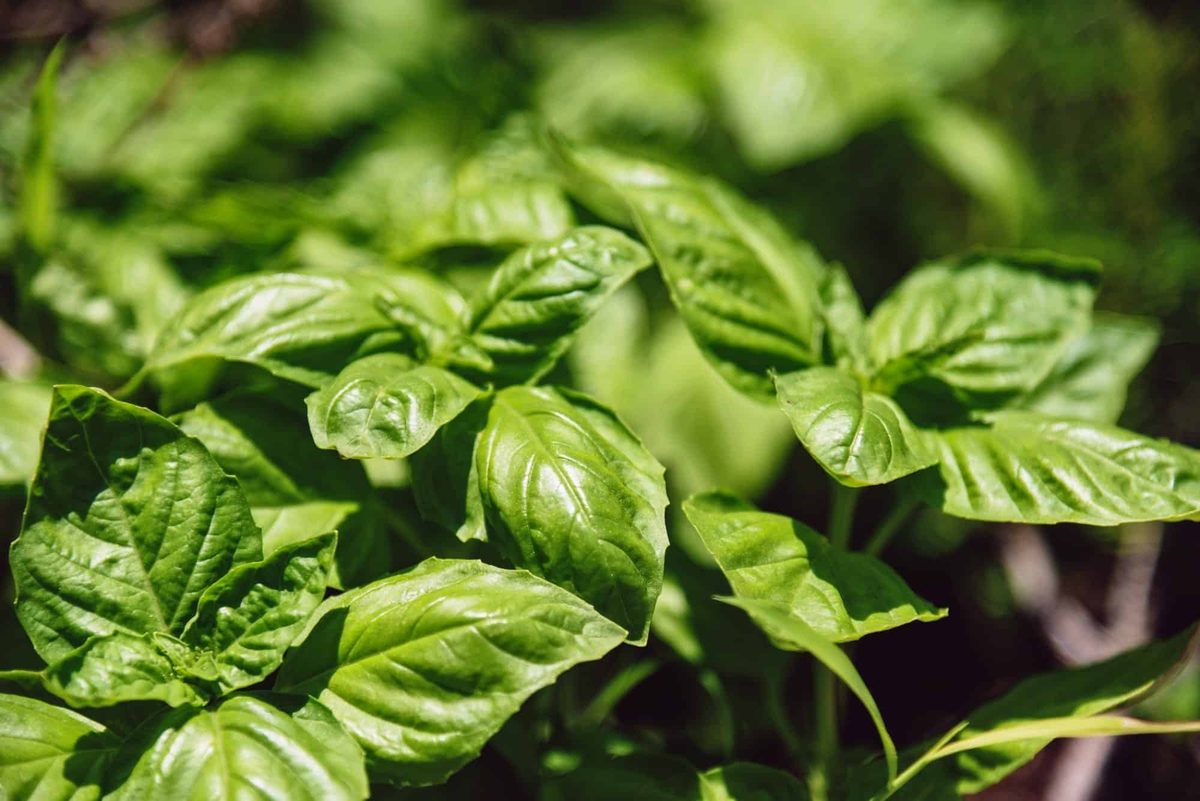
Genovese basil and Thai basil are the same species, Ocimum basilicum, but they smell like different herbs. Genovese is the large-leaved Italian pesto basil; Thai basil is a cultivated form sold in Thai as horapha.123 When Purdue University researchers grew both side by side, the Genovese oil was led by linalool, while most of the Thai basil lots were dominated by methylchavicol, also called estragole, the compound that makes up 60 to 75% of tarragon oil.435 That one difference explains most of what changes in the pan.
Side by side
| Genovese basil | Thai basil | |
|---|---|---|
| Species | Ocimum basilicum, a cultivar group of sweet basil41 | Ocimum basilicum; often labeled var. thyrsiflora, a name Kew treats as a synonym of ordinary sweet basil26 |
| Family | Lamiaceae (mint family)6 | Lamiaceae (mint family)6 |
| Native range of the species | Tropical and subtropical Asia to northern Australia7 | Same species |
| Stems and flowers, 1999 US trial | Green stem, white flower4 | Purple or pale-purple stems and pink flowers in three of four lots; one lot green with white flowers4 |
| Leaves | “Very large leaves” (Herb Society)1 | No source we opened describes the leaf shape |
| Main oil compounds, same trial | Linalool 77%, 1,8-cineole 12%4 | Methylchavicol 60 to 90% in three lots; one lot 13%4 |
| Flavor (editorial) | Sweet and green, with clove and a peppery edge | Strong anise or licorice, with a peppery bite |
| Protected form | Basilico Genovese PDO, Liguria only8 | None |
| Typical uses | Pesto above all1 | Thai stir-fries and green curry; raw with Vietnamese pho910 |
| Safety | Estragole and methyleugenol, assessed by EU and German regulators (see below)115 | Same compounds, same assessments115 |
| Price | No dated, sourced retail comparison found | No dated, sourced retail comparison found |
The flavor row is our description; the chemistry below supports the anise half of it. For each herb in depth, see the Genovese basil and Thai basil profiles.
The difference in the oil
Because both herbs were grown in the same 1999 Purdue field trial, from seed sold by North American suppliers and distilled the same way, their oils can be compared directly:4
| Cultivar (one seed lot each) | Stem / flower | Oil yield | Major aroma compounds |
|---|---|---|---|
| ‘Genovese’ | green / white | 0.90% | Linalool 77%, 1,8-cineole 12% |
| ‘Sweet Thai’ | purple / pink | 0.40% | Methylchavicol 60%, linalool 6% |
| ‘Thai’ (Companion Plants) | purple / pink | 0.75% | Methylchavicol 65%, linalool 12% |
| ‘Thai’ (Richters) | pale-purple / pink | 0.52% | Methylchavicol 90% |
| ‘Thai’ (Rupp Seeds) | green / white | 0.25% | Linalool 15%, methylchavicol 13% |
Three of the four Thai lots were dominated by methylchavicol; the fourth, the only one with green stems and white flowers, had a profile closer to the sweet basils.4 The Purdue authors also describe a basil oil type, produced more recently in Madagascar, Thailand and Vietnam, as characterized by high concentrations of methylchavicol.4 So a seed packet labeled “Thai” did not guarantee the methylchavicol-rich profile in this trial.
Two other studies point the same way, in different scopes. A 2018 Chiang Mai University study found Thai basil oil from plants grown in northern Thailand led by estragole, followed by geranial and neral, and linked it to anise, lime-like and fresh aromas.12 On the Genovese side, Italian researchers found methyleugenol and eugenol as the main components of young ‘Genovese Gigante’ plants.13 Those studies used different plants, ages and units, so their numbers are not set against the Purdue table.
How to tell them apart
Across O. basilicum, PROSEA records stems that are smooth or hairy when young and light green to dark purple, so color alone does not settle which basil you have.3 What PROSEA gives as the mark of the Thai type, var. thyrsiflorum, is the flower head: densely branched, with loose whorls of flowers.3 In the Purdue trial, most Thai lots had purple stems and pink flowers against Genovese’s green stem and white flower, and the Thai plants were shorter (35 to 41 cm against 49 cm).4
Andy Ricker warns that the label “holy basil” is sometimes put on purple-stemmed Thai or sweet basil.14 Holy basil is a separate species; see Thai basil vs. holy basil. The surest test is to rub a leaf: Thai basil smells plainly of anise. That is kitchen judgment.
Differences that change the dish
When it goes in. LSU AgCenter groups basil with the delicate herbs best added a minute or two before cooking ends, because long heat costs flavor and aroma,15 and the Herb Society advises adding basil in the last few minutes.1 That suits Genovese. Sherri Pengjad of Thai Foodie says Thai basil is sturdier and holds up much better in hot dishes, and she stirs it into green curry right before serving.9 Both herbs, then, go in late. We found no test of how long either survives a simmer.
Pesto. Genovese is the pesto basil; the Herb Society calls it “an ideal pesto basil.”1 A methylchavicol-rich Thai basil would put anise at the center of a pesto; that is our reading of the chemistry, not a tasting result.
Raw on the plate. In Vietnamese cooking, Andrea Nguyen lists Thai basil on her pho garnish plate, adding it when it is in season and telling readers to add or subtract herbs as they like.10 Genovese leaves are just as edible raw, but their flavor reads as Italian; that is editorial.
Italian and Thai classics. PROSEA lists pizzas, pasta, chicken and cheese dishes, and pesto as Italian uses of sweet basil,3 and calls sweet basil, under the Thai name horapha, an important ingredient of Thai cuisine.3
Can one stand in for the other?
The amounts below follow our Thai basil substitutes page.
- Genovese for Thai basil: same amount (Attributed). Nagi Maehashi of RecipeTin Eats calls normal basil the best substitute for Thai basil, while noting that it lacks the slight aniseed flavor.16 Pengjad also names Italian basil as the best substitute.9 Pailin Chongchitnant’s pad kra pao recipe lists holy basil or regular basil in the same 1 1/4 cups and says Thai basil will also work, which treats them as interchangeable by volume.17 Add it at the very end.
- To get closer to Thai basil (Method). Pengjad suggests mixing Italian basil with a little mint, without amounts.9 No published ratio exists; start with about four parts basil to one part mint, in the same total amount, and taste.
- Thai basil for Genovese (Method). We found no source that publishes this swap. In a cooked tomato sauce it works if you accept a licorice note; start with a little less than the recipe’s basil and taste. For pesto, Caprese salad and other raw Italian uses, the anise takes over, so we would not swap. If you must use Thai basil raw, pick the leaves off the stems and slice them fine; that is kitchen judgment.
What isn’t known
- The like-for-like comparison is one 1999 field trial with one seed lot per cultivar.4 No newer study grows Genovese and Thai basil side by side.
- No source we opened describes the leaf shape or edge of Thai basil compared with Genovese.
- The claim that Thai basil tolerates long cooking better than Genovese is a cook’s observation; no test was found.
- No published ratio exists for using Thai basil in place of Genovese.
Safety
The anise compound that sets Thai basil apart, estragole, is the one regulators have examined most for basil. The EU Scientific Committee on Food concluded in 2001 that estragole is genotoxic and carcinogenic, based mainly on studies in mice, and could not set a safe exposure limit.5 Germany’s BfR said in 2022 that the risk from estragole and the related methyleugenol in food cannot yet be conclusively assessed; it named basil-containing pesto among foods that may contain high amounts and made no consumption recommendation for consumers.11 Neither body tells people to stop eating basil or singles out either type.
Related
- Genovese basil and Thai basil profiles
- Basil vs. Thai basil and Genovese basil vs. sweet basil
- Thai basil substitutes and Thai basil vs. holy basil
- Cinnamon basil vs. Thai basil, holy basil vs. basil
- Thai spices, how to store basil
Footnotes
-
Michele Meyers, Basil: An Herb Society of America Guide, The Herb Society of America, 2003. herbsociety.org · Reference work ↩ ↩2 ↩3 ↩4 ↩5 ↩6
-
Ocimum thyrsiflorum L. (synonym of O. basilicum var. basilicum), Plants of the World Online, Royal Botanic Gardens, Kew. powo.science.kew.org · Reference work ↩ ↩2
-
N.O. Aguilar, Pham Truong Thi Tho and L.P.A. Oyen, Ocimum basilicum, Plant Resources of South-East Asia (PROSEA). uses.plantnet-project.org · Reference work ↩ ↩2 ↩3 ↩4 ↩5 ↩6
-
“Comparative evaluation of North American commercially available Ocimum basil cultivars”, Table 1, Perspectives on New Crops and New Uses (1999), Purdue NewCROP. hort.purdue.edu · Peer-reviewed ↩ ↩2 ↩3 ↩4 ↩5 ↩6 ↩7 ↩8 ↩9 ↩10 ↩11
-
Opinion of the Scientific Committee on Food on Estragole, European Commission, 2001. food.ec.europa.eu · Regulator ↩ ↩2 ↩3 ↩4
-
“Basil”, Encyclopaedia Britannica, 2026. britannica.com · Reference work ↩ ↩2 ↩3
-
Ocimum basilicum L., Plants of the World Online, Royal Botanic Gardens, Kew. powo.science.kew.org · Reference work ↩
-
“Basilico Genovese” DOP, disciplinare di produzione, eAmbrosia, European Commission. webgate.ec.europa.eu · Regulator ↩
-
Sherri Pengjad, “Thai Basil: What It Is and How to Use It”, Thai Foodie, 2026. thai-foodie.com · Publication ↩ ↩2 ↩3 ↩4
-
Andrea Nguyen, “Pho Garnish Plate”, from The Pho Cookbook, via The Splendid Table, 2017. splendidtable.org · Publication ↩ ↩2
-
“Alkenylbenzenes in food: how large is the health risk?”, BfR Communication No. 22/2022. bfr.bund.de · Regulator ↩ ↩2 ↩3
-
Tangpao, Chung and Sommano, “Aromatic Profiles of Essential Oils from Five Commonly Used Thai Basils”, Foods, 2018. mdpi.com · Peer-reviewed ↩
-
Miele, Dondero, Ciarallo and Mazzei, “Methyleugenol in Ocimum basilicum L. cv. Genovese Gigante”, Journal of Agricultural and Food Chemistry, 2001 (abstract). agris.fao.org · Peer-reviewed ↩
-
Andy Ricker with J.J. Goode, “Stir-fried chicken with hot basil”, from Pok Pok, via The Splendid Table. splendidtable.org · Publication ↩
-
“Flavorful Herbs”, LSU AgCenter. lsuagcenter.com · Reference work ↩
-
Nagi Maehashi, “Thai Basil Chicken”, RecipeTin Eats, 2019 (updated 2025). recipetineats.com · Publication ↩
-
Pailin Chongchitnant, pad kra pao beef recipe, Hot Thai Kitchen. hot-thai-kitchen.com · Publication ↩