Blog · Storage
The Best Containers for Spices: Glass Jars, Tins, Plastic and Bags Compared
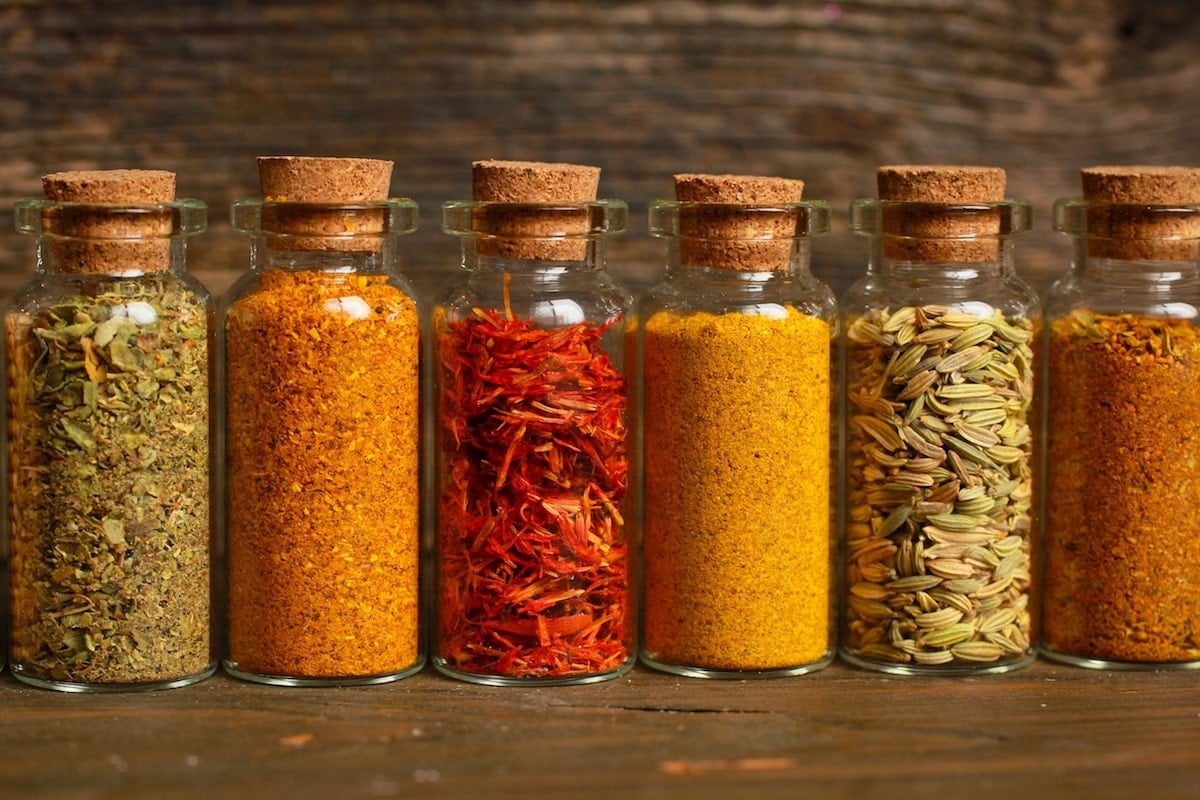
The best container for a dried spice is a small glass jar with a tight lid, kept in a cupboard or drawer away from the stove. That is the advice of the University of California Cooperative Extension and America’s Test Kitchen, which both say a tightly closed container and a dark spot matter more than anything else you can control at home.12 The container cannot stop a spice from fading, but the wrong one can speed it up. This page covers what each kind of container does well and badly, and what the evidence behind each recommendation actually is.
At a glance
| Container | Verdict | Why |
|---|---|---|
| Glass jar, tight lid | Best choice | ATK recommends glass because it does not absorb flavors and odors or react with spice oils, as plastic can.23 |
| Original glass jar from the store | Fine | ATK suggests buying spices already sold in glass if you don’t want to decant them.2 |
| Metal tin | No test found | No source we found compared tins with glass for spice quality. |
| Plastic shaker or tub | Second choice | ATK says plastic can absorb flavors and odors and react with volatile oils.23 |
| Thin plastic bag | Short term only | In one study, thin LDPE packaging let one dried herb lose most of its aroma compounds in storage.4 |
| Paper bag | Short term only | No test found; paper is not a tightly covered container, which is the extension’s baseline advice.1 |
What a container has to do
The UC Cooperative Extension names four things that speed the loss of flavor and color in herbs and spices: air, light, moisture and heat.1 America’s Test Kitchen names heat, light and moisture.5 A container can deal with air and moisture directly. Light and heat are mostly a matter of where the container sits.
- Air: keep the spice in a tightly covered container.1
- Light: keep it in a dark place away from sunlight.1
- Moisture: keep moisture out of the container while you use it: take spice out with a dry spoon, and don’t shake it straight from the jar over a steaming pot.1
- Heat: don’t store spices above the stove, dishwasher, microwave or refrigerator, or near a sink or heating vent.1 ATK also says to keep them off the counter near the stove.5
Glass jars
Glass is the material every source we found recommends. America’s Test Kitchen’s spice storage review says it is best to store spices in glass containers, because glass does not react with the oils in spices or absorb flavors and odors the way plastic does.2 A separate ATK article makes the same point.3
Clear glass shows you what is inside, which is useful, but it means the jar itself does nothing about light. ATK’s answer is placement: store spices in a cool, dark place, since heat and light make them go bad faster, and pick a cabinet or drawer that is not near the stove or oven.2 It advises skipping countertop racks unless you have no other space.2
Amber or other tinted glass is often sold as blocking light. We found no test comparing tinted and clear jars for spice quality, so we can’t say how much difference it makes inside a dark cupboard.
Size. ATK’s makeover used a set of 4-ounce, square-sided glass jars.3 Smaller is generally better, but the reason the extension gives is turnover rather than headspace: buy a smaller container until you know how fast you use a particular spice.1 ATK likewise recommends buying most spices in small quantities.2 A widely repeated claim says the empty air in a half-full jar is what stales the spice. We found no measurement of that.
Labels. ATK recommends labeling the lids and storing the jars below eye level, for visibility.2
Metal tins
Tins keep light out completely, and a tin with a tight lid is a tightly covered container. Beyond that, we found no study or test comparing tins with glass for flavor retention, and no source ranking metal second after glass. ATK’s review mentions tins only as one of the container shapes a good rack should hold.2
Plastic bottles and tubs
Many spices are sold in plastic. ATK’s position is that glass does not absorb flavors or odors or react with the volatile oils in some spices, “as plastics can.”3 That is a reason to prefer glass for long storage, especially if you refill the same container with different spices. It is not a measured shelf-life difference; we found no test putting a number on it for kitchen spices.
Plastic bags
There is one useful piece of evidence here, though it is not on a kitchen spice. A 2013 Queensland study stored three dried Australian native herbs, lemon myrtle, anise myrtle and Tasmanian pepper leaf, in different packaging for six months at room temperature. The authors note that the standard polyethylene packaging used for these herbs had proven ineffective at preventing a significant loss of volatile compounds.4
| Packaging | Loss of volatiles from lemon myrtle |
|---|---|
| Traditional LDPE (low-density polyethylene) | 87% |
| PVDC-coated PET/CPP (a coated plastic film) | 58% |
| PET/PET/foil/LLDPE (a multilayer foil laminate) | 23% |
Source: Chaliha et al., 2013.4 For anise myrtle and Tasmanian pepper leaf, losses in both high-barrier materials were below 30%.4
Scope matters: this is one study, on three high-oil native herbs, in commercial packaging films. It did not test zipper-top kitchen bags. What it does show is that a thin polyethylene film can let a large share of a dried herb’s aroma escape over months, and that the barrier material makes a big difference. If you buy spices in bags, move them into a glass jar or use them quickly.
Paper bags
We found no test of paper bags for spice storage. A paper bag is not a tightly covered container, which is the extension service’s first recommendation.1 If you must use one briefly, whole spices are the better candidates: both the extension service and ATK give whole spices about twice the life of ground ones.15
Whole spices keep longer than ground in any container
The container matters less than the form. America’s Test Kitchen advises buying spices whole whenever possible and grinding them just before use.5 Published shelf-life guidance differs between sources, but every source we found gives ground spices the same or a shorter life than whole:
| Source | Whole spices | Ground spices | Leafy herbs |
|---|---|---|---|
| UC Cooperative Extension, 20021 | 2 years | 1 year | 1 year (grouped with ground spices) |
| America’s Test Kitchen5 | 2 years | 1 year | 1 year |
| McCormick (a spice company’s own guidance)6 | 3–4 years | 2–4 years | 1–3 years |
These are quality windows, not safety dates. We have not averaged them. For more, see do spices go bad?
The refrigerator
The extension service recommends refrigerating paprika, chili powder and red pepper for best color retention, especially in summer or in hot climates.1 A 1992 laboratory study of Hungarian paprika powders supports the point for paprika: after 150 days, untreated powder had lost an estimated 27% of its color at ambient temperature, against 15% under refrigeration.7 The same study found that adding antioxidants reduced the loss further, which is a processing step, not something you can do at home.7 If you refrigerate a spice, keep it in a tightly covered container, as for any other storage.1
Related
- Do spices go bad?
- How long can spices last?
- How to store nutmeg
- How to store saffron
- How to store sage
- How to store thyme
- Dried herbs vs fresh
- Whole spices that keep well: black pepper, cloves, cardamom, nutmeg, cinnamon
- Paprika
Footnotes
-
Add a Little Spice to Your Life! Part II, University of California Cooperative Extension. ucanr.edu · Reference work ↩ ↩2 ↩3 ↩4 ↩5 ↩6 ↩7 ↩8 ↩9 ↩10 ↩11 ↩12 ↩13
-
The Best Spice Storage Solutions, America’s Test Kitchen. americastestkitchen.com · Publication ↩ ↩2 ↩3 ↩4 ↩5 ↩6 ↩7 ↩8 ↩9 ↩10
-
One-Step Spice Storage Makeover, America’s Test Kitchen. americastestkitchen.com · Publication ↩ ↩2 ↩3 ↩4 ↩5
-
Chaliha et al., Journal of Agricultural and Food Chemistry, 2013. era.dpi.qld.gov.au · Peer-reviewed ↩ ↩2 ↩3 ↩4
-
Keeping Spices and Dried Herbs Fresher Longer, America’s Test Kitchen. americastestkitchen.com · Publication ↩ ↩2 ↩3 ↩4 ↩5
-
How Long Do Spices Last?, McCormick. mccormick.com · Merchant ↩
-
Biacs, Czinkotai and Hoschke, Journal of Agricultural and Food Chemistry, 1992. agris.fao.org · Peer-reviewed ↩ ↩2