Spice Comparisons · Comparison
Fenugreek vs. Fennel Seed: A Bitter Legume and a Sweet Anise Seed
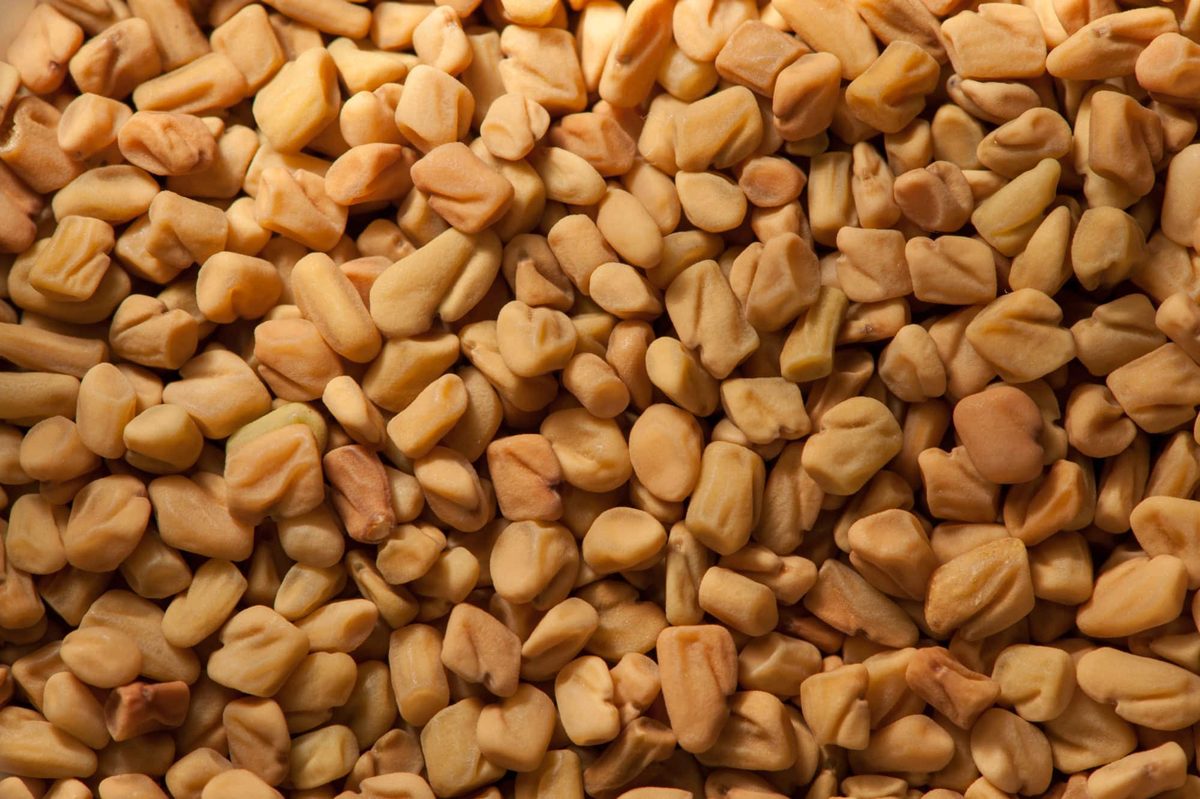
Fenugreek and fennel seed are both small, hard seeds sold whole or ground, and both appear in Indian spice blends, but they come from unrelated plants and taste nothing alike. Fenugreek is the seed of a legume in the pea family; its smell is maple syrup, from the compound sotolon, and its taste is bitter.123 Fennel is the fruit of a carrot-family herb; its smell and taste are sweet anise, from anethole.45 Where they overlap is in what they do in hot oil and spice blends, not in flavor.
Side by side
| Fenugreek | Fennel seed | |
|---|---|---|
| Species | Trigonella foenum-graecum1 | Foeniculum vulgare6 |
| Family | Fabaceae (pea family)1 | Apiaceae (carrot family)4 |
| Native range (Kew) | Iraq to northern Pakistan1 | Mediterranean to Ethiopia and western Nepal6 |
| Part used | Seed7 | Dried fruit, sold as seed4 |
| What it looks like | Oblong-rhomboid, 3 to 5 mm, brownish, with a deep furrow7 | Greenish-brown to yellowish-brown oblong oval, about 6 mm4 |
| Key aroma compound | Sotolon, up to 25 ppm in the seed32 | Anethole, up to 70 to 80% of sweet-fennel oil5 |
| Essential oil | Only minute quantities3 | 3 to 4% (Britannica)4 |
| Bitterness | Bitter; Katzer attributes it probably to furostanol glycosides3 | Sweet fennel is sweet; bitter fennel has a bitter aftertaste and camphor-like odor, and fenchone is the character compound of its oil5 |
| Flavor (editorial) | Maple, burnt sugar and celery over a bitter base | Sweet licorice, lighter and greener than anise |
| Typical uses | Panch phoron, curry powder, berbere, Yemeni hilbeh3 | Five-spice powder, curries, sausage, pastries, sweet pickles, fish849 |
| India’s crop, 2024-25 (final) | 260,803 tonnes10 | 180,066 tonnes10 |
| Price | No dated, sourced retail comparison found | No dated, sourced retail comparison found |
The two oil figures are not comparable as strength measures. Fenugreek’s sotolon is a trace compound measured in the seed, while the anethole figure is a share of fennel’s essential oil, which is itself a few percent of the seed. Both come from different references and different samples. The flavor row is our description; it is consistent with Britannica’s “strong, sweetish, and somewhat bitter” for fenugreek and with PROSEA’s attribution of fennel’s anise fragrance and sweet taste to anethole.115
For each spice on its own, see fenugreek and fennel seed.
The differences that change a dish
Maple versus anise
Sotolon is a flavor impact compound in fenugreek, and maple syrup contains it too; that shared compound is why fenugreek smells of maple and is used to make imitation maple syrup.211 PROSEA describes fenugreek seed as nutty with notes of celery and maple.7 Fennel’s anethole gives a sweet anise taste, and PROSEA notes that fennel and anise fruits are often confused and substituted for each other.5 Neither spice can supply the other’s signature note.
Bitterness
Fenugreek’s bitterness is part of its job. Katzer calls the seed bitter and aromatic, attributes the bitterness probably to furostanol glycosides, and says dry toasting can enhance the flavor and reduce the bitterness if the seeds are not overheated.3 Sweet fennel, the kind most cooks buy, adds sweetness instead; only bitter fennel, a separate group, leaves a bitter aftertaste.5
How much to use
Fenugreek is usually a small part of a blend. Katzer says small amounts belong in any good curry powder and that Ethiopian berbere contains small amounts.3 In Bong Eats’s panch phoron, fenugreek and fennel go in at the same measure, one tablespoon each, and the mix is used for tempering.12 Using fenugreek with a light hand is cooking judgment, consistent with those sources.
Can one stand in for the other?
Not for flavor. They can share a structural role in a tempering or blend, and one published swap puts fennel inside a fenugreek substitute.
| Swap | Starting amount | Treatment |
|---|---|---|
| Fennel and yellow mustard seed, mixed, for fenugreek seed | 1 part mix per 1 part fenugreek | Attributed |
| Fennel seed alone for fenugreek | About half the fenugreek amount, then taste | Method |
| Fenugreek for fennel seed | Not recommended; a quarter of the amount at most | Method |
- Fennel and mustard for fenugreek. Tasting Table suggests a mix of fennel and yellow mustard seeds, with the mustard tempering the fennel’s sweetness, and says it can replace fenugreek seed one to one.13 It gives no split between the two seeds. See fenugreek substitutes for the full ranking.
- Fennel alone for fenugreek. We found no published ratio. Fennel will make the dish sweeter and bring no maple or bitterness. Method: start with about half the fenugreek amount and taste.
- Fenugreek for fennel. We found no source that recommends it. Fenugreek brings bitterness and maple where the recipe expects sweet anise. Method: if you must, use no more than a quarter of the fennel amount, toasted, and only in a savory spice mix. For better options, see fennel seed substitutes, where anise seed ranks first.
When to use which
- Fenugreek. Katzer calls it an essential part of the Bengali five-spice mix panch phoron, alongside fennel; a component of curry powder and of Ethiopian berbere; and the main ingredient, with chiles, of Yemen’s hilbeh sauce.3 Britannica calls it a characteristic ingredient in some curries and chutneys.11
- Fennel seed. Britannica lists it among the five spices in Chinese five-spice powder and names pastries, sweet pickles and fish among its uses.84 Illinois Extension says fennel seed is used in sausage.9 Great British Chefs lists fennel among the spices commonly used in garam masala.14 In Italian-American cooking it is the signature seasoning of Italian sausage, by common practice.
- Both. Panch phoron uses both seeds whole, in equal measure, for tempering.12 There the fennel’s sweetness and the fenugreek’s bitterness work together (editorial).
What isn’t known
- No study compares the flavor intensity of fenugreek and fennel seed, so the starting amounts above are judgment, not measurement.
- Fenugreek is often said to go into garam masala and into halva; we found no source for either and have left them out.
- The sotolon and anethole figures come from different references and are not a measure of which seed is stronger.
Related
- Fenugreek leaves vs. seeds
- Fennel seed vs. anise seed, caraway seeds vs. fennel seeds and fennel seeds vs. cumin seeds
- Kasuri methi, too much fenugreek and fennel vs. dill
- Yellow mustard seeds and anise seed
Footnotes
-
Trigonella foenum-graecum L., Plants of the World Online, Royal Botanic Gardens, Kew. powo.science.kew.org · Reference work ↩ ↩2 ↩3 ↩4
-
Podebrad et al., “Sotolone: the odour of maple syrup urine disease”, Journal of Inherited Metabolic Disease, 1999. pubmed.ncbi.nlm.nih.gov · Peer-reviewed ↩ ↩2 ↩3
-
Gernot Katzer, “Fenugreek”, Gernot Katzer’s Spice Pages. gernot-katzers-spice-pages.com · Reference work ↩ ↩2 ↩3 ↩4 ↩5 ↩6 ↩7 ↩8
-
“Fennel”, Encyclopaedia Britannica. britannica.com · Reference work ↩ ↩2 ↩3 ↩4 ↩5 ↩6 ↩7
-
Purwaningsih, Harmida and M. Brink, Foeniculum vulgare, Plant Resources of South-East Asia (PROSEA). uses.plantnet-project.org · Reference work ↩ ↩2 ↩3 ↩4 ↩5 ↩6
-
Foeniculum vulgare Mill., Plants of the World Online, Royal Botanic Gardens, Kew. powo.science.kew.org · Reference work ↩ ↩2
-
C.S. Tawan and N. Wulijarni-Soetjipto, Trigonella foenum-graecum, Plant Resources of South-East Asia (PROSEA). uses.plantnet-project.org · Reference work ↩ ↩2 ↩3
-
Tony Hill, “Five-spice powder”, Encyclopaedia Britannica. britannica.com · Reference work ↩ ↩2
-
“Fennel”, University of Illinois Extension. extension.illinois.edu · Reference work ↩ ↩2
-
Spice wise area and production in India, 2021-22 to 2025-26, Spices Board India. indianspices.com · Regulator ↩ ↩2
-
“Fenugreek”, Encyclopaedia Britannica. britannica.com · Reference work ↩ ↩2 ↩3
-
“Panch phoron”, Bong Eats, 2017. bongeats.com · Publication ↩ ↩2
-
Alice Rich, “11 Best Substitutes For Fenugreek”, Tasting Table, 2024. tastingtable.com · Publication ↩
-
“How to make garam masala”, Great British Chefs, 2025. greatbritishchefs.com · Publication ↩