Spices · Cooking with
Cooking With Hyssop: A Bitter Herb for Rich Meats, Soups and Sweets
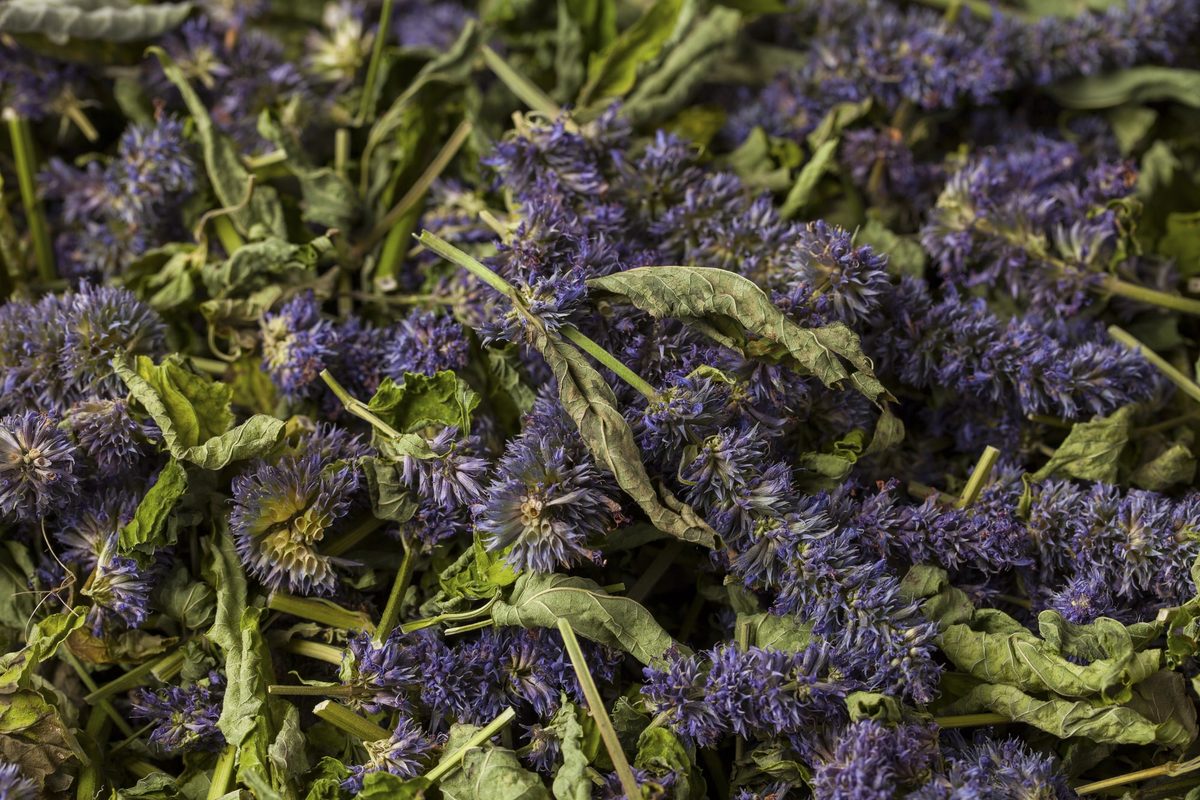
Hyssop is a mint-family herb whose main contribution to a dish is a bitter, herbal edge. Gernot Katzer’s Spice Pages describes it as aromatic and slightly bitter, with a weak aroma and a rather bitter taste, which is why he rates it of limited value as a spice.1 Used with that in mind, a little hyssop suits rustic, rich food: bean and potato soups, fatty meat, and as a stand-in for sage.1
At a glance
| Question | Short answer |
|---|---|
| What does it taste like? | Aromatic and slightly bitter; the bitterness comes with tannins common in the mint family1 |
| Fresh or dried? | Fresh. Katzer says drying reduces the weak aroma to nil1 |
| Which parts? | Stems, leaves and flowers are used together1 |
| Best dishes | Potato or bean soup, fatty meat, veal and chicken in place of sage1; Britannica adds fish, vegetables, salads and sweets2 |
| How much? | No published amount; start with a few leaves (Method, below) |
| Is it the biblical hyssop? | Almost certainly not23 |
| Anise hyssop? | A different plant, Agastache foeniculum4 |
Make sure it is the right plant
Three different plants share the name, and they cook very differently.
- Hyssop, Hyssopus officinalis, is the subject of this page. Kew now lists it as Dracocephalum officinale, a mint-family subshrub native from Europe and the Mediterranean to Iran.5 FDA lists hyssop among spices generally recognized as safe.6
- Anise hyssop, Agastache foeniculum, is a North American perennial in a different genus.4 Despite the shared name, it is a different herb; see hyssop vs. lavender and the hyssop profile.
- Syrian hyssop, Origanum syriacum, is known in Arabic as za’atar, according to Old Dominion University’s Plants of the Bible.7 It is a wild oregano, not hyssop; see za’atar.
A common claim says hyssop is used throughout Middle Eastern cooking because it is the hyssop of the Bible. Britannica says the biblical plant is not Hyssopus officinalis, which is alien to Palestine,2 and the Middle Eastern herb usually meant is the za’atar plant above.7
How it tastes, and why that matters
Our own description: piney, herbal and somewhat medicinal, with bitterness in the finish. Katzer is blunter: the aroma is weak and the taste rather bitter, and the plant contains rather large amounts of bitter tannins, as many mint-family plants do.1 He gives its essential oil content as 0.3 to 0.9%,1 while the Wolters Kluwer monograph says up to 2%;3 the two figures have not been reconciled.
Read that way, the risk with hyssop is bitterness rather than an overpowering aroma (our reading). Add a little, taste, then add more.
Fresh or dried
Use it fresh where you can. Katzer says the dried plant is less aromatic than the fresh one, and that drying reduces its already weak aroma to nil.1 If dried hyssop is all you have, expect mostly bitterness.
To swap between them, NDSU Extension’s general herb rule is 1 tablespoon of finely cut fresh herbs for 1 teaspoon dried.8 That rule is for herbs in general, not tested on hyssop, and given Katzer’s point about drying, dried hyssop may need more for the same aroma (our judgment).
What to cook with it
Soups and rustic dishes. Katzer suggests it for robust, rustic dishes such as potato or bean soup.1
Fatty meat. It goes well with fat meat, Katzer writes, and some cooks use it on veal and chicken as an alternative to sage.1 Lamb, pork, duck and sausages fit that description (our suggestions). Chop a few fresh leaves into a rub or a marinade with garlic and olive oil.
In a bundle. Katzer notes that hyssop is sometimes added to a bouquet garni.1 Tying sprigs into a bundle and removing it before serving lets you control the bitterness in a long braise (our judgment).
Vegetables, fish and salads. Britannica lists meats, fish, vegetables, salads and sweets among hyssop’s modern uses.2 In a salad, use young leaves or the flowers sparingly (our judgment).
Sweets and drinks. The Wolters Kluwer monograph says hyssop extracts have flavored liqueurs, sauces, puddings and candies,3 and Britannica names absinthe among the liqueurs.2 At home, steep a few sprigs in simple syrup or cream for a custard and strain them out (common practice for herb infusions).
How much to use
We found no published amount for cooking with hyssop. Our Method starting point: for a pot of soup or a braise serving four, one or two fresh sprigs or about a teaspoon of chopped fresh leaves, added and tasted, then increased if the dish can take more bitterness. That is a starting point, not a measurement.
When to add it
No source we found tested when to add hyssop. Its aroma is weak and its main contribution is bitterness,1 so in a long-cooked dish a removable sprig, added partway through and tasted, is the safest approach (our judgment).
Tea
Hyssop is often made into tea. Britannica records a strong tea of the leaves, sweetened with honey, as a traditional remedy for nose, throat and lung complaints.2 That is folk use, not evidence: the Wolters Kluwer monograph says there are no clinical trial data supporting hyssop’s traditional uses.3 The honey also takes the edge off the bitterness (editorial).
Safety
Hyssop leaves used as seasoning are on FDA’s list of spices generally recognized as safe.6 The concentrated essential oil is another matter. The Wolters Kluwer monograph reports convulsions in rats at 0.13 g/kg, links the oil’s neurotoxicity to pinocamphone and isopinocamphone, notes case reports of seizures in adults and children, and advises avoiding hyssop in pregnancy.3 Do not cook with hyssop essential oil.
Not yet measured
- How much hyssop to use per serving: no recipe or reference gives an amount.
- Whether hyssop holds up in long cooking or should go in late.
- Whether the flowers are milder than the leaves, a common claim we could not source.
- Why published essential oil contents differ (0.3 to 0.9% vs. up to 2%).
Related
- Hyssop
- Hyssop substitutes
- Hyssop vs. lavender
- Cooking with lavender
- Sage, mint, rosemary and bouquet garni
Footnotes
-
Hyssop, Gernot Katzer’s Spice Pages. gernot-katzers-spice-pages.com · Reference work ↩ ↩2 ↩3 ↩4 ↩5 ↩6 ↩7 ↩8 ↩9 ↩10 ↩11 ↩12 ↩13
-
Hyssop, Encyclopaedia Britannica. britannica.com · Reference work ↩ ↩2 ↩3 ↩4 ↩5 ↩6
-
Hyssop, professional natural product monograph, Drugs.com (Wolters Kluwer Health), 2026. drugs.com · Reference work ↩ ↩2 ↩3 ↩4 ↩5
-
Agastache foeniculum (Pursh) Kuntze, Plants of the World Online, Royal Botanic Gardens, Kew. powo.science.kew.org · Reference work ↩ ↩2
-
Dracocephalum officinale (L.) Y.P.Chen & B.T.Drew, Plants of the World Online, Royal Botanic Gardens, Kew. powo.science.kew.org · Reference work ↩
-
21 CFR 182.10, US Food and Drug Administration. ecfr.gov · Regulator ↩ ↩2
-
Hyssop, Plants of the Bible, Old Dominion University. ww2.odu.edu · Reference work ↩ ↩2
-
Julie Garden-Robinson, Ingredient Substitutions (FN198), NDSU Extension, 2018. ksre.ksu.edu · Reference work ↩