Spice Substitutes · Substitutes
Hyssop Substitutes for Savory Dishes, Desserts and Za’atar Recipes
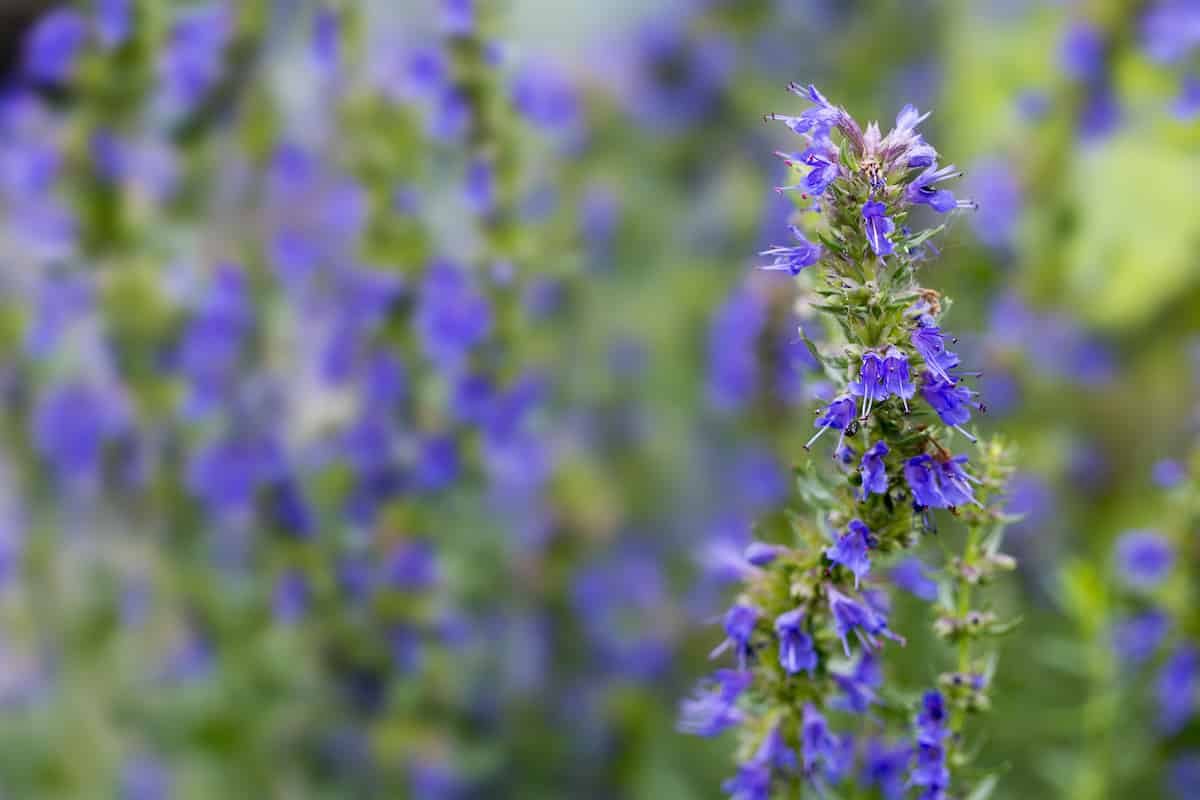
Hyssop (Hyssopus officinalis, which Kew now lists as Dracocephalum officinale) is a woody herb of the mint family (Lamiaceae).1 Britannica lists its uses as flavoring meats, fish, vegetables, salads, sweets and liqueurs such as absinthe.2 It is strongly aromatic and somewhat bitter, so no single herb copies it. The right stand-in depends on whether hyssop is seasoning a savory dish or a sweet one. Before you choose, check whether your recipe means this hyssop at all.
First, which hyssop does your recipe mean?
Old Dominion University’s Plants of the Bible site notes that Origanum syriacum, called Syrian hyssop in English, is known in Arabic as za’atar.3 So a Middle Eastern recipe that calls for hyssop may mean that plant. It is a different species from garden hyssop: Kew lists it as a mint-family subshrub of the eastern Mediterranean and Arabian Peninsula, in the same genus as oregano.4 If that is what your recipe means, especially in a spice blend, the closer substitute is oregano or a za’atar blend, not the herb on the rest of this page. See za’atar substitutes and oregano.
Quick answer
| What hyssop is doing | Best substitute | Starting amount, per 1 part hyssop | Treatment |
|---|---|---|---|
| Savory seasoning (lamb, rich meats, beans, soups) | Rosemary | 1/2 part, then taste | Method |
| Savory seasoning, with a sharper edge | Sage | 1/2 part, then taste | Method |
| Floral note in sweets, syrups and infusions | Culinary lavender | 1/2 part, then taste | Method |
| Fresh herbal note in salads or desserts | Mint | 1 part, then taste | Method |
| Dried hyssop in place of fresh | Dried hyssop | 1 tsp dried per 1 Tbsp fresh | Computed |
How the ratios on this page are labeled
Every ratio carries one of four labels.
- Computed: based on a measurable physical relationship, with the source named.
- Attributed: a named source publishes this ratio. We quote it as theirs.
- Disputed: named sources give different answers to the same swap. We show each one and do not average them.
- Method: we found no published ratio. We give a direction and a cautious starting point, and say so.
We found no published ratio for replacing hyssop with any other herb. Every herb-for-herb amount on this page is a cautious starting point, not a measured equivalent.
What hyssop tastes like, and what’s in it
Hyssop’s essential oil is made up mainly of pinocamphone, isopinocamphone, alpha- and beta-pinene and camphene, according to the Wolters Kluwer monograph published on Drugs.com,5 and a 2011 review names pinocamphone, isopinocamphone and beta-pinene among the principal components.6 To us, it smells somewhere between mint, sage and rosemary, with a floral note and a bitter finish; that description is ours, not a measurement.
None of the usual substitutes contains pinocamphone. The closest chemical overlap is with rosemary, through the pinenes.
If hyssop is a savory seasoning
1. Rosemary
Kew now places rosemary in the sage genus, as Salvia rosmarinus,7 which puts it in the mint family too.8 In one study of rosemary oils, alpha-pinene made up 13.5 to 37.7 percent and 1,8-cineole 16.1 to 29.3 percent.9 PROSEA attributes rosemary’s warm, piny scent to alpha-pinene.10 That pine note is the part of hyssop’s aroma that rosemary can supply. It lacks hyssop’s floral side.
Ratio (Method): No published ratio was found. Start with about half as much rosemary as hyssop, chopped fine, and taste. Rosemary is strong, and its needles are tough, so in our judgment it suits long-cooked dishes better than salads.
2. Sage
Sage (Salvia officinalis) is also in the mint family.8 PROSEA attributes its strong, characteristic smell to the thujones,11 which are not among hyssop’s main compounds. In our judgment, it shares hyssop’s bitter, resinous strength more than its specific aroma.
Ratio (Method): No published ratio was found. Start with about half as much sage as hyssop and taste. In our judgment, sage works best in cooked dishes with fatty meats or beans, and less well in salads or sweets.
3. Oregano
Oregano is a mint-family herb whose oil contains thymol and carvacrol.12 In our judgment, it can fill in for hyssop’s pungency in savory cooking but not its aroma.
Ratio (Method): No published ratio was found. Start with about half as much and taste.
If hyssop is flavoring something sweet
Britannica lists sweets among hyssop’s uses,2 and the Wolters Kluwer monograph mentions puddings and candies.5
1. Culinary lavender
Lavender is another mint-family genus.13 Its flavor depends on the species. The Herb Society of America calls true lavender (Lavandula angustifolia) the most delightful species to cook with, and warns that lavandin and Spanish lavender are high in cineole and camphor.14 In one study of L. angustifolia oils, linalool and linalyl acetate were the principal constituents of every sample.15 In our judgment, lavender gives you hyssop’s floral side but none of its pine or bitterness. Britannica notes that lavender is sometimes used to flavor beverages and sweets.13
Ratio (Method): No published ratio was found. Start with about half as much lavender as hyssop, and add more as you go, as the Herb Society suggests for lavender generally.14 Use L. angustifolia sold for culinary use.
2. Mint
Mint is the easiest substitute to find. Its chemistry is different: peppermint oil is led by menthol and menthone, and spearmint is rich in carvone.16 To us, mint gives a cool, fresh note but none of hyssop’s bitterness or pine.
Ratio (Method): No published ratio was found. Mint is milder than hyssop in our judgment, so start with an equal amount and add more to taste.
Dried hyssop for fresh
If you have dried hyssop and the recipe calls for fresh, you can use the general fresh-to-dried herb conversion.
Ratio (Computed): NDSU Extension equates 1 tablespoon of finely cut fresh herbs with 1 teaspoon of dried.17 America’s Test Kitchen’s tests found that 1 part dried herb to 3 parts fresh came closest to equal flavor strength.18 In the same tests, the hardy dried herbs (thyme, rosemary and sage) did reasonably well in dishes with fairly long cooking times, more than 20 minutes, and a good amount of liquid.18 Neither source tested hyssop specifically.
A note on hyssop oil
Hyssop oil is not a substitute for the herb. The Wolters Kluwer monograph reports that the oil has caused convulsions in rats, links its neurotoxicity to pinocamphone and isopinocamphone, and notes case reports of seizures in adults and children.5 Those findings concern the concentrated oil, not leaves used as a seasoning.
What isn’t known
- There is no published ratio for any hyssop substitute. Every herb-for-herb amount here is a starting point.
- It is sometimes said that hyssop smells like lemon and lavender combined. We found no source for this.
- No source compares the flavor strength of hyssop with lavender, sage, rosemary or mint.
Related
- Hyssop, cooking with hyssop and hyssop vs. lavender
- Rosemary, sage, sage substitutes and rosemary vs. sage
- Lavender, lavender substitutes and sage vs. lavender
- Mint, mint substitutes and oregano vs. mint
- Za’atar and za’atar substitutes
Footnotes
-
Dracocephalum officinale (L.) Y.P.Chen & B.T.Drew, Plants of the World Online, Royal Botanic Gardens, Kew. powo.science.kew.org · Reference work ↩
-
Hyssop, Encyclopaedia Britannica. britannica.com · Reference work ↩ ↩2
-
Hyssop, Plants of the Bible, Old Dominion University. ww2.odu.edu · Reference work ↩
-
Origanum syriacum L., Plants of the World Online, Royal Botanic Gardens, Kew. powo.science.kew.org · Reference work ↩
-
Hyssop, professional natural product monograph, Drugs.com (Wolters Kluwer Health), 2026. drugs.com · Reference work ↩ ↩2 ↩3
-
Fathiazad and Hamedeyazdan, A review on Hyssopus officinalis L., African Journal of Pharmacy and Pharmacology, 2011. dspace.tbzmed.ac.ir · Peer-reviewed ↩
-
Salvia rosmarinus Spenn., Plants of the World Online, Royal Botanic Gardens, Kew. powo.science.kew.org · Reference work ↩
-
Salvia officinalis L., Plants of the World Online, Royal Botanic Gardens, Kew. powo.science.kew.org · Reference work ↩ ↩2
-
Satyal et al., Chemotypic Characterization and Biological Activity of Rosmarinus officinalis, Foods, 2017. mdpi.com · Peer-reviewed ↩
-
de Guzman, Rosmarinus officinalis (PROSEA), Plant Resources of South-East Asia. uses.plantnet-project.org · Reference work ↩
-
Dasuki, Salvia officinalis (PROSEA), Plant Resources of South-East Asia. uses.plantnet-project.org · Reference work ↩
-
Pant, Oregano, Encyclopaedia Britannica. britannica.com · Reference work ↩
-
Petruzzello, Lavender, Encyclopaedia Britannica. britannica.com · Reference work ↩ ↩2
-
Legarre, Lavender in the Kitchen, The Herb Society of America blog, 2025. blog.herbsociety.org · Publication ↩ ↩2
-
Pokajewicz et al., Chemical Composition of the Essential Oil of the New Cultivars of Lavandula angustifolia, Molecules, 2021. mdpi.com · Peer-reviewed ↩
-
Singh and Pandey, Prospective of Essential Oils of the Genus Mentha as Biopesticides, Frontiers in Plant Science, 2018. frontiersin.org · Peer-reviewed ↩
-
Garden-Robinson, Ingredient Substitutions (FN198), NDSU Extension. ksre.ksu.edu · Reference work ↩
-
Science: Substituting Dried Herbs for Fresh, America’s Test Kitchen. americastestkitchen.com · Publication ↩ ↩2