Herbs · Profile
Rosemary (Salvia rosmarinus): Flavor, Compounds, History and How to Use It
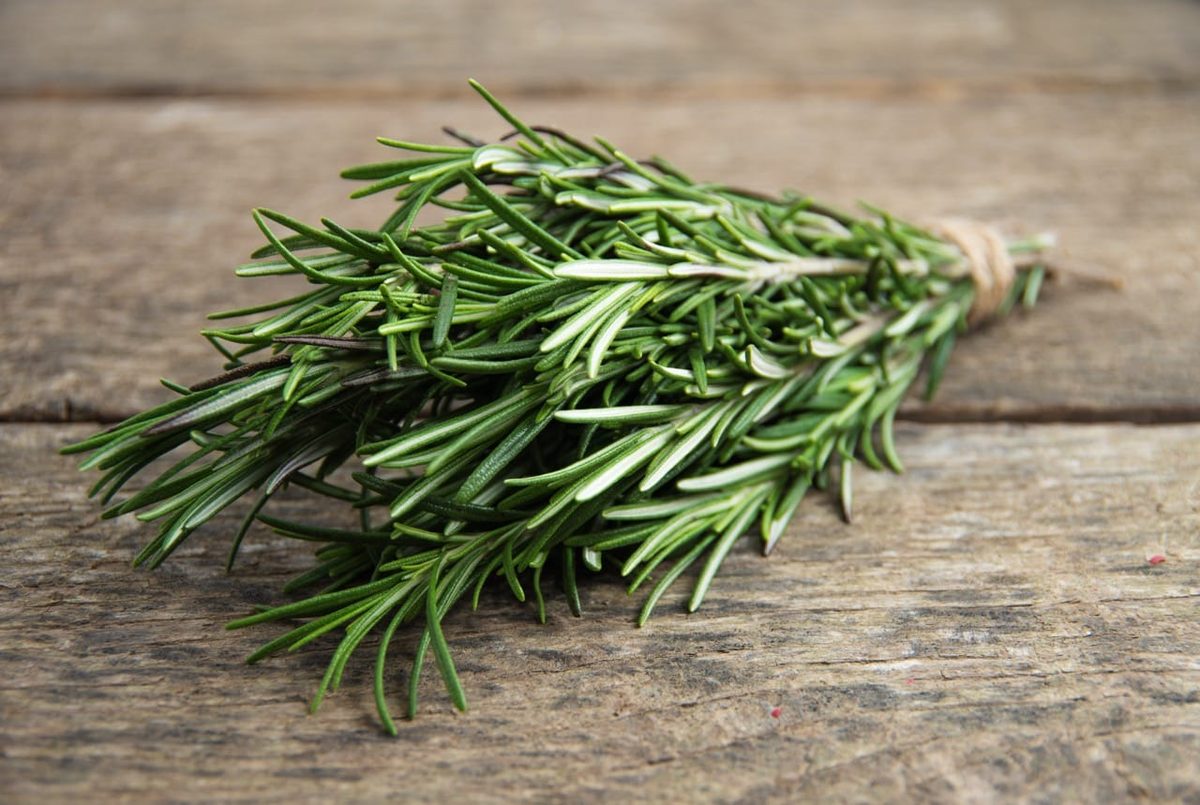
Rosemary is the leaf of an evergreen Mediterranean shrub in the mint family, used fresh or dried to season meats, vegetables, soups and breads.12 Botanists now place it in the sage genus, as Salvia rosmarinus.31 This page covers what the plant is, where its resinous smell comes from, its documented history, how cooks use it, and the few safety points that apply.
At a glance
| Botanical name | Salvia rosmarinus Spenn.; formerly Rosmarinus officinalis L.3 |
| Plant family | Lamiaceae (mint family)3 |
| Part used | Leaves, fresh or dried1 |
| Native range | The Mediterranean, from Spain and Morocco east to Türkiye and Egypt3 |
| Main producers | No current production statistics found for the herb. For the essential oil, PROSEA names Spain, Tunisia and Morocco (figures from around 1990)2 |
| Key aroma compounds | α-pinene, 1,8-cineole, camphor, borneol24 |
| Essential oil in the dried leaf | 1–2%2 |
| Forms sold | Fresh sprigs, dried leaves, ground; also essential oil and an antioxidant extract used by food makers (E 392)25 |
Measured values
7 figures, sourced| Measure | Value | Scope | Source |
|---|---|---|---|
| Essential oil | 1–2 % of dried leaf | Dried leaf, PROSEA | uses.plantnet-project.org |
| α-Pinene | 13.5–37.7 % of essential oil | Rosemary oils from plants collected in Australia, the USA, South Africa, Kenya, Nepal and Yemen (Satyal et al. 2017; at least five chemotypes) | mdpi.com |
| 1,8-Cineole | 16.1–29.3 % of essential oil | Rosemary oils from plants collected in Australia, the USA, South Africa, Kenya, Nepal and Yemen (Satyal et al. 2017; at least five chemotypes) | mdpi.com |
| Camphor | 0.7–7.0 % of essential oil | Rosemary oils from plants collected in Australia, the USA, South Africa, Kenya, Nepal and Yemen (Satyal et al. 2017; at least five chemotypes) | mdpi.com |
| 1,8-Cineole | 24.0 % of essential oil | One Spanish oil of the camphor type, as reported by PROSEA | uses.plantnet-project.org |
| Camphor | 35.3 % of essential oil | One Spanish oil of the camphor type, as reported by PROSEA | uses.plantnet-project.org |
| Pyrrolizidine alkaloids, maximum Limit | 400 µg/kg | EU Regulation 2023/915, dried herbs (covers dried rosemary, not among the named exceptions) | eur-lex.europa.eu |
Each figure is quoted as its source states it, with the samples or standard it applies to. Where sources differ, both are shown; nothing is averaged. All measured values
What rosemary is
Rosemary is a bushy evergreen shrub that usually reaches 0.6 to 2 meters (about 2 to 6.5 feet).1 Its leaves are narrow, leathery and glossy dark green, with margins that curl under; PROSEA gives the blade as 1–5 cm long and only 1–2 mm wide, which is why cooks call them needles.12 The small flowers are pale blue or blue, seldom white, and grow in short clusters where the leaves meet the stem; bees are drawn to them.12
From Rosmarinus to Salvia
Kew’s Plants of the World Online accepts Salvia rosmarinus Spenn., first published in 1835, as the plant’s name and lists the familiar Rosmarinus officinalis L. as a synonym.3 Britannica dates the change in practice to a 2017 taxonomic revision that moved rosemary out of Rosmarinus and into Salvia.1 Extension services have followed: the University of Delaware’s rosemary fact sheet uses Salvia rosmarinus.6 Older names persist in regulation, though; the FDA’s list of spices generally recognized as safe still enters it as Rosmarinus officinalis L.7 Both names mean the same plant. The practical upshot for cooks is a curiosity: rosemary now shares a genus with garden sage, Salvia officinalis.38 For how the two compare in the kitchen, see rosemary vs. sage.
Cultivars
Named cultivars differ mainly in habit, hardiness and flower color, and the sources we found describe them as garden plants rather than as different flavors:
- ‘Tuscan Blue’: dark blue-violet flowers (PROSEA); a tall, dark-blue-flowered variety (University of Delaware).26
- ‘Arp’: a tall, upright variety that Delaware’s extension describes as cold tolerant.6
- ‘Albus’: white flowers.2
- ‘Collingwood Ingram’: 0.6–0.9 m tall, usable as a tall ground cover.2
Trailing and “barbecue” rosemaries are widely sold, but we found no reliable source describing their flavor, so this page makes no claim about it.
Flavor and aroma
Britannica describes the leaves as having a pungent, slightly bitter taste.1 In the pan, rosemary reads as piney and resinous with a camphor edge, and that edge gets harsh when too much is used; that description is ours, and the chemistry below fits it.
The compounds
The aroma sits in the leaf’s essential oil, which makes up 1–2% of the dried leaf according to PROSEA.2 PROSEA links rosemary’s pungent, camphor-like smell and burning taste to borneol, and its warm, piny note to α-pinene.2 Britannica also names borneol as a key component of the oil.1
How much of each compound an oil contains depends on the plant’s chemotype, and rosemary has several:
| Scope | α-pinene | 1,8-cineole | Camphor | Source |
|---|---|---|---|---|
| Rosemary oils from plants collected in Australia, the USA, South Africa, Kenya, Nepal and Yemen | 13.5–37.7% | 16.1–29.3% | 0.7–7.0% | 4 |
| One Spanish oil of the camphor type, as reported by PROSEA | not given | 24.0% | 35.3% | 2 |
The 2017 study found at least five distinct chemotypes among the oils it analyzed.4 These figures describe distilled oils from particular plants, not a teaspoon of dried rosemary, and they should not be merged into one number.
Fresh vs. dried
Dried herbs are stronger than fresh by volume; the University of Delaware’s extension guide equates 3/4 to 1 teaspoon of crumbled dried herb with 2 to 3 teaspoons of fresh.9 That is a general herb rule, not one measured on rosemary. For a closer comparison, see dried rosemary vs. fresh.
Origin and history
Kew gives rosemary’s native range as the Mediterranean, listing it as native from Portugal, Spain and Morocco through France, Italy, Greece and the Balkans to Türkiye, Cyprus, Libya and Egypt.3 It has been introduced elsewhere, including Great Britain, the Canary Islands, central Mexico and Texas.3 Britannica adds that it has been introduced and cultivated across Europe, Asia and the Americas.1
- Name. The Latin ros marinus means “dew of the sea”; the English form was later bent toward the unrelated words “rose” and “Mary”.10
- Antiquity. Britannica reports that Egyptians used rosemary in burial rituals, that traces have been found in tombs dated to 3000 BCE, and that in ancient Greece and Rome the herb was associated with memory and purification.1
- Britain. According to Britannica, the Romans introduced rosemary to Britain.1
- Middle Ages. Rosemary was often burned in homes and hospitals for purification and was widely used in Europe to ward off illness.1
- Shakespeare. In Hamlet, Ophelia hands out flowers with the line “There’s rosemary, that’s for remembrance.”11 The line is symbolic; it is not a claim that rosemary improves memory.
Rosemary’s role at weddings and funerals is often mentioned, but we could not trace it to a source we could open, so it is left out here.
How rosemary is used
Britannica lists meats, vegetables, soups and beverages, and mentions baking, infused oils and herbal teas.1 PROSEA adds sauces, stews, herbal butters, jams, biscuits and bread.2 In practice that covers roast lamb, chicken and pork, roast potatoes, focaccia and other breads, bean and tomato soups, and infused olive oil, vinegar and simple syrup.
Technique
America’s Test Kitchen groups rosemary with the “hearty” herbs that go in early in cooking, noting that their flavor compounds are somewhat more heat-stable than those of tender herbs.12 The University of Delaware’s guide gives the opposite general rule for long simmering: add herbs during the last 45 minutes.9 Both are general herb guidance rather than tests on rosemary, so treat them as two reasonable starting points: whole sprigs early in a braise for a background note, chopped leaves near the end for a sharper one.
Delaware’s guide also puts rosemary among the strong herbs and warns that the flavor can be “extremely objectionable” if too much is used.9 If a dish has gone over, see too much rosemary. More ideas are on rosemary uses and cooking with rosemary.
Pairings
Rosemary turns up in commercial blends with thyme and sage; McCormick’s culinary poultry seasoning, for example, lists thyme, sage, marjoram, rosemary, black pepper and nutmeg.13 Beyond that, pairing is cooking judgment: garlic, thyme, sage, black pepper, lemon and olive oil are the classic partners. Rosemary is also one of the five herbs in the French Label Rouge specification for herbes de Provence, with thyme, savory, oregano and basil.14 See rosemary vs. thyme and rosemary vs. lavender for side-by-side comparisons.
Buying and quality
We did not find an international grading standard for dried rosemary leaf during this review. As kitchen judgment: fresh sprigs should be flexible with no blackened or slimy leaves, and dried rosemary should smell strongly when a leaf is crushed between the fingers.
Rosemary also matters to food makers beyond flavor. PROSEA reports that rosemary oleoresin is used as a natural antioxidant, and that carnosic acid, the main phenolic diterpene in the leaves, outperformed the synthetic antioxidants BHA and BHT in soybean oil.2 In the EU, extracts of rosemary are an authorized food additive, numbered E 392.5
Storage
We found no published shelf-life figure for fresh or dried rosemary from a regulator or standards body. Because the flavor is carried in volatile oil, the practical test is smell: if a crushed leaf barely registers, the rosemary has faded. For methods, see how to store rosemary, can you freeze rosemary? and how to dry rosemary.
Safety
- Food use. The FDA lists rosemary among spices and natural seasonings generally recognized as safe for their intended use.7
- Thujone. The European Medicines Agency names rosemary, alongside sage, thyme and wormwood, among plants that contain thujone in highly variable amounts, and estimates that average diets already supply 0.3 to 1 mg of thujone a day.15 The EMA statement concerns herbal medicines, not seasoning, and gives no figure for rosemary leaf itself.
- Rosemary extract (E 392). JECFA set a temporary acceptable daily intake of 0–0.3 mg per kg of body weight, expressed as carnosic acid plus carnosol.5 EFSA’s 2018 exposure assessment concluded that its own estimates “very likely overestimate” real exposure; the highest 95th-percentile estimate was 0.20 mg/kg body weight per day, in children.5
- Contaminants. EU law caps pyrrolizidine alkaloids in dried herbs at 400 µg/kg, a limit that covers dried rosemary since it is not among the named exceptions.16
This page makes no claim that rosemary treats or prevents any condition.
Substitutes and comparisons
Dried rosemary is the closest stand-in for fresh, using less of it (see the conversion above). Thyme and sage can cover some of its savory, resinous role, but none of them tastes the same. No source we found gives a tested swap ratio. See rosemary substitutes for the ranked list, and tarragon vs. rosemary for another comparison.
Footnotes
-
“Rosemary”, Encyclopaedia Britannica. britannica.com · Reference work ↩ ↩2 ↩3 ↩4 ↩5 ↩6 ↩7 ↩8 ↩9 ↩10 ↩11 ↩12 ↩13 ↩14
-
C.C. de Guzman, Rosmarinus officinalis, Plant Resources of South-East Asia (PROSEA). uses.plantnet-project.org · Reference work ↩ ↩2 ↩3 ↩4 ↩5 ↩6 ↩7 ↩8 ↩9 ↩10 ↩11 ↩12 ↩13 ↩14 ↩15
-
Salvia rosmarinus Spenn., Plants of the World Online, Royal Botanic Gardens, Kew. powo.science.kew.org · Reference work ↩ ↩2 ↩3 ↩4 ↩5 ↩6 ↩7 ↩8
-
Satyal et al., “Chemotypic Characterization and Biological Activity of Rosmarinus officinalis”, Foods, 2017. mdpi.com · Peer-reviewed ↩ ↩2 ↩3
-
EFSA ANS Panel, “Refined exposure assessment of extracts of rosemary (E 392) from its use as food additive”, EFSA Journal, 2018. pmc.ncbi.nlm.nih.gov · Regulator ↩ ↩2 ↩3 ↩4
-
Judd and Hermenaus, “Rosemary”, University of Delaware Cooperative Extension, 2024. udel.edu · Reference work ↩ ↩2 ↩3
-
21 CFR 182.10, US Food and Drug Administration. ecfr.gov · Regulator ↩ ↩2
-
Salvia officinalis L., Plants of the World Online, Royal Botanic Gardens, Kew. powo.science.kew.org · Reference work ↩
-
“Using Herbs and Spices”, University of Delaware Cooperative Extension, 2025. udel.edu · Reference work ↩ ↩2 ↩3
-
“rosemary”, Online Etymology Dictionary. etymonline.com · Reference work ↩
-
Shakespeare, Hamlet 4.5, Folger Shakespeare Library. folger.edu · Reference work ↩
-
Liz Bomze, “Our Guide to Fresh Herbs”, America’s Test Kitchen, 2019. americastestkitchen.com · Publication ↩
-
McCormick Culinary Poultry Seasoning, product page, McCormick & Company. mccormick.com · Merchant ↩
-
Label Rouge “Herbes de Provence” (LA 02/03), specification modification request, INAO, 2014. extranet.inao.gouv.fr · Regulator ↩
-
Public statement on herbal medicinal products containing thujone, European Medicines Agency, 2012. ema.europa.eu · Regulator ↩
-
Commission Regulation (EU) 2023/915, Annex I, section 2.4. eur-lex.europa.eu · Regulator ↩