Cooking · Cooking with
Cooking With Mint: Which Mint, When to Add It, Muddling and Storage
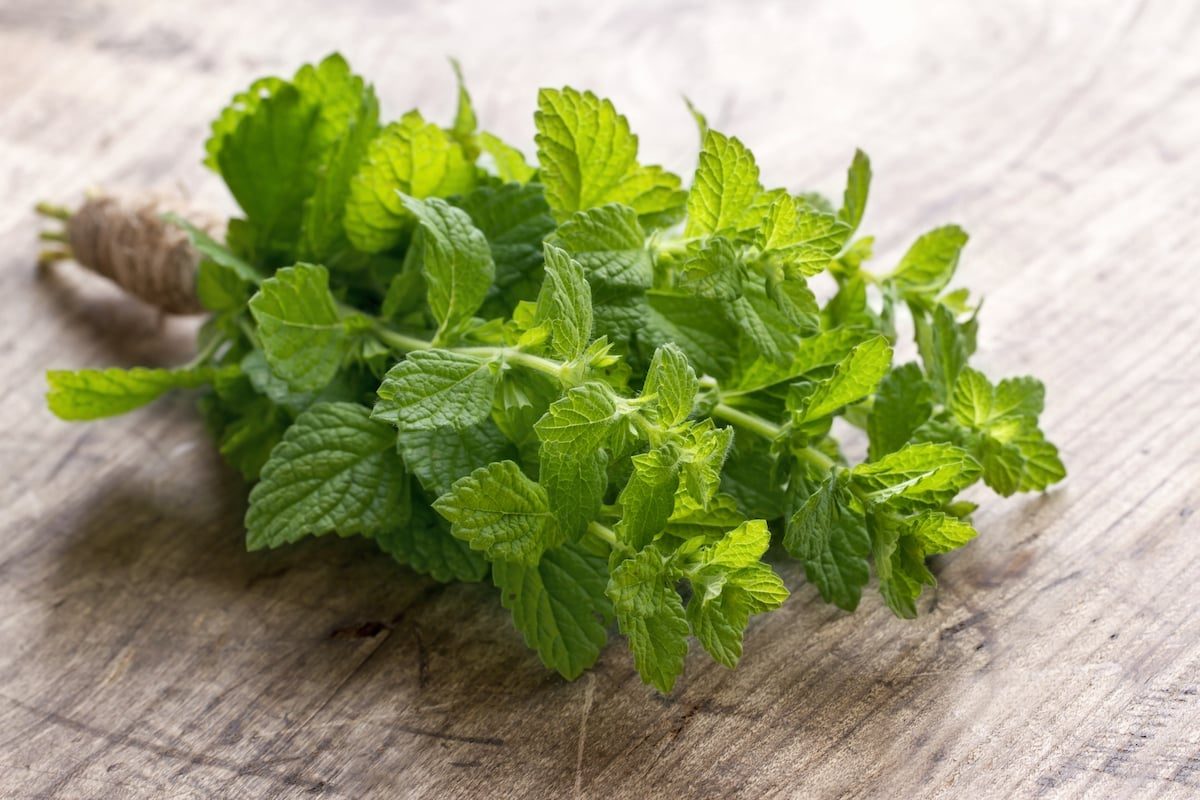
In cookery, “mint” usually means one of two plants, peppermint or spearmint, according to Britannica.1 They behave very differently in food, so the first decision in cooking with mint is which one you have. The second is timing: mint is a delicate herb, and long cooking costs it flavor.2
At a glance
| Question | Short answer |
|---|---|
| Which mint for savory food? | Usually spearmint: milder, with no menthol (McCormick).3 |
| Peppermint? | Strong and cooling; Gernot Katzer says it is used almost entirely for sweets and liqueurs.4 |
| When to add | Toward the end of cooking.32 |
| Fresh or dried? | Fresh where you can. America’s Test Kitchen (ATK) says mint is much weaker dried.5 |
| Fresh to dried | 1 tablespoon fresh to 1 teaspoon dried, as a general herb rule.2 |
| Muddling | Press gently; pounding hard brings out bitter, vegetal notes.6 |
| Keep fresh | Methods differ; see Storage. |
Spearmint or peppermint?
The difference comes down to chemistry. Peppermint oil consists mainly of menthol and menthone, while spearmint is rich in carvone.7 McCormick puts peppermint’s menthol at about 40% and says spearmint is milder and has no menthol.3 Katzer describes spearmint as minty but not pungent.4
That decides where each goes:
| Spearmint | Peppermint | |
|---|---|---|
| Main flavor compound | Carvone7 | Menthol and menthone7 |
| Strength | Milder (McCormick)3 | Stronger, with menthol’s bite3 |
| Typical uses | Britannica lists beverages, salads, soups, cheeses, meats, fish, sauces, fruits and vegetables8 | Katzer: almost exclusively confectionery and sweet liqueurs; very good with chocolate4 |
| Classic dish | British mint sauce with lamb (Katzer)4 | Chocolate and peppermint sweets4 |
Swapping one for the other is not even. We found no published ratio, and peppermint’s menthol has no counterpart in spearmint,3 so if a savory recipe written for spearmint gets peppermint, start with much less and taste (kitchen judgment). Other mints, from apple to chocolate mint, are covered on types of mint.
When to add mint
LSU AgCenter groups mint with basil, chives, cilantro, dill leaves and parsley as delicate herbs, and warns that prolonged heat causes flavor and aroma loss.2 McCormick’s advice is the same in kitchen terms: add mint leaves toward the end of cooking to keep their flavor and texture.3 For a raw dish, it goes in with everything else.
Dried mint is a different ingredient. ATK lists mint with basil, parsley, chives and cilantro as herbs that are much weaker in flavor once dried, and better used fresh.5 LSU’s general conversion is 1 tablespoon finely cut fresh herbs to 1 teaspoon crumbled dried.2 Because mint loses so much in drying, treat that as a ceiling, not a target, and taste (kitchen judgment).
How cooks use it, with named recipes
| Dish | How mint is used | Amount in the recipe |
|---|---|---|
| Mint sauce (Saveur)9 | Finely chopped leaves steeped with sugar, salt and boiling water, then vinegar; rested 1 hour | 2 1/4 cups leaves, 1 cup white vinegar, 1 tablespoon sugar; makes 1 1/4 cups |
| Tabbouleh (Saveur, October 2014)10 | Roughly chopped, raw, with parsley, tomato, onion, olive oil, lemon, allspice and cinnamon; no bulgur | 1 1/2 cups packed leaves with 3 cups parsley; serves 8 |
| Mint julep (Britannica)11 | With bourbon and sugar over ice | not given |
Those two Saveur recipes show how much mint a mint-led dish takes: cups, not sprigs. In the tabbouleh, mint is half as plentiful as parsley and is never cooked.10 Saveur’s recipe does not name a mint, but Katzer says spearmint is the mint to use for British mint sauce, which is served with lamb.4
Other sourced uses:
- Salsas, fruit salads, desserts and stews. McCormick suggests all four.3
- Noodle soup. In Vietnam, according to Katzer, a mild spearmint- or caraway-scented mint is preferred with noodle soup.4
- Chocolate. Katzer says peppermint goes extremely well with chocolate.4
Pairings
McCormick lists oregano, thyme, cilantro, paprika and basil as herbs and spices that pair well with mint.3 Saveur’s tabbouleh puts it with parsley, allspice and cinnamon.10 A widely shared list also pairs mint with cumin, coriander, fennel, nutmeg and cardamom, and with peas, cucumbers and carrots. Those are reasonable but we found no source behind them, so treat them as common practice.
Muddling mint for drinks
Sylvia Tomczak, writing for Tasting Table, warns that pounding mint leaves too hard unleashes their unpleasant vegetal and bitter notes and can make the leaves brown and break apart, and suggests shaking the mint with ice instead.6 So press gently, just enough to bruise the leaves. A common explanation blames the bitterness on chlorophyll released by over-muddling. We found no source for that mechanism, and Tasting Table does not give one.
Storing fresh mint
The sources disagree on the basic method:
| Source | Method |
|---|---|
| McCormick3 | Trim the stems and stand them in a glass with about 1 inch of water, leaves loosely covered; or wrap the leaves in damp paper towels in a partly sealed bag |
| ATK12 | For delicate herbs: wrap in slightly damp paper towels in an open zipper-lock bag in the fridge; keep them from touching liquid, which encourages rot |
| Government of Canada13 | Fresh herbs stored unwashed in the crisper, for up to 5 days |
None of these was a measured test on mint. Our guide on how to store mint sets out every figure we could trace.
Freezing. Penn State Extension lists mint among the herbs that freeze well. Its ice cube method half-fills the tray with water, adds chopped herbs, then tops off once frozen; frozen herbs go into cooked dishes without thawing, in the same amounts as fresh.14 See can you freeze mint.
Infusions and mint oil. A mint syrup or infusion is a handy way to get flavor without leaves in the dish (kitchen practice). Mint in oil is a different matter: Oregon State University Extension warns that herbs are low-acid foods that can carry Clostridium botulinum, and that homemade mixtures of fresh herbs in oil must be refrigerated and used within 4 days, or frozen.15
Mint tea and health
Mint tea is often said to aid digestion, settle the stomach and ease bloating. The NIH’s National Center for Complementary and Integrative Health (NCCIH) says very little research has been done on peppermint leaf. The evidence it does describe is for peppermint oil in enteric-coated capsules, which may improve symptoms of irritable bowel syndrome in adults; and it says there is no evidence that peppermint oil alone helps indigestion.16 NCCIH adds that peppermint tea appears to be safe.16 This page makes no claim that mint treats any condition.
Not yet measured
- A fresh-to-dried conversion for mint specifically; the general rule likely overstates dried mint’s strength.
- A peppermint-for-spearmint ratio.
- How long fresh mint keeps by the glass-of-water method versus damp towels.
- Whether chlorophyll has anything to do with bitterness from over-muddling.
Related
- Mint, mint uses and types of mint
- Spearmint, peppermint and spearmint vs. peppermint
- Mint substitutes and too much mint
- How to store mint, can you freeze mint and how to dry mint
- Chocolate mint, apple mint, watermint, orange mint and ginger mint
Footnotes
-
“Mint (plant)”, Encyclopaedia Britannica. britannica.com · Reference work ↩
-
“Flavorful Herbs”, LSU AgCenter. lsuagcenter.com · Reference work ↩ ↩2 ↩3 ↩4 ↩5
-
“About Mint: Uses, Pairings and Recipes”, McCormick, 2026. mccormick.com · Merchant ↩ ↩2 ↩3 ↩4 ↩5 ↩6 ↩7 ↩8 ↩9 ↩10
-
“Mint (Mentha)”, Gernot Katzer’s Spice Pages. gernot-katzers-spice-pages.com · Reference work ↩ ↩2 ↩3 ↩4 ↩5 ↩6 ↩7 ↩8
-
Danielle Lapierre, “When You Should Actually Use Dried Herbs (and Which Ones to Avoid)”, America’s Test Kitchen, 2022. americastestkitchen.com · Publication ↩ ↩2
-
Sylvia Tomczak, “Why You Should Think Twice Before Muddling Mint In Your Next Mojito”, Tasting Table, 2024. tastingtable.com · Publication ↩ ↩2
-
Pooja Singh and Abhay K. Pandey, “Prospective of Essential Oils of the Genus Mentha as Biopesticides: A Review”, Frontiers in Plant Science, 2018. frontiersin.org · Peer-reviewed ↩ ↩2 ↩3
-
“Spearmint”, Encyclopaedia Britannica. britannica.com · Reference work ↩
-
“Mint Sauce”, Saveur. saveur.com · Publication ↩
-
“Tabbouleh”, Saveur, 2014. saveur.com · Publication ↩ ↩2 ↩3
-
“Mint julep”, Encyclopaedia Britannica. britannica.com · Reference work ↩
-
Liz Bomze, “Our Guide to Fresh Herbs”, America’s Test Kitchen, 2019. americastestkitchen.com · Publication ↩
-
“Food safety tips for fresh herbs”, Government of Canada. oc4h.ucanr.edu · Regulator ↩
-
Martha Zepp, “Freezing Herbs”, Penn State Extension, 2025. extension.psu.edu · Reference work ↩
-
Raab and Woodburn, “Herbs and vegetables in oil” (SP 50-701), Oregon State University Extension Service, 2025. extension.oregonstate.edu · Reference work ↩
-
“Peppermint Oil”, National Center for Complementary and Integrative Health, 2025. nccih.nih.gov · Regulator ↩ ↩2