Spice Comparisons · Comparison
Spearmint vs. Peppermint: Carvone, Menthol and When to Use Each
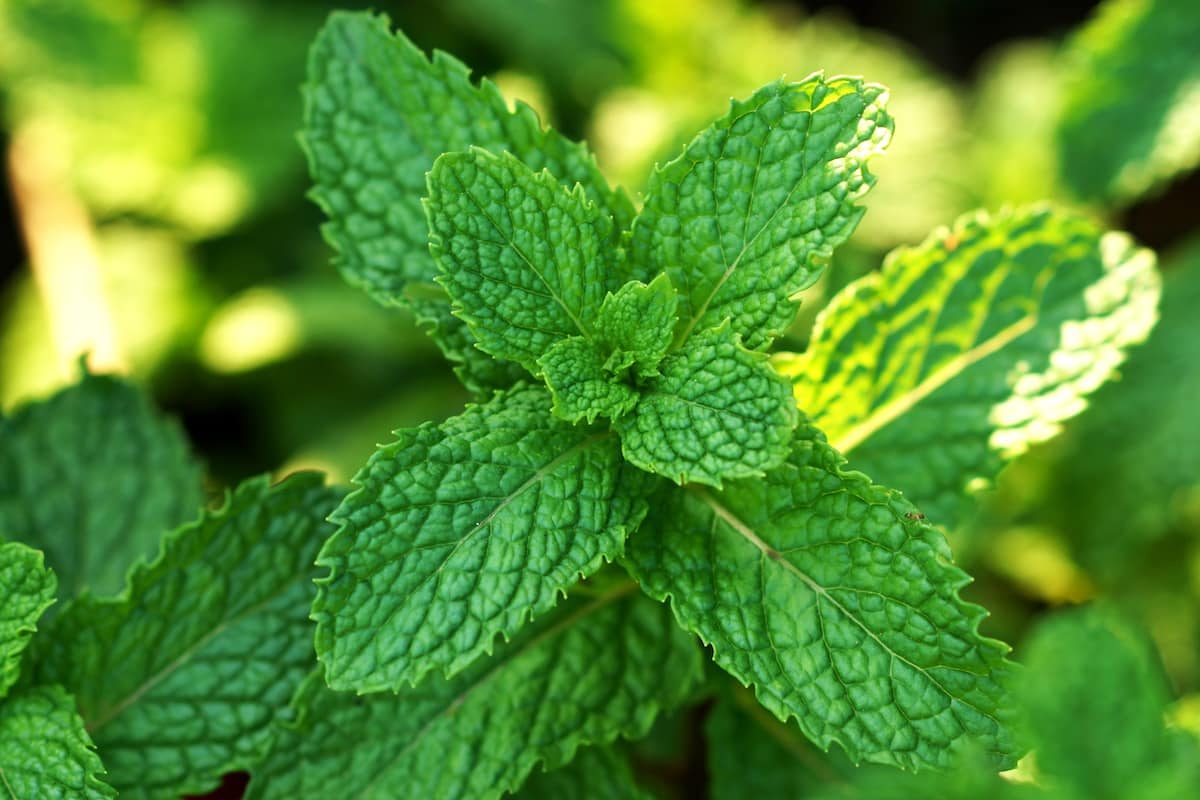
Spearmint and peppermint taste different because their oils are built on different compounds. Spearmint’s principal component is carvone; peppermint’s oil consists mainly of menthol and menthone.12 That is why peppermint tastes cold and sharp and spearmint sweeter and greener. They are also parent and child: peppermint is a natural cross between water mint and spearmint.3 In cookery, “mint” usually means one of these two.4
Side by side
| Spearmint | Peppermint | |
|---|---|---|
| Botanical name | Mentha spicata5 | Mentha × piperita, a hybrid6 |
| Parents | A species in its own right5 | Water mint × spearmint23 |
| Family | Lamiaceae (mint family)7 | Lamiaceae (mint family)7 |
| Native range | Europe to China5 | Mostly known in cultivation, occasionally naturalized6 |
| The plant | Square stems, sharply serrated leaves in opposite pairs; spreads aggressively by creeping stolons1 | Square stems, stalked dark green leaves2 |
| Leading oil compounds | Carvone17 | Menthol and menthone27 |
| Flavor | “Minty but not pungent” (Katzer);8 sweet and green (editorial) | Sharp and intensely cool (editorial) |
| Forms | Fresh sprigs, dried leaf, oil and flavorings | Fresh leaves, dried leaf, oil and extract29 |
| Typical uses | Sweets, drinks, salads, soups, cheeses, meats, fish, sauces;1 British mint sauce8 | Confectionery and sweet liqueurs; a classic partner for chocolate8 |
| US food status | GRAS spice10 | GRAS spice10 |
What’s in the oils
| Scope | Carvone | Menthol | Menthone | Source |
|---|---|---|---|---|
| One Serbian spearmint oil, as tabulated in a 2018 review | 69.5% | not among the main compounds listed | 21.9% | Singh and Pandey7 |
| One peppermint oil (Clark and Menory, 1980), as tabulated in the same review | not among the main compounds listed | 29–48% | 20–31% | Singh and Pandey7 |
| European Pharmacopoeia requirement for peppermint oil, as quoted by the EMA | not given here | 30–55% | 14–32% | EMA assessment report11 |
The first two rows come from the same review but from different studies, one sample each. They show what leads each oil, not a typical figure. The third row is a quality standard for medicinal peppermint oil, not a measurement.
Two points the chemistry settles:
- Does spearmint contain menthol? A widely repeated claim puts spearmint’s menthol at 1 percent or less. We found no source for that number. McCormick says spearmint lacks menthol,12 and Katzer’s list of spearmint’s aroma compounds names carvone, limonene, dihydrocarvone, menthone, pulegone, 1,8-cineol and β-pinene; menthol is not among them.8
- Is peppermint the menthol champion? McCormick puts peppermint’s menthol at about 40 percent.12 But Katzer notes that the world’s most important source of menthol is not peppermint but field mint, Mentha arvensis.8
We found no source we could open that explains how menthol produces its cooling sensation, or where the “pepper” in peppermint’s name comes from, so this page does not repeat the usual explanations.
How each is used
Spearmint is the all-round kitchen mint. Britannica lists sweets, beverages, salads, soups, cheeses, meats, fish, sauces, fruits and vegetables,1 and Katzer names it as the mint for British mint sauce served with lamb.8 Yogurt sauces such as tzatziki, mint chutneys, tabbouleh and the mojito usually take spearmint too; that is common practice rather than a sourced fact.
Peppermint is the sweets mint. Katzer says true peppermint is used almost exclusively for confectioneries and sweet liqueurs, and that its freshness goes extremely well with chocolate.8 McCormick suggests a few drops of its peppermint extract in hot cocoa, frosting or brownie batter.9 Britannica notes that peppermint leaves are typically used fresh as a culinary herb.2
Both are delicate. LSU AgCenter groups mint with the herbs best added near the end of cooking, because prolonged heat can cause flavor and aroma losses.13 Its general rule is 1 tablespoon of finely cut fresh herbs to 1 teaspoon of crumbled dried, a guide for herbs in general rather than a mint measurement.13
Can one stand in for the other?
Yes, for fresh leaves in drinks, desserts and salads, as long as you accept the change in character. No published ratio exists, so our mint substitutes and peppermint substitutes pages treat both directions as Method:
| Swap | Starting amount | Treatment |
|---|---|---|
| Spearmint in place of peppermint | The same amount, then more if the dish needs lift | Method |
| Peppermint in place of spearmint | About half, then taste | Method |
The reasoning is the chemistry above. Spearmint cannot supply peppermint’s cold menthol bite however much you add; it will taste sweeter and softer. Peppermint in a savory spearmint dish such as a yogurt sauce or a lamb sauce reads as minty toothpaste if overdone, so start low. If the leaves themselves don’t matter, as in a frosting, McCormick’s mint extract is a blend of spearmint and peppermint oils.14
Health and safety
Both are listed by the FDA as spices generally recognized as safe.10 Most research concerns peppermint oil, not the leaf. NCCIH reports that enteric-coated peppermint oil capsules may improve IBS symptoms in adults, and that very little research has been done on peppermint leaf; peppermint tea appears to be safe.3 We found no comparable summary for spearmint. This page makes no claim that either mint relieves congestion or treats any condition.
What isn’t known
- No study we found analyzes spearmint and peppermint oils in the same lab; the oil rows above come from different studies.
- No published figure for menthol in spearmint was found.
- No published swap ratio exists in either direction; both are Method starting points.
Related
- Profiles: spearmint, peppermint, mint and types of mint
- Substitutes: mint substitutes and peppermint substitutes
- Comparisons: apple mint vs. peppermint, lemon balm vs. mint, basil vs. mint and oregano vs. mint
- Other mints: watermint, Moroccan mint and chocolate mint
- Cooking: cooking with mint, mint uses and too much mint
Footnotes
-
“Spearmint”, Encyclopaedia Britannica. britannica.com · Reference work ↩ ↩2 ↩3 ↩4 ↩5
-
“Peppermint”, Encyclopaedia Britannica. britannica.com · Reference work ↩ ↩2 ↩3 ↩4 ↩5 ↩6
-
“Peppermint Oil”, National Center for Complementary and Integrative Health, 2025. nccih.nih.gov · Regulator ↩ ↩2 ↩3
-
“Mint (plant)”, Encyclopaedia Britannica. britannica.com · Reference work ↩
-
Mentha spicata L., Plants of the World Online, Royal Botanic Gardens, Kew. powo.science.kew.org · Reference work ↩ ↩2 ↩3
-
Mentha × piperita L., Plants of the World Online, Royal Botanic Gardens, Kew. powo.science.kew.org · Reference work ↩ ↩2
-
Pooja Singh and Abhay K. Pandey, “Prospective of Essential Oils of the Genus Mentha as Biopesticides: A Review”, Frontiers in Plant Science, 2018. frontiersin.org · Peer-reviewed ↩ ↩2 ↩3 ↩4 ↩5 ↩6
-
Gernot Katzer, “Mint (Mentha)”, Gernot Katzer’s Spice Pages. gernot-katzers-spice-pages.com · Reference work ↩ ↩2 ↩3 ↩4 ↩5 ↩6 ↩7
-
Pure Peppermint Extract, McCormick product page. mccormick.com · Merchant ↩ ↩2
-
21 CFR 182.10, US Food and Drug Administration. ecfr.gov · Regulator ↩ ↩2 ↩3
-
Assessment report on Mentha x piperita L., folium and aetheroleum, Revision 1, European Medicines Agency. ema.europa.eu · Regulator ↩
-
“About Mint: Uses, Pairings and Recipes”, McCormick, 2026. mccormick.com · Merchant ↩ ↩2
-
“Flavorful Herbs”, LSU AgCenter. lsuagcenter.com · Reference work ↩ ↩2
-
Pure Mint Extract, McCormick product page. mccormick.com · Merchant ↩