Cooking · Uses
Mint Uses: Lamb Sauce, Tabbouleh, Tea, Cocktails, Desserts and Preserving
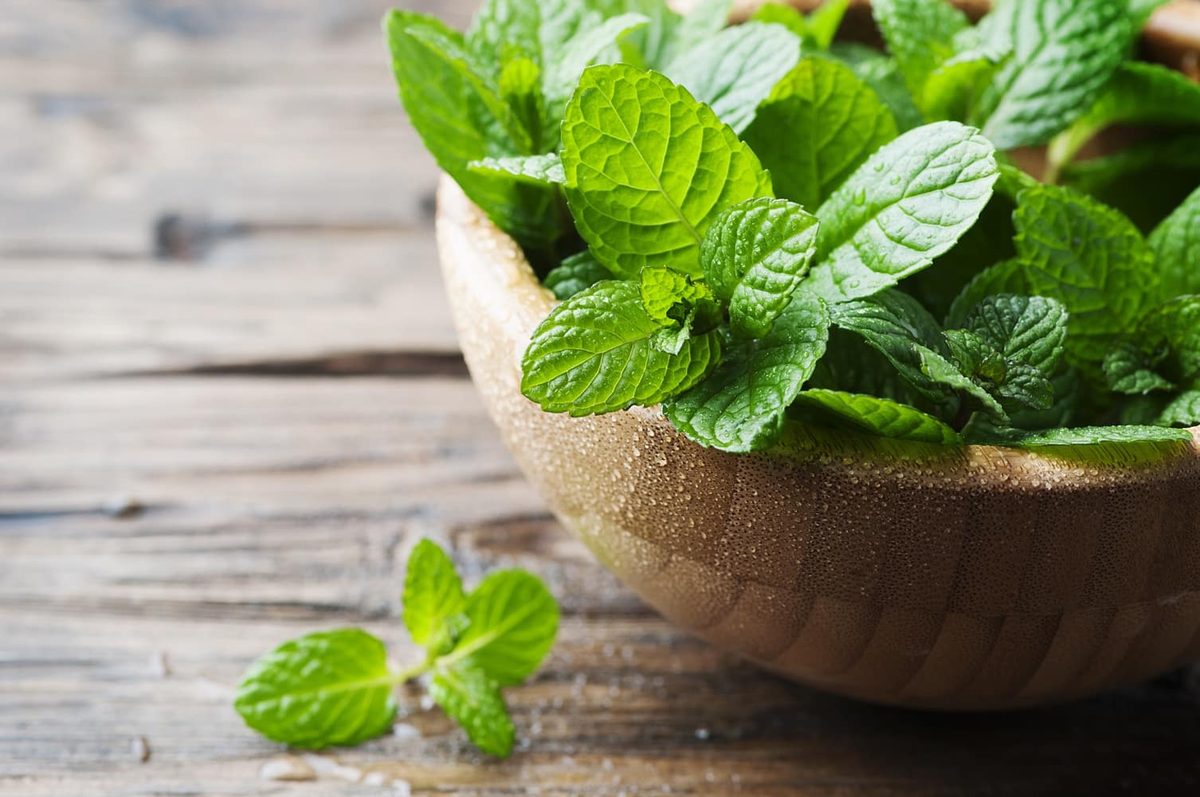
In cookery, “mint” usually means peppermint or spearmint, according to Britannica,1 and the two go to different places. Spearmint, milder and without menthol,2 covers most savory food and drinks; Britannica lists beverages, salads, soups, cheeses, meats, fish, sauces, fruits and vegetables among its uses.3 Peppermint, says Gernot Katzer’s Spice Pages, is used almost entirely for sweets and sweet liqueurs.4 This page maps where mint goes. For which mint to buy, when to add it and how to muddle it, see cooking with mint.
At a glance
| Use | Usual mint | Example from a named source |
|---|---|---|
| Mint sauce for lamb | Spearmint (Katzer)4 | 2 1/4 cups chopped leaves, vinegar, sugar (Saveur)5 |
| Mint jelly | Not specified | Water-bath canned, served with lamb or chicken (NDSU Extension)6 |
| Tabbouleh | Not specified | 1 1/2 cups packed leaves to 3 cups parsley (Saveur)7 |
| North African tea | Not specified | About 25 sprigs with green tea and sugar (Saveur)8 |
| Mint julep | Not specified | Bourbon, mint and sugar over ice (Britannica)9 |
| Mojito | Menthol mints (Belsinger)10 | Press gently or steep; see below |
| Lemonade | Not specified | 1/3 cup leaves for nine servings (NDSU Extension)6 |
| Chocolate desserts | Peppermint (Katzer)4 | Extract in cocoa, frosting, brownies (McCormick)11 |
| Vietnamese noodle soup | Mild spearmint-type (Katzer)4 | Served with the soup |
With meat: lamb sauce, jelly and Greek seasoning
Mint sauce. North Dakota State University (NDSU) Extension calls mint a frequent accompaniment to pork or lamb, and notes that in England roasted lamb is often served with mint sauce.6 Saveur’s recipe, introduced with Megan Wetherall’s description of the sauce as a simple composition of fresh mint, sugar and vinegar, uses 2 1/4 cups of finely chopped leaves; the mint, sugar and salt are steeped in boiling water, then vinegar goes in and the sauce rests for an hour.5 Katzer says spearmint is the mint to use for it.4 A widely repeated story says the sauce began as a way to mask stale or fatty meat. We found no source for that history.
Mint jelly. NDSU Extension publishes a tested mint jelly made from mint juice (1 1/2 cups firmly packed fresh mint steeped in 2 1/4 cups water), processed in a boiling water-bath canner for 5 minutes at elevations up to 1,000 feet, and longer higher up; it makes about 3 or 4 half-pint jars.6 NDSU suggests serving it with roasted lamb or chicken, or as a topping for chocolate or vanilla ice cream.6 Mint jelly is often called the American version of British mint sauce; we found no source for that framing.
Greek seasoning. McCormick describes its Culinary Greek seasoning as a blend of oregano, garlic and onion with a touch of mint.12 See Greek seasoning and gyro spices.
In salads and soups
- Tabbouleh. NDSU Extension cites tabbouleh as an example of mint in Middle Eastern dishes.6 Saveur’s version is an herb salad, with 1 1/2 cups of packed mint to 3 cups of parsley, plus tomatoes, and notes that it leaves out bulgur, a common ingredient.7 The mint is raw, and plentiful.
- Green and fruit salads. Britannica lists salads and fruits among spearmint’s uses.3 Particular pairings, such as watermelon or strawberries, are common practice rather than sourced.
- Noodle soup. In Vietnam, Katzer writes, a mild spearmint- or caraway-scented mint is preferred with noodle soup.4
- Peas and other vegetables. Minted peas are often described as a traditional English dish. We found no source for that in our research; Britannica’s list of spearmint uses includes vegetables in general.3
Drinks
Tea. NDSU Extension’s method is simple: add several leaves to boiling water and steep for up to five minutes.6 Saveur notes that mint tea is served throughout North Africa; its Moroccan version steeps 2 tablespoons of Chinese gunpowder or green tea, a bunch of mint (about 25 sprigs) and sugar in 4 cups of boiling water for 10 minutes.8 On health, the NIH’s National Center for Complementary and Integrative Health (NCCIH) says very little research has been done on peppermint leaf, and that peppermint tea appears to be safe.13 The digestive evidence it describes is for peppermint oil capsules, not tea; this page makes no claim that mint tea treats anything. See Moroccan mint.
Lemonade. NDSU’s mint lemonade mashes 1/3 cup of mint leaves with 1/4 cup of sugar in the pitcher, and makes nine 1-cup servings.6 NDSU notes that mint goes into both cold and hot drinks.6
Mint julep. Britannica describes it as an iced cocktail of bourbon, mint and sugar.9
Mojito. Herbalist Susan Belsinger, quoted in Garden & Gun, says the brightness of menthol is what stands up to the rum and lime.10 How to get the mint into the drink is disputed:
| Source | Method |
|---|---|
| Tasting Table (Sylvia Tomczak)14 | Don’t pound the leaves; hard muddling releases bitter, vegetal notes. Shake the mint with ice instead |
| Ruhlman.com recipe15 | Grind 10 leaves to a paste in a mortar, let the rum sit on it 5 to 10 minutes, then strain it through a cloth |
The two agree more than it seems: the Ruhlman method strains the crushed leaves out before the drink is built. Neither is a controlled test.
Desserts
Katzer says peppermint goes extremely well with chocolate.4 In practice much dessert mint comes from extract rather than leaves. McCormick’s Pure Peppermint Extract lists alcohol, water and oil of peppermint, and McCormick suggests a few drops in hot cocoa, frosting or brownie batter.11 Britannica notes that spearmint leaves flavor many foods, particularly sweets,3 so spearmint has a dessert role too. For mint ice cream, chocolate mint and other sweet uses, see chocolate mint and spearmint vs. peppermint.
Preserving mint
- Mint vinegar. Colorado State University Extension lists mint among the fresh herbs for flavored vinegar and allows at least 10 days for the flavor to develop; it keeps up to six to eight months in the refrigerator.16
- Mint in oil. Oregon State University Extension warns that herbs are low-acid foods that can carry Clostridium botulinum, so homemade herb oil must be refrigerated and used within 4 days, or frozen.17
- Freezing and keeping fresh. NDSU says fresh mint keeps in a glass of water or wrapped in plastic in the refrigerator for up to a week, and can be frozen in airtight freezer bags.6 See how to store mint, can you freeze mint? and how to dry mint.
Mint pesto
Mint can be pounded with garlic, oil and nuts into a pesto-style sauce, alone or with basil. That is kitchen practice; we did not find a named recipe to cite, and it is a different sauce from basil pesto alla genovese.
Not yet sourced
- Minted peas as a traditional English dish.
- Mint in tzatziki: we found no recipe meeting our standard that includes it.
- The history of mint sauce as a mask for stale meat.
- A taste test of muddled versus shaken mint.
Related
- Mint, cooking with mint, types of mint and too much mint
- Spearmint, peppermint, Moroccan mint, chocolate mint, apple mint and orange mint
- Mint substitutes, basil vs. mint, oregano vs. mint and lemon balm vs. mint
Footnotes
-
“Mint (plant)”, Encyclopaedia Britannica. britannica.com · Reference work ↩
-
“About Mint: Uses, Pairings and Recipes”, McCormick, 2026. mccormick.com · Merchant ↩
-
“Spearmint”, Encyclopaedia Britannica. britannica.com · Reference work ↩ ↩2 ↩3 ↩4
-
“Mint (Mentha)”, Gernot Katzer’s Spice Pages. gernot-katzers-spice-pages.com · Reference work ↩ ↩2 ↩3 ↩4 ↩5 ↩6 ↩7
-
“Mint Sauce”, Saveur. saveur.com · Publication ↩ ↩2
-
Julie Garden-Robinson and Tom Kalb, “Field to Fork: Mint” (FN1937), North Dakota State University Extension, 2025. ndsu.edu · Reference work ↩ ↩2 ↩3 ↩4 ↩5 ↩6 ↩7 ↩8 ↩9 ↩10
-
“Tabbouleh”, Saveur, 2014. saveur.com · Publication ↩ ↩2
-
Penny De Los Santos, “Moroccan Mint Tea”, Saveur, 2010. saveur.com · Publication ↩ ↩2
-
“Mint julep”, Encyclopaedia Britannica. britannica.com · Reference work ↩ ↩2
-
CJ Lotz Diego, “Meet the Mints”, Garden & Gun, 2017, quoting Susan Belsinger. gardenandgun.com · Publication ↩ ↩2
-
Pure Peppermint Extract, McCormick. mccormick.com · Merchant ↩ ↩2
-
Greek Seasoning, 23 oz, McCormick Culinary. mccormick.com · Merchant ↩
-
“Peppermint Oil”, National Center for Complementary and Integrative Health, 2025. nccih.nih.gov · Regulator ↩
-
Sylvia Tomczak, “Why You Should Think Twice Before Muddling Mint In Your Next Mojito”, Tasting Table, 2024. tastingtable.com · Publication ↩
-
“Mojito”, Ruhlman.com. ruhlman.com · Publication ↩
-
“Making Flavored Vinegar”, Fact Sheet 9.340, Colorado State University Extension, 2021. foodsmartcolorado.colostate.edu · Reference work ↩
-
Raab and Woodburn, “Herbs and vegetables in oil” (SP 50-701), Oregon State University Extension Service, 2025. extension.oregonstate.edu · Reference work ↩