Cooking · Uses
Dukkah Uses: Bread and Olive Oil, Eggs, Vegetables, Crusts and Sweets
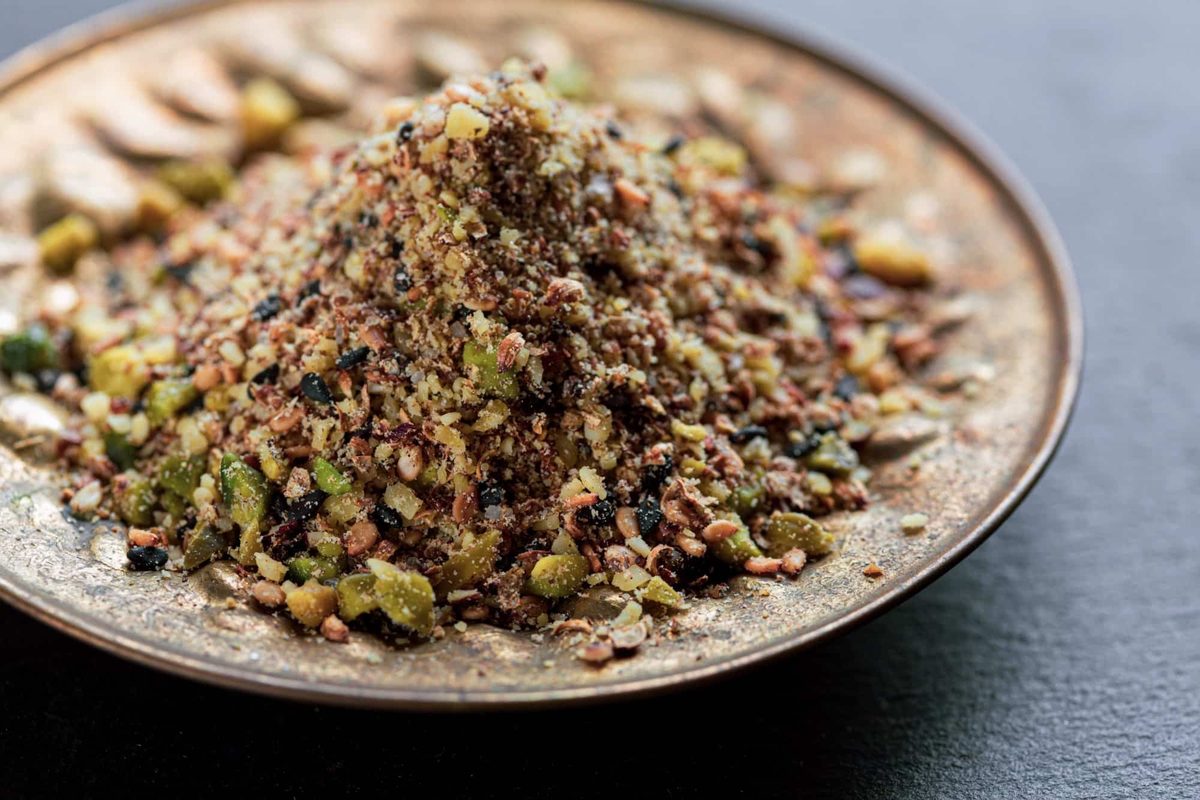
Dukkah (also written duqqa) is a coarse Egyptian mix of crushed seeds, spices and often nuts. The Oxford Companion to Food lists sesame and coriander seeds, cumin, salt and pepper as typical, perhaps with hazelnuts, and says the name comes from the Arabic verb meaning “to pound.”1 It is a condiment with crunch, and food writer Claudia Roden insists it should be a crushed dry mixture, never a paste.1 Mary Fawzy, writing for Tasting Table, notes that dipping bread in oil first helps dukkah cling to it, and that its crunch makes it a good crust.2
This page covers what to eat dukkah with. For what goes into it, see dukkah.
Where dukkah goes
| Use | How | Source |
|---|---|---|
| Bread and olive oil | Dip bread in oil, then in dukkah | Oxford Companion; Fawzy12 |
| Eggs | Sprinkled on, or with bread and a boiled egg | Fawzy2 |
| Shakshuka | As a finishing seasoning | Fawzy2 |
| Yogurt | Stirred in for a dip for raw vegetables | Fawzy2 |
| Salads | Sprinkled over | Fawzy2 |
| Roasted vegetables | Sprinkled on straight from the oven | Fawzy2 |
| Lamb and fish | As a crust | Fawzy2 |
| Savory breakfasts | On oatmeal or waffles | Fawzy2 |
| Sweets | On carrot cake, shortbread or cookies | Fawzy2 |
With bread and olive oil
This is the traditional use. The Oxford Companion says dukkah is usually eaten with bread dipped in olive oil, and that in Egypt it is served at breakfast.1 Fawzy explains the order: bread goes into the olive oil first, then into the dukkah, so the dukkah sticks.2 She adds that eating it with a bread called simit is even more traditional, often with a boiled egg alongside.2
Michele Redmond of Food & Nutrition Magazine also mixes dukkah with olive oil to make a dip for bread.3
Street food. Fawzy says dukkah is mostly made at home in Egypt, but street vendors sometimes sell freshly toasted dukkah in little cones made from newspaper, with pita or simit.2
Eggs and breakfast
Fawzy says dukkah works on any egg dish: scrambled, fried, poached or boiled.2 She also uses it to finish shakshuka, and suggests it for savory takes on breakfast dishes such as oatmeal or waffles.2 See spices for scrambled eggs.
Salads, yogurt and dips
- Salads. Fawzy uses dukkah as a salad sprinkle.2 Used the way you would use croutons or toasted nuts, it adds salt and crunch; that comparison is ours.
- Yogurt dip. Stir dukkah into plain yogurt for a quick dip for raw vegetables, or a sauce for sandwiches and wraps, Fawzy suggests.2
- Hummus. Dukkah over hummus is a natural pairing, but we found no named recipe for it. Its coarse texture gives the smooth hummus some crunch (our judgment). See hummus spices.
Roasted vegetables
Fawzy names roasted carrots as a popular choice, sprinkled with dukkah just as they come out of the oven, and she says the same works for Brussels sprouts, pumpkin, eggplant and other vegetables that sweeten when roasted.2
Crusts for lamb, fish and chicken
Fawzy uses dukkah as a crust for a rack of lamb or for grilled fish, and notes that it suits quick-cooking proteins because there is no risk of burning it through long exposure to oven heat.2 That is the opposite of a common suggestion to cook dukkah-rubbed meat low and slow. Pressing it onto oiled fish fillets, chicken cutlets or lamb chops and cooking them quickly is our suggestion. Chicken isn’t on her list, but the same logic applies (our judgment). See good spices for chicken and spices for lamb.
Most dukkah already contains salt,1 so season the meat lightly.
Sweet uses
Fawzy suggests dukkah on shortbread or cookies, and a sweet version on carrot cake, which often shares ingredients such as nuts and cinnamon.2 These are modern uses, not Egyptian tradition.
Popcorn and snacking
Dukkah on buttered popcorn, or eaten by the spoonful, is an obvious snack because it is already salted; no source we found describes it, so treat it as a suggestion.
Keep it fresh
Because nuts and sesame contain natural oils, Redmond advises storing homemade dukkah in the refrigerator for no more than a month.3 Fawzy makes a fresh batch every month and keeps it in the fridge.2 Toasting is part of making it: Redmond browns the nuts in the oven for 4 to 8 minutes.3 More on that at dukkah.
Allergen note
Most dukkah contains sesame, and many versions contain hazelnuts or other tree nuts.13 The FDA counts tree nuts, peanuts and sesame among the major food allergens.4 Check labels, and ask when it is served in restaurants.
Related
- Dukkah and dukkah substitutes
- Za’atar uses, another blend eaten with bread and olive oil
- Sesame seeds, coriander and cumin uses
Footnotes
-
Alan Davidson, “Duqqa”, The Oxford Companion to Food, 2014. app.ckbk.com · Reference work ↩ ↩2 ↩3 ↩4 ↩5 ↩6
-
Mary Fawzy, “What Exactly Is Dukkah?”, Tasting Table, 2024. tastingtable.com · Publication ↩ ↩2 ↩3 ↩4 ↩5 ↩6 ↩7 ↩8 ↩9 ↩10 ↩11 ↩12 ↩13 ↩14 ↩15 ↩16 ↩17 ↩18 ↩19 ↩20 ↩21
-
Michele Redmond, “Do You Dukkah? You’ve Got to Try the Egyptian Spice Mix”, Food & Nutrition Magazine. foodandnutrition.org · Publication ↩ ↩2 ↩3 ↩4
-
“Food Allergies”, U.S. Food and Drug Administration. fda.gov · Regulator ↩