Blog · Uses
Za’atar Uses: Flatbread, Labneh, Eggs, Chicken, Vegetables and More
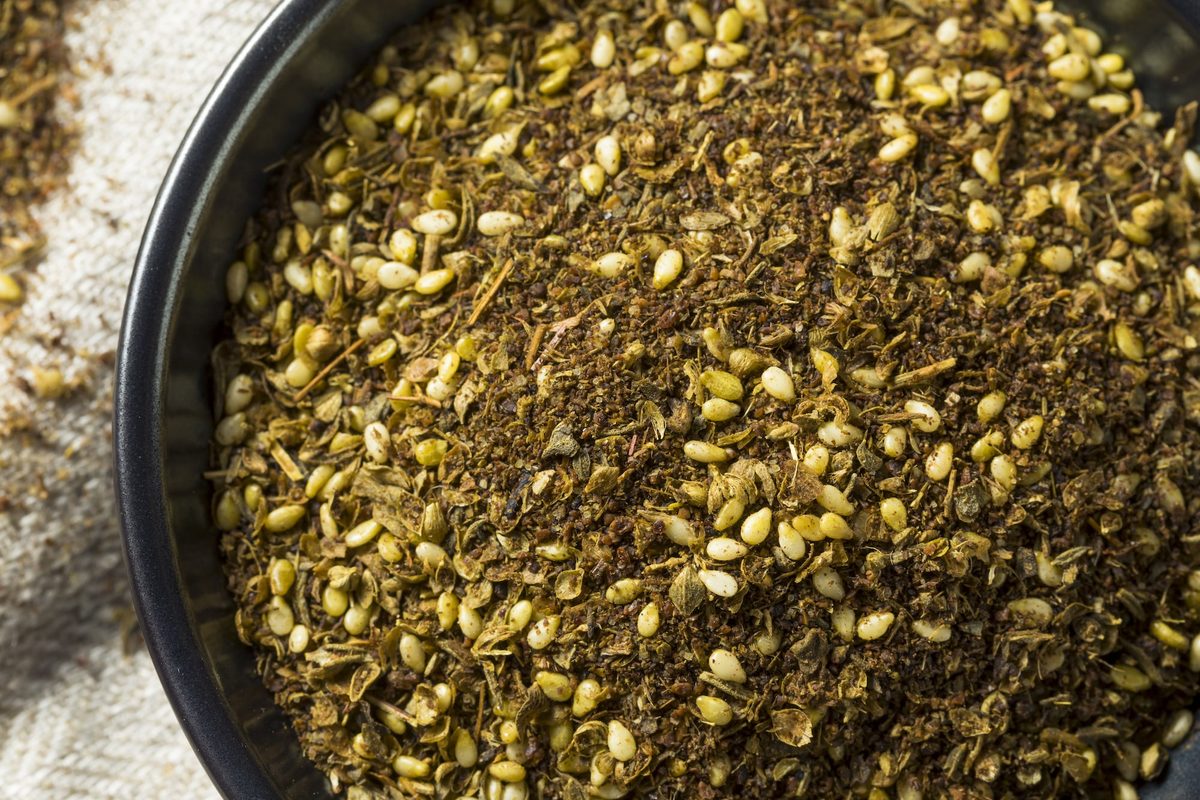
Za’atar is a blend of dried thyme, oregano or marjoram, ground sumac and toasted sesame, often salted.12 It is herbal, sour and nutty at once, and in the sources below it is mostly sprinkled on, stirred into oil, or rubbed on just before cooking, more like a condiment than a cooking spice. Laura Crowley of the UC Master Food Preservers lists what it pairs with: chickpeas and hummus, eggs, vegetables, olives, feta, yogurt dips and labneh, lentils and meat kebabs.1
This page is about what to use za’atar in. For the blend itself, how to make it and how to keep it, see cooking with za’atar and za’atar.
Where za’atar goes
| Meal | Use | Source |
|---|---|---|
| Breakfast | Man’ouché flatbread; eggs; labneh | UNESCO; Crowley31 |
| Bread | Brushed on with oil before baking; mixed into dough; an oil dip | Belsinger; Katzer45 |
| Mezze | Hummus, chickpeas, olives, feta, yogurt dips | Crowley1 |
| Meat and fish | Grilled and fried meat, kebabs, roast chicken, fish | Katzer; Crowley; Ottolenghi and Tamimi; Belsinger5164 |
| Vegetables and grains | Roasted, grilled or steamed vegetables, lentils, grains, beans | Crowley; Belsinger14 |
| Soups, salads and sauces | Sprinkled in or on | Belsinger4 |
Bread and olive oil
UNESCO describes Lebanon’s man’ouché as the quintessential Lebanese breakfast: a flatbread topped with a mixture of thyme, sumac, toasted sesame, salt and olive oil.3 Susan Belsinger brushes rolls, flatbread, pitas or pizzas with olive oil and sprinkles them with za’atar, and also works the blend into bread or cracker dough.4
Mixed with oil, it becomes a dip. Gernot Katzer notes that za’atar combined with olive oil works as a bread dip,5 and Belsinger’s proportions are about 1/4 cup of the blend to 1/4 cup of olive oil.4
Breakfast plates
- Labneh. UNESCO lists labne among man’ouché toppings, along with tomatoes, cucumbers, olives and mint.3 Crowley pairs za’atar with yogurt cheese (labna) and yogurt dips.1 A plate of labneh with olive oil and za’atar on top is a simple way to serve it (our suggestion).
- Eggs. Crowley and Belsinger both name eggs.14 Fried, scrambled or boiled, add it at the end. See spices for scrambled eggs.
- Olives and feta. Both are on Crowley’s list.1 A plate of olives and feta dressed with oil and za’atar is a quick mezze.
Hummus and chickpeas
Crowley names chickpeas and hummus first.1 Sprinkle za’atar over hummus with a pool of olive oil, or toss it with roasted chickpeas. Lentils are on her list too.1 See hummus spices.
Meat, chicken and fish
Katzer says the zahtar he describes is mostly used to season fried and barbecued meat.5 Crowley suggests it for meat kebabs, and Belsinger for chicken or fish.14
For a whole dish, Yotam Ottolenghi and Sami Tamimi marinate a quartered chicken with 2 tablespoons of za’atar and 1 tablespoon of sumac, then roast it; they call it a simplified version of the Palestinian dish m’sakhan.6 See sumac uses for the traditional version and good spices for chicken and spices for lamb for more.
As a crust or breading. Za’atar mixed into breadcrumbs, or pressed onto fish or chicken before pan-frying, is a modern use; we found no recipe to cite. Keep the heat moderate, since dried herbs and sesame can scorch (our judgment).
Vegetables, grains and soups
Crowley names cauliflower, cucumber, eggplant, potatoes and any grilled vegetable.1 Belsinger sprinkles za’atar on steamed or grilled vegetables, grains, legumes and beans, salads, soups and sauces.4 Tossing roasted potatoes or cauliflower with oil and za’atar as they come out of the oven is our suggestion.
Snacks and the table
Za’atar on popcorn, on buttered toast or on a bowl of yogurt are modern snack ideas; no source we found describes them, but they follow from the uses above. At the table it works like salt and pepper, sprinkled to taste; that is common practice rather than a sourced claim.
How much, by dish
Amounts from named recipes (Attributed):
| Use | Za’atar | Source |
|---|---|---|
| Roast chicken, serves 4 | 2 tbsp, with 1 tbsp sumac | Ottolenghi and Tamimi6 |
| Bread-dipping oil | About 1/4 cup, with 1/4 cup olive oil | Belsinger4 |
Store-bought blends vary in salt. Crowley notes that salt can make up as much as half of a seasoned-salt version,1 so taste before salting the rest of the dish.
The name
Za’atar is also the Arabic name for several wild herbs. Katzer writes that it covers oregano, marjoram, thyme and savory, and that in Jordan it usually means a spice mixture containing them.7 When a Middle Eastern recipe calls for fresh za’atar leaves, it means the herb, not the blend.
Allergen note
Most za’atar contains sesame, which has been a major food allergen under U.S. labeling law since 2023.8 Check labels and ask in restaurants.
Related
- Za’atar, cooking with za’atar and za’atar substitutes
- Sumac uses and cooking with sumac
- Thyme uses, oregano uses and marjoram uses
- Dukkah uses, another blend eaten with bread and olive oil
Footnotes
-
Laura Crowley, “Za’atar Spice Blend”, UC Cooperative Extension Master Food Preservers of El Dorado County. ccfruitandnuts.ucanr.edu · Reference work ↩ ↩2 ↩3 ↩4 ↩5 ↩6 ↩7 ↩8 ↩9 ↩10 ↩11 ↩12 ↩13 ↩14
-
Bryan Roof, “Za’atar”, America’s Test Kitchen, 2017. americastestkitchen.com · Publication ↩
-
“Al-Man’ouché, an emblematic culinary practice in Lebanon”, UNESCO Intangible Cultural Heritage, 2023. ich.unesco.org · Reference work ↩ ↩2 ↩3
-
Susan Belsinger, “Za’atar: An Exotic Herb Blend”, Fine Gardening, 2010. finegardening.com · Publication ↩ ↩2 ↩3 ↩4 ↩5 ↩6 ↩7 ↩8 ↩9 ↩10
-
Gernot Katzer, “Sumac”, Gernot Katzer’s Spice Pages. gernot-katzers-spice-pages.com · Reference work ↩ ↩2 ↩3 ↩4
-
Yotam Ottolenghi and Sami Tamimi, “Roast Chicken with Sumac, Za’atar and Lemon”, from Ottolenghi: The Cookbook, via The Splendid Table. splendidtable.org · Publication ↩ ↩2 ↩3
-
Gernot Katzer, “Oregano”, Gernot Katzer’s Spice Pages. gernot-katzers-spice-pages.com · Reference work ↩
-
Robert M. Califf, “An Update on Sesame Allergen Labeling on Food Packages”, FDA, 2023. fda.gov · Regulator ↩