Cooking · Dish guide
Hummus Spices: Garlic, Cumin, Sumac, Aleppo Pepper and the Tahini Base
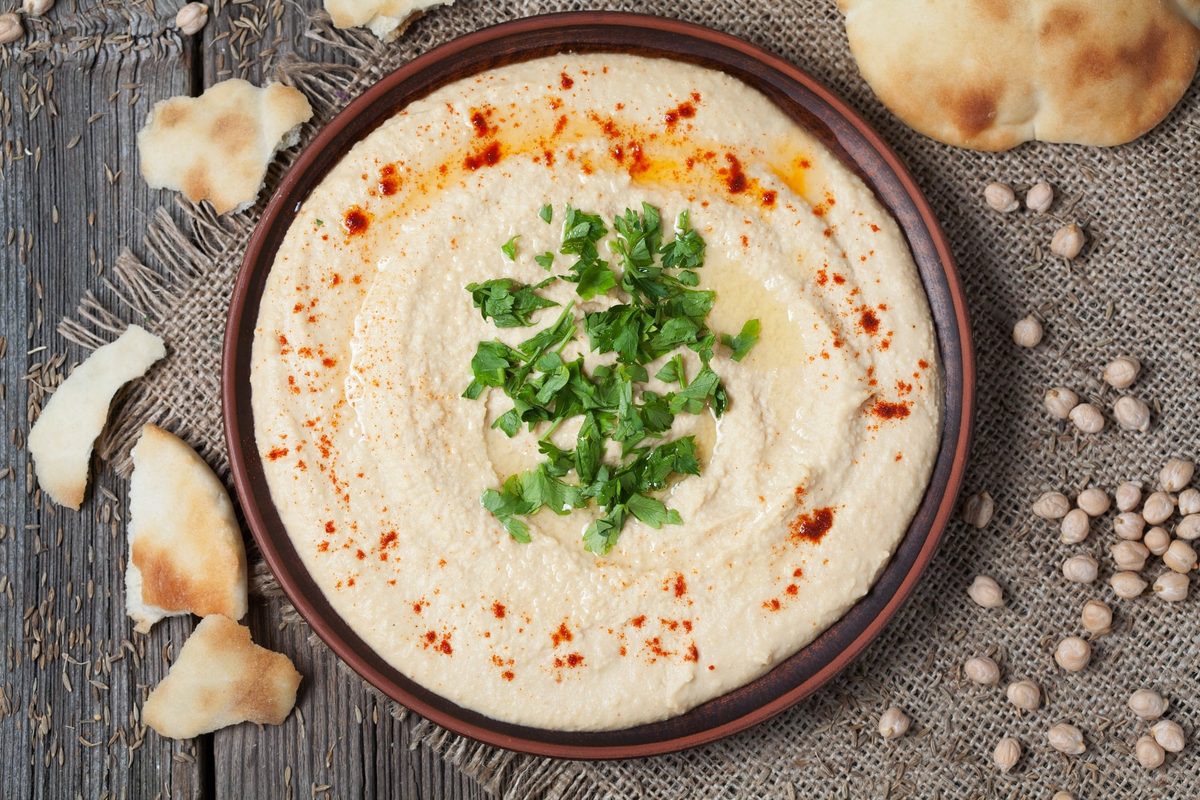
Hummus needs very little seasoning. Britannica’s definition is chickpeas mashed with tahini, garlic, lemon juice and salt,1 and many cooks stop there. When spices do go in, the usual ones are ground cumin in the dip and a red or tart spice on top: sumac, Aleppo pepper or cayenne. This page covers what each one does, with the quantities two named recipes use.
At a glance
| Seasoning | Where it goes | Job | Source |
|---|---|---|---|
| Tahini | In the dip | Sesame flavor, body | Britannica; both recipes123 |
| Garlic | In the dip | Pungent backbone | Britannica; both recipes123 |
| Lemon juice | In the dip | Acidity | Britannica; both recipes123 |
| Salt | In the dip | Seasoning | Britannica; both recipes123 |
| Cumin | In the dip, sometimes on top | Warm, earthy depth | Both recipes (optional in one)23 |
| Sumac | On top | Tart, fruity finish | Grinshpan3 |
| Aleppo pepper or cayenne | On top (cayenne also in the dip) | Mild to moderate heat, color | Goldstein2 |
| Black pepper, parsley, olive oil | In the dip or on top | Finishing | Goldstein2 |
The base: what hummus is
Britannica describes hummus as a paste from the Middle East, traditionally made of cooked chickpeas, pureed or mashed, mixed with tahini, garlic, lemon juice and salt.1 Harvard’s Nutrition Source calls it a mezze popular in Syria, Lebanon, Egypt, Saudi Arabia and Israel.2 Garlic and lemon are therefore part of the standard recipe, not optional extras.
Tahini
Tahini is sesame seed ground into a paste.4 It is the largest flavoring by volume in both recipes here: 1 cup of tahini to one 15-ounce can of chickpeas in Goldstein’s, and 1 cup to two cans in Grinshpan’s.23 See sesame seeds.
Garlic and lemon
Goldstein uses 2 finely minced garlic cloves and ½ cup of fresh lemon juice for one can of chickpeas; Grinshpan uses 2 cloves and the juice of one large lemon for two cans.23 Raw garlic is the strongest flavor in the bowl and is easy to overdo (our judgment); if that happens, see too much garlic.
Spices in the dip
Cumin
Cumin is the spice most often added to the dip itself. Goldstein lists ½ teaspoon ground cumin as optional; Grinshpan uses 1 teaspoon.23 PROSEA describes cumin’s flavor as strong, warm, pungent and persistent, and names cuminaldehyde as the most important constituent of its oil.5 In a dip that is mostly chickpeas and sesame, a little goes a long way (our judgment). For more, see cumin uses and too much cumin.
Cayenne and black pepper
Goldstein’s recipe also seasons the dip with ½ teaspoon freshly ground black pepper and an optional ¼ teaspoon of cayenne.2
Spices on top
Sumac
The spice sold as sumac comes from the fruit of Rhus coriaria,6 a member of the cashew family.7 Katzer describes its taste as tart and sour with slightly astringent overtones.6 Grinshpan finishes her hummus and salad topping with olive oil and a pinch of sumac.3 It brings acidity and a deep red color without adding liquid, which lemon juice cannot do (our judgment). See cooking with sumac and sumac uses.
Aleppo pepper and cayenne
Goldstein’s garnish options include ½ teaspoon of cayenne or Aleppo pepper.2 According to The Spice House, which sells it, Aleppo pepper originates in the Syrian town of Aleppo, its own supply now comes from a Turkish region just north of the city, and its blend is chiles, vegetable oil and salt.8 The same merchant suggests using it anywhere you would use crushed red pepper flakes.8 Cayenne gives more heat for the same amount (our judgment; no source compares the two directly). See red pepper flakes.
Herbs and oil
Goldstein suggests sprinkling the finished hummus with olive oil, chopped flat-leaf parsley or other garnishes.2 See parsley.
Two recipes side by side
| Recipe | Chickpeas | Tahini | Garlic | Acid | Spices |
|---|---|---|---|---|---|
| Joyce Goldstein, via Harvard Nutrition Source2 | 1 can (15 oz) | 1 cup | 2 cloves | ½ cup lemon juice | ½ tsp salt, ½ tsp black pepper, optional ¼ tsp cayenne and ½ tsp cumin; garnish of cayenne or Aleppo pepper, parsley, olive oil |
| Eden Grinshpan, Tahini Baby, via House & Home3 | 2 cans (15 oz) | 1 cup | 2 cloves | Juice of 1 large lemon | 1½ tsp kosher salt, 1 tsp ground cumin; sumac on the topping |
These are the named cooks’ recipes, not a house standard.
Related
Footnotes
-
Hummus, Encyclopaedia Britannica. britannica.com · Reference work ↩ ↩2 ↩3 ↩4 ↩5 ↩6
-
Hummus, recipe courtesy of Chef Joyce Goldstein, The Nutrition Source, Harvard T.H. Chan School of Public Health. nutritionsource.hsph.harvard.edu · Publication ↩ ↩2 ↩3 ↩4 ↩5 ↩6 ↩7 ↩8 ↩9 ↩10 ↩11 ↩12 ↩13 ↩14 ↩15
-
Hummus with Chopped Salad, Tahini, Lemon and Sumac, Lauren Medeiros (recipe by Eden Grinshpan), House & Home, 2025. houseandhome.com · Publication ↩ ↩2 ↩3 ↩4 ↩5 ↩6 ↩7 ↩8 ↩9 ↩10 ↩11
-
Sesame, Gernot Katzer’s Spice Pages. gernot-katzers-spice-pages.com · Reference work ↩
-
Cuminum cyminum (PROSEA), P.C.M. Jansen, via Pl@ntUse. uses.plantnet-project.org · Reference work ↩
-
Sumac, Gernot Katzer’s Spice Pages. gernot-katzers-spice-pages.com · Reference work ↩ ↩2
-
Sumac, Encyclopaedia Britannica. britannica.com · Reference work ↩
-
Aleppo Pepper, product page, The Spice House. thespicehouse.com · Merchant ↩ ↩2