Cooking · Dish guide
The Best Spices for Scrambled Eggs: Pepper, Chives, Fresh Herbs, Heat and Curry Spices
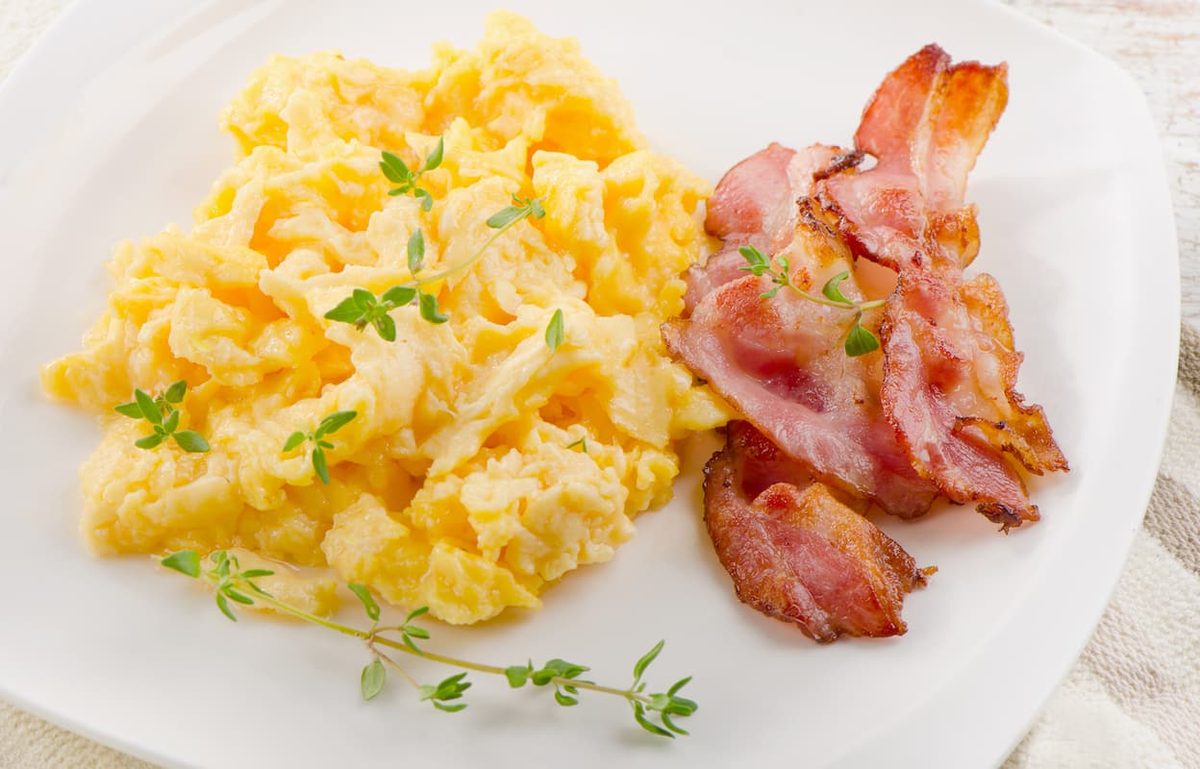
Eggs have a mild flavor, so a little seasoning goes a long way. The classic choices are salt and pepper, fresh chives or other soft herbs, and a touch of heat. Further afield, Parsi akuri turns scrambled eggs into a spiced dish with turmeric, chili and cumin.1 This page covers what each seasoning does, when to add it, and the one food-safety rule that applies to every version: the FDA says scrambled eggs should not be runny.2 Quantities appear only where a named recipe gives them.
At a glance
| Seasoning | What it brings | When to add |
|---|---|---|
| Black pepper or white pepper | Heat and aroma; white keeps the eggs unspeckled | Beaten into the eggs, or at the end34 |
| Chives | Mild onion flavor, green color | At the end56 |
| Fines herbes (chives, chervil, tarragon, parsley) | The classic French egg herbs | Beaten into the eggs, in Pépin’s omelet37 |
| Dill | Warm, slightly sharp herb flavor | At the end6 |
| Thyme | Sharp, savory, stronger herb | With the fat, early8 |
| Cayenne or red pepper flakes | Dry heat | A pinch, to taste |
| Hot sauce | Heat plus vinegar tang | At the table9 |
| Turmeric, chili powder, cumin (akuri) or curry powder | Color and warm spice | Cooked in the fat before the eggs go in1 |
| Wasabi | Sharp, nose-tingling heat that fades | At the end |
Cook them firm: the food-safety rule
The FDA’s egg-safety guidance is short: cook eggs until both the yolk and the white are firm, and scrambled eggs should not be runny. Casseroles and other dishes containing eggs should reach 160°F, checked with a food thermometer.2 Seasoning does not change that.
The core seasonings
Black or white pepper
Both come from the same berries of Piper nigrum. Black pepper is made from berries dried whole with the skin on; white pepper has the skin removed.10 America’s Test Kitchen describes black pepper as unripe berries dried until the skins blacken, and white pepper as fully ripe berries soaked to ferment before the skin comes off.11
Which one is hotter is disputed. Britannica says white pepper’s flavor is less pungent than black pepper’s,12 while Gernot Katzer says white pepper keeps the full pungency of black.4 On aroma the sources agree more: ATK notes that stripping the skin removes much of the volatile oils and aroma compounds.11 So black pepper gives more aroma; white gives clean color. Katzer notes white pepper is often suggested for cream-based sauces where black pepper would spoil the color,4 and the same logic applies to a pale plate of eggs. Jacques Pépin beats the salt, pepper and herbs into the eggs before cooking his omelet.3 See white pepper vs. black pepper.
Chives
Britannica lists chives as a common seasoning for eggs, soups, salads and vegetables.13 The leaves have a mild onion flavor, and University of Wisconsin-Madison Extension notes they are usually sprinkled on food just before serving.5 The LSU AgCenter puts chives among the delicate herbs best added a minute or two before the end of cooking.6 The green flecks against yellow eggs are a bonus. See chives vs. green onions.
Fines herbes and other soft herbs
The French answer to herbed eggs is fines herbes, a mix that commonly includes parsley, chives, tarragon and chervil.7 Pépin’s classic omelet uses 1 tablespoon of a chopped chervil, tarragon and chive mix plus 1 tablespoon of chopped parsley.3 The same herbs work in scrambled eggs; see tarragon and chervil.
Dill
Britannica describes dill as warm and slightly sharp, somewhat reminiscent of caraway.14 Like chives, the leaves are a delicate herb that LSU advises adding at the end.6 Dill and chives together are a common pairing with eggs; that is kitchen practice rather than a sourced rule. See cooking with dill and dill seed vs. dill weed.
Thyme
Thyme is stronger. Its oil’s characteristic constituents are thymol and carvacrol,15 and America’s Test Kitchen classes it as a hearty herb to add early in cooking.8 For eggs that means warming a few leaves in the butter before the eggs go in, and using less than you would of chives or dill. See cooking with thyme and too much thyme.
Heat: cayenne, flakes or hot sauce
Ground cayenne adds heat without liquid. The McCormick Science Institute notes cayenne powder is typically hotter than red pepper flakes,16 so start with a pinch. Hot sauce brings acidity and moisture along with heat: Louisiana-style sauces are built on a fermented red pepper mash,16 and a bottle such as Cholula lists water, peppers, salt and vinegar.9 Whether it goes in the pan or on at the table is a matter of preference. See cayenne pepper uses.
Turmeric, chili and cumin: Parsi akuri
Akuri is the Parsi version of spiced scrambled eggs; Sanjeev Kapoor describes it as spicy scrambled eggs eaten with toasted bread.1 His recipe for 4 eggs:
| Ingredient | Amount (Sanjeev Kapoor)1 |
|---|---|
| Eggs | 4 |
| Onion | 1, finely chopped |
| Green chilies | 1 to 2, finely chopped |
| Turmeric powder | 1/4 tsp |
| Red chili powder | 1 tsp |
| Cumin powder | 1/2 tsp |
| Fresh coriander leaves | 1 tbsp plus 1 tsp, chopped |
| Butter | 1 tbsp, to finish |
The onion and chilies are sautéed first, then the powders are stirred in and cooked for 1 minute before the beaten eggs go in.1 Ready-made curry powder is a shortcut to a similar result; the spices that typically flavor Indian curries include coriander, cumin, fenugreek and turmeric, which gives the yellow color.17 See turmeric and cumin.
Wasabi
Wasabi’s heat comes mainly from allyl isothiocyanate, 86 to 94% of the heat compounds measured in one New Zealand study,18 the same compound that gives horseradish its pungency.19 A widely repeated claim says the heat is water-soluble. It is only slightly soluble: about 2 grams per liter of water at 20°C.20 The burn passes within minutes because the compound is volatile.21 Freshly grated wasabi also loses its punch fast, by Chowhound’s account within about 15 minutes.22 Most “wasabi” paste sold in the West is made from horseradish,23 which behaves the same way. Stir a little into the eggs off the heat, or serve it on the side. See wasabi and horseradish.
When to add each seasoning
- Into the raw eggs: salt, pepper and, in Pépin’s method, the fines herbes.3
- Into the fat first: thyme, and the turmeric, chili and cumin for akuri.81
- At the end: chives, dill and other soft herbs.65
- At the table: hot sauce, extra pepper.
Related
Footnotes
-
Sanjeev Kapoor, “Akuri”, sanjeevkapoor.com, 2017. sanjeevkapoor.com · Publication ↩ ↩2 ↩3 ↩4 ↩5 ↩6
-
“Egg Safety: What You Need to Know”, U.S. Food and Drug Administration, May 2022. fda.gov · Regulator ↩ ↩2
-
Jacques Pépin, “Fine-Herbes Omelet: Conventional and Classic” (Knopf, 2001), via KQED. kqed.org · Publication ↩ ↩2 ↩3 ↩4 ↩5
-
Gernot Katzer, “Black Pepper (Piper nigrum L.)”, Gernot Katzer’s Spice Pages. gernot-katzers-spice-pages.com · Reference work ↩ ↩2 ↩3
-
Susan Mahr, “Chives, Allium schoenoprasum”, University of Wisconsin-Madison Extension. hort.extension.wisc.edu · Reference work ↩ ↩2 ↩3
-
“Flavorful Herbs”, LSU AgCenter. lsuagcenter.com · Reference work ↩ ↩2 ↩3 ↩4 ↩5
-
“Fines herbes”, Encyclopaedia Britannica. britannica.com · Reference work ↩ ↩2
-
Liz Bomze, “Our Guide to Fresh Herbs”, America’s Test Kitchen, 2019. americastestkitchen.com · Publication ↩ ↩2 ↩3
-
Cholula Hot Sauce Original, product listing, Whole Foods Market. wholefoodsmarket.com · Merchant ↩ ↩2
-
Codex Alimentarius, Standard for Black, White and Green Peppers (CXS 326-2017). fao.org · Standard ↩
-
“Substituting Black Pepper for White Pepper”, America’s Test Kitchen. americastestkitchen.com · Publication ↩ ↩2
-
“Black pepper”, Encyclopaedia Britannica. britannica.com · Reference work ↩
-
“Chive”, Encyclopaedia Britannica. britannica.com · Reference work ↩
-
Melissa Petruzzello, “Dill”, Encyclopaedia Britannica. britannica.com · Reference work ↩
-
S.H. Widodo, “Thymus vulgaris”, PROSEA. uses.plantnet-project.org · Reference work ↩
-
“Red Pepper”, McCormick Science Institute. mccormickscienceinstitute.com · Merchant ↩ ↩2
-
“Curry”, Encyclopaedia Britannica. britannica.com · Reference work ↩
-
Tamanna Sultana, “Factors affecting the yield of isothiocyanates, the flavour compounds, in wasabi”, PhD thesis, Lincoln University. researcharchive.lincoln.ac.nz · Reference work ↩
-
“Isothiocyanate”, Encyclopaedia Britannica. britannica.com · Reference work ↩
-
“Allyl isothiocyanate (CID 5971)”, PubChem, National Library of Medicine. pubchem.ncbi.nlm.nih.gov · Reference work ↩
-
Sylvia Tomczak, “Why Horseradish Is So Potent For Such A Short Time”, Tasting Table, 2022. tastingtable.com · Publication ↩
-
Elias Nash, “Why Genuine Wasabi Is So Expensive In The US”, Chowhound, 2023. chowhound.com · Publication ↩
-
Melissa Petruzzello, “Wasabi”, Encyclopaedia Britannica. britannica.com · Reference work ↩