Spice Substitutes · Substitutes
Dukkah Substitutes, Ranked by How You’re Using It
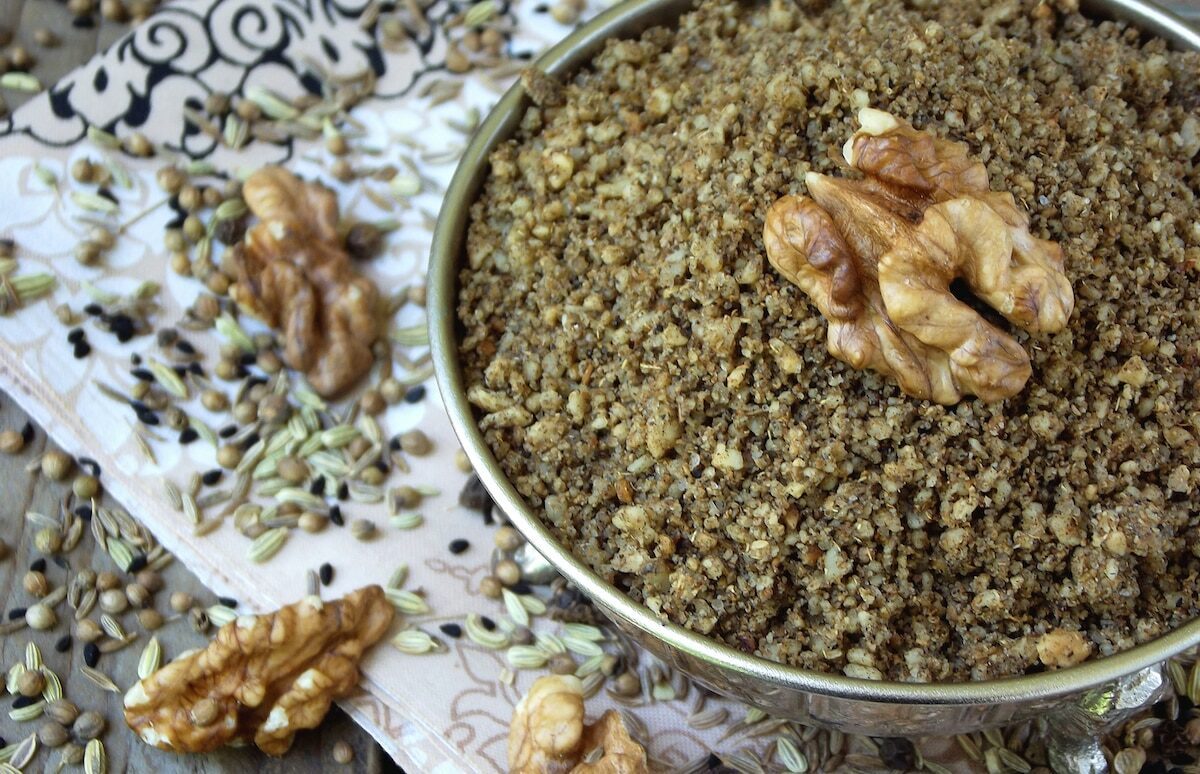
Dukkah (also written duqqa) is a coarse Egyptian mix of crushed seeds and spices, often with nuts. The Oxford Companion to Food lists sesame and coriander seeds, cumin, salt and pepper as typical, perhaps with hazelnuts, and says it is usually eaten with bread dipped in olive oil.1 What makes it dukkah is that combination of crunch, toasted sesame and warm seed spices. No ready-made blend has all three, so the best substitute depends on which of them your dish needs most.
Quick answer
| What dukkah is doing | Best substitute | Starting amount | Treatment |
|---|---|---|---|
| Dip for bread and olive oil | Quick homemade dukkah | A published recipe, scaled down | Attributed |
| The same, with no nuts in the house | Za’atar | Use as you would dukkah, then taste for salt and sourness | Method |
| Crunchy crust or topping (lamb, fish, eggs, vegetables) | Chopped toasted nuts with sesame, coriander and cumin | About 1 part sesame to 2 parts nuts, seasoned to taste | Method |
| Crust where heat is welcome | Suya spice (yaji) | About half the dukkah amount, then add | Method |
| Sesame and salt finish only | Gomasio or furikake | About half the dukkah amount | Method |
| Spice flavor only, no crunch | Ground coriander and cumin, plus a pinch of chaat masala or shichimi | A small pinch per serving | Method |
How the ratios on this page are labeled
Every ratio carries one of four labels.
- Computed: based on a measurable physical relationship, with the source named.
- Attributed: a named source publishes this ratio. We quote it as theirs.
- Disputed: named sources give different answers to the same swap. We show each one and do not average them.
- Method: we found no published ratio. We give a direction and a cautious starting point, and say so.
We found no published ratio for replacing dukkah with any other blend. Dukkah itself has no fixed recipe: Claudia Roden, quoted in the Oxford Companion, explains that its ingredients vary.1 So apart from one published recipe, every amount below is a starting point, not a measured equivalent.
If dukkah is a dip for bread and olive oil
This is the classic use: tear off bread, dip it in olive oil, then into the dukkah.1 The mix has to stick to oiled bread and give it crunch, so texture matters as much as flavor. Roden is firm that dukkah should be a crushed dry mixture and definitely not a paste.1
1. Make a quick batch
Dukkah is made from pantry staples, so making it is the closest substitute.
Formula (Attributed): Michele Redmond’s recipe in Food & Nutrition Magazine uses 1/3 cup each of hazelnuts and almonds, 2 heaping tablespoons sesame seeds, 2 tablespoons coriander seeds, 1 tablespoon cumin seeds, 1 teaspoon fennel seeds, 1 teaspoon black peppercorns and 1/2 teaspoon coarse sea salt.2 She bakes the nuts at 375°F until lightly browned, 4 to 8 minutes, toasts the sesame in a skillet, heats the other spices until fragrant, and crushes everything together.2
The older descriptions treat nuts as optional,1 so if you have only sesame, coriander, cumin, salt and pepper, you can still make a version the Oxford Companion would recognize. Crush rather than grind, and stop while the mix is still coarse.
Why it works: the flavor comes from a few well-studied spices. Linalool and related terpene alcohols make up 60 to 80 percent of coriander seed oil,3 and cuminaldehyde 20 to 72 percent of cumin oil.4 Toasting adds its own compounds: in sesame, pyrazines dominate the flavor under mild toasting at about 160°C.5
2. Za’atar
Za’atar is the nearest ready-made blend for this job. It is eaten the same way: Susan Belsinger, writing in Fine Gardening, suggests brushing flatbread with olive oil and sprinkling it with za’atar, or mixing the two as a dip.6 Sesame is a standard ingredient, and Katzer records sesame in the Jordanian mixture.5
The difference is the rest of the blend. At its most basic, according to UC Cooperative Extension’s Master Food Preservers, za’atar contains sumac, thyme, oregano and sesame seeds.7 Katzer describes sumac as tart and sour, with slightly astringent overtones.8 So za’atar swaps dukkah’s warm, toasty seed spices for a herbal, sour profile, and it has no nuts.
Ratio (Method): No published ratio. For dipping, use it as you would dukkah. Some versions include salt (one recipe Belsinger quotes uses 1 part salt to 4 parts each of herb and sesame),6 so taste before salting the oil or the dish. If you have coriander and cumin seeds, toasting and crushing a spoonful of each into the za’atar brings it closer to dukkah. That is our suggestion, not a tested recipe.
If dukkah is a crunchy crust or topping
Pressed onto lamb, chicken or fish, or scattered over eggs, yogurt or roasted vegetables, dukkah is mainly a textured seasoning. That use is kitchen practice rather than a sourced tradition. For this job, crunch and toastiness count for more than an exact spice match.
1. Chopped toasted nuts and seeds
Ratio (Method): No published ratio. Toast what nuts you have with sesame seeds, chop them coarsely, and season with ground coriander, cumin, salt and pepper. About 1 part sesame to 2 parts nuts by volume is a reasonable start; Redmond’s recipe uses a little less sesame than that against its 2/3 cup of nuts.2 Pistachios, walnuts or cashews all work in place of hazelnuts, as a matter of taste.
2. Suya spice (yaji), if you like heat
Suya is grilled, skewered beef from West Africa. Great British Chefs’ Helen Graves describes it as a barbecue tradition originating with the Hausa people, rubbed with a spice mixture called yaji.9 Like dukkah, yaji is built on ground nuts, in this case peanuts. America’s Test Kitchen’s version by Kiano Moju uses dry-roasted peanuts, ginger, garlic and onion, with white and cayenne pepper for heat.10 Graves’s yaji adds paprika, Scotch bonnet powder, cumin seeds, cloves and grains of Selim.9
That makes it a good crust but a hot one. Dukkah is not a chile blend in any of the sources above,12 and yaji usually is.
Ratio (Method): No published ratio. Start with about half the amount of dukkah called for, taste for heat, and make up the crunch with chopped nuts or sesame.
3. Gomasio or furikake, for a sesame finish
Gomasio is toasted sesame and salt. Makiko Itoh of JustBento calls it the most basic furikake and gives the sesame-to-salt ratio of commercial gomashio as usually 8 to 1 by weight.11 Furikake, Japanese for “sprinkle,” is a rice seasoning; Namiko Hirasawa Chen of Just One Cookbook describes a common mix of bonito flakes, toasted sesame seeds, nori seaweed, sugar and salt.12 Some versions add salmon flakes, dried shrimp, shiso, egg, wasabi or vegetables.12
Both supply dukkah’s toasted sesame. Neither has its coriander or cumin, and furikake brings a seafood and seaweed taste and some sweetness that dukkah lacks.
Ratio (Method): No published ratio. Because both are salt-forward, start with about half the dukkah amount and add ground coriander and cumin if you have them.
If dukkah is only adding spice flavor
Sometimes dukkah goes into a dressing or a dish where the crunch is lost anyway. Then the job is spice flavor, and loose spices do it best.
1. Ground coriander and cumin
Ratio (Method): No published ratio. These are the two spices every source above puts in dukkah.12 Toast them lightly if they are whole, then add a pinch each per serving, with salt and black pepper. You lose the nuts and sesame, which in a dressing matters little.
2. Chaat masala, as a small accent
Chaat masala is a finishing blend sprinkled over snacks, fruit and other finished food.1314 It shares cumin with dukkah, but it is dominated by different flavors. Tarla Dalal credits amchur (dried mango powder) with its tang and kala namak (black salt) with its distinctive aroma,13 and the Gulf News recipe uses a full tablespoon of black salt.14 Neither of the two recipes we compared lists coriander or sesame.
Ratio (Method): No published ratio. Use a small pinch alongside coriander and cumin, not in place of dukkah’s full amount, and leave out other salt until you have tasted.
3. Shichimi togarashi, if you want heat
Shichimi, also sold as Japanese seven-spice or nanami togarashi, is a table condiment sprinkled over noodles, rice bowls and yakitori.15 Nippon.com lists chile, sansho and sesame as its standard ingredients, with the rest varying by maker, and notes sansho’s tongue-numbing heat.16 It shares only sesame with dukkah.
Ratio (Method): No published ratio. Use it as a light sprinkle for heat and aroma, a pinch at a time, rather than as a measure-for-measure swap.
Allergens
Dukkah and most of its substitutes contain sesame, and many contain tree nuts or peanuts. The FDA lists tree nuts, peanuts, sesame, fish and soybeans among the major food allergens,17 which also matters for furikake made with bonito.12 Check labels before serving any of these to guests.
What isn’t known
- No published source gives a ratio for replacing dukkah with za’atar, gomasio, furikake, suya spice, chaat masala or shichimi. Every swap on this page except the homemade recipe is a Method starting point.
- Dukkah itself varies,1 so a jar you buy may be nuttier, saltier or more heavily spiced than the recipe quoted here.
- Some guides name tsire and chichinga as regional names for West African suya spice. The sources we opened name only yaji, so those names are not used here.
Related
- Dukkah and dukkah uses
- Za’atar and za’atar substitutes
- Gomasio, furikake and gomasio vs. furikake
- Shichimi togarashi and chaat masala
- Sesame seeds, coriander and cumin
Footnotes
-
Alan Davidson, “Duqqa”, The Oxford Companion to Food, 2014. app.ckbk.com · Reference work ↩ ↩2 ↩3 ↩4 ↩5 ↩6 ↩7 ↩8
-
Michele Redmond, “Do You Dukkah? You’ve Got to Try the Egyptian Spice Mix”, Food & Nutrition Magazine. foodandnutrition.org · Publication ↩ ↩2 ↩3 ↩4 ↩5
-
Al-Khayri et al., “Essential Oil from Coriandrum sativum: A Review”, Molecules, 2023. mdpi.com · Peer-reviewed ↩
-
P.C.M. Jansen, Cuminum cyminum, Plant Resources of South-East Asia (PROSEA). uses.plantnet-project.org · Reference work ↩
-
Gernot Katzer, “Sesame”, Gernot Katzer’s Spice Pages. gernot-katzers-spice-pages.com · Reference work ↩ ↩2
-
Susan Belsinger, “Za’atar: An Exotic Herb Blend”, Fine Gardening, 2010. finegardening.com · Publication ↩ ↩2
-
“Za’atar Spice Blend”, UC Cooperative Extension Master Food Preservers of El Dorado County. ccfruitandnuts.ucanr.edu · Reference work ↩
-
Gernot Katzer, “Sumac”, Gernot Katzer’s Spice Pages. gernot-katzers-spice-pages.com · Reference work ↩
-
Helen Graves, “Suya”, Great British Chefs, 2018. greatbritishchefs.com · Publication ↩ ↩2
-
Kiano Moju, “Beef Suya”, America’s Test Kitchen, 2025. americastestkitchen.com · Publication ↩
-
Makiko Itoh, “Homemade furikake no. 6: Gomashio, sesame salt”, JustBento. justbento.com · Publication ↩
-
Namiko Hirasawa Chen, “Homemade Furikake (Rice Seasoning)”, Just One Cookbook. justonecookbook.com · Publication ↩ ↩2 ↩3
-
Tarla Dalal, “Chaat Masala”, TarlaDalal.com. cdn.tarladalal.com · Publication ↩ ↩2
-
Anupa Kurian, “Homemade Indian chaat masala”, Gulf News, 2022. gulfnews.com · Publication ↩ ↩2
-
Namiko Hirasawa Chen, “Shichimi Togarashi”, Just One Cookbook. justonecookbook.com · Publication ↩
-
“七味唐辛子の七つ全部言える?”, Nippon.com (Japan Data). nippon.com · Publication ↩
-
“Food Allergies”, U.S. Food and Drug Administration. fda.gov · Regulator ↩