Cooking · Profile
Ethiopian Spices: Berbere, Mitmita, Niter Kibbeh and the Spices Behind Them
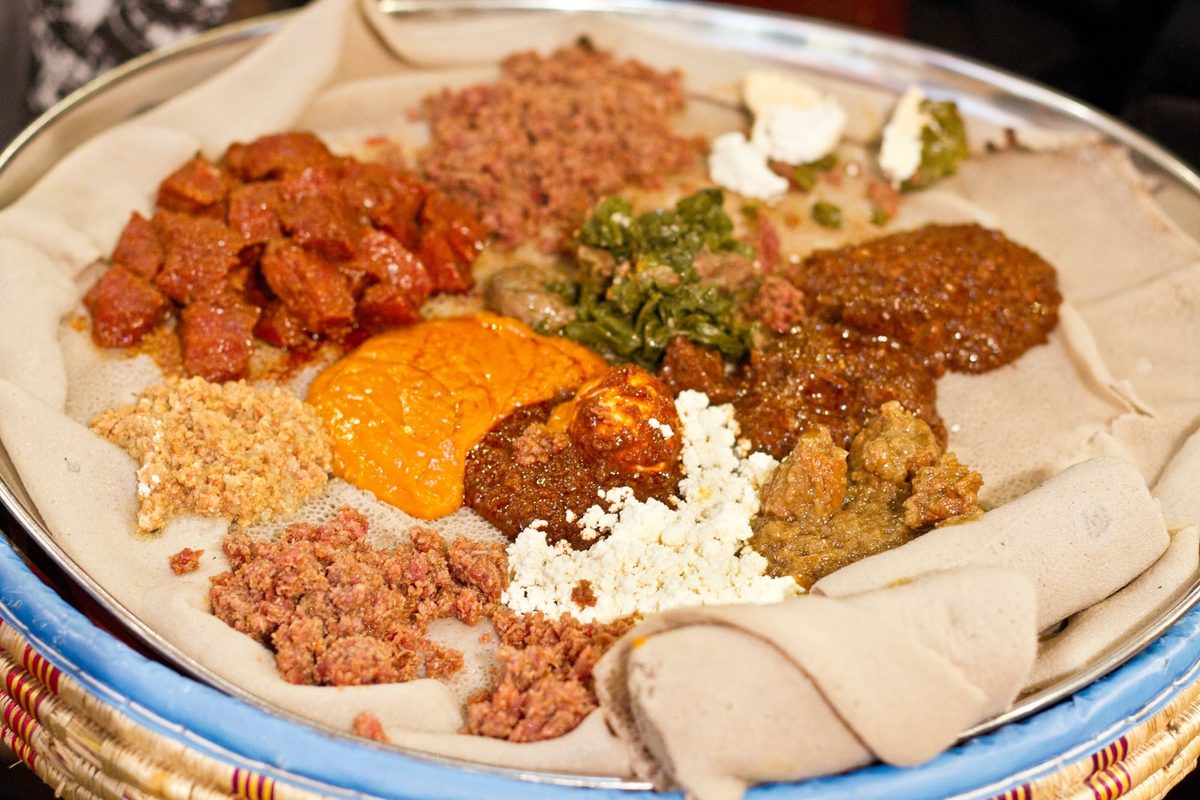
Ethiopian cooking is built less on single spices than on a handful of house-made blends and seasoned fats: berbere, mitmita, awaze and spiced clarified butter. A 2025 ethnobotanical review documents 63 plant species used as spices and condiments across Ethiopia,1 and it describes Ethiopia as a center of origin and domestication for several spices, korarima among them. This page covers the main blends, what goes into each according to named sources, and the individual spices behind them, with links to our full profiles.
At a glance
| Name | What it is | Key ingredients in the named sources | Main use |
|---|---|---|---|
| Berbere | Chile-spice blend; also a word for coarse chile powder23 | Chiles, plus sweet spices, peppers, ginger, coriander, fenugreek31 | Stews (wat) such as doro wat23 |
| Mitmita | Very hot chile blend4 | Bird’s eye chiles (Capsicum frutescens), cardamom or korarima14 | Raw meat such as kitfo, injera, bread, cooked roots15 |
| Awaze | Berbere made into a paste3 | Berbere with water, wine or mead3 | Table condiment3 |
| Niter kibbeh | Spiced clarified butter36 | Cardamom, coriander, fenugreek, long pepper, nigella and herbs (Saveur)6 | Flavoring for stews and kitfo35 |
| Mekelesha | A finishing blend1 | No published ingredient list found | Not documented in the sources reviewed |
Katzer, an established spice reference, notes that spice use in Ethiopia parallels Indian tradition in several ways, and that berbere resembles the Indian masalas.3 The idea that this reflects Ethiopia’s role in an ancient spice trade with Europe is widely repeated, but no source was found for it.
Berbere
Berbere is Ethiopia’s essential chile-spice blend; Saveur says the name means “hot” in Amharic.2 In Ethiopia the same word also names a coarse powder of semihot to hot chiles.3 The 2025 review calls it a quintessential Ethiopian blend typically containing Capsicum.1 Those chiles are New World plants: Capsicum annuum is native from the southern United States to Brazil and the Caribbean.7
What goes in. There is no single recipe. Marcus Samuelsson says every family makes its own berbere and dries it in the sun.8 Katzer describes chiles toasted until they darken, then ground with long and black pepper, ginger, coriander and fenugreek, with sweet tones from cinnamon, cardamom, cloves and even allspice, and a little ajwain.3 The 2025 review adds that coriander and cumin are vital components,1 and that rue is occasionally included.1 Fenugreek carries sotolon, which PROSEA says is responsible for its characteristic curry aroma.9
How hot. Sources disagree. Katzer calls the mixture rather hot,3 while Samuelsson describes his as a mild chile blend mellowed with sweet and floral flavors.8 The heat depends on the chiles each cook chooses.
How it is used. Saveur names doro wot and misir wot among the dishes that depend on it.2 Katzer describes doro wat as chicken and hard-boiled eggs in a gravy of chiles, onions and garlic, and says berbere is traditionally used for mutton.3 Doro wat is often called Ethiopia’s national dish; no source for that title was found. See our full berbere profile and berbere substitutes.
Mitmita
Mitmita is the fiercer blend. Kittee Berns, in her Ethiopian cookbook Teff Love, calls it an intensely hot spice blend traditionally served with Ethiopian meat dishes, made from ground bird’s eye chiles, which are hotter than cayenne.4 The 2025 review confirms that the dried, powdered fruits of Capsicum frutescens are essential to it, and lists korarima among its ingredients.1 Berns’s own version swaps in cayenne and adds ground cardamom.4
The review describes mitmita as a versatile condiment used to season raw meat, injera, bread and cooked roots or tubers.1 Its best-known partner is kitfo, minced raw beef from the Gurage region: Saveur’s kitfo is seasoned with mitmita and spiced clarified butter and warmed just until the mixture is lightly warmed but still raw.5 The review credits much of the distinctive aroma of Gurage-style kitfo to koseret (Lippia adoensis), an aromatic herb grown in Gurage home gardens.1
Several details often repeated about mitmita could not be traced: that it ranks second in popularity after berbere, that it normally contains salt and cloves, and that it is served with the raw beef or mutton dish called kurt or tere saga.
Awaze
Awaze (also awazi) is berbere made into a paste with water, wine or mead, and is usually served as a table condiment.3 The review lists it among Ethiopia’s hot pepper sauces.1 Recipes that add olive oil, or combine berbere with mitmita, could not be traced to a source we opened.
Niter kibbeh (spiced clarified butter)
Clarified butter is a common ingredient in Ethiopian cooking, and Katzer notes that the Ethiopian version is prepared with spices and used more often as a flavoring than as a cooking medium.3 Saveur explains that Ethiopian cooks simmer fragrant spices, onions or garlic into the clarified butter, then filter it; clarified butter becomes a brilliant yellow oil that keeps for about 2 months.6
Saveur’s recipe flavors a pound of butter with cardamom pods, coriander seed, fenugreek seed, long pepper, nigella, grains of paradise, dried basil and dried thyme.6 The 2025 review adds that cumin is a critical ingredient of clarified butter and that koseret leaves are integral to spiced butter among the Gurage and Oromo.1 Turmeric does not appear in Saveur’s version; Saveur notes that clarified butter on its own becomes a brilliant yellow oil.6
Mekelesha
The 2025 review names mekelesha alongside berbere, mitmita and awaze as one of Ethiopia’s complex spice blends that vary by region, but gives no ingredient list.1 The widely repeated description of mekelesha as a nutmeg, cinnamon and black pepper blend sprinkled over stews just before serving could not be traced. For context, Katzer says the traditional meat stews are seasoned mostly with long pepper together with black pepper, nutmeg, cloves and turmeric.3
The individual spices
| Spice | Botanical name | Role in Ethiopian cooking | Profile |
|---|---|---|---|
| Chile | Capsicum annuum, C. frutescens71 | Base of berbere; bird’s eye chiles in mitmita31 | Cayenne pepper |
| Korarima (Ethiopian cardamom) | Aframomum corrorima1 | Mitmita, awaze, spice blends, coffee1 | Related: cardamom, black cardamom |
| Fenugreek | Trigonella foenum-graecum1 | Berbere; small amounts improve injera31 | Fenugreek |
| Cumin | Cuminum cyminum1 | Berbere and clarified butter1 | Cumin |
| Coriander | Coriandrum sativum1 | Berbere1 | Coriander |
| Black cumin (tikur azmud) | Nigella sativa1 | Berbere-type blends; spiced butter (Saveur)16 | Nigella seeds |
| Long pepper | Piper longum10 | Berbere, stews, spiced butter36 | Long pepper |
| Ethiopian black pepper | Piper capense111 | Used in Ethiopian blends1 | See below |
| Rue | Ruta chalepensis1 | Dairy, coffee, sometimes berbere1 | None |
Korarima. The review says korarima holds a unique place in Ethiopian cuisine and is used in hot pepper sauces such as mitmita and awaze, in spice blends and even to flavor coffee.1 It also notes rising market demand for forest spices such as korarima and long pepper, many of them wild-harvested.1
Timiz and Piper capense. The review lists Piper capense, which it calls Ethiopian black pepper, among the native and naturalized species in Ethiopian blends.1 It is a scrambling shrub or tree of the pepper family, Piperaceae, native to tropical and southern Africa, the Comoros and Madagascar.11 The Amharic name timiz is commonly attached to it, but Katzer lists timiz as an Amharic name for long pepper, Piper longum,3 a different species native from the eastern Himalaya to Indo-China.10 The sources we reviewed do not settle which plant the name means in a given market. Descriptions of a smoky, tobacco-like aroma could not be traced.
Cumin’s old reputation. Ethiopian cumin had a name in antiquity: Pliny the Elder noted that some preferred African, Ethiopian or Egyptian cumin.12
Safety: mycotoxins in chile
The chiles in berbere are the main safety concern. In a 2023 study of the berbere supply chain in Ethiopia, chile pods were spread directly on the ground to sun-dry, and all 100 berbere samples collected tested positive for mycotoxins.13 That is one study of one supply chain. See our berbere profile for the regulatory limits.
Related pages
- Berbere and berbere substitutes
- Fenugreek and cooking with fenugreek
- Long pepper and long pepper vs. black pepper
- Cardamom and nigella seeds
- The master list of herbs and spices
Footnotes
-
Ethnobotanical review of Ethiopian spices and condiments: traditional uses, cultural significance, and applications (Amsalu, Birhanu and Awoke, Journal of Ethnic Foods 12:35, 2025), Springer Nature (Journal of Ethnic Foods). link.springer.com · Peer-reviewed ↩ ↩2 ↩3 ↩4 ↩5 ↩6 ↩7 ↩8 ↩9 ↩10 ↩11 ↩12 ↩13 ↩14 ↩15 ↩16 ↩17 ↩18 ↩19 ↩20 ↩21 ↩22 ↩23 ↩24 ↩25 ↩26 ↩27 ↩28 ↩29 ↩30 ↩31 ↩32 ↩33
-
Ethiopian Spice Mix (Berbere) (29 Feb 2008), Saveur. saveur.com · Publication ↩ ↩2 ↩3 ↩4
-
Long Pepper (Piper longum, P. retrofractum), Gernot Katzer’s Spice Pages. gernot-katzers-spice-pages.com · Reference work ↩ ↩2 ↩3 ↩4 ↩5 ↩6 ↩7 ↩8 ↩9 ↩10 ↩11 ↩12 ↩13 ↩14 ↩15 ↩16 ↩17 ↩18 ↩19 ↩20
-
Mitmita, in Teff Love: Adventures in Vegan Ethiopian Cooking (Kittee Berns, 2015), ckbk. app.ckbk.com · Publication ↩ ↩2 ↩3 ↩4
-
Beef Tartare With Spiced Clarified Butter (Kitfo), by Saveur Editors (19 Apr 2019), Saveur. saveur.com · Publication ↩ ↩2 ↩3
-
Ethiopian Spiced Clarified Butter (Niter Kibbeh), by Saveur Editors (19 Apr 2019), Saveur. saveur.com · Publication ↩ ↩2 ↩3 ↩4 ↩5 ↩6 ↩7
-
Capsicum annuum L., Plants of the World Online, Royal Botanic Gardens, Kew. powo.science.kew.org · Reference work ↩ ↩2
-
Berbere Is Marcus Samuelsson’s Secret Weapon (Jacqueline Raposo, 9 Nov 2016), Tasting Table. tastingtable.com · Publication ↩ ↩2
-
Trigonella foenum-graecum (PROSEA), C.S. Tawan and N. Wulijarni-Soetjipto, Plant Resources of South-East Asia, via Pl@ntUse. uses.plantnet-project.org · Reference work ↩
-
Piper longum L., Plants of the World Online, Royal Botanic Gardens, Kew. powo.science.kew.org · Reference work ↩ ↩2
-
Piper capense L.f., Plants of the World Online, Royal Botanic Gardens, Kew. powo.science.kew.org · Reference work ↩ ↩2
-
Pliny the Elder, Natural History, Book 19, chapter 47 (English translation; Latin text ed. Mayhoff 1906), Perseus Digital Library, Tufts University. perseus.tufts.edu · Reference work ↩
-
Postharvest handling practices and mycotoxin occurrence along the dried berbere chilli pepper value chain: a case study from Northern Ethiopia (Satheesh, Parmar, Fanta and Stathers, Journal of Stored Products Research 103:102157, 2023), University of Greenwich Academic Literature Archive (GALA). gala.gre.ac.uk · Peer-reviewed ↩