Seasonings · Profile
Berbere: Ethiopia’s Chile Spice Blend, What Is in It and How It Is Used
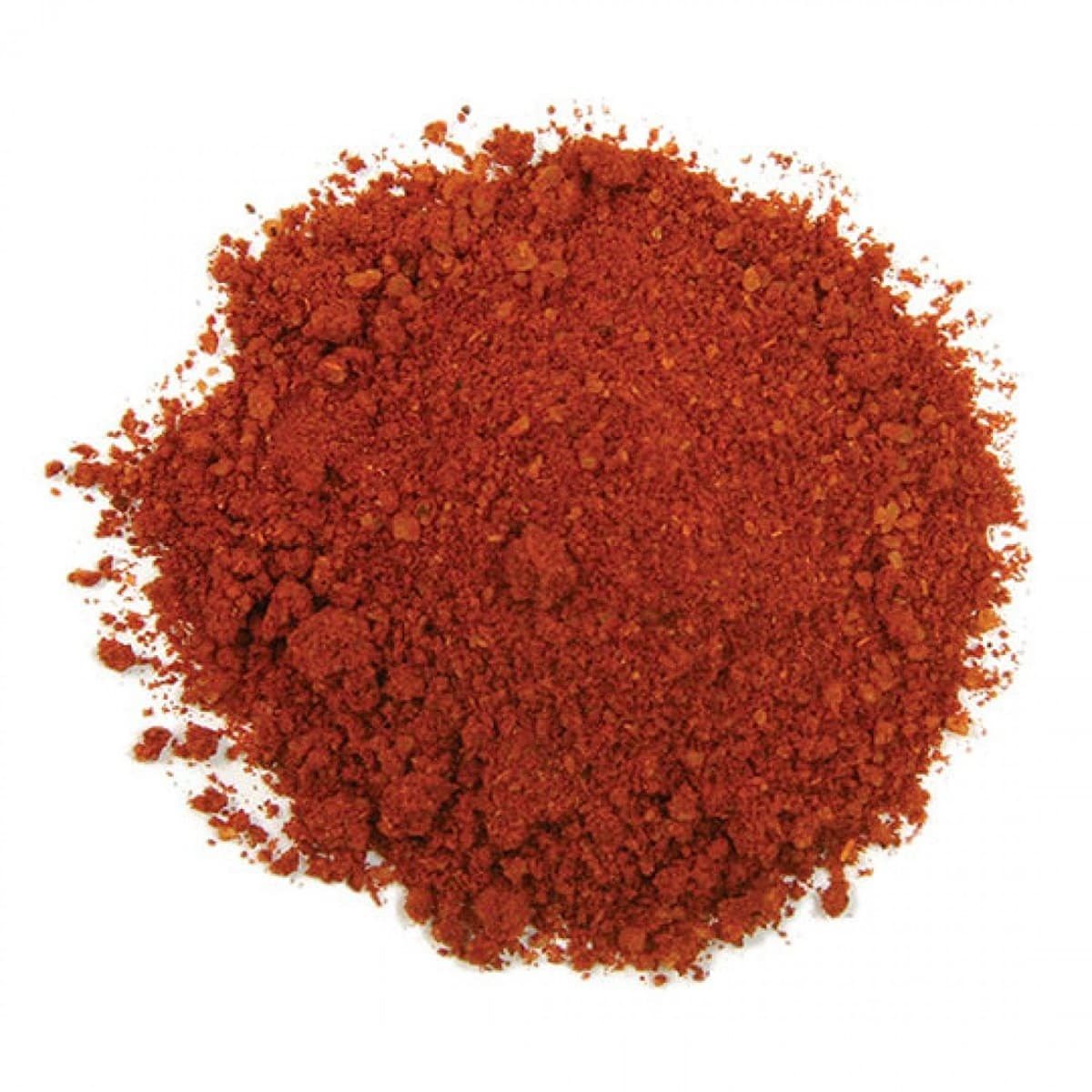
Berbere is the chile-based spice blend at the center of Ethiopian cooking. Saveur calls it essential to many Ethiopian dishes, including doro wot and misir wot, and says the name means “hot” in Amharic.1 Dried red chiles are toasted and ground with fenugreek, coriander, pepper, ginger and warm spices such as cardamom, cloves and allspice.2 The word also names the coarse chile powder itself, and every household’s version is different.32
At a glance
| What it is | A blend led by dried red chile, with fenugreek, coriander, pepper, ginger and warm spices12 |
| Name | Means “hot” in Amharic (Saveur); PepperScale traces it to the Ethiopian word barbare, “hot”; also used for plain coarse chile powder (Katzer)142 |
| Region | Ethiopia; Eritrea has its own berbere paste with less chile and dried onion2 |
| Forms | Dry powder; also moistened into a paste, awaze, served at the table2 |
| Key dishes | Doro wot (chicken and hard-boiled eggs), misir wot (lentils), siga wat (beef)12 |
| Heat | Semihot to hot chiles (Katzer); “mild” by Marcus Samuelsson’s account of his own blend; typically medium (PepperScale)324 |
| Keeps | Up to 6 months in an airtight container (Saveur; Tasting Table’s Samuelsson recipe)15 |
What is in it
Katzer describes Ethiopian berbere as dried chiles toasted until they darken, with long and black pepper, ginger, coriander, fenugreek and a little ajwain added, and sweetness from cinnamon, cardamom, cloves and even allspice.2 He notes that rue, often left out of recipes written for Western cooks, is another traditional ingredient, and that some complex recipes add rue leaves and basil before a final drying.2 He also says the allspice in Ethiopian berbere comes from Réunion.6
Two widely circulated American recipes are close to identical:
| Ingredient | Saveur (2008) | Marcus Samuelsson, via Tasting Table |
|---|---|---|
| Coriander seeds | 2 tsp | 2 tsp |
| Fenugreek seeds | 1 tsp | 1 tsp |
| Black peppercorns | 1/2 tsp | 1/2 tsp |
| Allspice | 1/4 tsp whole | 3 berries |
| Cardamom pods | 6 (white) | 6 |
| Cloves | 4 whole cloves | none; 4 garlic cloves instead |
| Dried onion flakes | 1/2 cup | 1/2 cup |
| Chiles de árbol | 5 | 5 |
| Paprika | 3 tbsp | 3 tbsp |
| Kosher salt | 2 tsp | 2 tsp |
| Nutmeg, ginger, cinnamon (ground) | 1/2 tsp each | 1/2 tsp each |
| Method | Toast whole spices about 4 minutes, grind with onion and chiles, stir in the rest | Same |
Sources: Saveur,1 Tasting Table.5
Neither recipe includes long pepper, ajwain or rue, which Katzer lists for Ethiopian berbere,2 and both lean on paprika for bulk and color. Readers comparing them should note that one has whole cloves where the other has garlic cloves. Samuelsson has said that every Ethiopian family makes its own berbere and dries it in the sun.3
Heat and flavor
Berbere tastes of toasted red chile first, then a warm, slightly bitter, maple-like depth from fenugreek and a sweet, perfumed finish from cardamom, cloves and cinnamon. That description is ours. How hot it is depends on the chiles. Katzer describes berbere chile as semihot to hot,2 while Samuelsson calls his blend a mild chile blend mellowed out with sweet and floral flavors.3 PepperScale puts it in between, at a typically medium heat that varies by blend, and describes the flavor as earthy and richly aromatic, likened by some to curry powder combined with chili powder.4 All three are true of different blends, so taste a new jar before using a full measure. The chiles de árbol in both American recipes above are rated 15,000 to 30,000 Scoville heat units on PepperScale’s pepper list, a conventional range rather than a measurement of any batch.7
The measured compounds belong to the individual spices: fenugreek’s characteristic curry aroma comes from sotolon,8 and coriander seed oil is 60–80% linalool.9 No published aroma analysis of a berbere blend was found.
History
Chiles, the main ingredient of berbere today, are Capsicum species native to the Americas; Kew gives the native range of Capsicum annuum as the southern US to Brazil and the Caribbean.10 Katzer counts the long pepper in berbere among the signs of Arab influence on spice blends from the region.11 A widely repeated claim that berbere dates to around 5 BC, when Ethiopian traders controlled a Red Sea route to the Silk Road, could not be traced to any source.
How berbere is used
Wots. Berbere is the base of Ethiopia’s stews. Katzer describes siga wat as lean beef braised in a thick, spicy gravy of chiles, onions and garlic, and doro wat as chicken and hard-boiled eggs in a similar gravy.2 Saveur names doro wot and misir wot as dishes that depend on it.1
Awaze. Berbere can be made into a paste with water, wine or tej (mead), called awaze, which is usually served as a table condiment; the paste can also be dried again at high heat for a more aromatic spice.2 PepperScale describes awaze as berbere mixed with wine and garlic, and suggests a berbere paste made with oil, water or vinegar as a marinade.4 It is not a roux.
Eritrea. Eritrean cooking uses a berbere paste made with less chile, where dried onions give the typical flavor, in dishes such as the chicken stew tsebhi dorho and the beef stew zigni.2
Beyond Ethiopia. Samuelsson uses berbere from starters to dessert: sprinkled on ricotta toast, in brown butter for a warm beef tartare, as a coating on raw fish, as a rub for rack of lamb and stirred into honey over pineapple.3
Buying and quality
There is no standard for berbere, so read the label: paprika-heavy blends will be milder and redder than ones led by hot chile, and some blends contain salt (both recipes above do).15 Both recipes above, like the Ethiopian practice Katzer describes, toast the whole spices before grinding.12
Storage
Saveur and Tasting Table’s Samuelsson recipe both say to keep the blend in an airtight container for up to 6 months.15 That is recipe guidance, not a measured shelf life. The University of California Cooperative Extension lists air, light, moisture and heat as the factors that speed flavor and color loss in spices.12 If the blend has little aroma when rubbed between your fingers, it has faded.
Safety
Mycotoxins in the chiles. A 2023 study of the berbere chile value chain in Amhara, northern Ethiopia, found that farmers commonly spread the pods directly on the ground to sun-dry. Of 100 berbere samples collected from harvest to retail, all tested positive for mycotoxins (aflatoxins and ochratoxins).13 A 2024 study of hot red pepper sold in North Shewa, Oromia, reported total aflatoxin levels in packaged pepper powder above maximum tolerable limits.14 Both studies sampled Ethiopian markets, not berbere sold in the US or Europe. EU law caps ochratoxin A in dried Capsicum products at 20 µg/kg, aflatoxin B1 at 5.0 µg/kg and total aflatoxins at 10.0 µg/kg.15
Lead in spices. A New York City health department review of 1,496 spice samples from 41 countries, collected 2008 to 2017, found detectable lead in more than half; spices bought abroad had higher average levels.16 The abstract does not report results by blend.
Health claims
No regulator or systematic review we found supports health claims for berbere as a blend. On two of its ingredients, the NIH’s National Center for Complementary and Integrative Health says research shows ginger may help with nausea and vomiting in pregnancy,17 and that studies of fenugreek for blood sugar were mostly not of high quality.18 Both summaries concern supplement doses, not the amounts in a stew. Claims that the chiles in berbere lower cholesterol and prevent heart attacks, or that its ginger treats diarrhea, colds or flu, could not be traced to any credible source.
Substitutes and related pages
For stand-ins, see berbere substitutes. For the wider pantry, see Ethiopian spices. Ingredients: fenugreek, coriander, long pepper, black pepper, ginger, cardamom, cloves, allspice, cinnamon, carom seeds (ajwain) and paprika. Other chile blends: harissa powder, chili powder and cayenne pepper. Related blends: baharat and hawaij.
Footnotes
-
“Ethiopian Spice Mix (Berbere)”, Saveur, 2008. saveur.com · Publication ↩ ↩2 ↩3 ↩4 ↩5 ↩6 ↩7 ↩8 ↩9 ↩10
-
Gernot Katzer, “Long Pepper (Piper longum)”, Gernot Katzer’s Spice Pages. gernot-katzers-spice-pages.com · Reference work ↩ ↩2 ↩3 ↩4 ↩5 ↩6 ↩7 ↩8 ↩9 ↩10 ↩11 ↩12 ↩13 ↩14 ↩15 ↩16
-
Jacqueline Raposo, “Berbere Is Marcus Samuelsson’s Secret Weapon”, Tasting Table, 2016. tastingtable.com · Publication ↩ ↩2 ↩3 ↩4 ↩5
-
Matt Bray, “What Is Berbere? The Story Behind The Spice”, PepperScale, 2023. pepperscale.com · Publication · PepperScale is also owned by Matt Bray, the editor of this site. ↩ ↩2 ↩3 ↩4
-
“Marcus Samuelsson’s Berbere Spice Recipe”, Tasting Table. tastingtable.com · Publication ↩ ↩2 ↩3 ↩4
-
Gernot Katzer, “Allspice (Pimenta dioica)”, Gernot Katzer’s Spice Pages. gernot-katzers-spice-pages.com · Reference work ↩
-
“The Hot Pepper List: 170+ Chilies Profiled”, PepperScale. pepperscale.com · Publication · PepperScale is also owned by Matt Bray, the editor of this site. ↩
-
C.S. Tawan and N. Wulijarni-Soetjipto, Trigonella foenum-graecum, Plant Resources of South-East Asia (PROSEA). uses.plantnet-project.org · Reference work ↩
-
Al-Khayri et al., “Essential Oil from Coriandrum sativum: A Review”, Molecules, 2023. mdpi.com · Peer-reviewed ↩
-
Capsicum annuum L., Plants of the World Online, Royal Botanic Gardens, Kew. powo.science.kew.org · Reference work ↩
-
Gernot Katzer, “Paprika (Capsicum annuum)”, Gernot Katzer’s Spice Pages. gernot-katzers-spice-pages.com · Reference work ↩
-
Add a Little Spice to Your Life! Part II, University of California Cooperative Extension. ucanr.edu · Reference work ↩
-
Satheesh, Parmar, Fanta and Stathers, “Postharvest handling practices and mycotoxin occurrence along the dried berbere chilli pepper value chain”, Journal of Stored Products Research, 2023. gala.gre.ac.uk · Peer-reviewed ↩
-
“Exposure and Health Risk Assessment of Aflatoxins in Hot Red Pepper Marketed in North Shewa Zone, Oromia Region, Ethiopia”, Environmental Health Insights, 2024. doaj.org · Peer-reviewed ↩
-
Commission Regulation (EU) 2023/915, EUR-Lex. eur-lex.europa.eu · Regulator ↩
-
Hore et al., “A Spoonful of Lead”, Journal of Public Health Management and Practice, 2019. scholars.mssm.edu · Peer-reviewed ↩
-
“Ginger: Usefulness and Safety”, National Center for Complementary and Integrative Health, 2025. nccih.nih.gov · Regulator ↩
-
“Fenugreek”, National Center for Complementary and Integrative Health, 2025. nccih.nih.gov · Regulator ↩