Spice Comparisons · Comparison
Long Pepper vs. Black Pepper: Two Piper Species, One Pungent Compound
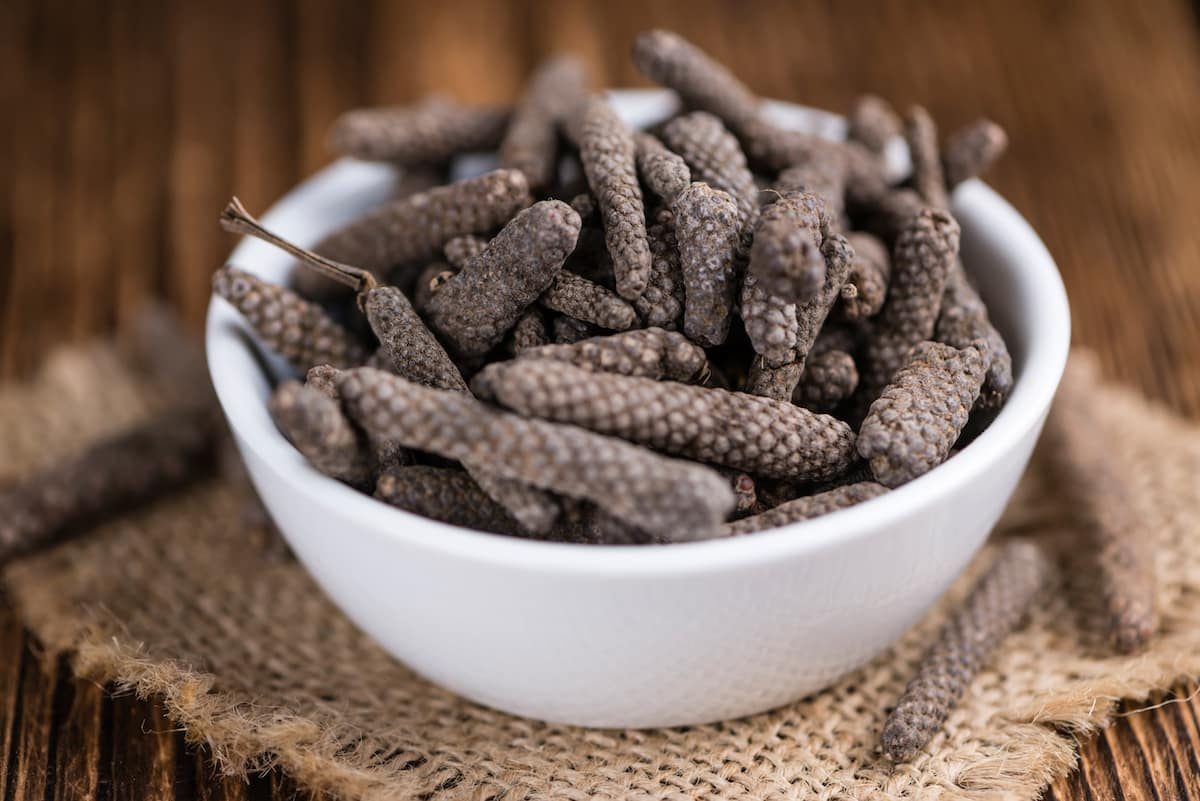
Long pepper and black pepper are two species of the same genus, Piper, in the pepper family, Piperaceae.12 Black pepper is a round dried berry; long pepper is a whole fruiting spike of tiny fused fruits, about 2 cm long.34 Both get their bite from piperine.24 The differences that matter in the kitchen are aroma, which comes from different compounds, and heat, where the sources disagree.
Side by side
| Long pepper | Black pepper | |
|---|---|---|
| Species | Piper longum1 | Piper nigrum5 |
| Family | Piperaceae1 | Piperaceae2 |
| Native range | Eastern Himalaya to southern Yunnan and Indo-China (Kew)1 | Western Ghats of Kerala, India, per Kew’s species profile; Kew’s distribution data list only Sri Lanka5 |
| Part used | The whole fruiting spike, about 1.8 to 2.5 cm long and 0.6 to 0.75 cm across4 | The dried berry, a small sphere62 |
| Piperine | About 3 to 5% of dry weight (2026 review);4 about 6% (Katzer)3 | 4.9 to 7.7% (PROSEA)7 |
| Essential oil | About 1%43 | 1.0 to 1.8% in commercial cultivars (PROSEA); up to 3% in ground pepper (Britannica)72 |
| Aroma chemistry | Major volatiles include β-caryophyllene, bisabolene, pentadecane and zingiberene;4 Katzer says terpene components are missing from its aroma3 | About 90% of the oil is monoterpene and sesquiterpene hydrocarbons7 |
| Flavor, as sources describe it | “Hot and warm, with sweet and somewhat earthy overtones” (Katzer);3 sweeter than black pepper, with a citrusy bite (Atlas Obscura)6 | Its characteristic flavor comes principally from piperine (Britannica)2 |
| Supply | Much of the Indian trade is wild-harvested4 | Vietnam, Brazil and Indonesia grow more than 60% of world pepper (AramcoWorld, 2021; no year given)8 |
| Availability | Hard to find in much of the West;6 sold in South Asian grocery stores9 | One of the most widely used spices in the world (Kew)5 |
| Price | No dated, sourced comparison found | No dated, sourced comparison found |
The piperine figures come from different sources and samples. They show the two are in the same range, not which one is higher. For each spice in depth, see long pepper and black pepper.
The differences that change a dish
Heat: the sources disagree
Piperine is the shared pungent compound. It acts on TRPV1, the same heat receptor that capsaicin activates, though in a study on human receptors in cultured cells it was far less potent than capsaicin.10 Whether long pepper is hotter or milder than black pepper is not settled:
| Source | What it says |
|---|---|
| Gernot Katzer’s Spice Pages3 | More pungent than black pepper; “must be used with care” |
| The Spice House11 | “A bit more heat than traditional black peppercorns” |
| James Hancock, World History Encyclopedia12 | The most popular pepper in Rome because of its greater pungency |
| Atlas Obscura food entry6 | Sweeter and “not as hot” as black pepper |
The piperine figures do not settle it either. Katzer puts long pepper at about 6%, “slightly higher than in black pepper,” while a 2026 review gives 3 to 5% of dry weight, and PROSEA gives 4.9 to 7.7% for black pepper.347 Those come from different samples and methods. No study measuring both spices side by side was found. In practice, start with less of whichever you are substituting and taste.
Aroma: different compounds
This is the clearer difference. Black pepper’s essential oil is about 90% monoterpene and sesquiterpene hydrocarbons, with limonene, sabinene and β-pinene leading in one Indian sample reported by PROSEA.7 Katzer says terpene components are missing from long pepper’s aroma, and that is his reason it cannot be replaced by ordinary black pepper.3 The 2026 review lists its major volatiles as β-caryophyllene, bisabolene, pentadecane, zingiberene and α-zingiberene.4 The Spice House describes notes of nutmeg, cinnamon and ginger;11 Atlas Obscura, a citrusy bite.6 The upshot, in our judgment: black pepper smells brighter and more resinous, long pepper warmer and sweeter.
Form and grinding
A long pepper spike is a rod of tiny fused fruits,3 not a hard sphere. The Spice House says it can be used in most peppermills that grind black pepper,11 and it can go into a stew or a slow-roasted lamb dish whole.11 Atlas Obscura describes it being used whole, crushed in a mortar, or broken up for a spice grinder.6
How each is used
Long pepper. Katzer says its main use in India is in spicy vegetable pickles, and that it usually appears in traditional Ethiopian meat stews (wat) and sometimes in the complex spice mixtures of Morocco.3 PepperScale’s ras el hanout explainer draws the same contrast between the two peppers: black pepper shows up in most blends, while long pepper is optional.13 Atlas Obscura names rasam, lentil curries and Indian pickles, and calls it essential to the mutton stew nihari.6 See berbere seasoning and ras el hanout.
Black pepper. Kew calls it one of the earliest known and most widely used spices in the world.5 Finishing, crusts such as steak au poivre, dressings and spice blends are common practice; see black pepper.
History: the older European pepper
Katzer says long pepper probably reached Europe before black pepper, and that in the Roman Empire it cost about three times as much.3 Hancock calls it the most popular pepper in Rome.12 Atlas Obscura says it was used in hippocras, a mulled medicinal wine, until the 1500s, and that its use in Europe faded almost entirely after Columbus brought chiles back from the Americas.6 Black pepper’s history is the better-known one: Britannica records tributes levied in pepper in ancient Greece and Rome, and Venetian and Genoese merchants became its main distributors in medieval Europe.2 The English word pepper traces back through Latin to the Sanskrit name for long pepper, pippali, according to Atlas Obscura.9
Can one stand in for the other?
The sources split on this as well. No published ratio exists in either direction, so every amount below is Method.
- Black pepper in place of long pepper. Katzer says long pepper cannot be substituted by ordinary black pepper, and suggests white pepper plus a little mace instead.3 Our long pepper substitutes page ranks that combination above plain black pepper. Ratio (Method): if black pepper is all you have, start with about 3/4 as much, freshly ground, and taste; a pinch of mace or nutmeg covers some of the missing warmth.
- Long pepper in place of black pepper. Zingerman’s, which sells long pepper, suggests using it any way you would black pepper,14 and The Spice House says it works in most peppermills.11 Ratio (Method): because three of the four heat sources above call it hotter, start with about 3/4 as much long pepper as the black pepper called for, then taste. In a dish built on black pepper’s bright aroma, such as cacio e pepe or steak au poivre, expect a sweeter, warmer result; that is our judgment.
- Grades of black pepper. For a look at whether a premium black pepper changes the picture, see Tellicherry pepper vs. black pepper.
What isn’t known
- No study has measured piperine in long pepper and black pepper side by side, and published figures for long pepper disagree (about 3 to 5% versus about 6%).
- Whether long pepper is hotter or milder than black pepper is disputed among the sources above.
- No source was found describing the color of dried long pepper against black pepper.
- No source supports a recent revival of long pepper, its use in Chinese cooking, or its use in garam masala.
- No published substitution ratio exists in either direction.
- No dated, sourced price comparison was found.
Related
- Long pepper and long pepper substitutes
- Black pepper, black pepper substitutes, white pepper vs. black pepper, cracked vs. ground black pepper
- Other peppery spices: cubeb pepper, grains of paradise, allspice vs. black pepper, black pepper vs. cayenne
- Too much pepper? How to fix the dish.
Footnotes
-
Piper longum L., Plants of the World Online, Royal Botanic Gardens, Kew. powo.science.kew.org · Reference work ↩ ↩2 ↩3 ↩4
-
“Black pepper”, Encyclopaedia Britannica. britannica.com · Reference work ↩ ↩2 ↩3 ↩4 ↩5 ↩6 ↩7
-
Gernot Katzer, “Long Pepper (Piper longum, P. retrofractum)”, Gernot Katzer’s Spice Pages. gernot-katzers-spice-pages.com · Reference work ↩ ↩2 ↩3 ↩4 ↩5 ↩6 ↩7 ↩8 ↩9 ↩10 ↩11 ↩12
-
Bhatia et al., “From Ancient Spice to Advanced Science: Insights into the Fruits of Piper longum”, Drug Design, Development and Therapy, 2026. dovepress.com · Peer-reviewed ↩ ↩2 ↩3 ↩4 ↩5 ↩6 ↩7 ↩8 ↩9
-
Piper nigrum L., Plants of the World Online and Kew Species Profiles, Royal Botanic Gardens, Kew. powo.science.kew.org · Reference work ↩ ↩2 ↩3 ↩4
-
Jared Rydelek, “Long Pepper”, Atlas Obscura. atlasobscura.com · Publication ↩ ↩2 ↩3 ↩4 ↩5 ↩6 ↩7 ↩8
-
Piper nigrum, Plant Resources of South-East Asia (PROSEA). uses.plantnet-project.org · Reference work ↩ ↩2 ↩3 ↩4 ↩5
-
Jeff Koehler, “Spice Migrations: Pepper”, AramcoWorld, 2021. aramcoworld.com · Publication ↩
-
Andrew Coletti, guide to different kinds of pepper, Atlas Obscura, 2025. atlasobscura.com · Publication ↩ ↩2
-
McNamara, Randall and Gunthorpe, “Effects of piperine at the human vanilloid receptor (TRPV1)”, British Journal of Pharmacology, 2005. pmc.ncbi.nlm.nih.gov · Peer-reviewed ↩
-
Long Pepper product page, The Spice House. thespicehouse.com · Merchant ↩ ↩2 ↩3 ↩4 ↩5
-
James Hancock, “Pepper”, World History Encyclopedia, 2021. worldhistory.org · Publication ↩ ↩2
-
Matt Bray, “What Is Ras El Hanout? The Story Behind The Spice”, PepperScale, 2019. pepperscale.com · Publication · PepperScale is also owned by Matt Bray, the editor of this site. ↩
-
“The Loveliness of Long Pepper”, Zingerman’s Delicatessen, 2023. zingermansdeli.com · Merchant ↩