Spice Comparisons · Comparison
Garlic Powder vs. Garlic Salt: One Is Garlic, the Other Is Mostly Salt
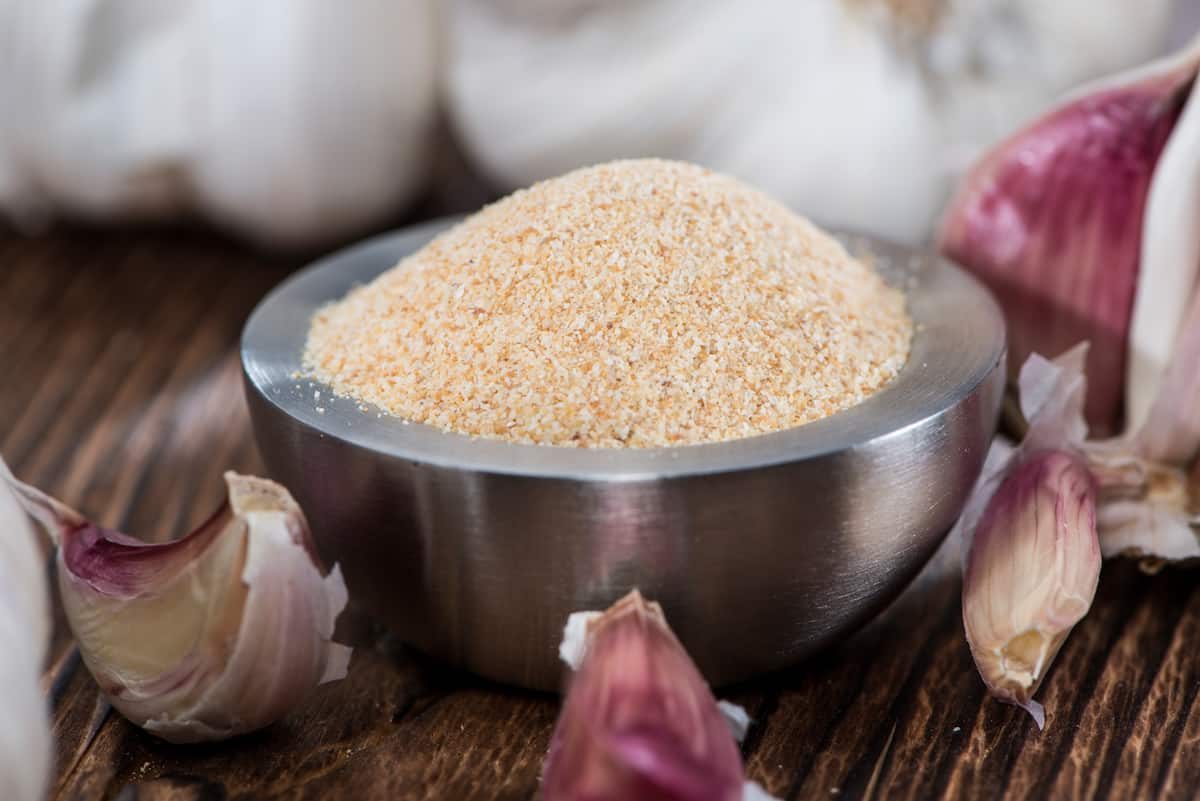
Garlic powder is dried, ground garlic. Garlic salt is salt with some of that garlic blended in, and it is mostly salt: McCormick’s garlic salt carries 540 mg of sodium per ¼ teaspoon,1 close to the 590 mg in the same measure of Morton’s iodized table salt.2 Plain garlic powder has almost none.3 So garlic powder seasons a dish with garlic, and garlic salt seasons it with salt that tastes of garlic. Measure each accordingly.
Side by side
| Garlic powder | Garlic salt | |
|---|---|---|
| What it is | Garlic cloves, usually sliced, dried at low temperature and ground4 | Salt blended with dried garlic, usually with an anticaking agent; some brands add starch, sugar or parsley15 |
| Plant | Garlic, Allium sativum6 | Same garlic, as a minor ingredient1 |
| Salt to garlic | None added | No label states it. ATK says commercial garlic salt is typically 3 parts salt to 1 part garlic powder;7 UC ANR’s home recipe is 4 to 18 |
| Sodium, per ¼ teaspoon | About 0.5 mg (USDA generic garlic powder; our arithmetic)3 | McCormick 540 mg;1 Lawry’s with Parsley 350 mg5 |
| For comparison | Morton iodized table salt, 590 mg per ¼ teaspoon2 | |
| One teaspoon weighs | 3.1 g (USDA)3 | No published figure found |
| Equal to one clove | 1/8 to 1/4 teaspoon; sources disagree (table below) | ¾ teaspoon per medium clove (NDSU)9 |
| Flavor (editorial) | Garlic only, rounder and sweeter than fresh | Salt first, garlic second |
| Typical uses | Rubs, blends, dressings, sauces, anywhere you want garlic without changing the salt | In place of some or all of a recipe’s salt: McCormick suggests burgers, chili, tacos and meatloaf1 |
| Price | No dated, sourced comparison found | No dated, sourced comparison found |
The sodium figures belong to different scopes. The garlic powder figure is USDA’s generic analysis: 60 mg of sodium per 100 g and 3.1 g per teaspoon,3 which by our arithmetic is about 2 mg per teaspoon. The garlic salt figures come from two brands’ Nutrition Facts labels, and the two brands differ by about 54 percent.15 Check your own jar.
The real difference: salt
Everything else follows from how much salt is in the jar. Table salt is about 40% sodium,10 and garlic salt is three or four parts salt to one of garlic, depending on whose figure you use.78 One teaspoon of McCormick’s garlic salt carries about 2,160 mg of sodium by our arithmetic from the label,1 more than the World Health Organization’s recommended adult limit of less than 2,000 mg of sodium a day.11
Two practical consequences, both our judgment:
- You can’t add garlic without adding salt. If a dish needs more garlic flavor, more garlic salt also means more salt. Garlic powder lets you set the two separately.
- Garlic salt replaces salt, not garlic. Use it where a recipe calls for salt, and cut the plain salt to match.
America’s Test Kitchen tested dried garlic products against fresh garlic in a Caesar salad and garlic bread. Its tasters gave garlic salt exceptionally low scores, objecting to a “chemical,” “super-salty” taste, and ATK’s advice is that in a pinch any dried garlic product except garlic salt will do where garlic is a background flavor.7
Flavor and how to get more of it
Garlic powder holds alliin and the enzyme alliinase, which react to make allicin, garlic’s main flavor compound, once the powder is wet.12 Heat can inactivate the enzyme.4 ATK found that powder straight from the jar has not developed its full flavor, and recommends stirring it into an equal amount of water before use.12 In its experiment, powder sautéed in butter before it met any moisture ended up with almost no garlic flavor at all.13
Garlic salt carries the same kind of dried garlic,1 so the same logic should apply, but we found no test of hydrating garlic salt. Treat that as untested.
Can one stand in for the other?
Yes, as long as you account for the salt. The ratio labels below follow the site’s four treatments: Computed (a measurable basis), Attributed (a named source’s figure), Disputed (sources disagree) and Method (no published number; a starting point).
Garlic powder in place of garlic salt
| Part of the swap | Per 1 teaspoon garlic salt | Treatment |
|---|---|---|
| Salt | About 7/8 teaspoon table salt to replace McCormick’s; about 5/8 teaspoon to replace Lawry’s | Computed from sodium labels152 |
| Garlic | A scant ¼ teaspoon garlic powder | Attributed: 3:1 (ATK) puts ¼ teaspoon of powder in each teaspoon; 4:1 (UC ANR) puts 1/5 teaspoon78 |
The salt figures match sodium, not flavor, and hold only for those labels: McCormick’s 540 mg and Lawry’s 350 mg per ¼ teaspoon against Morton’s 590 mg.152 The garlic figure is our arithmetic from each source’s ratio. More options are on garlic salt substitutes.
To keep a jar on hand, UC Agriculture and Natural Resources gives a home recipe: 4 parts salt to 1 part garlic powder, blended for 1 to 2 seconds, packed in an airtight container.8
Garlic salt in place of garlic powder
Salt (Computed): By volume, McCormick’s garlic salt carries about 92 percent of the sodium of Morton’s table salt.12 Replace up to the same volume of the recipe’s salt with garlic salt.
Garlic (Method): No source gives a garlic-salt-for-garlic-powder ratio. To match the garlic in a recipe’s powder you would need three or four times as much garlic salt, with far more salt than most dishes can take. Let the recipe’s salt set the amount and accept a milder garlic flavor. See garlic powder substitutes.
Against fresh garlic
Both are often measured against a clove. Published powder-to-clove figures disagree:
| Source | Garlic powder | Fresh garlic |
|---|---|---|
| NDSU Extension, FN1989 | 1/8 tsp | 1 small clove |
| NMSU Extension, E-13114 | 1/8 tsp | 1 small clove |
| McCormick organic garlic powder page, product details15 | 1/4 tsp | 1 clove |
| McCormick organic garlic powder page, image tip15 | 1/8 tsp | 1 clove |
These are round-number kitchen rules, not measurements, and they don’t agree on clove size. ATK also gives 1/4 teaspoon per clove.7 A reasonable starting point is 1/8 teaspoon per clove, then taste. For garlic salt, NDSU gives ¾ teaspoon for one medium clove;9 if you swap that for fresh garlic, add plain salt back. For more, see garlic powder vs. garlic.
Which to use where
These are kitchen judgments rather than sourced rules:
- Garlic powder for spice rubs and blends where you set the salt separately, for dressings and sauces (hydrate it first12), and for any dish that is already salty, such as one with soy sauce, cheese or cured meat.
- Garlic salt as the salt in a simple dish: garlic bread, popcorn, fries, roasted potatoes, or the burgers, chili, tacos and meatloaf McCormick suggests.1
- Neither in a hot, dry pan. Powder heated before it meets moisture loses most of its flavor.13 Add it with liquid or after the aromatics.
Health: it’s the sodium
WHO names raised blood pressure as the primary health effect of diets high in sodium, and its fact sheet lists cardiovascular diseases, gastric cancer, obesity, osteoporosis, Ménière’s disease and kidney disease among the associated risks.11 Its recommendation for adults is less than 2,000 mg of sodium a day, equivalent to less than 5 g of salt.11 Plain garlic powder contributes almost no sodium;3 garlic salt contributes nearly as much as table salt.12 If you’re watching sodium, garlic powder plus a measured amount of salt gives you control that a premixed jar can’t.
Neither form is a meaningful source of nutrients at seasoning amounts. Garlic’s health research mostly concerns supplements, not seasonings; see garlic powder.
What isn’t known
- No commercial garlic salt label states its salt-to-garlic ratio. ATK’s 3:1 and UC ANR’s 4:1 are a test kitchen’s general description and a home recipe.
- No source tests whether hydrating garlic salt improves its garlic flavor, as it does for powder.
- No published weight per teaspoon for garlic salt was found, so the comparisons on this page are by volume.
- No source measures how strong garlic salt’s garlic flavor is against powder or fresh garlic.
Related
- Garlic powder, garlic salt and garlic
- Garlic powder substitutes and garlic salt substitutes
- Garlic powder vs. garlic and granulated garlic vs. garlic powder
- Onion salt vs. onion powder, seasoned salt and table salt
- Too much garlic powder and too much salt
Footnotes
-
McCormick Garlic Salt, label ingredients, Nutrition Facts and description as listed by Stop & Shop. stopandshop.com · Merchant ↩ ↩2 ↩3 ↩4 ↩5 ↩6 ↩7 ↩8 ↩9 ↩10 ↩11 ↩12 ↩13
-
Morton Iodized Table Salt, Nutrition Facts, Morton Salt. mortonsalt.com · Merchant ↩ ↩2 ↩3 ↩4 ↩5 ↩6
-
Spices, garlic powder (FDC ID 171325), USDA FoodData Central. fdc.nal.usda.gov · Regulator ↩ ↩2 ↩3 ↩4 ↩5
-
Garlic, Linus Pauling Institute Micronutrient Information Center, Oregon State University. lpi.oregonstate.edu · Reference work ↩ ↩2
-
Lawry’s Garlic Salt with Parsley, label ingredients and Nutrition Facts as listed by Stop & Shop. stopandshop.com · Merchant ↩ ↩2 ↩3 ↩4 ↩5
-
Allium sativum L., Plants of the World Online, Royal Botanic Gardens, Kew. powo.science.kew.org · Reference work ↩
-
Garlic Substitutes, America’s Test Kitchen. americastestkitchen.com · Publication ↩ ↩2 ↩3 ↩4 ↩5
-
Linda J. Harris, Garlic: Safe Methods to Store, Preserve, and Enjoy, UC Agriculture and Natural Resources, 2016. ccfruitandnuts.ucanr.edu · Reference work ↩ ↩2 ↩3 ↩4
-
Julie Garden-Robinson, Ingredient Substitutions (FN198), NDSU Extension, 2018. ksre.ksu.edu · Reference work ↩ ↩2 ↩3
-
Sodium Sources: Where Does All That Sodium Come From?, American Heart Association, 2025. heart.org · Reference work ↩
-
Sodium reduction, World Health Organization fact sheet. who.int · Regulator ↩ ↩2 ↩3
-
Carolyn Grillo, For Great Garlic Bread, Hydrate Your Garlic Powder First, America’s Test Kitchen, 2021. americastestkitchen.com · Publication ↩ ↩2 ↩3
-
Experiment: Bringing Out the Best in Garlic Powder, America’s Test Kitchen. americastestkitchen.com · Publication ↩ ↩2
-
In a Pinch Ingredient Substitution (E-131), NMSU Cooperative Extension, 2016. pubs.nmsu.edu · Reference work ↩
-
McCormick Gourmet Organic Garlic Powder product page, McCormick. mccormick.com · Merchant ↩ ↩2