Spice Comparisons · Comparison
Green Peppercorns vs. Capers: Two Brined Bites From Unrelated Plants
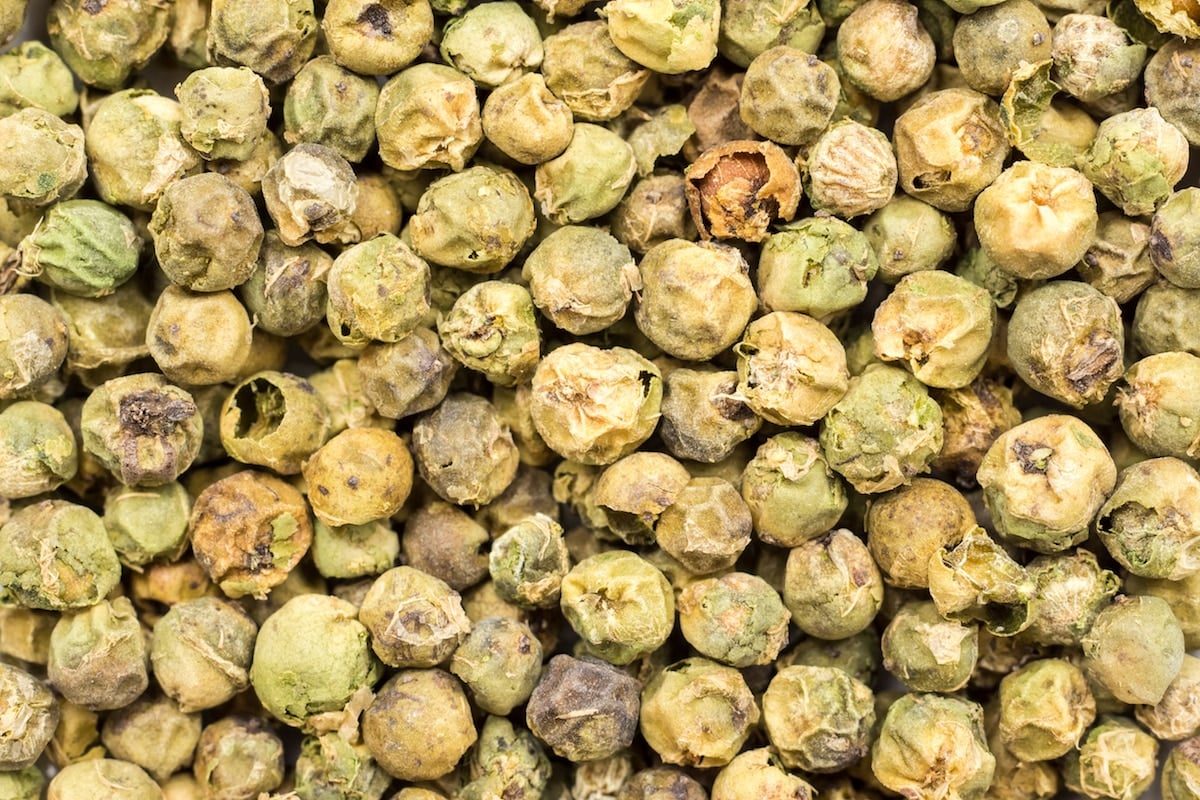
Green peppercorns and capers sit side by side in jars of brine, and in a sauce they look alike. They come from unrelated plants and bite for different chemical reasons. Green peppercorns are unripe berries of the black pepper vine, Piper nigrum, and their heat comes from piperine.12 Capers are the unopened flower buds of the caper bush, Capparis spinosa, and their pungency comes from a mustard oil.34 That difference decides when one can replace the other.
Side by side
| Green peppercorns | Capers | |
|---|---|---|
| Plant | Piper nigrum, the same vine as black and white pepper1 | Capparis spinosa, the caper bush35 |
| Family | Piperaceae2 | Capparaceae5 |
| Native range | Western Ghats of Kerala, India, per Kew’s species profile; Kew’s distribution data list only Sri Lanka (see black pepper)6 | Mediterranean to Mongolia and the Indian subcontinent, and the Philippines to the western and southern Pacific5 |
| Part used | Green (unripe) berries1 | Flower buds, picked just before they open4 |
| Size | About 2.0 to 6.0 mm across, whole, under Codex1 | Smallest grades (nonpareilles, surfines) under 1 cm; larger capucines and communes over 1.5 cm4 |
| How they are kept | Dried under controlled conditions, or preserved in brine; one processor’s bulk brine is 17% ± 2% salt17 | Never dried; pickled in oil, brine or vinegar, or less often packed in coarse salt that must be rinsed off4 |
| Pungent compound | Piperine, the main source of pepper’s flavor2 | Glucocapparin, a mustard oil glycoside that releases methyl isothiocyanate4 |
| Other notable compounds | Codex sets no piperine minimum for green pepper, though it does for black and white1 | Bitter flavonoid glycosides; rutin is the most important flavonoid4 |
| Flavor, as sources describe it | Fresh ones give “a sharp, herbal heat” (Suwanee);8 Katzer rates green pepper the least pungent of the three peppers9 | Pickled capers smell spicy and a little sour, and taste slightly astringent and pungent (Katzer)4 |
| Flavor (editorial) | Bright, green, gently hot | Briny, tart, sharp, faintly floral |
| Main uses | Thai jungle curry;8 cream and pan sauces (common practice) | Mediterranean, especially Italian cooking: tomato or wine sauces, poultry, fish, cold meats, vitello tonnato4 |
| Price | No dated, sourced comparison found | No dated, sourced comparison found |
The editorial flavor row is ours. For the pepper in depth, see green peppercorns.
The differences that change a dish
Two kinds of bite
Pepper’s characteristic flavor comes mainly from piperine,2 the compound shared by black, white and green pepper. Capers have none of it. Their sharpness comes from glucocapparin, which breaks down enzymatically to methyl isothiocyanate, a mustard oil.4 So capers give a mustardy, sour edge, and green peppercorns give pepper heat. Neither can supply the other’s kind of bite.
How hot green peppercorns are is not well measured. Katzer says pungency is strongest in white pepper and weakest in green,9 and Codex sets piperine minimums for black and white pepper but none for green.1 We found no study that measures piperine in green peppercorns.
Cooking time
Katzer advises adding capers to a sauce as late as possible, when it is only lukewarm, and notes that caper berries, the fruit of the same shrub, tolerate boiling much better than the buds.4 We read that as advice to treat the buds as a finishing ingredient. Green peppercorns are commonly simmered in cream sauces, by common practice; we found no source measuring how their flavor holds up to cooking.
Salt and brine
Both arrive salty. In one Kerala Agricultural University process, green peppercorns are stored in a 17% ± 2% salt solution.7 Salt-packed capers must be rinsed before use.4 Rinsing brined green peppercorns too is kitchen judgment if you want to control the salt yourself.
Size and look
The two look most alike at the small end. Codex puts whole green pepper at about 2.0 to 6.0 mm,1 and the smallest caper grades are under 1 cm.4 Larger capers, over 1.5 cm, are much bigger than any peppercorn.4 Katzer notes that the white spots often seen on pickled capers are said to be rutin.4
One vine, three peppers
Green, black and white pepper are the same berry handled differently. Codex defines green pepper as green berries with moisture removed under controlled conditions, black as dried berries with the outer layer unbroken, and white as dried berries with that layer removed.1 The McCormick Science Institute sums it up: depending on harvest time and processing, peppercorns can be black, white, green or red.10 See white pepper vs. black pepper.
Can one stand in for the other?
They overlap on brine, softness and size, and not on flavor. No published ratio exists for either swap, so both are Method.
- Capers in place of green peppercorns. Our green peppercorn substitutes page ranks rinsed capers as the stand-in for the soft, briny pops of green peppercorns in pâtés, terrines and butters. Ratio (Method): start with an equal amount, chopped if the capers are larger than peppercorns, and add a little cracked black pepper for the heat capers lack. In a cream sauce for steak, the pepper is the point, so cracked black pepper is the better substitute there.
- Green peppercorns in place of capers. You get the brine and the soft texture but pepper heat instead of a mustardy sourness. Ratio (Method): no published figure. Start with about half as many drained green peppercorns as the capers called for, because they add heat that capers do not, then taste. A splash of the caper dish’s vinegar or lemon juice can make up some of the tartness; that is our judgment. In a dish where capers lead, such as a tomato or wine sauce,4 the result will taste noticeably different.
What isn’t known
- No study measuring the piperine content of green peppercorns was found, and Codex sets no minimum.1
- No source opened for this page describes how bitter fresh caper buds are or how much brining reduces bitterness, although Katzer reports bitter flavonoid glycosides in capers.4
- No published ratio exists for swapping capers and green peppercorns in either direction.
- No dated, sourced price comparison was found.
Related
- Green peppercorns and green peppercorn substitutes
- Black pepper, black pepper substitutes, white peppercorns
- Pink pepper, which is not a pepper either
- Peppercorn medley vs. black pepper
- Too much pepper? How to fix the dish.
Footnotes
-
Standard for Black, White and Green Peppers, CXS 326-2017, Codex Alimentarius. fao.org · Standard ↩ ↩2 ↩3 ↩4 ↩5 ↩6 ↩7 ↩8 ↩9 ↩10
-
“Black pepper”, Encyclopaedia Britannica. britannica.com · Reference work ↩ ↩2 ↩3 ↩4
-
“Caper”, Encyclopaedia Britannica. britannica.com · Reference work ↩ ↩2
-
Gernot Katzer, “Caper (Capparis spinosa)”, Gernot Katzer’s Spice Pages. gernot-katzers-spice-pages.com · Reference work ↩ ↩2 ↩3 ↩4 ↩5 ↩6 ↩7 ↩8 ↩9 ↩10 ↩11 ↩12 ↩13 ↩14 ↩15 ↩16
-
Capparis spinosa L., Plants of the World Online, Royal Botanic Gardens, Kew. powo.science.kew.org · Reference work ↩ ↩2 ↩3
-
Piper nigrum L., Plants of the World Online and Kew Species Profiles, Royal Botanic Gardens, Kew. powo.science.kew.org · Reference work ↩
-
Pepper (Piper nigrum): Processing and Value Addition, Kerala Agricultural University. celkau.in · Reference work ↩ ↩2
-
Suwanee, Jungle curry (gaeng pa), Simply Suwanee. simplysuwanee.com · Publication ↩ ↩2
-
Gernot Katzer, “Black Pepper (Piper nigrum)”, Gernot Katzer’s Spice Pages. gernot-katzers-spice-pages.com · Reference work ↩ ↩2
-
“Black Pepper”, McCormick Science Institute. mccormickscienceinstitute.com · Reference work ↩