Spices · Substitutes
Black Pepper Substitutes, Ranked by the Job Pepper Is Doing
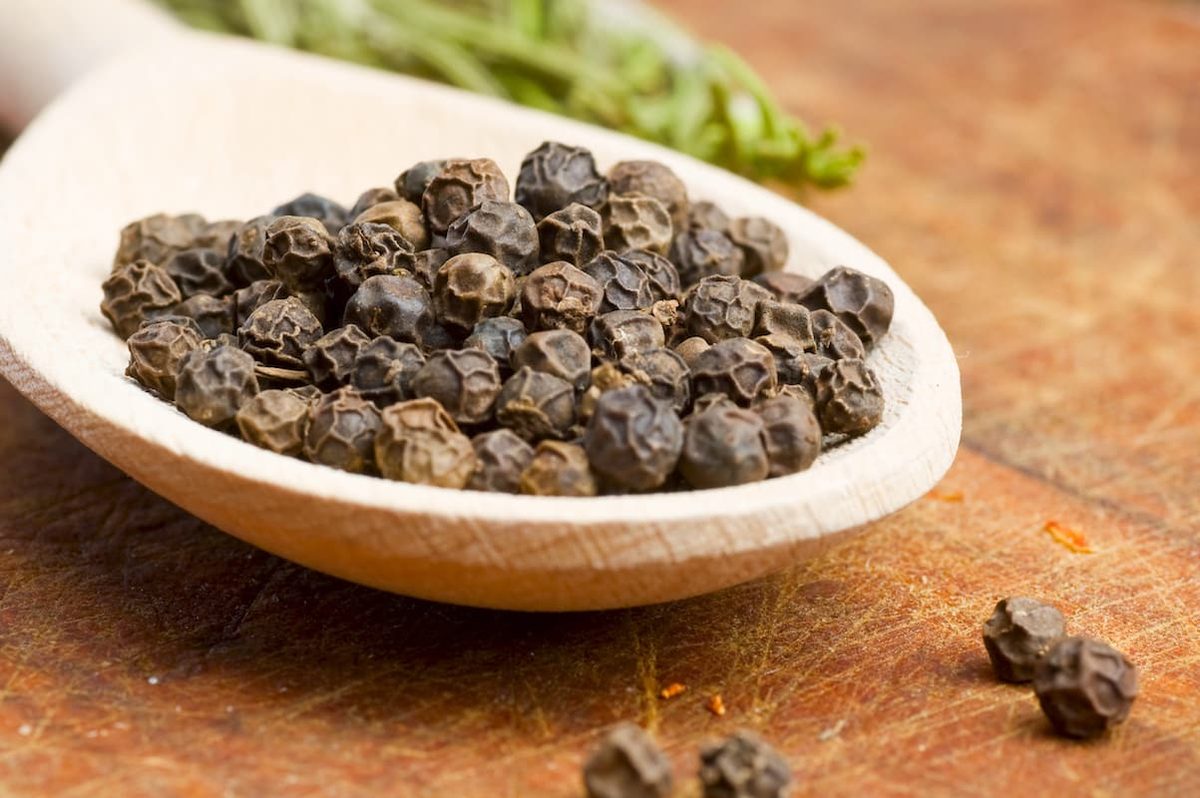
Black pepper does two things at once. Its bite comes from piperine, an alkaloid that PROSEA puts at 4.9 to 7.7% of black pepper,1 and Britannica says pepper’s characteristic flavor comes principally from it.2 Its smell comes from a small amount of essential oil, up to 3% of ground pepper according to Britannica, about 90% of it monoterpene and sesquiterpene hydrocarbons such as limonene, sabinene and β-pinene.21 A good substitute replaces whichever of the two your dish depends on, and it may also need to match pepper’s look: dark specks, or none.
Quick answer
| What pepper is doing | Best substitute | Starting amount, per 1 part black pepper | Treatment |
|---|---|---|---|
| Bite in everyday cooking | Ground white pepper | 1 part | Attributed |
| Heat, with no pepper flavor needed | Cayenne | ¼ part | Attributed |
| Seasoning a pale sauce or soup | Ground white pepper | 1 part | Attributed |
| Pepper’s aroma, for finishing | Long pepper or grains of paradise, freshly ground | ½ part, then taste | Method |
| You have whole peppercorns, the recipe says ground | Whole black peppercorns, ground | 1 tsp whole for 1½ tsp ground | Computed |
The rest of the page explains each choice, the other options, and the ones that don’t work as well as their reputation.
How the ratios on this page are labeled
Every ratio carries one of four labels.
- Computed: based on a measurable physical relationship, with the source named.
- Attributed: a named source publishes this ratio. We quote it as theirs.
- Disputed: named sources give different answers to the same swap. We show each one and do not average them.
- Method: we found no published ratio. We give a direction and a cautious starting point, and say so.
Only one published ratio for replacing black pepper turned up from a source that meets our standard: Better Homes & Gardens’ substitution list. Most “peppery” spices have never had their strength compared with black pepper’s in any study we found.
What makes each substitute peppery
The bite in black pepper and its closest relatives comes from piperine and related amides; the other substitutes get their pungency from different compounds. That is why some taste “peppery” without tasting like pepper.
| Spice | Pungent compound | How much | Scope | Source |
|---|---|---|---|---|
| Black pepper (Piper nigrum) | Piperine | 4.9–7.7% | Range given for black pepper | PROSEA1 |
| White pepper (same plant, hull removed) | Piperine | At least 4.0% (Grade I, dry basis) | Codex minimum for graded whole white pepper, not a measurement | Codex CXS 326-20173 |
| Green peppercorns (same plant, unripe) | Piperine | No minimum set | Codex sets none for green pepper | Codex CXS 326-20173 |
| Long pepper (Piper longum) | Piperine | About 3–5% of dry weight | One 2026 review | Bhatia et al.4 |
| Cubeb (Piper cubeba) | Cubebin, a lignan; the amides behind black pepper’s bite play no significant role | About 2% | Katzer | Katzer5 |
| Grains of paradise | (6)-paradol, (6)-shogaol, (6)-gingerol, the ginger family’s pungent compounds | No figure given | Katzer | Katzer6 |
| Cayenne | Capsaicinoids, acting on the same heat receptor as piperine | See note below | Cell study | McNamara et al., 20057 |
A note on cayenne and pepper. Piperine acts on TRPV1, the same heat receptor that capsaicin from chiles activates, but in a 2005 study on human receptors grown in cultured cells it was the less potent of the two: it took about 37.9 µM of piperine to reach half its maximum effect.7 That is a laboratory measure, not a taste test, so it does not tell you how much cayenne matches a given amount of pepper in food.
If pepper is the bite in everyday cooking
1. White pepper
White pepper is the same berry with its outer layer removed: Codex defines it as pepper obtained from dried berries after removing the pericarp.3 Sources disagree on how its bite compares:
| Source | What it says |
|---|---|
| Britannica2 | White pepper’s flavor is less pungent than black pepper’s |
| Gernot Katzer8 | White pepper keeps the full pungency of black pepper |
| Codex CXS 326-20173 | Sets a higher piperine minimum for Grade I white pepper (4.0%) than for Grade I black |
What the sources agree on is that white pepper is less aromatic. Katzer gives its essential oil as about 1.5% and rates black and green peppercorns as more aromatic than white.8 So white pepper replaces the bite well and the aroma less well. Katzer also warns that overstored white pepper can develop a fecal, musty note from skatole;8 smell the jar first.
Ratio (Attributed): Better Homes & Gardens says to replace ½ teaspoon of black pepper with ½ teaspoon of ground white pepper.9
When the amount is large. America’s Test Kitchen tested the reverse swap in hot and sour soup, using 1 teaspoon of black or white pepper. Tasters found the black-pepper soup more aromatic and spicier and preferred the white-pepper version; in a stir-fry using less pepper, they could hardly tell the two apart.10 ATK’s advice is to swap only when the amount called for is small.10 The same logic, in our judgment, applies in this direction: for a pepper-led dish such as cacio e pepe or steak au poivre, white pepper will taste noticeably different.
2. Cayenne
Cayenne replaces the heat but none of the aroma, and its heat builds differently; that description is ours.
Ratio (Attributed): Better Homes & Gardens says ⅛ teaspoon of cayenne can replace ½ teaspoon of black pepper.9 That is a quarter of the amount.
It is sometimes said that white pepper and cayenne should be combined, ½ teaspoon white pepper plus ⅛ teaspoon cayenne for ½ teaspoon black pepper. Better Homes & Gardens gives these as alternatives, not a blend.9 Using both at once would add cayenne’s heat on top of white pepper’s full replacement.
If pepper is seasoning a pale dish
Katzer notes that white pepper is often suggested for white, cream-based sauces where black pepper would spoil the color.8 For béchamel, mashed potatoes, cream soups and pale fish dishes, white pepper is the natural swap.
Ratio (Attributed): As above, Better Homes & Gardens’ one-for-one.9
If pepper is aroma, ground over at the end
Here you want a spice that smells of pepper as well as biting. Each of these is a historical or regional pepper alternative, and none has a published ratio.
1. Long pepper
Long pepper is a close relative in the same genus, and it is pungent from piperine, about 3 to 5% of the fruit’s dry weight in one 2026 review.4 Atlas Obscura describes its flavor as similar to black pepper but with more complexity.11 Grind or grate the dried spikes.
Ratio (Method): No published ratio was found. Start with half the black pepper amount and taste; long pepper’s character is different enough that matching it by volume is guesswork.
2. Grains of paradise
Katzer says grains of paradise were a common substitute for black pepper in 15th-century Europe, and that their heat is not as strong as pepper’s but more subtle.6 The pungency comes from ginger-family compounds, not piperine (see table above).6 Grind them like peppercorns.
Ratio (Method): No published ratio was found. Start with half the black pepper amount and add more to taste.
3. Cubeb
Katzer calls cubeb, also a Piper species, a once-popular substitute for black pepper that later fell from favor,5 and the 1918 Dispensatory of the United States said it was used like black pepper but found much less powerful.12 Katzer describes it as bitter and hot, with an aroma variously called woody, camphor-like or spicy and peppery.5
Ratio (Method): No published ratio was found. Start with an equal amount and taste; it may need more for the same bite.
If pepper is a cracked crust
On steak and in rubs, cracked pepper adds texture as well as bite.
Green peppercorns
Green pepper comes from the same plant, made from green berries dried under controlled conditions.3 Codex sets no piperine minimum for it,3 and no study comparing its strength with black pepper was found. In brine, the berries are stored in strong salt solutions (17% ± 2% in one Kerala Agricultural University process),13 so rinse them. The Thai cook Suwanee describes fresh green peppercorns as adding a sharp, herbal heat different from dried pepper.14
Ratio (Method): No published ratio was found. For dried green peppercorns, start with an equal amount, cracked. For brined ones, crush them with the back of a spoon and add to taste; they are soft and wet and do not measure like dry peppercorns.
If you have whole peppercorns and the recipe says ground
Ratio (Computed): McCormick’s conversion is 1 teaspoon of peppercorns to 1½ teaspoons of ground pepper.15 This is a volume figure: ground pepper takes up more room than the corns it came from. It says nothing about potency. Pepper ground fresh will smell stronger than an old jar of ground pepper, in our judgment, so start below the full amount.
Substitutes that work less well than their reputation
| Substitute | What the sources say | Use it? |
|---|---|---|
| Pink peppercorns | Not related to pepper; Katzer says they are named for their shape only, and calls them sweet and aromatic, like juniper.16 Atlas Obscura calls the flavor only slightly peppery.17 Pink pepper is in the cashew family;16 Atlas Obscura found reports of a reaction limited to one patient with a tree-nut allergy.17 | For color and perfume, not bite |
| Papaya seeds | Chowhound’s writer describes dried, ground papaya seeds as sitting somewhere between black pepper and horseradish, slightly bitter and mustardy, and gives no amount.18 A widely repeated claim says their flavor is almost identical to black pepper’s; no source we found supports that. | A curiosity, not a match |
| Szechuan pepper | Its signature is a tingling numbness from hydroxy-α-sanshool,19 a different sensation from pepper’s heat. | Not a black pepper swap |
| Capers | Sometimes suggested as peppery; no source we found describes capers as tasting of pepper. | No |
How cooking changes the swap
In a 1992 study of spices boiled in curry for 15 to 30 minutes, 50 to 60% of the piperine was lost.20 That is one reason to add black pepper, or white pepper in its place, near the end of cooking. No comparable figure was found for long pepper, grains of paradise or cubeb.
What isn’t known
- No published study compares the strength of black pepper with any substitute in food. The only sourced ratios are Better Homes & Gardens’ two and McCormick’s volume conversion.
- Whether white pepper is milder or just less aromatic is disputed between named sources (see the table above).
- No source gives a ratio for green peppercorns, long pepper, grains of paradise, cubeb, pink pepper or papaya seeds in place of black pepper.
- It is sometimes said that 3 tablespoons of brined green peppercorns equal 1 ounce of black peppercorns. No source we found gives that figure.
Related
- Black pepper, white peppercorns, white pepper vs. black pepper and white pepper substitutes
- Green peppercorns, green peppercorns vs. capers, cracked vs. ground black pepper
- Long pepper and long pepper vs. black pepper, grains of paradise, cubeb pepper
- Pink pepper, Szechuan pepper, cayenne pepper and black pepper vs. cayenne
- Allspice vs. black pepper, peppercorn medley vs. black pepper, too much pepper
Footnotes
-
Piper nigrum, Plant Resources of South-East Asia (PROSEA). uses.plantnet-project.org · Reference work ↩ ↩2 ↩3
-
“Black pepper”, Encyclopaedia Britannica. britannica.com · Reference work ↩ ↩2 ↩3
-
Standard for Black, White and Green Peppers, CXS 326-2017, Codex Alimentarius. fao.org · Standard ↩ ↩2 ↩3 ↩4 ↩5 ↩6
-
Bhatia et al., From Ancient Spice to Advanced Science (Piper longum), Drug Design, Development and Therapy, 2026. dovepress.com · Peer-reviewed ↩ ↩2
-
Gernot Katzer, Cubeb Pepper (Piper cubeba), Gernot Katzer’s Spice Pages. gernot-katzers-spice-pages.com · Reference work ↩ ↩2 ↩3
-
Gernot Katzer, Grains of Paradise (Aframomum melegueta), Gernot Katzer’s Spice Pages. gernot-katzers-spice-pages.com · Reference work ↩ ↩2 ↩3
-
McNamara, Randall and Gunthorpe, “Effects of piperine, the pungent component of black pepper, at the human vanilloid receptor (TRPV1)”, British Journal of Pharmacology, 2005. pmc.ncbi.nlm.nih.gov · Peer-reviewed ↩ ↩2
-
Black Pepper (Piper nigrum), Gernot Katzer’s Spice Pages. gernot-katzers-spice-pages.com · Reference work ↩ ↩2 ↩3 ↩4
-
100 Emergency Ingredient Substitutions, Better Homes & Gardens. static.onecms.io · Publication ↩ ↩2 ↩3 ↩4
-
“Substituting Black Pepper for White Pepper”, America’s Test Kitchen. americastestkitchen.com · Publication ↩ ↩2
-
Jared Rydelek, Long Pepper, Atlas Obscura. atlasobscura.com · Publication ↩
-
Cubeba, The Dispensatory of the United States of America, 1918 (transcription, Henriette’s Herbal Homepage). henriettes-herb.com · Reference work ↩
-
Pepper: Processing and Value Addition, Kerala Agricultural University. celkau.in · Reference work ↩
-
Suwanee, Jungle curry, Simply Suwanee. simplysuwanee.com · Publication ↩
-
How to Grind Your Own Spices, McCormick, 2025. mccormick.com · Merchant ↩
-
Gernot Katzer, Pink Pepper (Schinus terebinthifolius and S. molle), Gernot Katzer’s Spice Pages. gernot-katzers-spice-pages.com · Reference work ↩ ↩2
-
Anne Ewbank, “When People Panicked Over Pink Peppercorns”, Atlas Obscura, 2018. atlasobscura.com · Publication ↩ ↩2
-
Jennifer M. McNeill, “The Seeds From This Tropical Fruit Are A Great Alternative For Black Pepper”, Chowhound, 2025. chowhound.com · Publication ↩
-
Zhang et al., Zanthoxylum bungeanum Maxim. (Rutaceae): A Systematic Review, International Journal of Molecular Sciences, 2017. mdpi.com · Peer-reviewed ↩
-
Srinivasan, Sambaiah and Chandrasekhara, “Loss of active principles of common spices during domestic cooking”, Food Chemistry, 1992. agris.fao.org · Peer-reviewed ↩