Spice Substitutes · Substitutes
Green Peppercorn Substitutes, Ranked by the Job They Are Doing
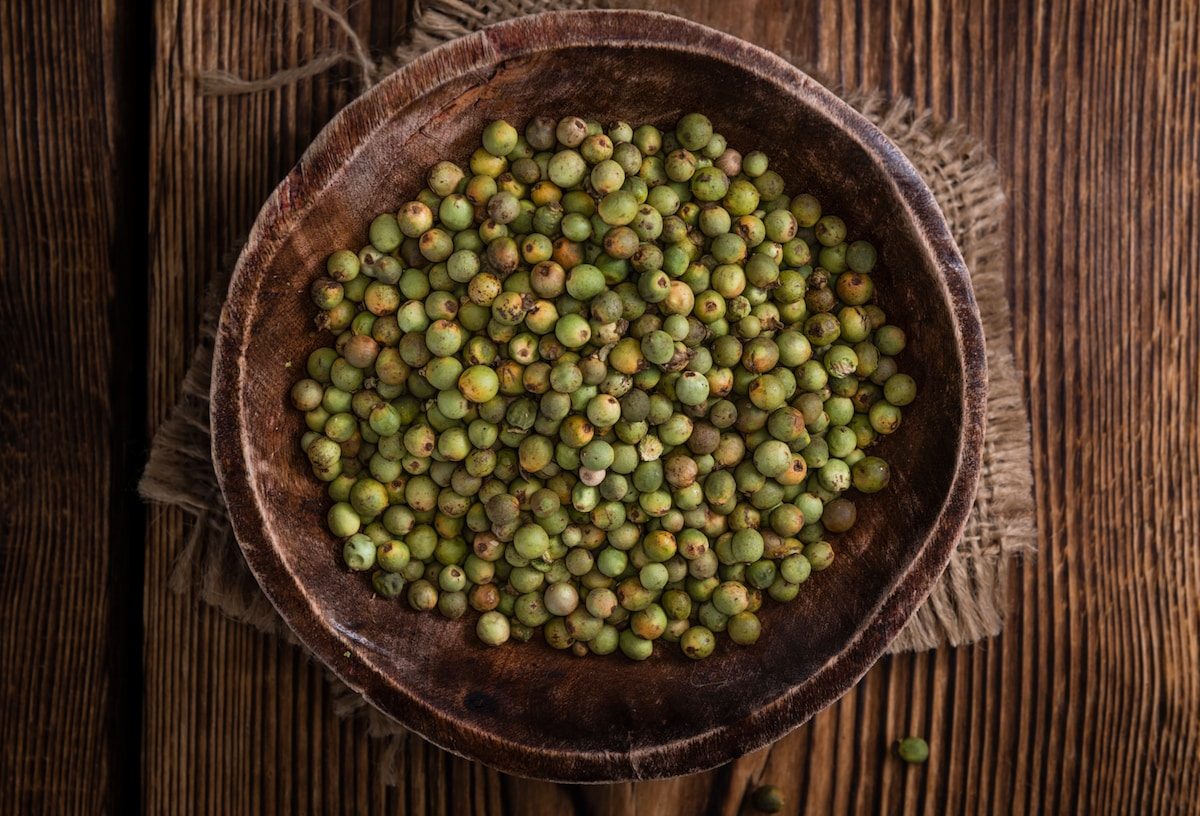
Green peppercorns are the unripe berries of the black pepper vine, Piper nigrum, dried under controlled conditions or preserved in brine.1 McCormick Science Institute puts it simply: depending on harvest time and processing, peppercorns can be black, white, green or red.2 That makes black and white pepper the natural stand-ins for the pepper side of green peppercorns. What they cannot copy is the soft, briny texture of the brined kind, and for that you need something else entirely.
Quick answer
| What green peppercorns are doing | Best substitute | Starting amount, per 1 part green peppercorns | Treatment |
|---|---|---|---|
| Pepper bite in a cream or pan sauce (steak, duck) | Black peppercorns, coarsely cracked | 1/2 part, then taste | Method |
| Pepper bite where dark specks would show | White pepper | 1/2 part, then taste | Method |
| Soft, briny pops in pâtés, terrines and butters | Capers, rinsed | 1 part, then taste | Method |
| Fresh green peppercorns in a Thai curry | Brined green peppercorns, lightly drained | 1 part, then taste | Method |
| Switching between whole and ground black pepper | Ground for whole | 1 tsp whole = 1½ tsp ground | Computed |
The rest of the page explains each choice and lists the alternatives.
How the ratios on this page are labeled
Every ratio carries one of four labels.
- Computed: based on a measurable physical relationship, with the source named.
- Attributed: a named source publishes this ratio. We quote it as theirs.
- Disputed: named sources give different answers to the same swap. We show each one and do not average them.
- Method: we found no published ratio. We give a direction and a cautious starting point, and say so.
We found no credible published ratio for replacing green peppercorns with anything. Brined peppercorns are also hard to measure against dry spices, because part of their volume is water and salt.
One vine, three peppers
The Codex standard defines all three by processing:1
| Pepper | How Codex defines it |
|---|---|
| Black | Dried berries with the outer layer (pericarp) unbroken |
| White | Dried berries with the pericarp removed |
| Green | Green berries with moisture removed under controlled conditions |
Piperine is the compound that gives pepper its characteristic flavor, according to Britannica.3 Codex sets piperine minimums for black and white pepper but none for green,1 and we found no study measuring how much green peppercorns contain.
How hot each one is relative to the others is not settled:
| Source | What it says |
|---|---|
| Katzer4 | Pungency is strongest in white pepper and weakest in green; black and green peppercorns are more aromatic than white |
| Britannica3 | White pepper is less pungent than black |
Britannica does not rate green pepper. Katzer rates it the least pungent of the three, which is why every pepper substitute below starts with less.
If green peppercorns are the pepper bite
1. Black peppercorns, cracked
Black pepper is the same berry, dried with its outer layer intact.1 It brings the same family of flavor with more bite and less of the fresh, green note. For a peppercorn sauce, crack the peppercorns coarsely rather than grinding them fine, so they behave more like whole green berries in the sauce.
Ratio (Method): No published ratio was found. Because Katzer rates green pepper the least pungent of the three,4 start with about half as much cracked black pepper as dried green peppercorns, taste, and add more. For brined green peppercorns, start with less still, since part of what you are measuring is brine.
Whole or ground (Computed): If you only have ground black pepper, McCormick’s conversion is 1 teaspoon peppercorns = 1½ teaspoons ground pepper.5 This is a volume figure for black pepper alone and says nothing about green peppercorns.
2. White pepper
White pepper also comes from Piper nigrum.6 Katzer says it is made from fully ripened fruits that are soaked, preferably for about a week in slow-running water, before the outer layer is removed.4 He suggests it for cream sauces where black pepper could spoil the color,4 which is often exactly where green peppercorns are used.
The trade-off is aroma. Katzer gives white pepper’s essential oil as about 1.5% and says black and green peppercorns are more aromatic than white.4 So white pepper supplies heat with less of the fresh, green character. Katzer also warns that overstored white pepper can develop a fecal, musty note,4 so smell the jar first.
Ratio (Method): No published ratio. Katzer rates white pepper the most pungent of the three,4 so start with about half as much as the green peppercorns called for, then taste.
If green peppercorns are soft, briny pops
Brined green peppercorns are a wet ingredient. In one Kerala Agricultural University process, the berries are stored in a 17% ± 2% salt solution with vinegar added.7 Studded through a pâté or a compound butter, they give soft bursts of salt and heat. Dry pepper cannot do that.
1. Capers
Capers are the flower buds of the caperbush, Capparis spinosa, pickled in vinegar and used as a pungent condiment.8 Kew gives the plant’s native range as the Mediterranean to Mongolia and the Indian subcontinent, and on to the Philippines and the western and southern Pacific.9 Katzer notes that capers are never dried: they are pickled in oil, brine or vinegar, or less often packed in coarse salt, which must be rinsed off.10
The bite is a different chemical kind from pepper’s. Katzer explains that capers hold a mustard oil glycoside, glucocapparin, from which methyl isothiocyanate is released, and describes the taste of pickled capers as slightly astringent and pungent.10 So capers give you the brine and a sharp, mustardy edge, but no pepper heat.
Size is close for the smallest grades. Katzer says nonpareilles and surfines are under one centimeter across,10 while Codex allows whole green pepper from 2.0 to 6.0 mm.1 Katzer also advises adding capers to a sauce as late as possible, because heat quickly destroys their aroma.10
Ratio (Method): No published ratio. Rinse the capers, start with an equal amount (chopped, if they are larger than the peppercorns), and add a little cracked black pepper if you want heat as well.
2. Green olives
In our judgment, chopped green olives can stand in for the color, firmness and brine in a terrine or relish. They add no pepper heat at all, so pair them with cracked black pepper.
Ratio (Method): No published ratio. Use roughly the same volume, chopped, and season with black pepper to taste.
If you are replacing fresh green peppercorns
Fresh green peppercorns on the stem go into Thai jungle curry. Suwanee, who writes the Thai cooking site Simply Suwanee, says they add “a sharp, herbal heat that’s different from dried pepper or chilies.” She notes that fresh clusters are rare in the U.S., points to green peppercorns preserved in brine at Asian grocery stores, and says to drain them lightly before using.11 Her recipe calls for ¼ cup, about 3 to 4 long stems.11
Ratio (Method): Suwanee does not give a conversion. Start with the same amount of brined peppercorns as the fresh ones called for, then taste for salt.
Pink peppercorns: for color, not flavor
Pink peppercorns are not related to black pepper. They come from two South American trees of the genus Schinus, from Brazil and Peru.12 Katzer says they are named for their shape only, not their flavor, and describes the taste as sweet and aromatic, similar to juniper.12 Atlas Obscura calls the flavor only slightly peppery.13 They brighten the look of a cream sauce, but they do not taste like green peppercorns. Atlas Obscura also reports an allergic reaction in a person with a tree nut allergy.13
Ratio (Method): No published ratio. Crush a few for color and add black pepper for the bite.
What isn’t known
- No published ratio exists for replacing green peppercorns with black or white pepper, capers, olives or pink peppercorns. Every amount above is a starting point.
- No study measuring the piperine content of green peppercorns was found, and Codex sets no minimum for it.1 It is often said that green peppercorns are much milder than black; Katzer ranks them the least pungent,4 but we found no measurement.
- It is sometimes said that 3 tablespoons of brined green peppercorns equal 1 ounce of black peppercorns. No source we found gives that figure.
Related
- Green peppercorns, the full profile, and green peppercorns vs. capers
- Black pepper, black pepper substitutes, cracked vs. ground black pepper
- White peppercorns, white pepper vs. black pepper, white pepper substitutes
- Pink pepper, peppercorn medley vs. black pepper
- Too much pepper? How to fix the dish
Footnotes
-
Standard for Black, White and Green Peppers, CXS 326-2017, Codex Alimentarius. fao.org · Standard ↩ ↩2 ↩3 ↩4 ↩5 ↩6
-
Black Pepper, McCormick Science Institute. mccormickscienceinstitute.com · Reference work ↩
-
Black pepper, Encyclopaedia Britannica. britannica.com · Reference work ↩ ↩2
-
Gernot Katzer, Black Pepper (Piper nigrum), Gernot Katzer’s Spice Pages. gernot-katzers-spice-pages.com · Reference work ↩ ↩2 ↩3 ↩4 ↩5 ↩6 ↩7 ↩8
-
How to Grind Your Own Spices, McCormick. mccormick.com · Merchant ↩
-
21 CFR 182.10, Spices and other natural seasonings and flavorings, eCFR. ecfr.gov · Regulator ↩
-
Pepper (Piper nigrum): Processing and Value Addition, Kerala Agricultural University. celkau.in · Reference work ↩
-
Caper, Encyclopaedia Britannica. britannica.com · Reference work ↩
-
Capparis spinosa, Plants of the World Online, Royal Botanic Gardens, Kew. powo.science.kew.org · Reference work ↩
-
Gernot Katzer, Caper (Capparis spinosa), Gernot Katzer’s Spice Pages. gernot-katzers-spice-pages.com · Reference work ↩ ↩2 ↩3 ↩4
-
Suwanee, Jungle curry (gaeng pa), Simply Suwanee. simplysuwanee.com · Publication ↩ ↩2
-
Gernot Katzer, Pink Pepper (Schinus), Gernot Katzer’s Spice Pages. gernot-katzers-spice-pages.com · Reference work ↩ ↩2
-
Ewbank, When People Panicked Over Pink Peppercorns, Atlas Obscura, 2018. atlasobscura.com · Publication ↩ ↩2