Blog · Storage
How to Dry Sage: Air, Dehydrator, Oven and Microwave, With the Temperatures That Matter
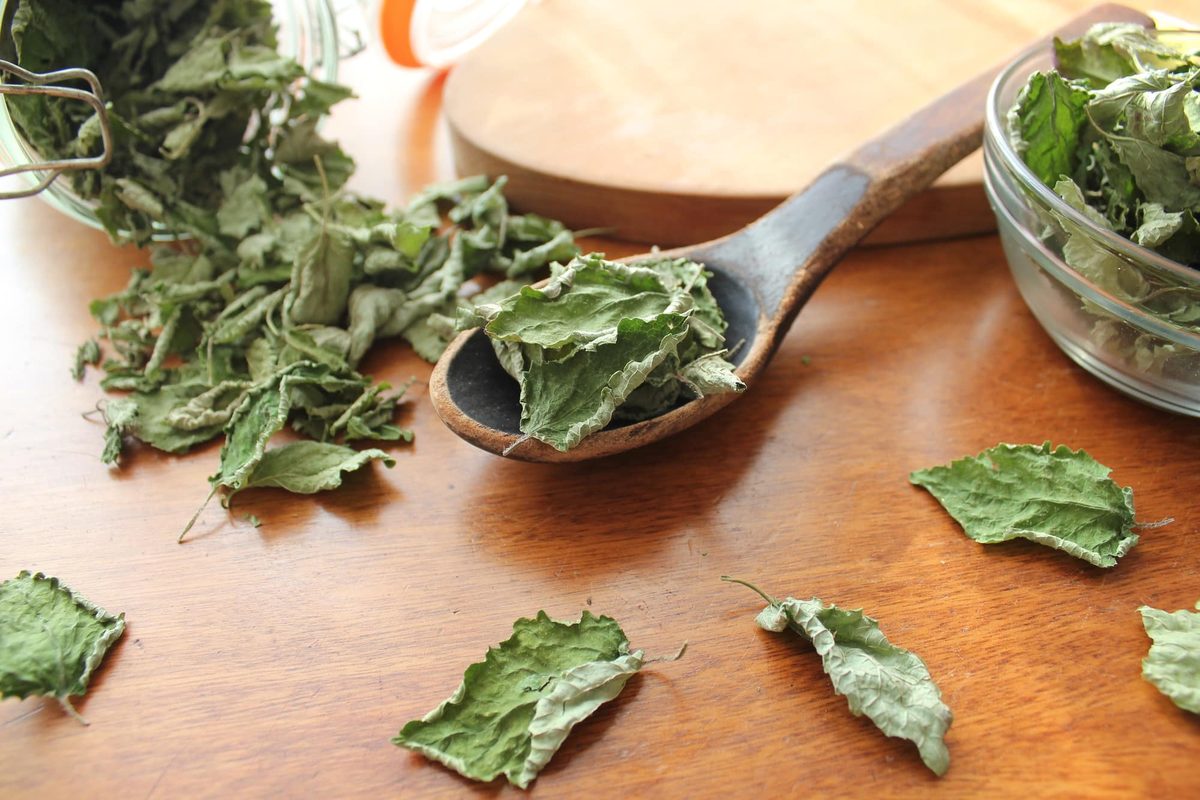
Sage is one of the easiest herbs to dry. Penn State Extension names it, with thyme and winter savory, as the easiest,1 and the National Center for Home Food Preservation (NCHFP) counts it among the sturdy herbs that dry well without a dehydrator.2 It is also one of the few herbs that is still worth cooking with once dried.34 The one thing that matters most is heat: gentle drying keeps most of sage’s aroma, and hot drying throws much of it away.56
At a glance
| Method | Temperature | Time | What the sources say |
|---|---|---|---|
| Air drying | Room temperature, dry and airy, out of the sun17 | A week or more; no fixed time7 | Small aroma losses in a lab comparison5 |
| Dehydrator | 95 to 115°F (NCHFP);2 95 to 110°F (Penn State)1 | 1 to 4 hours2 | The most controlled home method |
| Oven | Lowest setting, not above 180°F, door open1 | 3 to 4 hours1 | “Generally not recommended” by Penn State1 |
| Microwave | High or low power, in short bursts | Seconds to minutes; sources disagree (see below) | For small amounts only28 |
Before you start
Harvest just before flowering. Extension guidance for most herbs is to harvest for drying just before the flowers first open,12 and for sage specifically, PROSEA reports that the highest essential-oil content is in leaves of non-flowering plants.9 Penn State adds that herbs have more of their essential oil when picked mid-morning after the dew has evaporated.1 PROSEA also notes that sage stems are very poor in essential oil,9 so the leaves are what you are preserving.
Rinse and dry the leaves. Rinse in cool water and shake off the excess,1 and discard bruised, soiled or damaged leaves.2 Get the surface as dry as you can before any method below; water left on the leaves only lengthens drying.
Air drying
This is the default for sage, and the evidence favors it.
- Bundles. Penn State says herbs such as sage, mint or thyme can be tied in small clusters and hung in a dry place with good air circulation, away from the sink, stove or dishwasher.1 America’s Test Kitchen (ATK) hangs its bundles upside down by the tied end.7
- Loose leaves. NCHFP describes drying the leaves separately as especially nice for sage, mint and bay leaf.2 Spread them in a single layer on a screen or tray.
- A paper bag. A bag punched with holes keeps dust off the bundle.1
Where. Choose a dry, well-ventilated spot and avoid direct heat and sunlight, which ATK says can make flavor and color fade.7 Penn State does not recommend sun drying at all in its humid state.10 A common claim is that sage dries best somewhere hot, such as an attic. The sources point the other way. PROSEA says a warm, airy room is best for small batches and puts the best drying temperature for sage at 25 to 30°C (77 to 86°F), to limit oil loss.9
How long. ATK says it can take a week or weeks, and suggests taking a test pinch now and then.7 We found no sage-specific air-drying time.
What the research shows. In a 2012 study that dried sage six ways, air drying in the shade at room temperature was one of three methods the authors found caused only small losses of volatile compounds; the others were oven and infrared drying at 45°C.5 An earlier study found a significant loss of sage and thyme volatiles only when the herbs were dried at 60°C.6
Dehydrator
A dehydrator gives the most control, as long as it can be set low. Colorado State University Extension calls air drying the least expensive method but the least consistent one.8
- Temperature. NCHFP says to preheat to 95 to 115°F, and up to 125°F in humid areas.2 Penn State says herbs can be dried in a dehydrator if it can be set between 95 and 110°F.1
- Time. NCHFP gives 1 to 4 hours; check periodically.2
- Layout. Place the stems on the trays so they do not touch,1 and do not dry herbs together with fruits or vegetables, since flavors may mix.1
Oven
Penn State calls oven drying generally not recommended, because even the lowest setting destroys much of the flavor.1 If you use it anyway, Penn State’s instructions are the lowest temperature, no higher than 180°F, for 3 to 4 hours with the door open.1 NCHFP’s alternative is a very cool oven: the light of an electric oven, or a gas pilot light, can provide enough heat to dry herbs overnight.2
The sage research explains the caution. In the 2012 study, oven drying at 65°C (149°F) gave the lowest essential-oil yield of any method tested, 0.02%, while oven drying at 45°C (113°F) was among the methods with only small losses.5 Penn State’s ceiling of 180°F is 82°C, hotter than either.
Short oven methods are often recommended, such as heating for 15 minutes and then switching off, or drying for half an hour with the door cracked. We found no tested source for those times.
Microwave
Every source treats the microwave as a method for small amounts,28 and they do not agree on timing:
| Source | Method |
|---|---|
| Penn State Extension1 | Leaves between paper towels; high power for 2 to 3 minutes per cup. Start with 1 minute and stir every 30 seconds. A 1,000-watt or stronger oven may heat too fast. |
| Colorado State University Extension8 | Leaves between two paper towels, with ½ cup of water in a cup beside the plate; stop every 15 seconds to check and turn. |
| America’s Test Kitchen4 | Washed, dried herbs on a paper towel for 30 to 40 seconds. |
| NCHFP2 | Calls it fast for small quantities; gives no times. |
Because wattage varies, work in short bursts and check often. Penn State warns that paper towels can catch fire if there is not enough herb on them.1 No source we found recommends drying directly on the turntable without paper towels.
How to tell when sage is dry
Leaves are dry when they are crispy and crumble easily between your fingers,1 and the stems break when bent.2 Make sure they are completely dry before storing, to prevent mold.1
Storing dried sage
| Question | What the sources say |
|---|---|
| Whole or crumbled? | Whole herbs keep their flavor longer.810 Commercial practice separates the leaves from the stems after drying;9 crumble or rub them when you cook. |
| Container | Airtight, kept in a cool, dry, dark place.2 Colorado State suggests ceramic jars or darkened glass to block light.8 |
| Label | Label and date the jar.7 |
| How long | “Up to a year” for most dried herbs (Penn State);1 up to 3 months for herbs dried in the microwave (ATK).4 |
| Fridge or freezer? | Possible in freezer jars, but take care moving them back to a warm room so condensation does not form.10 |
These are figures for dried herbs in general, not sage measurements. PROSEA notes that sage keeps losing volatile oil after drying,9 so smell is the better test: if a crushed leaf smells faint, the dish will taste faint.
Cooking with dried sage
Dried sage holds up better than most dried herbs. In ATK’s tests, dried sage, rosemary and thyme fared reasonably well in dishes cooked for more than 20 minutes with a good amount of liquid.3 PROSEA lists sausages, stuffings, soups and canned vegetables among sage’s spice uses.9 Drying does change its aroma: in the 2012 study, camphor’s share of the oil rose under every drying method.5 For how much dried sage replaces fresh (published conversions disagree), see fresh sage vs dried sage.
Not yet measured
- How long sage takes to air dry in a home kitchen.
- How long home-dried sage keeps its flavor, measured on sage rather than dried herbs in general.
- How a home microwave affects sage’s flavor compared with air drying.
Related
- Sage
- Fresh sage vs dried sage
- How to store sage
- Cooking with sage
- Sage uses
- Sage substitutes
- Too much sage
- How to rehydrate herbs
- How to dry tarragon
Footnotes
-
Let’s Preserve: Drying Herbs, Penn State Extension. extension.psu.edu · Reference work ↩ ↩2 ↩3 ↩4 ↩5 ↩6 ↩7 ↩8 ↩9 ↩10 ↩11 ↩12 ↩13 ↩14 ↩15 ↩16 ↩17 ↩18 ↩19 ↩20 ↩21
-
Herbs (Drying), National Center for Home Food Preservation. nchfp.uga.edu · Reference work ↩ ↩2 ↩3 ↩4 ↩5 ↩6 ↩7 ↩8 ↩9 ↩10 ↩11 ↩12 ↩13 ↩14
-
Science: Substituting Dried Herbs for Fresh, America’s Test Kitchen. americastestkitchen.com · Publication ↩ ↩2
-
When You Should Actually Use Dried Herbs, America’s Test Kitchen. americastestkitchen.com · Publication ↩ ↩2 ↩3
-
Hamrouni Sellami et al., Food and Bioprocess Technology, 2012. humboldt-reloaded.uni-hohenheim.de · Peer-reviewed ↩ ↩2 ↩3 ↩4 ↩5
-
Venskutonis, Food Chemistry, 1997 (abstract). agris.fao.org · Peer-reviewed ↩ ↩2
-
Dry Your Own Herbs and Spices, America’s Test Kitchen. americastestkitchen.com · Publication ↩ ↩2 ↩3 ↩4 ↩5 ↩6
-
Herbs: Preserving and Using, Fact Sheet 9.335, Colorado State University Extension. ccfruitandnuts.ucanr.edu · Reference work ↩ ↩2 ↩3 ↩4 ↩5 ↩6
-
Salvia officinalis (PROSEA), Plant Resources of South-East Asia. uses.plantnet-project.org · Reference work ↩ ↩2 ↩3 ↩4 ↩5 ↩6
-
Preserving Herbs by Drying, Penn State Extension. extension.psu.edu · Reference work ↩ ↩2 ↩3