Cooking · Uses
Sage Uses: Stuffing, Sausage, Saltimbocca, Brown Butter, Cheese and More
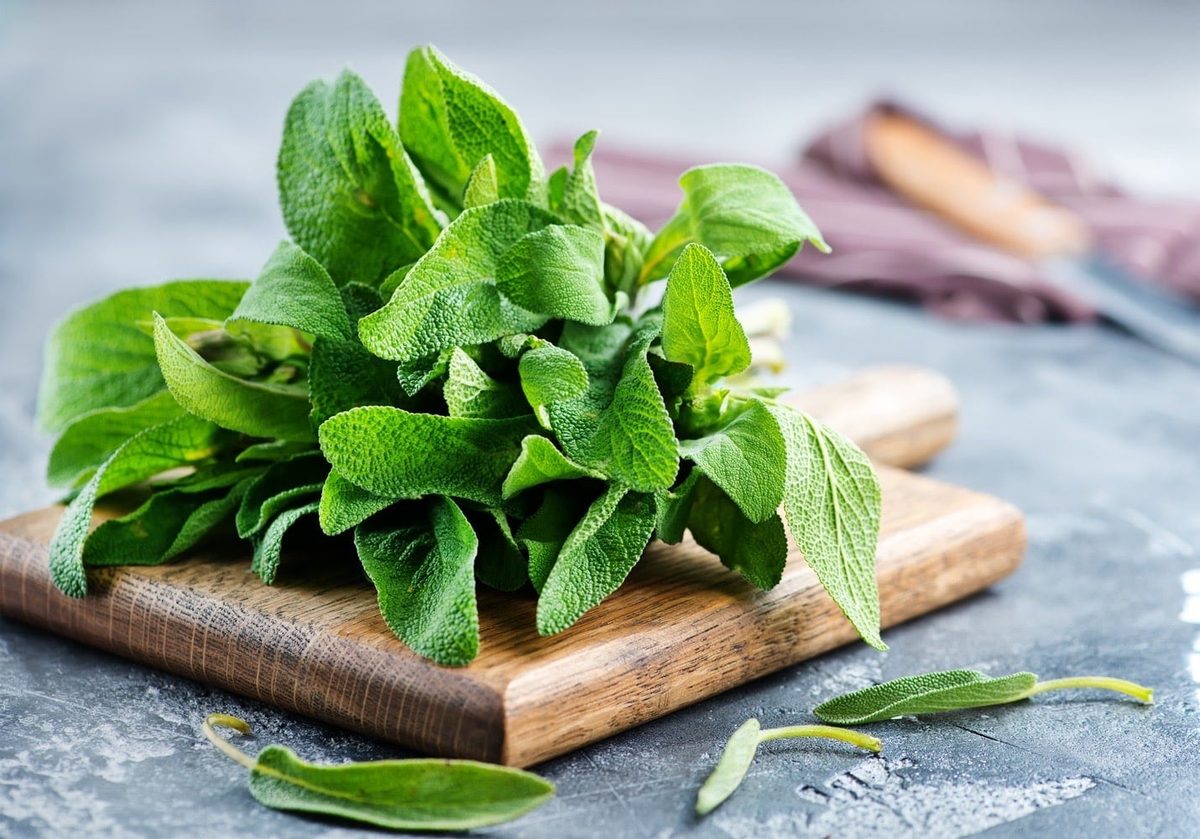
PROSEA, the Southeast Asian plant reference, sums up sage’s culinary role in two lists. Dried, it flavors sausages, stuffings, soups and canned vegetables; fresh leaves go into herb butters, cheeses, liqueurs, pickles, salads and vinegars.1 PROSEA also describes a nice aroma with a unique bitter and pungent taste,1 and the University of Delaware ranks sage among the strongest herbs, warning that too much is extremely objectionable.2 This page maps where sage goes. For timing, amounts and how to fry the leaves, see cooking with sage.
At a glance
| Use | Form | Example from a named source |
|---|---|---|
| Bread stuffing | Dried, often in poultry seasoning | Sage and thyme the dominant herbs (Yankee)3 |
| Sausage | Dried | PROSEA’s first-listed spice use1 |
| Saltimbocca | Fresh leaves | 16 to 24 leaves (Saveur)4 |
| Brown butter sauce | Fresh leaves, crisped in butter | 14 leaves to 1/2 cup butter (Alida Ryder)5 |
| Soups, stews, casseroles | Dried, early | ATK’s long-cooking tests6 |
| Cheese | Infused into the curd | Sage Derby (Belton Farm)7 |
| Herb butter, pickles, vinegar | Fresh | PROSEA; Colorado State18 |
Stuffing and poultry
Stuffing. Yankee Magazine’s New England bread stuffing is quite lightly seasoned, with sage and thyme the dominant herbs.3 PROSEA lists stuffings among sage’s main spice uses.1 Sage also comes ready-mixed in blends: McCormick Culinary’s poultry seasoning is thyme, sage, marjoram, rosemary, black pepper and nutmeg,9 and Bell’s Seasoning, the New England classic, is rosemary, oregano, sage, ginger, marjoram, thyme and pepper.10 If the stuffing cooks inside the bird, the USDA says it must reach 165°F, and for optimal safety recommends cooking it separately.11 See good stuffing spices, poultry seasoning and Thanksgiving herbs and spices.
Turkey, chicken and duck. Sage’s partners in poultry seasoning are thyme, marjoram and rosemary.9 A widely repeated view holds that sage is little used in the United States outside Thanksgiving. PROSEA’s figures point the other way: it names the United States as the biggest user of sage, at about 4,000 tonnes a year, though its data date from the late 1980s.1 Sage with roast chicken, in pan sauces and with duck is common practice; we found no named recipe for it in this research.
Sausage and pork
PROSEA puts sausages first among dried sage’s spice uses.1 A widely repeated claim names Germany and Greece as countries where sage sausage is common; we found no source for either. Sage’s fit with pork is long-standing practice, but we found no source that explains it, and this page does not claim that sage cuts fat or aids digestion.
Italian: saltimbocca and brown butter
Saltimbocca. Saveur calls saltimbocca alla romana a mainstay at trattorias throughout Rome, a quick dish of just three main ingredients; its veal version uses 16 to 24 fresh sage leaves.4 A common claim says the ancient Romans invented the dish and with it sage’s culinary career. We found no source for that history.
Brown butter sage sauce. Alida Ryder’s sauce crisps 14 sage leaves in 1/2 cup of browned butter; they sizzle and crisp in 30 to 60 seconds.5 She calls it best over ravioli, gnocchi or tortellini, says it works with long pasta such as spaghetti or pappardelle, and recommends it over roasted butternut squash or cauliflower.5 Her ravioli serving scatters the crispy leaves on top.5 Crisp sage on squash- or pumpkin-filled ravioli is often called traditional; we did not find a source that says so. See Italian spices.
Soups, stews and casseroles
Sage is one of the herbs that hold up dried. In America’s Test Kitchen’s tests, dried sage fared reasonably well in recipes cooked more than 20 minutes with plenty of liquid,6 and another ATK guide says dried sage works just fine in moist preparations.12 ATK also classes fresh sage as a hearty herb to add early in cooking.13 That makes sage a natural fit for bean soups, stews and casseroles that cook for a while (our judgment, from those findings). PROSEA lists soups among its uses.1 See fresh sage vs. dried sage.
Cheese and dairy
The best-known sage cheese is Sage Derby. Belton Farm, which makes it, describes a smooth, creamy Derby cheese marbled with a delicate sage infusion, and says production is believed to have begun in the 17th century, when sage was thought to have medicinal powers.7 That history is the maker’s own account. PROSEA lists cheeses and herb butters among fresh sage’s uses.1 A common claim says sage is unusual among herbs in pairing with dairy; we found nothing to support the “unusual” part. Sage leaves on pizza are kitchen practice.
Breads
Sage in breadsticks, cornbread and herb breads is common practice. We found no named recipe in this research to cite, so this page gives no amounts. See cornbread spices.
Pickles, vinegar and liqueurs
PROSEA lists pickles, vinegars and liqueurs among fresh sage’s uses.1 Colorado State University Extension includes sage among the fresh herbs for flavored vinegar, at 3 to 4 sprigs per pint, with at least 10 days for the flavor to develop; the vinegar keeps up to six to eight months in the refrigerator.8
Beyond the kitchen
PROSEA says sage essential oil is used in perfumery, deodorants and pesticidal preparations.1 The essential oil is a different matter from the leaf: see the safety note below.
A note on safety
The NIH’s National Center for Complementary and Integrative Health says sage is likely safe in the amounts commonly found in foods, but may be unsafe during pregnancy because of its thujone content.14 The sage profile covers concentrated products such as sage oil.
Not yet sourced
- Sage sausage as a German or Greek tradition.
- Saltimbocca’s ancient Roman origin.
- A named recipe for sage with duck, in pan sauces, or in breads.
- Fried sage as the “traditional” topping for squash ravioli.
Related
- Sage, cooking with sage and too much sage
- Fresh sage vs. dried sage, how to store sage and how to dry sage
- Sage substitutes, rosemary vs. sage, sage vs. lavender and pineapple sage
Footnotes
-
U.A. Dasuki, “Salvia officinalis”, PROSEA, via Pl@ntUse. uses.plantnet-project.org · Reference work ↩ ↩2 ↩3 ↩4 ↩5 ↩6 ↩7 ↩8 ↩9 ↩10 ↩11
-
“Using Herbs and Spices”, University of Delaware Cooperative Extension, 2025. udel.edu · Reference work ↩
-
“Bread Stuffing”, Yankee Magazine, 2007. newengland.com · Publication ↩ ↩2
-
“Veal Saltimbocca (Saltimbocca alla Romana)”, Saveur, 2019. saveur.com · Publication ↩ ↩2
-
Alida Ryder, “Brown Butter Sage Sauce”, Simply Delicious, 2026. simply-delicious-food.com · Publication ↩ ↩2 ↩3 ↩4
-
“Science: Substituting Dried Herbs for Fresh”, America’s Test Kitchen. americastestkitchen.com · Publication ↩ ↩2
-
“Under the Spotlight: Sage Derby”, Belton Farm, 2018. beltonfarm.co.uk · Merchant ↩ ↩2
-
“Making Flavored Vinegar”, Fact Sheet 9.340, Colorado State University Extension, 2021. foodsmartcolorado.colostate.edu · Reference work ↩ ↩2
-
Poultry Seasoning, McCormick Culinary. mccormick.com · Merchant ↩ ↩2
-
Aimee Tucker, “Bell’s Seasoning: A New England Thanksgiving Classic”, Yankee Magazine, 2021. newengland.com · Publication ↩
-
“Stuffing and Food Safety”, USDA Food Safety and Inspection Service. fsis.usda.gov · Regulator ↩
-
“Using Dried Herbs”, America’s Test Kitchen. americastestkitchen.com · Publication ↩
-
Liz Bomze, “Our Guide to Fresh Herbs”, America’s Test Kitchen, 2019. americastestkitchen.com · Publication ↩
-
“Sage”, National Center for Complementary and Integrative Health, 2025. nccih.nih.gov · Regulator ↩